
Educational information · Not medical advice
In brief
Strep throat: symptoms, testing, antibiotics, and how long you are contagious — plus how to tell it from a viral sore throat and when to get care fast.
In this article
- What is strep throat?
- How can you tell strep throat from a viral sore throat?
- How is strep throat tested?
- When do you need antibiotics for strep throat?
- How long is strep throat contagious?
- What helps while you recover from strep throat?
- When should a sore throat be seen promptly?
- Why do I keep getting strep throat?
- Frequently asked questions
- Conclusion
- Sources
Key Takeaways
- Strep throat is a bacterial infection caused by group A Streptococcus — most sore throats are viral, so symptoms alone cannot confirm it.
- A throat swab — a rapid antigen test or a throat culture — is needed to confirm strep throat before antibiotics.
- Penicillin or amoxicillin is the first-line treatment the CDC recommends for confirmed strep throat; antibiotics are not recommended when the test is negative.
- Stay home until you are fever-free and have taken an appropriate antibiotic for at least 12 to 24 hours, as the CDC advises.
A sore throat that arrives suddenly, hurts to swallow, and comes with a fever raises an obvious question: is this strep throat, or a virus that will pass on its own? Strep throat matters because it is the common bacterial cause of sore throat that does need antibiotics — and because guessing wrong in either direction has a cost.
This article explains what strep throat is, how its pattern differs from a viral sore throat, how testing works, when antibiotics help, and how long strep throat stays contagious, using the CDC's current clinical guidance for group A streptococcal pharyngitis.
What is strep throat?
Strep throat is an infection of the throat and tonsils (the oropharynx) caused by Streptococcus pyogenes, also called group A strep bacteria, according to the CDC's clinical guidance. It spreads through close contact, which the CDC calls the most common risk factor — parents of school-age children and adults who work with children are at increased risk, and crowded settings such as schools and daycare centers raise the risk further.
Age matters. The CDC says strep throat is most common in children 5 through 15 years old and rare in children younger than 3. Symptoms usually start about 2 to 5 days after exposure — that is the incubation period the CDC gives for group A strep pharyngitis.
How common is it? The CDC estimates group A strep causes 20% to 30% of pharyngitis episodes in children and 5% to 15% in adults — most sore throats are viral, which is why a test, not a hunch, decides treatment. If yours comes mainly from snoring overnight, see our guide to whether snoring can cause a sore throat.
How can you tell strep throat from a viral sore throat?
You often cannot tell for certain by looking — and the CDC is explicit about that limit. Without clear viral symptoms, clinicians cannot use examination alone to differentiate viral pharyngitis from strep throat. What you can do is weigh the pattern, because some features point one way and some point the other.
Strep throat commonly presents, the CDC says, with sudden onset of sore throat, fever, and pain when swallowing. On examination, people with strep throat usually have redness and swelling of the throat and tonsils, tonsillar enlargement with or without white patches or streaks (exudates), swollen glands at the front of the neck, and tiny red spots on the roof of the mouth (palatal petechiae). Children may also have headache, abdominal pain, nausea, or vomiting. A sandpaper-like red rash is scarlet fever, which the CDC notes can follow the same infection. For headache patterns once infection is ruled out, see our comparison of tension headache, migraine, and TMJ headache.
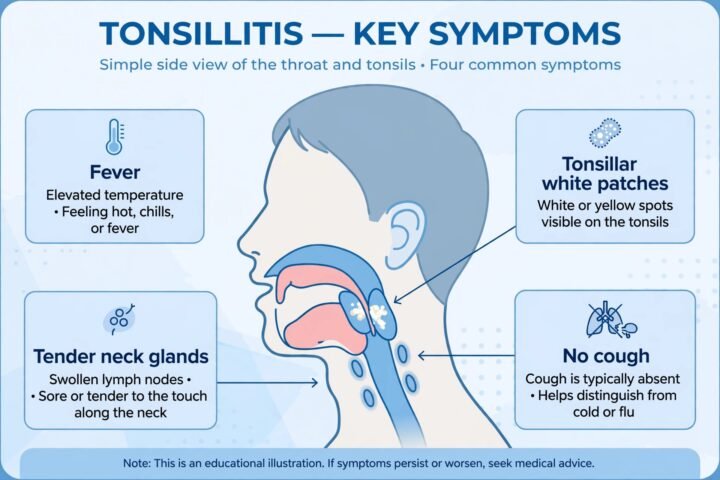
Four signs that make strep throat more likely: fever, tonsillar white patches, tender neck glands, and no cough.
Features that strongly suggest a virus point away from strep throat. The CDC lists cough, runny nose (rhinorrhea), hoarseness, mouth ulcers, and pink eye (conjunctivitis) as symptoms patients with strep throat typically do not have. When those clear viral symptoms are present, the CDC says testing for group A strep is not needed.
Clinicians sometimes summarize the strep-leaning signs with the Centor criteria. The CDC's adult outpatient guidance names them as fever, tonsillar exudates, tender cervical lymphadenopathy (tender front-of-neck glands), and absence of cough, and says adults who meet two or more should receive a rapid antigen test. The criteria raise or lower suspicion — they do not make the diagnosis by themselves.
| Feature | More typical of strep throat | More typical of a viral sore throat |
|---|---|---|
| Onset | Sudden, often with fever | Often gradual, with cold symptoms building |
| Cough and runny nose | Typically absent | Commonly present |
| Tonsils | Red, swollen, sometimes white patches | Red, usually without white patches |
| Neck glands | Swollen and tender at the front of the neck | Less prominent |
| Voice and eyes | Usually normal | Hoarseness or pink eye may occur |
| Confirmed by | Positive rapid test or throat culture | Clear viral pattern; no strep test needed per CDC |
How is strep throat tested?
Testing for strep throat uses a throat swab. The CDC says clinicians can confirm group A strep pharyngitis with either a rapid antigen detection test (RADT) or a throat culture. The rapid test gives a fast result in the clinic; a culture grows the bacteria in a lab and takes longer.
The CDC describes the trade-off plainly: rapid tests have high specificity but varying sensitivity compared with throat culture, and throat culture is the gold standard diagnostic test. A positive rapid test or culture confirms strep throat. A negative rapid test needs different follow-up by age.
20% to 30% in children, 5% to 15% in adults — the CDC's estimate for the share of sore throats caused by group A strep. Most sore throats are viral, which is why testing comes before antibiotics.
For children older than 3 years, the CDC says a negative rapid test should be followed with a throat culture, with a way to start antibiotics if it turns positive — because treating confirmed strep throat in children can reduce their risk of acute rheumatic fever. For other ages, that follow-up culture is not routinely indicated, and antibiotics are not recommended after a negative rapid test. People with clear viral symptoms do not need a strep test, and testing under age 3 is not routine.
When do you need antibiotics for strep throat?
Antibiotics are for confirmed strep throat. The CDC states it directly: patients of any age who have a positive rapid test or throat culture need antibiotics, and viral pharyngitis should not be treated with antibiotics. That answers the common search question about getting over strep throat without antibiotics — the sore throat itself may ease, but confirmed strep throat is treated to shorten symptoms, reduce spread, and lower complications, not simply to make the throat feel better.
The CDC lists three benefits of treatment: it shortens symptoms, reduces transmission to close contacts, and decreases complications. Complications are uncommon but named by the CDC: spread nearby can cause peritonsillar abscess or mastoiditis, and later sequelae can include acute rheumatic fever and post-streptococcal glomerulonephritis (a kidney condition) — more likely after an untreated infection.
Which antibiotic? The CDC says penicillin or amoxicillin is the antibiotic of choice for strep throat, and its adult guidance says amoxicillin and penicillin remain first-line because of their reliable activity against group A strep, with a recommended course of 10 days for oral beta-lactams. For people with a penicillin allergy, the CDC guidance lists other recommended regimens and warns to avoid cephalexin and cefadroxil in patients with immediate-type hypersensitivity to penicillin. The CDC also notes there has never been a report of group A strep resistant to penicillin, while resistance to azithromycin, clarithromycin, and clindamycin is well known and varies by place and time. Do not use a leftover antibiotic or someone else's prescription — the choice and course belong with the clinician who saw the test result.
Finish the course as prescribed even if you feel better quickly, and ask the clinician what to do if symptoms do not improve or worsen after starting treatment. Pain and fever relief, fluids, and rest can help you feel better while the antibiotic works; staying hydrated matters when swallowing hurts, as our guide to how much water you should drink explains for everyday intake.
How long is strep throat contagious?
Strep throat spreads when a person with the infection is in close contact with others, and treatment changes the timeline quickly. The CDC says treatment with an appropriate antibiotic for 12 hours or longer limits a person's ability to transmit group A strep bacteria.
The stay-home rule follows from that. The CDC says people with strep throat should stay home from work, school, or daycare until they are afebrile (no fever) and at least 12 to 24 hours have passed after starting appropriate antibiotic therapy. A footnote in the same guidance, citing the American Academy of Pediatrics Red Book, says children should not return to school or childcare until they are well appearing and at least 12 hours after beginning appropriate antibiotics, and that 24 hours should be considered in some settings, such as a healthcare worker or an outbreak.

Rest, fluids, and staying home for the first 12 to 24 hours of antibiotics help limit spread of strep throat.
While you are contagious, the CDC points to hand hygiene and respiratory etiquette — covering coughs and sneezes and washing hands — to reduce spread. Avoid sharing cups and utensils, and do not send a child back before the fever and the 12-to-24-hour window have both passed.
What helps while you recover from strep throat?
Recovery is mostly time, rest, and symptom relief while the antibiotic does its work for confirmed strep throat — or while a viral sore throat runs its course. The CDC's adult outpatient guidance notes that over-the-counter medications can provide symptom relief for common infections but have not been shown to shorten the length of illness, and that clinicians and patients should weigh benefits and adverse effects of symptomatic therapy.
Rest, drink fluids regularly, and eat soft foods until swallowing eases. If pain keeps you — or a child — from drinking, seek care promptly. Warm drinks and lozenges may feel soothing, but none treats group A strep bacteria: comfort measures are comfort measures, not cures, and they are not a substitute for testing or antibiotics.
When should a sore throat be seen promptly?
Most sore throats can be assessed in a clinic or urgent care visit, but some signs need prompt or urgent attention. Seek care promptly if you cannot swallow fluids, are drooling, have trouble breathing, cannot open your mouth fully, have one-sided throat swelling, or develop a rash, severe headache, neck swelling, or a fever that returns or does not settle. Those patterns can signal complications the CDC names, such as a peritonsillar abscess, rather than uncomplicated strep throat.
Also seek care if a sore throat lasts more than a few days without improving, episodes keep returning, or you have a weakened immune system. When in doubt, describe the symptoms and ask — a swab is quick.
Why do I keep getting strep throat?
Repeated episodes are a common worry, and this article will not invent a single cause for them. The CDC guidance points to the exposure side: close contact is the most common risk factor, contact with children raises risk, and crowded settings increase spread — so a parent, teacher, or older sibling in a household with school-age children can be re-exposed repeatedly during winter and the school year.
If episodes recur, bring your clinician a record: dates, test results, antibiotics taken, and whether household contacts were ill. That helps distinguish true recurrent strep throat from repeated viral sore throats that were never tested — a distinction that changes management.
Frequently asked questions
Can you get over strep throat without antibiotics?
The sore throat may ease on its own, but the CDC recommends antibiotics for anyone with a positive rapid test or throat culture. Treatment for strep throat shortens symptoms, reduces spread to close contacts, and decreases complications, including the rare risk of acute rheumatic fever in children.
How long is strep throat contagious after starting antibiotics?
The CDC says treatment with an appropriate antibiotic for 12 hours or longer limits transmission. People with strep throat should stay home until they have no fever and at least 12 to 24 hours have passed since starting antibiotics, with 24 hours considered in outbreak or healthcare settings.
How do doctors tell strep throat from a viral sore throat?
Symptoms and examination alone cannot reliably separate them when viral signs are absent, the CDC says. Fever, white tonsillar patches, tender neck glands, and no cough make strep throat more likely, but a rapid antigen test or throat culture from a throat swab confirms the diagnosis.
Why do I keep getting strep throat?
Close contact is the most common risk factor in CDC guidance, especially contact with school-age children and crowded settings, so repeated exposure at home or school is a common explanation. Keep dated records of tests and treatment and review them with your clinician to separate true recurrences from viral sore throats.
Conclusion
Strep throat is the bacterial sore throat that needs a test and, when confirmed, an antibiotic — and it is a minority of sore throats, especially in adults. The pattern that should prompt a swab is sudden onset, fever, pain on swallowing, swollen tonsils or neck glands, and no cough or cold symptoms. The pattern that points viral — cough, runny nose, hoarseness, mouth ulcers, pink eye — usually needs no strep test at all.
If your test is positive, take the antibiotic as prescribed, stay home until you are fever-free and 12 to 24 hours into treatment, and use rest and fluids for comfort while you recover. If symptoms worsen, swallowing fails, or episodes keep returning, go back to your clinician with the details. That sequence — test first, treat what is confirmed — is the whole lesson of strep throat.
Sources
- Centers for Disease Control and Prevention. Clinical Guidance for Group A Streptococcal Pharyngitis (updated November 18, 2025) — cause, incubation, age and close-contact risk, symptoms, testing, first-line treatment, complications, and the 12-to-24-hour stay-home rule cited throughout.
- Centers for Disease Control and Prevention. Outpatient Clinical Care for Adults (April 16, 2024) — pharyngitis row: group A strep as the common indication for antibiotics in sore throat, Centor criteria and rapid testing, no antibiotics after a negative test, first-line amoxicillin/penicillin and 10-day oral beta-lactam course.
- MedlinePlus (U.S. National Library of Medicine). Strep A Test — rapid test and throat culture basics and why culture follow-up matters in children and teens.
Medical disclaimer: This article is educational information only and is not medical advice. It does not diagnose or prescribe treatment for any individual. If you think you or your child may have strep throat, contact a clinician or urgent care service for testing and advice.


0 Comments