
In this article
- What the evidence actually shows about TMJ and dizziness
- Why the jaw and the balance system sit so close together
- TMJ dizziness vs. BPPV, Ménière’s disease, and vestibular migraine
- Red flags: when dizziness needs prompt care
- How clinicians sort out whether the jaw is involved
- What you can do while you wait for an appointment
- Frequently asked questions
- Conclusion
- Sources
If your jaw aches and the room sometimes spins, it is natural to connect the two — and many people do. Can TMJ cause dizziness? The honest answer is more careful than a yes or no. Jaw disorders and dizziness frequently occur together, and a 2026 systematic review and meta-analysis found people with temporomandibular disorders (TMD) report dizziness and other vestibular symptoms more often than people without them. But the same review concluded that a causal relationship could not be established: the studies were observational, heterogeneous, and could not show the jaw caused the balance symptom. This article explains what the link actually is, how jaw-related dizziness differs from the common inner-ear causes, and which warning signs mean getting checked promptly rather than assuming the jaw is to blame.
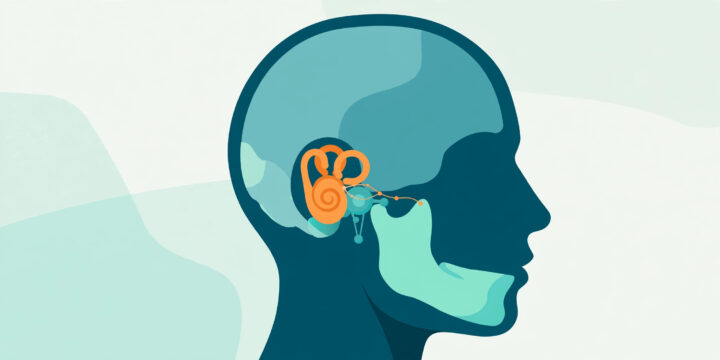
A quick note on terms: TMJ is the temporomandibular joint, the hinge in front of each ear that connects the lower jaw to the skull. TMD means temporomandibular disorder, an umbrella term for problems involving the joint, the chewing muscles, the disc, or how the brain processes pain — or a combination of these. Dizziness is a broad word for feeling lightheaded, unsteady, or faint; vertigo is a specific kind of dizziness, the sensation that you or the room is spinning. Keeping those apart matters, because the causes — and the right clinician — differ.
1. What the Evidence Actually Shows About TMJ and Dizziness
Dizziness is a frequently reported symptom among people with TMD, alongside jaw pain, ear fullness, and ringing in the ears (tinnitus). A systematic review and meta-analysis published in the Journal of Oral and Facial Pain and Headache in 2026 pooled the available studies and found a significant association between TMD and dizziness in descriptive studies, but a non-significant association in analytical studies, with high heterogeneity between studies. The authors’ conclusion was plain: TMDs are associated with increased dizziness and vestibular symptoms, particularly in descriptive research, but a causal relationship could not be established, and prospective studies are needed to clarify the relationship.
That distinction — association versus causation — is the whole story in one sentence. People with jaw pain may also have neck pain, headaches, stress, poor sleep, and ear symptoms, and any of those can contribute to feeling unsteady. A scoping review of the TMD–vestibular literature reached a similar place: studies indicate an association between vestibular and ear symptoms and TMD, with painful TMD more associated with dizziness and greater TMD severity linked to more vestibular symptoms — but the overall methodological quality was unclear and the evidence remains associative, not causal.
There is also no validated symptom pattern or self-test that can confirm the jaw as the source of dizziness. Timing alone cannot show which came first, and treating the jaw has not been shown to reliably resolve dizziness. A 2026 randomized trial in Scientific Reports tested adding TMJ and soft-tissue mobilization to standard canalith repositioning treatment in 42 adults with benign paroxysmal positional vertigo (BPPV): both groups improved on dizziness measures, with no significant between-group difference for dizziness, although the added jaw treatment improved temporomandibular function and one balance measure. In other words, jaw treatment helped the jaw — it did not clearly add benefit for the vertigo itself.
2. Why the Jaw and the Balance System Sit So Close Together
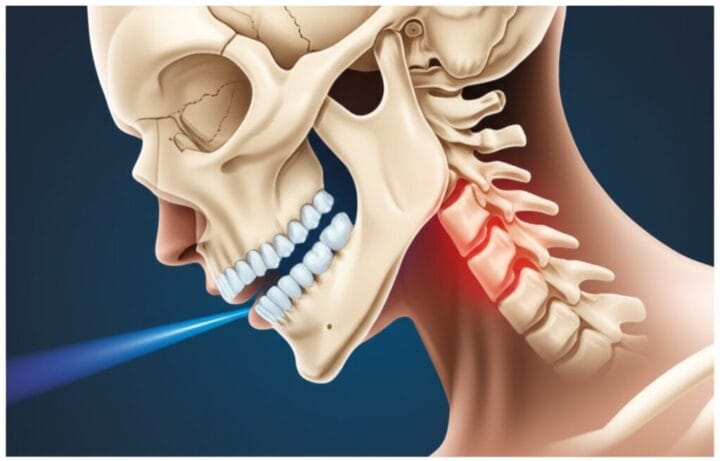
The proposed explanations for a jaw–balance link are anatomical, and they are theories, not proven mechanisms. The temporomandibular joint sits millimetres from the ear: the mandibular condyle (the rounded end of the jawbone) lies just in front of the external ear canal, close to the middle and inner ear, where the vestibular system — the balance apparatus — lives. The chewing muscles share nerve pathways with the ear and neck through the trigeminal nerve, which carries sensation from the face and jaw and connects with brainstem centres involved in balance.
Several mechanisms have been proposed. One is that jaw misalignment or inflammation irritates nearby structures and sends confusing signals through shared trigeminal pathways. Another involves the muscles of mastication and the neck: sustained clenching and poor head posture can alter neck muscle tension, and the neck contributes position information the brain uses for balance. A third involves the Eustachian tube, which connects the middle ear to the back of the nose and throat and equalises ear pressure; some authors have suggested jaw dysfunction could affect it, producing ear fullness and muffled hearing. None of these has been confirmed as the mechanism in patients, and the available studies did not test them — they are plausible routes, not established causes.
What is established is the neighbourhood: jaw pain, ear pain, tinnitus, ear fullness, headaches, and neck pain cluster together in TMD, and dizziness sits inside that cluster. That clustering is exactly why dizziness in someone with TMD still needs its own assessment rather than being filed away as “just the jaw.”
3. TMJ Dizziness vs. BPPV, Ménière’s Disease, and Vestibular Migraine
Most vertigo is not jaw-related at all. Three inner-ear and migraine-related causes account for much of it, and they differ from one another — and from a jaw pattern — mainly in how long a spell lasts, what triggers it, and whether hearing changes. The table below summarises the patterns described in the American Academy of Otolaryngology–Head and Neck Surgery clinical practice guidelines for BPPV (2017 update) and Ménière’s disease (2020), and in National Institute on Deafness and Other Communication Disorders (NIDCD) guidance. It is a way to describe what you notice to a clinician, not a way to diagnose yourself.
| BPPV | Ménière’s disease | Vestibular migraine | TMJ-related dizziness (reported pattern) | |
|---|---|---|---|---|
| How long a spell lasts | Seconds, usually under 1 minute | 20 minutes to 12 hours per attack | 5 minutes to 72 hours | Varies; often described as lightheadedness or unsteadiness rather than intense spinning |
| What sets it off | Specific head movements: rolling over in bed, lying down, looking up | Comes on by itself, sometimes after ringing or muffled hearing | Often with migraine features: light and sound sensitivity, visual aura, sometimes without headache | May accompany jaw pain, clenching, or chewing; no specific positional trigger established |
| Hearing changes | No — hearing loss is not a feature | Yes — fluctuating hearing loss, ringing, and ear fullness, usually in one ear | Usually no hearing loss | Ear fullness and tinnitus are commonly reported with TMD, but fluctuating hearing loss points elsewhere |
| How it is evaluated | Positional tests such as the Dix-Hallpike, watching for characteristic eye movements | History of attacks plus hearing tests, with other causes excluded | Recurring pattern plus migraine features, after other vestibular causes are considered | Dental/TMD examination plus ear and balance assessment — neither alone settles it |
Two questions separate most cases: does it come in brief bursts triggered by a head position, or does it come on by itself — and is hearing involved? Brief spinning on rolling over points toward BPPV, which is the most common peripheral vestibular disorder and is treated with a canalith repositioning maneuver, not with medication or jaw treatment. Spells of 20 minutes to 12 hours with fluctuating hearing loss, tinnitus, and fullness in one ear point toward Ménière’s disease, which an ear, nose, and throat (ENT) clinician usually diagnoses and manages. Dizziness with migraine features — light and sound sensitivity, visual aura, a personal history of migraine — points toward vestibular migraine, which can occur even without a headache. Dizziness that tracks with jaw pain and clenching, without a positional trigger or hearing loss, is the pattern most often described with TMD — but that pattern overlaps with all of the above, which is why it cannot diagnose itself.
4. Red Flags: When Dizziness Needs Prompt Care, Not a Jaw Explanation
Most dizziness is not dangerous, but some patterns need urgent assessment, and attributing them to the jaw would delay the right care. Seek emergency care — call 911 or your local emergency number — for sudden dizziness or loss of balance together with any of these: weakness or numbness on one side, slurred speech, double vision, trouble walking or loss of coordination, a severe or worst-ever headache, fainting, or chest pain. Sudden vertigo with any stroke sign needs a stroke check, even in younger people.
Seek prompt same-day or urgent care for sudden hearing loss in one ear, with or without dizziness: the NIDCD describes sudden sensorineural hearing loss as a medical emergency, and treatment delayed more than two to four weeks is less likely to help. Also seek prompt care for dizziness after a head injury, continuous vertigo lasting a day or more, repeated falls, or dizziness with new ear discharge, fever, or a recent ear infection. And see a clinician — your primary care clinician, an ENT clinician, or a dentist experienced in TMD, depending on the pattern — for any dizziness that keeps recurring, interferes with work or driving, or comes with jaw pain that is itself worsening. The point of the list is not alarm; it is that “probably the jaw” is not a safe default until the dangerous causes have been considered.
5. How Clinicians Sort Out Whether the Jaw Is Involved
There is no single test for TMJ-related dizziness, so the work-up is a process of elimination plus a jaw assessment. A clinician will usually start with the history: when spells happen, how long they last, what triggers them, whether hearing changes, what medicines you take, and whether migraine, head injury, or ear disease is in the picture. The examination may include positional tests such as the Dix-Hallpike manoeuvre, which looks for the characteristic eye movements of BPPV; hearing tests (audiometry) when ear symptoms are present; and a dental examination of jaw movement, muscle tenderness, joint sounds, and bite. Imaging is not routine: the BPPV guideline recommends against imaging when the diagnosis is clear from positional testing and nothing else points elsewhere.
If TMD is confirmed alongside dizziness, treating the jaw follows the usual conservative path for TMD — education, jaw rest and habit change, physical therapy, heat or cold, stress management, and an occlusal splint or night guard where appropriate — as described in the site’s Botox for TMJ article, which covers why jaw treatments are chosen for muscle-driven pain rather than for the joint itself. What that path does not offer is a promise about dizziness: the evidence does not establish that treating TMD reliably improves or resolves it, and any improvement in balance symptoms alongside jaw treatment may reflect the natural course of the vestibular problem, the effect of the vestibular treatment, or both. If dizziness persists after the jaw improves, the vestibular cause still needs its own follow-up — and if the jaw improves but the dizziness was actually BPPV, the repositioning maneuver is what treats it, not the splint.
It also works the other way: someone with genuine TMD can develop BPPV or vestibular migraine independently, and treating only the jaw would miss the real cause of the spinning. That is why the most useful outcome of an assessment is often a referral — dentist to ENT, or ENT to dentist — rather than a single diagnosis.
6. What You Can Do While You Wait for an Appointment
None of this replaces an assessment, but a few low-risk steps fit both jaw pain and balance symptoms. Give the jaw a rest: avoid wide yawning, gum chewing, and hard or chewy foods for a few days; keep the teeth slightly apart and the tongue resting lightly on the roof of the mouth rather than clenched; notice daytime clenching and interrupt it with a short break, a stretch, or a change of posture. Sleep position matters for both: avoid sleeping on the painful jaw side if that worsens symptoms, and keep the neck supported rather than twisted.
For the dizziness itself, move slowly when changing position — sit up before standing, especially first thing in the morning — and avoid driving or working at height during a spell. Keep a short note of each episode for the appointment: date and time, how long it lasted, what you were doing, whether hearing changed, and whether jaw pain was present. That record is more useful to a clinician than any description from memory weeks later. Do not attempt repositioning maneuvers from a video without guidance if you have neck problems, a recent head injury, or any of the red-flag symptoms above; the maneuver is simple for straightforward BPPV, but it is a clinician-taught treatment, and doing it for the wrong cause wastes the window for the right one. And do not start vestibular-suppressant medicines, muscle relaxants, or jaw exercises as a long-term plan without discussing them with a clinician: the BPPV guideline was written partly to cut inappropriate use of vertigo-suppressing medicines, which can slow the brain’s own compensation for a balance problem.
Frequently Asked Questions
Can TMJ cause dizziness?
TMD and dizziness often occur together, and a 2026 systematic review found an association between them — but it could not establish that the jaw causes the dizziness. The accurate statement is that jaw disorders and vertigo may co-occur; unexplained dizziness should still be assessed on its own rather than automatically blamed on the jaw.
How can you tell TMJ dizziness from BPPV?
BPPV causes brief spinning, usually under a minute, triggered by specific head movements such as rolling over in bed, with no hearing loss. Dizziness described with TMD is more often lightheadedness or unsteadiness that tracks with jaw pain and clenching, without a clear positional trigger. Only positional testing can confirm BPPV, so the distinction is made in the clinic, not from symptoms alone.
Can TMJ cause vertigo and ear fullness?
Ear fullness and tinnitus are commonly reported alongside TMD, and the jaw sits close to the ear, so the pairing is familiar to clinicians. But fluctuating hearing loss with fullness in one ear is a hallmark of Ménière’s disease, not of TMD, and new hearing loss needs prompt ENT assessment regardless of jaw symptoms.
Will treating my TMJ stop the dizziness?
Not reliably, based on current evidence. Jaw treatment can improve jaw pain and function, and some people report their dizziness easing alongside it, but trials have not shown that TMD treatment resolves dizziness, and a 2026 trial found no added dizziness benefit from jaw mobilization over standard BPPV treatment. If dizziness continues after jaw treatment, it needs its own follow-up.
Conclusion
The jaw and the balance system are neighbours, share nerve pathways, and produce overlapping symptoms — so it is unsurprising that dizziness is common among people with TMD, or that the two are so often linked in conversation. But the research, including a 2026 systematic review and meta-analysis, supports association, not causation, and there is no symptom pattern that proves the jaw is the source of a person’s dizziness. The practical takeaway is a two-track one: take jaw pain seriously and treat it conservatively, and give dizziness its own assessment — noting how long spells last, what triggers them, and whether hearing changes — so that BPPV, Ménière’s disease, vestibular migraine, and the rarer urgent causes are not missed behind a jaw explanation. A short episode diary and a prompt appointment, with the right referral between dentist and ENT, will usually settle in weeks what months of assuming cannot.
This article is for educational purposes only and is not medical advice. It is general information, not a diagnosis or a recommendation for any individual. Discuss dizziness, vertigo, hearing changes, or jaw pain with your own clinician or dentist, and seek emergency care for sudden dizziness with weakness, slurred speech, double vision, severe headache, fainting, or sudden hearing loss.
Sources
- Prevalence of dizziness in patients with temporomandibular disorders: a systematic review and meta-analysis, Journal of Oral and Facial Pain and Headache, 2026 (PMID 42548103) — pubmed.ncbi.nlm.nih.gov/42548103
- Effect of temporomandibular joint and soft tissue mobilization as an adjunct to canalith repositioning in BPPV: randomized controlled trial (42 adults), Scientific Reports, 2026 — nature.com/articles/s41598-026-52637-x
- American Academy of Otolaryngology–Head and Neck Surgery clinical practice guidelines: benign paroxysmal positional vertigo (2017 update) and Ménière’s disease (2020) — cited for episode durations, triggers, and evaluation; no direct link used.
- National Institute on Deafness and Other Communication Disorders (NIDCD) — balance disorders and sudden hearing loss guidance, cited by name; no direct link used.
- Association between temporomandibular disorders and vestibular symptoms: a scoping review, World Physiotherapy congress proceedings (search to 13 September 2024) — cited for the associative evidence base and unclear methodological quality.



0 Comments