
Educational information · Not medical advice
In brief
Anxiety jaw clenching can keep jaw muscles working all day. Learn how the stress-pain loop works, how to spot daytime clenching, and practical ways to break it.
In this article
- Why does anxiety make you clench your jaw during the day?
- What is awake bruxism, and how is it different from sleep bruxism?
- How does the stress–pain loop keep anxiety jaw clenching going?
- How can you spot daytime clenching before pain builds?
- What actually helps break the loop?
- When should you get help for jaw clenching and anxiety?
- Frequently asked questions
- Conclusion
- Sources
Key Takeaways
- Anxiety jaw clenching is usually daytime, or awake, clenching — sustained tooth contact, bracing, or thrusting of the jaw while you are awake, often during concentration or stress.
- Pain then feeds back: sore muscles, headaches, and poor sleep raise stress, which makes clenching more likely the next day. That is the stress–pain loop.
- The evidence for breaking the loop is behavioural first: awareness cues, habit reversal, relaxation, cognitive behavioural therapy (CBT), and biofeedback, alongside simple jaw self-care.
- A night guard protects teeth at night, but it does not switch off daytime anxiety jaw clenching — the daytime habit needs its own plan.
You finish a tense meeting, a drive, or an hour at a screen and realise your teeth are pressed together and your jaw aches. That pattern has a name: anxiety jaw clenching during the day. It is common, it is rarely a sign that you have damaged the joint in a single afternoon, and it is understandable — concentration and stress often show up first in the jaw muscles.
This article explains why anxiety jaw clenching happens, how it differs from grinding in sleep, and how the stress–pain loop keeps it going. It then sets out practical, evidence-based ways to break that loop, from simple daytime cues to CBT and biofeedback, and the signs that mean you should get assessed rather than just pushing through. A quick note on terms: TMJ is the temporomandibular joint in front of each ear; TMD means temporomandibular disorder, the group of more than 30 conditions affecting the jaw joint and the muscles that move it, as the U.S. National Institute of Dental and Craniofacial Research (NIDCR) defines them.
Why does anxiety make you clench your jaw during the day?
Start with what anxiety does in the body. A stressed or anxious state raises general muscle readiness — shoulders lift, hands tighten, and the chewing muscles, the masseter and temporalis, tighten too. For many people that tension settles in the jaw without any conscious decision to clench. Add a task that demands focus — a deadline, a difficult conversation, driving in traffic — and the teeth meet, the jaw braces, and the muscles keep working long after the moment has passed.
The NIDCR puts the broader picture carefully: in most cases the exact cause of a TMD is not clear, and research suggests a combination of genes, psychological and life stressors, and how someone perceives pain may play a part in why a TMD develops and whether it becomes long-lasting. That matters for how you read your own symptoms. Anxiety jaw clenching does not mean your pain is imagined, and it does not mean anxiety is the only cause. It means stress is one real, measurable input into muscle load and pain sensitivity — alongside sleep, habits, injury, and the joint itself. Our earlier article on how stress affects TMJ disorders covers that wider stress connection.
About 1 in 4 — awake bruxism is reported by approximately one in four individuals in the general population, according to a 2026 systematic review of awake bruxism management in BMC Oral Health. Daytime clenching is common, not unusual.
There is also a learning element. If clenching happens every time you concentrate, the jaw learns it as a default posture. Teeth that should rest apart, with the lips together and the tongue relaxed, instead stay in light contact for hours. Light contact sounds harmless, but sustained low-level muscle work is tiring work — which is why the ache often arrives in the late afternoon, at the temples, or as a dull headache rather than as a sharp joint pain.
What is awake bruxism, and how is it different from sleep bruxism?
Bruxism is repetitive jaw-muscle activity that can include clenching, grinding, bracing, or thrusting of the jaw. Clinicians split it by timing. Sleep bruxism happens during sleep and may involve grinding sounds that a partner hears. Awake bruxism happens during wakefulness, with repetitive or sustained tooth contact, bracing, or thrusting — and it is the form most closely tied to daytime stress and concentration.
The distinction changes the plan. A guard worn at night can protect teeth from sleep grinding, as our comparison of a TMJ splint vs. a night guard explains, but it cannot be worn through every meeting and it does not teach the jaw a new daytime habit. Anxiety jaw clenching needs daytime tools: noticing the habit, interrupting it, and lowering the background tension that drives it. If you clench both day and night, tell your dentist — the two patterns often travel together, but they are assessed and managed differently.
Consequences, when clenching is frequent, are mainly about overload: sore or tired chewing muscles, temple headaches, tooth sensitivity, and, over time, tooth wear or cracked restorations. The systematic review notes those same possible consequences, from tooth wear and fractures of dental restorations to orofacial pain related to musculoskeletal overload. That is a reason to act early, not a reason to panic about a single stressful week.
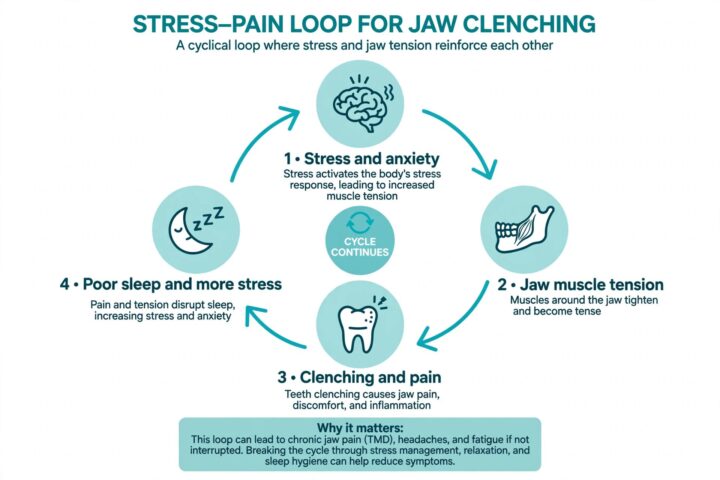
How does the stress–pain loop keep anxiety jaw clenching going?
The loop has four steps, and each one makes the next more likely. First, stress and anxiety raise muscle tension. Second, the jaw braces or clenches, often for long stretches without you noticing. Third, overloaded muscles hurt — and pain is itself stressful, especially when it interferes with eating, speaking, work, or sleep. Fourth, poor sleep and ongoing pain lower your tolerance for the next day’s stress, so tension and clenching start sooner and last longer.
Once pain has lasted a while, the nervous system can also become more sensitive, so ordinary chewing or light pressure hurts more than the state of the joint alone would explain. That amplification is described in our article on when TMJ pain becomes chronic. You do not need to wait for that stage to use the loop idea, though. Even in a short-lived flare, breaking any one step — tension, clenching time, pain load, or sleep — weakens the whole cycle.
Notice what the loop model does not claim. It does not claim every jaw pain is caused by anxiety, that a stressful life means you brought pain on yourself, or that relaxation alone will fix a joint problem, a tooth problem, or a locked jaw. It is a map for the common daytime pattern, to be used alongside — not instead of — a proper assessment when symptoms persist or change.
How can you spot daytime clenching before pain builds?
Most daytime clenching is unnoticed until the ache arrives, so the first skill is noticing earlier. Useful checks are simple and brief:
- The teeth-apart check: several times a day, ask: are my teeth touching? At rest they normally should not be. Lips together, teeth apart, tongue resting gently — that is the resting posture to return to.
- Trigger mapping: note when you catch yourself clenching for a few days — screens, driving, exercise, meetings, studying. A pattern usually appears quickly, and a pattern can be planned for.
- Muscle check: press gently over the jaw muscles in front of the ear and at the temples. Tenderness that matches your usual ache is a clue that muscle overload, not only the joint, is involved.
- End-of-day signs: tired jaw, temple headache, or teeth that feel sensitive in the evening after a high-focus day point toward daytime load rather than only nighttime grinding.
Keep tracking light. A few phone reminders or sticky notes that prompt a teeth-apart check are a recognised behavioural tool, not a gimmick: the awake-bruxism systematic review lists reminder prompts among the strategies that generally showed positive effects. Checking constantly, testing the jaw by opening wide, or repeatedly pressing sore muscles can irritate tissues and raise anxiety — a few calm checks a day are enough.
What actually helps break the loop?
The honest evidence summary is that behavioural care comes first, evidence is still limited, and no single treatment works for everyone. The 2026 systematic review screened thousands of abstracts and found only nine eligible studies with 165 participants on awake bruxism management; most strategies fell under cognitive behavioural therapy, and the studies generally suggested positive effects for biofeedback, habit reversal, reminder prompts, and counselling with self-management. Small evidence is not no evidence — it is a reason to start with low-risk, reversible steps and review whether they help you.

Awareness and habit reversal. Use your trigger map: place a cue where clenching happens — a note on the monitor, a phone prompt before meetings — and pair it with a replacement action: teeth apart, tongue relaxed, shoulders down, one slow breath out. Habit reversal works by making an automatic habit deliberate, then shorter, then less frequent.
Relaxation and CBT. The NIDCR lists self-management and behavioural health approaches for TMD, including learning about your condition, becoming aware of and reducing habits such as jaw clenching, practising meditation and relaxation, setting goals, and staying involved in meaningful activities. It also notes that CBT and biofeedback, usually offered by a psychologist, can help manage TMDs: CBT works on negative thought patterns and coping skills, while biofeedback uses a sensor — for example on the jaw — to show muscle tightening as it happens, so you can learn to notice and release it.
Simple jaw self-care. During a flare, the NIDCR’s first steps apply: eat softer foods for a short period, apply heat or cold to the face alongside gentle stretching exercises, use over-the-counter pain medication as directed if you choose to, and reduce habits such as jaw clenching, gum chewing, or nail biting. Gentle is the key word — do not force stretches through sharp pain.
Sleep and the next day. Protecting sleep weakens the loop from the other side. Keep a regular sleep schedule, and raise snoring, witnessed pauses in breathing, or morning headaches with your clinician, because sleep problems and jaw pain reinforce each other and may need their own assessment, including for sleep apnea or sleep bruxism.
What about medication or a guard? Medication for anxiety or pain is a prescriber’s decision, made with your full history — do not start, stop, or change a prescribed medicine because of jaw symptoms without talking to the prescriber, and mention new jaw clenching after a medicine change. A guard or splint may still be recommended to protect teeth, especially if nighttime grinding is also present, but treat it as tooth protection alongside the daytime plan, not a substitute for it.
When should you get help for jaw clenching and anxiety?
Book a dental or medical assessment if jaw pain persists, keeps returning, limits opening, or interferes with eating, sleep, or work; if teeth are wearing, chipping, or becoming sensitive; or if headaches are frequent. Seek prompt care for a jaw that locks open or closed, swelling, fever, recent injury, new numbness, unexplained weight loss, or pain that steadily worsens — those are not stress-loop signs and need their own diagnosis.
Help for anxiety itself matters in parallel. If anxiety is persistent, rising, or limiting daily life, discuss it with your primary care clinician or a mental health professional in its own right, not only as a jaw problem. Conversely, tell your dentist about anxiety and about any medicines you take for it, because that context changes how clenching is assessed. The most useful appointments are the ones where both sides of the loop are on the table at once.
Finally, follow the NIDCR’s conservative-first caution: because evidence for many TMD treatments is limited, experts recommend conservative treatment and avoiding treatments that permanently change the jaw joints, teeth, or bite, or involve surgery, especially as a first response to clenching-related muscle pain.
Frequently asked questions
Can anxiety really cause jaw clenching during the day?
Yes, anxiety and stress are closely linked to awake bruxism — sustained tooth contact, bracing, or clenching while awake. Anxiety raises general muscle tension and often appears during concentration, so the jaw muscles stay working for long stretches. That does not mean anxiety is the only possible cause of jaw pain, which is why persistent or changing symptoms still deserve a dental assessment.
How do I know if I clench my jaw during the day or only at night?
Daytime clenching tends to show up as a tired or aching jaw by late afternoon, temple headaches after high-focus work, and moments when you catch your teeth pressed together at a screen, in traffic, or in meetings. Night grinding is more often reported by a partner hearing sounds, or morning tooth sensitivity and wear found by a dentist. Many people have both, so mention both patterns.
Will a night guard stop daytime jaw clenching?
No. A night guard separates the teeth and protects them from wear during sleep, and it may reduce muscle activity at night, but it does not switch off a daytime habit and is not worn through the working day. Daytime anxiety jaw clenching responds to awareness cues, habit reversal, relaxation, and, when needed, CBT or biofeedback — alongside any guard your dentist recommends for nighttime protection.
What is the fastest way to relax a clenched jaw in the moment?
Use a short reset: stop, let your lips close gently, separate your teeth, rest your tongue, drop your shoulders, and breathe out slowly. Then return to the task with that teeth-apart posture as the default. Repeating that reset at planned cues through the day is more effective than one long relaxation session, because it shortens the total time your jaw muscles spend braced and working.
Conclusion
Anxiety jaw clenching is a daytime habit with a loop behind it: stress tightens the jaw, clenching overloads the muscles, pain and poor sleep raise stress, and the cycle repeats. Breaking the loop does not require a dramatic intervention. It starts with noticing — teeth apart at rest, triggers mapped, cues placed where clenching happens — and builds with relaxation, self-care during flares, protected sleep, and, when needed, CBT or biofeedback and a coordinated dental and medical assessment.
If you recognise the late-afternoon ache, try the teeth-apart check today and note your triggers for a few days. If pain persists, teeth are wearing, your jaw locks, or anxiety itself is limiting your life, bring that record to your dentist or clinician and ask for a plan that treats both sides of the loop.
This article is for educational purposes only and is not medical advice. It is general information, not a diagnosis or a recommendation for any individual. Discuss persistent jaw pain, tooth wear, locking, swelling, or anxiety with your own dentist, clinician, or mental health professional.
Sources
- National Institute of Dental and Craniofacial Research (NIDCR) — Temporomandibular Disorders (TMD): more than 30 conditions, causes including psychological and life stressors, conservative-first treatment, self-management, CBT and biofeedback — nidcr.nih.gov
- Graham DA, et al. Management of awake bruxism: a systematic review. BMC Oral Health, 2026 — awake bruxism reported by about one in four people, consequences including tooth wear and orofacial pain, and limited evidence suggesting benefits of behavioural approaches including biofeedback, habit reversal, reminder prompts, and counselling with self-management — pubmed.ncbi.nlm.nih.gov
- Bruxism as a Biopsychosocial Disorder: An Interdisciplinary Cross-Sectional Study. Journal of Clinical Medicine, 2025 — students with bruxism had higher anxiety (GAD-7) scores, with clinically relevant anxiety nearly three times more frequent in the bruxism group — mdpi.com
About this information
Consult the sources listed in the article. This notice does not certify an individual clinical review.
This article is for education only and is not medical advice. Talk to a qualified clinician about your own symptoms.



0 Comments