Educational information · Not medical advice
In brief
Health anxiety googling symptoms at 2 AM? Learn why the search loop backfires, what cyberchondria is, and the CBT steps that help you stop and sleep well.
In this article
- What is health anxiety, and when does searching become part of it?
- What is cyberchondria?
- Why does googling symptoms make health anxiety worse?
- How can you search a symptom once, safely?
- How do you break the 2 AM searching cycle?
- What treatment actually helps health anxiety?
- When should you get help promptly?
- Frequently asked questions
- Conclusion
- Sources
Key Takeaways
- Health anxiety googling symptoms is a reassurance loop: a bodily sensation triggers a search, the search brings brief relief or new fears, and the urge to search returns stronger.
- Researchers call the excessive, distressing version cyberchondria. In a meta-analysis of 20 studies with 7,373 people, health anxiety correlated strongly with cyberchondria (r = 0.62).
- Searching is not the enemy — repeated searching for certainty is. One planned search of a trusted source, then stopping, is very different from an hour of escalating tabs.
- Cognitive behavioural therapy (CBT) has the strongest evidence for health anxiety: a meta-analysis of 14 randomised trials found a large effect that lasted at 6- and 12-month follow-up.
- If worry has persisted for months, is interfering with sleep, work, or relationships, or keeps sending you back to the search bar, that is a reason to talk to a clinician — not to search harder.
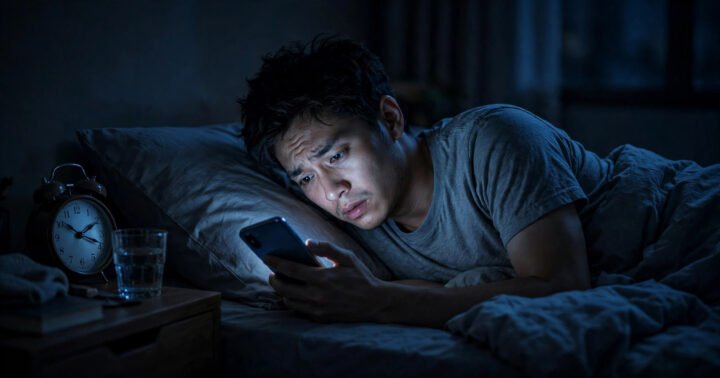
It is 2 AM, you noticed a new sensation earlier — a flutter, an ache, a spot — and now you are three pages deep into health anxiety googling symptoms you barely understand. If that scene is familiar, the problem is usually not a lack of information. Health anxiety googling symptoms follows a loop: the search is meant to bring certainty, but for health anxiety it mostly brings the next search. This article explains that loop, what researchers call cyberchondria, how to search a symptom once and stop, and what treatment actually helps.
A note on terms first. Health anxiety is a persistent, disproportionate worry that you have, or may develop, a serious illness. Searching online can be a sensible first step for a new symptom. It becomes part of health anxiety when the searching is driven by dread, repeats for the same symptom, and leaves you more anxious than you started.
What is health anxiety, and when does searching become part of it?
In the current diagnostic framework (DSM-5-TR), health anxiety is mainly described through two diagnoses. Illness anxiety disorder is a preoccupation with having or acquiring a serious illness when physical symptoms are absent or only mild, lasting at least six months, with high anxiety about health and either excessive health-related behaviours — such as repeatedly checking the body for signs of illness — or avoidance of doctors and hospitals. Somatic symptom disorder covers the pattern where significant physical symptoms are present and the worry, time, and energy devoted to them are out of proportion.
Most people who google symptoms at night do not meet either diagnosis, and this article cannot diagnose anyone. The useful line is functional, not formal: is searching helping you decide a next step, or is it a ritual you perform to feel safe for a few minutes? Ordinary concern ends in an action — book an appointment, watch and wait, go to sleep. Health anxiety googling symptoms ends in another tab.
There is also a jaw connection many readers of this site will recognise. Anxiety commonly shows up as daytime jaw clenching and muscle tension, and the resulting ache then becomes a new symptom to worry about. Our guide to anxiety, jaw clenching, and the stress–pain loop explains that mechanism — and why a sore jaw after a stressful week is usually muscle load, not a catastrophe.
r = 0.62 — the correlation between health anxiety and cyberchondria in the McMullan 2019 meta-analysis of 20 studies and 7,373 participants: a strong association. The same review found a smaller correlation (r = 0.34) between health anxiety and ordinary online health information seeking — it is the excessive, distressing pattern, not searching itself, that tracks anxiety most closely.
What is cyberchondria?
Cyberchondria is a research term, not a diagnosis. Starcevic and Berle defined it as an excessive or repeated search for health-related information on the internet, driven by distress or anxiety about health, which only amplifies that distress or anxiety. A 2021 systematic review in the Journal of Medical Internet Research (Schenkel and colleagues), covering 25 studies qualitatively and 7 studies with 3,069 people quantitatively, found a similarly strong association between cyberchondria and health anxiety (r = 0.63), and linked cyberchondria to intolerance of uncertainty, anxiety sensitivity, and obsessive-compulsive symptoms.
Two cautions belong with those numbers. First, correlation is not causation: anxious people search more, and searching can also feed anxiety — the relationship likely runs in both directions, as the McMullan review notes. Second, cyberchondria describes a pattern of behaviour, not a character flaw. The search bar is available at 2 AM, a clinician is not, and the urge to resolve uncertainty immediately is entirely human.
Why does googling symptoms make health anxiety worse?
Several features of searching work against a worried mind. Search results are not ranked by how likely a cause is for you personally; serious conditions generate large amounts of content, so a headache search surfaces brain tumours alongside tension and dehydration. Forums and anecdotes add vivid worst cases without base rates. And each new page introduces new terms — which become new searches.
Underneath the technology is a learning loop. Clinicians describe reassurance-seeking as a safety behaviour: it lowers anxiety briefly, which teaches the brain that searching was necessary, so the next sensation triggers a stronger urge. Mayo Clinic's summary of illness anxiety disorder treatment makes the same point from the therapy side — CBT for this condition specifically works on reducing behaviours such as frequently checking the body for signs of illness and repeatedly seeking reassurance. The relief is real; it is just rented, at rising rates. Slow breathing can lower arousal in the moment while you practise not searching — our comparison of breathwork for anxiety: box breathing, 4-7-8, and cyclic sighing covers the patterns and their evidence — but breathing is a pause button, not the fix for the loop itself.
A short, slow-breathing pause can lower arousal while an urge to search passes. Generated clip for context; it is not a real patient or a clinical result.
How can you search a symptom once, safely?
You do not need a rule of never searching. You need a search with an end. A practical protocol:
- Write the question first. One specific question — "when does a tension headache need urgent care?" — not a symptom typed in panic.
- Use one trusted source. A national health service, a university medical centre, or a guideline body, rather than ten open tabs and a forum.
- Decide the action before you read. For example: "If this lists red flags I have, I will call today; otherwise I will watch for 48 hours and note what happens." A search that ends in a decision does not need to be repeated.
- Close it when you have the answer. If you find yourself rewording the same query, that is the loop, not research. Note the time, put the phone down, and let the discomfort peak and fall — it does, usually within tens of minutes.
- Take persistent symptoms to a person. A clinician who can examine you, order a test if one is warranted, and record a plan gives the kind of closure a search engine structurally cannot.
If exhaustion and worry are spilling beyond health into work and mood generally, our article on burnout vs depression and why the response differs may help you describe that wider pattern accurately.
How do you break the 2 AM searching cycle?
The CBT-informed steps below target the loop, not just the phone:
Delay, do not debate. When the urge hits, set a delay — 20 minutes, then an hour, then until morning — and do something absorbing in the gap. Urges that are not fed usually fade; each delay is evidence your brain collects that uncertainty is survivable.
Keep a worry log instead of a search history. Write the sensation, the feared explanation, and what actually happened over the next few days. Over weeks, the log shows the base rate your anxious moments hide: most sensations resolved, and none were helped by the 2 AM search.
Cut the checking that feeds it. Repeatedly palpating a lymph node, re-measuring a pulse, or re-reading the same thread keeps attention locked on the body. Gentle, planned reduction — fewer checks, at set times — is a standard CBT step, best done with support if checking is entrenched.
Protect the night. Charge the phone outside the bedroom if you can, and treat a night waking as a cue for a wind-down routine, not research. If stress shows up in your body at night, techniques such as slow breathing or the approaches in our guide to vagus nerve exercises for stress can help you settle — with the honest caveat there that only slow breathing has strong evidence.

Putting the phone face-down and taking a slow breath is the daytime version of breaking the loop. Photo-style image for context; it is not a real patient or a clinical result.
What treatment actually helps health anxiety?
Cognitive behavioural therapy adapted for health anxiety has the strongest evidence. A systematic review and meta-analysis by Cooper and colleagues (2017) included 14 randomised controlled trials and 21 comparisons, and found a large effect for CBT compared with control conditions at post-treatment (d = 1.01, 95% CI 0.77–1.25), maintained at 6- and 12-month follow-up. In practice, CBT for health anxiety works on catastrophic interpretations of ordinary bodily sensations, gradually reduces checking and reassurance-seeking, and builds tolerance for uncertainty — including, in modern programmes, internet-delivered CBT with therapist guidance.
Medication is a second line a clinician may discuss: Mayo Clinic notes that antidepressants such as selective serotonin reuptake inhibitors (SSRIs) may help treat illness anxiety disorder. That is a prescriber decision based on your full history — do not start, stop, or change a prescribed medicine because of health worry without talking to the prescriber. What does not help, on the evidence, is more testing without a clinical indication or more searching: both feed the same reassurance loop the treatment is trying to unwind.
When should you get help promptly?
Book an appointment — rather than another search — if health worry has lasted months, is taking significant time each day, is disrupting sleep, work, or relationships, or is leading you to avoid medical care altogether out of fear of results. Avoidance is the other face of health anxiety, and it carries its own risks.
Seek prompt medical care for symptoms themselves when they warrant it on ordinary clinical grounds: chest pain or pressure, sudden weakness or speech change, fainting, unexplained weight loss, a new lump that persists, fever that does not settle, or any symptom that is rapidly worsening. Health anxiety and real illness can coexist; the goal is a proportionate response — a clinician's assessment — not dismissal in either direction. If anxiety comes with thoughts of harming yourself, seek urgent help immediately.
Frequently asked questions
What is cyberchondria?
Cyberchondria is a research term for excessive or repeated online searching for health information, driven by anxiety about health, that increases rather than relieves that anxiety. It is not a formal diagnosis. In meta-analyses it correlates strongly with health anxiety (r = 0.62–0.63), which is why clinicians treat the searching pattern itself — not just the feared disease — as part of the problem to work on.
Can googling symptoms cause health anxiety?
The evidence shows association, not simple causation. People with higher health anxiety search more, and repeated searching can amplify worry by surfacing rare, serious causes and by acting as reassurance-seeking that keeps the anxiety loop going. A single, bounded search of a trusted source for a new symptom is normal health behaviour; the risk pattern is repeated, escalating searching for the same worry.
How do I stop googling symptoms at night?
Start with friction and a delay: charge the phone outside the bedroom if possible, and when an urge hits, postpone the search until morning and write the worry in a log instead. Most urges fade within tens of minutes. If the pattern persists for months or disrupts sleep and daily life, ask a clinician about CBT for health anxiety, which directly targets checking and reassurance-seeking.
Is health anxiety the same as hypochondria?
They overlap, but the older term hypochondriasis was retired in DSM-5 and split mainly into illness anxiety disorder — preoccupation with having or acquiring a serious illness, with absent or mild symptoms, for at least six months — and somatic symptom disorder, where distressing physical symptoms are present and the response to them is disproportionate. Health anxiety is the everyday term covering this spectrum of worry.
Conclusion
Health anxiety googling symptoms feels like problem-solving, and that is exactly why the loop is so sticky: every search promises the certainty that would finally let you rest, and delivers just enough relief — or just enough new fear — to guarantee the next one. The research picture is consistent. The excessive pattern, cyberchondria, tracks health anxiety strongly; ordinary, bounded searching does not carry the same association; and CBT that reduces checking and reassurance-seeking has large, durable effects.
So keep the search bar, but give it an end: one question, one trusted source, one decision. And if the worry itself has become the symptom that will not settle, bring that — not another printout of search results — to a clinician. That conversation is the one that actually closes the tab.
Medical disclaimer: This article is educational information only and is not medical advice, diagnosis, or treatment. It cannot tell you whether you have health anxiety or any other condition. Discuss your symptoms with your clinician or mental health professional, and seek urgent help if you have thoughts of harming yourself.
Sources
- McMullan RD, Berle D, Arnáez S, Starcevic V. The relationships between health anxiety, online health information seeking, and cyberchondria: systematic review and meta-analysis. Journal of Affective Disorders 2019;245:270–278. PubMed — 20 studies, 7,373 participants; r = 0.34 for online health information seeking, r = 0.62 for cyberchondria.
- Schenkel SK, Jungmann S, Gropalis M, Witthöft M. Conceptualizations of cyberchondria and relations to the anxiety spectrum: systematic review and meta-analysis. Journal of Medical Internet Research 2021;23(11):e27835. JMIR — 25 studies qualitative, 7 studies / 3,069 people quantitative; r = 0.63.
- Cooper K, Gregory JD, Walker I, Lambe S, Salkovskis PM. Cognitive behaviour therapy for health anxiety: a systematic review and meta-analysis. Behavioural and Cognitive Psychotherapy 2017;45(2):110–123. PubMed — 14 RCTs, large effect at post-treatment (d = 1.01), maintained at follow-up.
- Mayo Clinic. Illness anxiety disorder — diagnosis and treatment. Mayo Clinic — CBT targets, including reducing body checking and reassurance-seeking; SSRIs may be added.
- American Psychiatric Association. DSM-5-TR criteria for illness anxiety disorder, as summarised in clinical references: preoccupation for at least 6 months, absent/mild somatic symptoms, excessive health behaviours or maladaptive avoidance.





0 Comments