Educational information · Not medical advice
In brief
Vagus nerve exercises for stress: which ones hold up? Slow breathing, cold water, humming and gargling — sorted by evidence, with a safe routine to try.
In this article
- What is the vagus nerve, and why does it matter for stress?
- Which vagus nerve exercises actually hold up?
- Why does slow breathing have the strongest evidence?
- Does cold water on your face really help?
- What about humming, singing, and gargling?
- How are home devices different from medical vagus nerve stimulation?
- How can you try a safe, simple routine?
- When should you get help instead of doing exercises?
- Frequently asked questions
- Conclusion
- Sources
Key Takeaways
- Most vagus nerve exercises are not a reset. They can briefly shift heart rate or how calm you feel, but lasting anxiety relief is proven for only a few of them.
- Slow breathing is the clear winner: a meta-analysis of 223 studies found vagally mediated heart rate variability rose during slow breathing, after one session, and after multi-session training.
- Cold water on the face triggers a real diving reflex that slows the heart, but that lab effect has not been shown to treat anxiety on its own.
- Humming, singing, and gargling have little or no direct trial evidence. They may feel relaxing, which is different from proven vagus stimulation.
- Never press or massage the sides of your neck to stimulate the vagus, and do not confuse home exercises with implanted medical vagus nerve stimulation, which is FDA-approved only for specific conditions.
Vagus nerve exercises are everywhere online: hum, gargle loudly, splash cold water, or buy a clip for your ear and supposedly switch off stress in minutes. Some of that story has a real nerve behind it, and some of it is marketing. This article sorts vagus nerve exercises into what holds up, what is plausible but unproven, and what to avoid — so you can use the helpful parts without expecting a cure they cannot deliver.
The vagus nerve does influence heart rate, digestion, and stress responses, which is why these techniques can change how you feel in the moment. The harder question is whether a brief change in a body signal adds up to lasting relief from anxiety. For most vagus nerve exercises, the honest answer is: not yet shown.
What is the vagus nerve, and why does it matter for stress?
The vagus nerve is the tenth cranial nerve and the main nerve of the parasympathetic nervous system — the system often described as “rest and digest.” Cleveland Clinic and MedlinePlus describe the vagus nerves (you have a left and a right) running from the brainstem through the neck and chest to the abdomen, carrying signals involved in heart rate, digestion, breathing, swallowing, and speech.
Because the vagus helps slow the heart after stress, researchers often use heart rate variability (HRV) — the variation in time between heartbeats — as a stand-in for vagal activity. Higher vagally mediated HRV is generally linked with more flexible stress regulation, while people with anxiety disorders tend, on average, to show lower resting HRV. That link is real, but it is an association, not proof that raising HRV with a trick will treat anxiety.
That distinction matters for everything that follows. A technique can raise HRV for a few minutes and still not be a treatment. If you also live with jaw tension when you are stressed, our guide to anxiety, jaw clenching, and the stress–pain loop explains how that loop works and what helps it.
Which vagus nerve exercises actually hold up?
Here is the evidence at a glance. The table below is a comparison, not a ranking by how good a technique feels in a video.
| Technique | What happens in the body | Evidence for stress or anxiety |
|---|---|---|
| Slow breathing | Raises vagally mediated HRV during practice | Strongest: 223-study meta-analysis; modest anxiety benefit in breathwork trials |
| Cold water on face | Diving reflex slows heart rate | Solid physiology; no well-designed anxiety trial found |
| Humming / singing | Long exhale, vibration in throat | Small, mostly uncontrolled lab studies only |
| Gargling | Throat muscle contraction | Essentially no direct trial evidence |
| Ear or neck devices | Electrical stimulation through skin | Investigational for anxiety; consumer devices are wellness products, not FDA-cleared for anxiety |
In short, vagus nerve exercises fall into three groups: slow breathing with a real evidence base, cold exposure with real physiology but no anxiety outcome trial, and humming or gargling with popularity far ahead of their data.
Why does slow breathing have the strongest evidence?
Slow breathing — usually around five to six breaths a minute, with a longer, easy exhale — is the one technique in this list that has been studied at scale. Laborde and colleagues, in a 2022 systematic review and meta-analysis in Neuroscience and Biobehavioral Reviews, screened 1,842 abstracts and included 223 studies. They found increases in vagally mediated HRV during slow breathing, immediately after a single session, and after multi-session programmes.
That does not make breathing a cure for an anxiety disorder. It does make it a low-cost, low-risk tool that reliably changes the body signal these exercises claim to target, and breathwork trials also report small to moderate reductions in self-reported stress and anxiety. If you want technique detail, our comparison of box breathing, 4-7-8, and cyclic sighing for anxiety walks through the main patterns and their safety notes.
Try it simply: sit down, breathe in comfortably for about four counts and out for about six, for two to five minutes. Stop if you feel dizzy, tingly, or more panicky — forcing deep breaths can backfire. Gentle and slow beats big and dramatic.
Does cold water on your face really help?
Cold water on the face triggers the diving reflex, a well-documented response in which cooling and wetting the face, via the trigeminal nerve, activates vagal pathways and slows the heart. In a classic study in healthy volunteers, cold-water face immersion to maximum endurance produced a pulse drop of about 15.5 beats per minute — larger than the Valsalva manoeuvre or carotid massage in the same study.
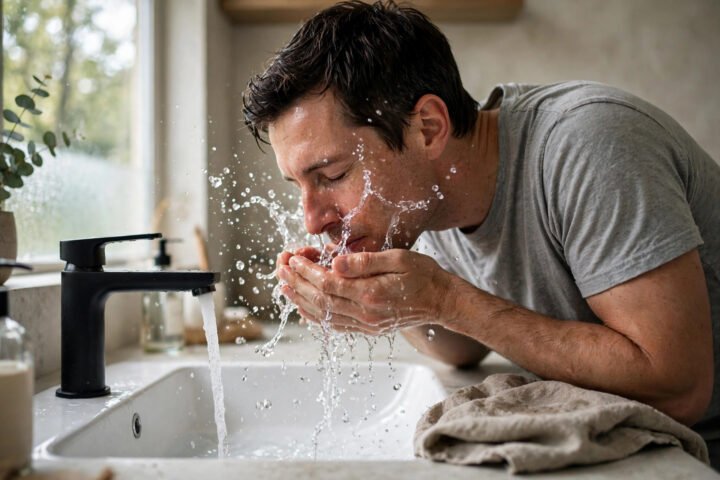
Clinicians do use vagal manoeuvres like this in specific, monitored settings for certain fast heart rhythms. That is not the same as proving that a cold splash treats everyday anxiety. No well-designed trial we found tested cold water on the face as an anxiety treatment. A brief splash of cool — not icy — water, or a cool damp cloth on your face for 15 to 30 seconds, is low risk for most healthy adults and may help you feel reset in a tense moment. Avoid prolonged ice, breath-holding challenges, or cold immersion if you have heart disease, fainting, or a clinician has told you to avoid vagal manoeuvres.
What about humming, singing, and gargling?
Humming, chanting, and singing combine a long exhale with vibration in the throat and larynx, which the vagus nerve supplies. That makes the idea plausible, and a handful of small lab studies measuring HRV point in a favourable direction. But the samples are tiny and mostly uncontrolled, so they cannot show that humming reduces anxiety over time. The often-cited humming study, for example, measured nasal nitric oxide in a very small group — interesting physiology, not an anxiety trial.
Gargling is weaker still. Vigorous gargling contracts throat muscles, which is the entire basis for the claim, and there is essentially no direct trial evidence that it stimulates the vagus in a meaningful way or relieves anxiety. If humming a song or singing with other people relaxes you, enjoy it for that reason — music, social connection, and a slower exhale are worthwhile on their own. Just do not pay for a programme on the promise that gargling is proven vagus therapy, and never gag yourself as an exercise.
One firm safety rule belongs here: do not massage or press the sides of your neck to “stimulate the vagus.” Pressing the carotid sinus is a clinical manoeuvre done with heart monitoring because it can slow the heart sharply. It is not a home exercise.
How are home devices different from medical vagus nerve stimulation?
Medical vagus nerve stimulation (VNS) is a different category entirely. Cleveland Clinic describes implanted VNS as a device that sends regular, mild electrical pulses through the vagus nerve in the neck to the brainstem. The U.S. Food and Drug Administration (FDA) has approved implanted VNS for treatment-resistant epilepsy, for treatment-resistant depression in selected adults, and as a rehabilitation aid after stroke in selected people — after other treatments have not worked, under specialist care.
Non-invasive devices are not that treatment. One prescription neck device, gammaCore, is FDA-cleared for specific headache indications such as migraine and cluster headache pain — not for anxiety or stress. Consumer ear-clip and neckband devices sold for stress and sleep are generally marketed as general wellness products and are not FDA-cleared to treat anxiety. Early sham-controlled trials of transcutaneous stimulation for anxiety are interesting, but they study specific devices in specific groups and do not validate every gadget or routine sold online. If you are considering a device, ask what exact clearance it holds, for what exact condition.
How can you try a safe, simple routine?
Keep vagus nerve exercises in their proper place: a short calming routine, not a diagnosis or a treatment plan. A simple version that uses only the better-supported pieces looks like this:
- Sit down first. Do not do breathing or cold-water exercises while driving, in a bath, or standing somewhere you could fall if you feel light-headed.
- Breathe slowly for two to five minutes. Comfortable inhale, longer easy exhale, around five to six breaths a minute. Let your jaw unclench and your shoulders drop as you exhale.
- Add cool water if you like. Splash cool water on your face or hold a cool damp cloth there briefly. Skip this step if it makes you feel worse.
- Notice, then move on. If your heart rate and tension ease, use that window for the next helpful step — a walk, food, sleep, or contacting support — rather than repeating exercises all day.
If stress is also showing up as exhaustion that rest does not fix, read our guide to burnout vs depression and why the response differs — the right next step depends on which pattern you have. And if jaw clenching is part of your stress picture, structured breathwork for anxiety pairs well with the jaw-relaxation habits in our anxiety and clenching guide linked above.
When should you get help instead of doing exercises?
Get clinical help promptly if anxiety is persistent, is interfering with work, sleep, or relationships, or comes with panic attacks, depression, or thoughts of harming yourself. Seek urgent care for chest pain, fainting, a very slow or irregular heartbeat, or a fast heartbeat that does not settle — do not try vagal manoeuvres on your own for a heart rhythm problem. People with heart disease, a history of fainting, pregnancy, or implanted electrical devices should ask their clinician before trying cold exposure routines or any electrical stimulation device.
Vagus nerve exercises can be a useful pause button. They are not a substitute for evidence-based anxiety care such as cognitive behavioural therapy, other psychological treatment, or medication when a clinician recommends it.
Frequently asked questions
Do vagus nerve exercises really work?
Some do, in a limited sense. Slow breathing reliably raises vagally mediated heart rate variability in a 223-study meta-analysis and can modestly reduce self-reported stress. Cold water on the face really does slow the heart through the diving reflex. Humming and gargling, by contrast, have little or no direct trial evidence, and no home exercise has been shown to cure an anxiety disorder.
What is the best vagus nerve exercise for anxiety?
Slow breathing has the strongest evidence by far. Breathing at about five to six breaths a minute, with a longer easy exhale, increased vagal HRV during practice, after one session, and after multi-session training in the Laborde 2022 meta-analysis. It is free, low risk for most people, and does not require a device. Stop if it makes you dizzy or more anxious, and seek care for persistent anxiety.
Is cold water on your face safe?
For most healthy adults, briefly splashing cool — not icy — water on the face or using a cool damp cloth is low risk and triggers a real heart-slowing reflex. Avoid prolonged ice, breath-holding challenges, or cold immersion, especially if you have heart disease, fainting, or have been told to avoid vagal manoeuvres. It has not been proven as an anxiety treatment, so treat it as a brief reset, not therapy.
Can I stimulate my vagus nerve by massaging my neck?
No — do not press or massage the sides of your neck to stimulate the vagus nerve. That area contains the carotid sinus and carotid artery, and pressing there is a clinical manoeuvre performed with heart monitoring because it can slow the heart sharply or cause fainting. Gentle relaxation of tight jaw, neck, and shoulder muscles is fine; targeted pressure on the side of the neck is not a home exercise.
Conclusion
Vagus nerve exercises are a mixed bag, and sorting them honestly makes the useful ones more useful, not less. Slow breathing holds up: it changes vagal heart rate variability at scale and can take the edge off stress. Cold water on the face has real physiology behind it but no anxiety trial. Humming may feel good, gargling has essentially no evidence, neck pressure is unsafe, and consumer devices are not the same as medical vagus nerve stimulation.
Use the simple, safe pieces as a short routine when tension rises, keep your expectations in proportion to the evidence, and get proper care when anxiety persists. That combination — a calm pause plus real treatment when you need it — is what actually helps.
Medical disclaimer: This article is educational information only and is not medical advice. It does not diagnose or treat any condition. Talk with your clinician, dentist, or mental health professional about your own symptoms and before starting any new exercise, cold-exposure routine, or stimulation device.
Sources
- Cleveland Clinic. Vagus Nerve Stimulation (VNS) — what implanted VNS is, and its FDA-approved uses in epilepsy, treatment-resistant depression, and stroke rehabilitation.
- MedlinePlus (U.S. National Library of Medicine). Vagus nerve stimulation — the vagus nerve’s role in digestion, breathing, and heart rate, and how the implanted device works.
- Laborde S, et al. Effects of voluntary slow breathing on heart rate and heart rate variability: a systematic review and a meta-analysis. Neuroscience and Biobehavioral Reviews, 2022 — 223 studies; vagally mediated HRV increased during, immediately after, and after multi-session slow breathing.
- American Journal of Medicine study of vagally mediated bedside manoeuvres in healthy volunteers — cold-water face immersion produced the largest pulse drop (about 15.5 beats per minute to maximum endurance) among the manoeuvres tested, supporting the diving reflex physiology described above.





0 Comments