Educational information · Not medical advice
In brief
Box breathing for anxiety, 4-7-8, or cyclic sighing? Compare the three patterns, what the trials actually found, how to practice safely, and when to get help.
In this article
- What is breathwork, and why does slowing your breath calm you?
- How do you do box breathing for anxiety?
- How do you do 4-7-8 breathing?
- What is cyclic sighing?
- What does the evidence actually show?
- Which pattern should you choose?
- How do you practice safely?
- When is breathwork not enough?
- Frequently asked questions
- Conclusion
- Sources
Key Takeaways
- Box breathing for anxiety uses four equal phases — inhale, hold, exhale, hold — usually counted to four each. It is simple and focusing, but it was not the standout pattern in the best head-to-head trial.
- In a 2023 randomized trial of daily 5-minute practice for a month, cyclic sighing — a double inhale followed by a long exhale — improved mood more than mindfulness meditation and more than box breathing.
- Across randomized trials, breathwork has a small-to-medium effect on stress and anxiety. It is a useful calming tool, not a treatment for an anxiety disorder on its own.
- The 4-7-8 pattern has the thinnest direct evidence of the three: one small laboratory study in young adults found heart rate and systolic blood pressure fell right after practice.
- Stop and breathe normally if you feel dizzy, lightheaded, or more panicked. Breath holds are optional — a slow exhale without holds works too.
When anxiety spikes, your breathing usually speeds up first — and that is exactly why box breathing for anxiety has become so popular. Slow the breath down on purpose, the thinking goes, and the body gets the message that there is no emergency. That idea has real evidence behind it, but the details matter: the three patterns in this article are not equally well tested, and the best-studied one is not the most famous one.
This guide explains how to do each pattern correctly, what the trials actually found, and how to choose. If anxiety also shows up as a tight jaw, our article on anxiety, jaw clenching, and the stress–pain loop covers that connection.
What is breathwork, and why does slowing your breath calm you?
Breathwork simply means deliberately changing how you breathe for a few minutes — slowing it, timing it, or lengthening the exhale. Your heart rate naturally rises slightly as you inhale and falls as you exhale. Breathing slowly makes that swing larger, and longer exhales lean into the calming, slowing side of the cycle.
A 2018 systematic review by Zaccaro and colleagues looked at slow breathing techniques — fewer than 10 breaths per minute — across 15 studies in healthy people. Slow breathing was linked with increased heart rate variability, a marker of flexible, calmer autonomic activity, and with more comfort and relaxation and fewer symptoms of arousal, anxiety, depression, anger, and confusion. The authors were studying healthy volunteers, not people diagnosed with anxiety disorders, so the results describe a normal nervous system settling down — helpful context, not proof of treatment.
That mechanism is shared by all three patterns below. What differs is the structure: equal phases, a long hold with a longer exhale, or no holds at all with the longest exhale of the three.
How do you do box breathing for anxiety?
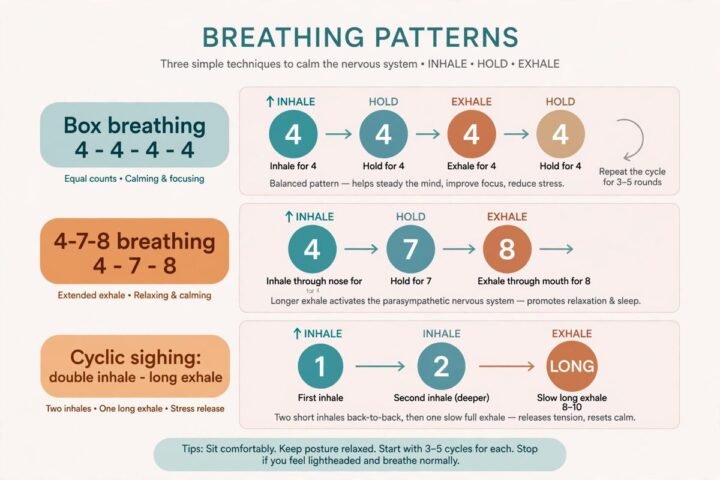
Box breathing for anxiety is the pattern most people meet first, partly because it is easy to remember and partly because of its association with military stress training. The “box” is four equal sides:
- Breathe in through your nose for a count of 4.
- Hold gently for a count of 4.
- Breathe out slowly for a count of 4.
- Hold gently, lungs empty, for a count of 4.
- Repeat for 3–5 rounds, or for about 5 minutes.
Keep the breaths ordinary-sized. The point is the rhythm, not filling your lungs as far as they will go, and the holds should feel like a pause, not a strain. Many people find the counting itself useful: it gives a racing mind one concrete job. Using box breathing for anxiety before a meeting, a flight, or a difficult conversation is the classic use case — a short, structured pause rather than a long practice session.
The honest evidence note: box breathing was tested head-to-head in the 2023 Stanford trial described below, and it did improve mood within its own group — but cyclic sighing, not box breathing, was the pattern that beat mindfulness meditation. Box breathing for anxiety is a reasonable choice; it is just not the best-supported one.
How do you do 4-7-8 breathing?
The 4-7-8 pattern swaps the box’s symmetry for a long hold and an even longer exhale. It was popularized by integrative medicine specialist Andrew Weil, MD, and has roots in pranayama, the yogic practice of focusing on the breath. Cleveland Clinic describes the steps like this:
- Rest the tip of your tongue against the back of your top front teeth, and keep it there.
- Breathe out fully through your mouth with a soft whooshing sound.
- Breathe in quietly through your nose for a count of 4.
- Hold your breath, without straining, for a count of 7.
- Breathe out through your mouth, with the same whoosh, for a count of 8.
- Repeat for three more cycles — four cycles in total to start.
The counts are a ratio, not a stopwatch test. If the seven-count hold feels too long, count a little faster and keep the 4-7-8 proportions; beginners commonly feel a little lightheaded at first, which is a sign to slow down or stop, not to push through. Because the exhale is long and the practice is quiet and repetitive, many people use 4-7-8 in bed as a wind-down. If a racing mind at night is a pattern for you, our guide to weighted blankets for sleep and anxiety covers another popular wind-down tool — and what its trials found.
What is cyclic sighing?
Cyclic sighing is built around the physiological sigh — something your body already does spontaneously every few minutes. The deliberate version is simple:
- Breathe in through your nose, filling your lungs most of the way.
- Take a second, short inhale on top of the first, topping the lungs right up.
- Let the breath out slowly through your mouth in one long exhale, longer than both inhales together.
- Repeat for about 5 minutes.
There are no holds, which makes cyclic sighing the easiest of the three for people who find breath-holding uncomfortable or who notice that focusing on a held breath makes them more anxious, not less. The long exhale does the work: of the three patterns, this one spends the largest share of each cycle on the calming, heart-rate-slowing side of the breath.
What does the evidence actually show?
The strongest single study is the 2023 randomized controlled trial by Balban and colleagues at Stanford, published in Cell Reports Medicine. Adults practiced one of three 5-minute daily breathwork exercises — cyclic sighing, box breathing, or cyclic hyperventilation with retention — or spent the same 5 minutes on mindfulness meditation, for one month. Breathwork as a group produced greater improvement in mood and a greater reduction in respiratory rate than meditation, and the exhale-focused cyclic sighing group did best of all (p < 0.05 for both comparisons). Every group, including meditation, reported less state anxiety after practice.
The wider literature points the same way, with smaller print. A 2023 meta-analysis by Fincham and colleagues in Scientific Reports pooled randomized trials of breathwork: 12 trials with 785 adults for stress, plus 20 trials for anxiety and 18 for depression. Breathwork was associated with lower stress than control conditions, with a small-to-medium effect (g = −0.35), and similar effects for anxiety (g = −0.32) and depression (g = −0.40). The authors urged caution: most studies carried a moderate risk of bias, and they warned against hype outrunning the evidence.
A 2023 systematic review by Bentley and colleagues, covering 58 studies and 72 breathing interventions, found 54 of the interventions effective — and a pattern in what worked. Effective practices avoided fast-only breathing and sessions shorter than 5 minutes, and they included guided training, multiple sessions, and longer-term practice. In other words, five quiet minutes, repeated daily, beats a single heroic session.
For 4-7-8 specifically, the direct evidence is one small laboratory study. In 2022, Vierra and colleagues had 43 healthy adults aged 19 to 25 perform three sets of 4-7-8 breathing — six cycles per set, with a minute of normal breathing between sets. Heart rate and systolic blood pressure fell significantly right afterward in both a rested group and a sleep-deprived group. That is a genuine short-term calming signal, in a small, young, healthy sample, measured once. It does not tell us how 4-7-8 performs for anxiety over weeks — that trial has not been done.
Which pattern should you choose?
| Pattern | How it goes | Breath holds? | Best direct evidence | Often suits |
|---|---|---|---|---|
| Box breathing | In 4, hold 4, out 4, hold 4 | Yes, two per cycle | Improved mood within its group in the 2023 Stanford trial; not the standout | Focus and steadiness before a demanding moment |
| 4-7-8 breathing | In 4, hold 7, out 8 | Yes, one long hold | Small 2022 lab study: heart rate and systolic blood pressure fell right after practice | Evening wind-down, if holds feel comfortable |
| Cyclic sighing | Double inhale, then one long exhale | No | Best mood improvement in the 2023 Stanford trial, beating mindfulness meditation | Everyday stress, and anyone who dislikes breath holds |
A practical way to decide: if you want the pattern with the best trial behind it, start with cyclic sighing for 5 minutes a day. If you want structure and counting to occupy a busy mind, box breathing for anxiety is built for that. If you want a bedtime ritual and the long hold feels easy, 4-7-8 is a reasonable choice — just hold its evidence lightly. Whichever you pick, consistency matters more than the pattern: the trials that worked used short daily practice over weeks.
How do you practice safely?
These patterns are low-risk for most healthy adults, but “low-risk” is not “no rules”:
- Sit or lie down, somewhere safe. Never practice while driving, swimming, or in the bath — lightheadedness and a road or water do not mix.
- Stop if you feel dizzy, lightheaded, tingly, short of breath, or more panicked. Let your breathing return to normal. Those sensations are common when people breathe bigger or hold longer than they are used to, and they are a stop signal, not a stage to pass.
- Skip the holds if they bother you. If holding your breath raises your anxiety — a common experience for people with panic sensitivity — use cyclic sighing, or simply breathe out slowly for longer than you breathe in, with no counting at all.
- Ask a clinician first if you have a lung or heart condition, faint easily, or are pregnant and new to breath-holding practice. Longer holds are the part most likely to need modifying.
- Keep it gentle. Ordinary-sized breaths, no straining, no forcing the last of the air out. If you are white-knuckling your way through a breathing exercise, it has stopped being one.
One more connection worth knowing: stress breathing and jaw clenching travel together. If you wake with a sore jaw after anxious days, our article on why you clench your jaw at night explains the stress, medication, and sleep apnea causes.
When is breathwork not enough?
Breathwork is a regulation tool — it can lower arousal in the moment and, practiced daily, modestly reduce stress and anxiety symptoms. It is not a treatment for an anxiety disorder, panic disorder, or depression, and the meta-analysis effect sizes (small-to-medium) say exactly that: helpful, not sufficient on their own for most people with a clinical condition.
Talk with a clinician or mental health professional if anxiety is persistent, is interfering with work, sleep, or relationships, or comes with panic attacks, avoidance, or low mood that does not lift. Evidence-based care for anxiety disorders — therapies such as cognitive behavioral therapy, and medication where appropriate — has much larger effects than any breathing pattern. Note too that some medications can themselves cause jaw clenching and tension; if that started after a prescription change, our guide to jaw clenching on Zoloft or Lexapro explains what to ask your prescriber. Breathwork fits best as one layer alongside care, not instead of it.
Frequently asked questions
Does box breathing work for anxiety?
It can help in the moment, and it improved mood within its own group in the 2023 Stanford trial — but in that same trial, cyclic sighing improved mood more, and beat mindfulness meditation. Across all breathwork trials, effects on anxiety are small-to-medium. So box breathing for anxiety is a reasonable, simple tool; just expect a modest calming effect, not a switch that turns anxiety off.
How long should a breathwork session be?
About 5 minutes is the best-supported starting point. The Stanford trial used 5 minutes daily for a month, and the 2023 systematic review of 58 studies found that sessions shorter than 5 minutes were among the features of practices that did not work. Longer is not automatically better — daily repetition mattered more than session length in the research.
Is 4-7-8 breathing good for sleep?
It is widely used as a wind-down, and its long exhale is calming, but direct evidence for sleep itself is thin. The main 4-7-8 study measured heart rate and blood pressure right after practice in young adults — not how fast anyone fell asleep. Treat it as a relaxing bedtime ritual that may help you settle, not a proven insomnia treatment.
What if focusing on my breath makes me more anxious?
That is common, especially with breath holds and with panic sensitivity — attention to breathing can feel like attention to the symptom. Stop the pattern and breathe normally. You can try a hold-free version (a slow, longer exhale), an external focus such as counting sounds in the room, or skip breathwork entirely; it is one tool among many, and it is not the right one for everyone.
Conclusion
Box breathing, 4-7-8, and cyclic sighing all slow the breath and lean on the same calming mechanism — a longer, slower exhale. The evidence, read honestly, ranks them: cyclic sighing has the best single trial behind it, box breathing for anxiety is simple and focusing with a smaller demonstrated effect, and 4-7-8 has the thinnest direct evidence but a loyal following as a wind-down. Pick the one you will actually do for 5 minutes a day, practice it gently and safely, and treat persistent anxiety as something that deserves real care, not just a breathing pattern.
Medical disclaimer: This article is educational information only and is not medical advice. Breathing exercises are not a substitute for diagnosis or treatment of anxiety, panic, lung, or heart conditions. If you have persistent anxiety, breathing difficulty, chest pain, or fainting, seek care from a qualified clinician promptly.
Sources
- Balban MY et al. Brief structured respiration practices enhance mood and reduce physiological arousal. Cell Reports Medicine, 2023. PubMed abstract
- Fincham GW et al. Effect of breathwork on stress and mental health: a meta-analysis of randomised-controlled trials. Scientific Reports, 2023. PubMed abstract
- Zaccaro A et al. How breath-control can change your life: a systematic review on psycho-physiological correlates of slow breathing. Frontiers in Human Neuroscience, 2018. (PMC6137615)
- Bentley TGK et al. Breathing practices for stress and anxiety reduction: a systematic review. Brain Sciences, 2023. PubMed abstract
- Vierra J et al. Effects of sleep deprivation and 4-7-8 breathing control on heart rate variability, blood pressure, blood glucose, and endothelial function in healthy young adults. Physiological Reports, 2022. PubMed abstract
- Cleveland Clinic. 4-7-8 Breathing Method for Sleep and Relaxation. — health.clevelandclinic.org




0 Comments