
Educational information · Not medical advice
In brief
How much water should I drink a day? The 8-glasses rule has no study behind it — what the intake research, thirst, and electrolytes say for most adults.
In this article
- Where did the 8-glasses rule come from?
- How much water should I drink a day, according to the reference intakes?
- Does food count toward your daily water?
- Can you just drink to thirst?
- Who genuinely needs a drinking plan?
- Do you need electrolytes or a sports drink?
- What are the signs you need more water — and can you drink too much?
- Frequently asked questions
- Conclusion
- Sources
Key Takeaways
- The 8-glasses rule has no study behind it: a 2002 review in the American Journal of Physiology searched for its source and found none.
- The National Academies' reference values are totals — 3.7 liters a day for men, 2.7 for women, from food and all drinks combined.
- For most healthy adults, the National Academies panel concluded thirst is an adequate guide — there is no single studied answer to how much water should i drink a day.
- Some people need a deliberate target instead: kidney stone formers, endurance exercisers, people who are ill, and those pregnant or breastfeeding.
Type “how much water should i drink a day” into a search box and you will get a confident answer — usually eight glasses. The number is memorable and tidy, but no study ever established it — and the reference values researchers set look quite different once food and drinks count.
This article walks through what the intake research says about how much water should i drink a day: the rule's origin, the reference intakes, food water, thirst, and when a deliberate plan beats drinking by feel.
Where did the 8-glasses rule come from?
The rule is usually stated as “8 × 8”: eight 8-ounce glasses, about 1.9 liters (64 ounces) of plain water a day, on top of everything else you eat and drink — still the default answer given to how much water should i drink a day. In 2002, Heinz Valtin, a kidney physiologist at Dartmouth Medical School, published an invited review in the American Journal of Physiology after searching for the rule's source. He found no scientific studies in support of 8 × 8.
The most plausible origin was a 1945 Food and Nutrition Board recommendation of roughly 1 milliliter of water per calorie of food — about 2 to 2.5 quarts a day. It referred to total water and noted most of it comes from prepared food; read without that sentence, it hardened into a drink-this-much rule.
Valtin also flagged two things the rule gets wrong: caffeinated drinks count toward the daily total, and the body's osmoregulatory system — the physiology behind thirst and urine concentration — regulates water balance tightly. His conclusion was deliberately limited to healthy, largely sedentary adults in temperate climates.
How much water should I drink a day, according to the reference intakes?
So how much water should i drink a day if you go by the reference values? In 2004, the Institute of Medicine (now the National Academy of Medicine) set an Adequate Intake (AI) for total water — all beverages and food combined — of 3.7 liters a day for men and 2.7 liters a day for women.
Two features of those numbers are widely misunderstood. First, they are totals: in the survey data behind them, beverages supplied about 81 percent of total water (13 cups for men, 9 cups for women) and food about 19 percent. Second, an AI is not a minimum: it was set from the median intake of adequately hydrated people, and the panel concluded their needs are met by letting thirst be their guide. Actual U.S. intakes (NHANES, 2009–2012) land close: 3.46 liters a day for men, 2.75 for women — the same reference-range pattern as how much protein you actually need.
| Group | Total water per day | Of which beverages (approx.) |
|---|---|---|
| Men, 19 and older | 3.7 L (about 15.5 cups) | 3.0 L (about 13 cups) |
| Women, 19 and older | 2.7 L (about 11.5 cups) | 2.2 L (about 9 cups) |
| Pregnancy | 3.0 L | — |
| Breastfeeding | 3.8 L | — |
Does food count toward your daily water?
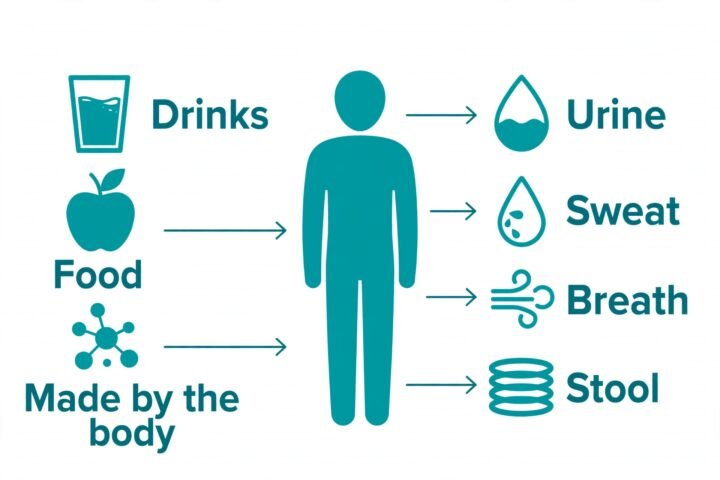
Yes — and it is not a rounding error: about a fifth of daily water in the National Academies' data, the same ballpark (about 20 percent) Mayo Clinic gives. Many fruits and vegetables are mostly water by weight — Mayo Clinic lists cantaloupe, strawberries, watermelon, cabbage, and squash as almost entirely water — and soups, yogurt, and cooked grains contribute.
Drinks other than water count as well. Coffee and tea contribute — Valtin's review covered the studies showing caffeinated drinks can be counted — and milk and juice are mostly water. The caveat is what rides along: sugar-sweetened drinks add sugar and calories without nutrients, a separate issue we cover in does sugar cause inflammation.
Can you just drink to thirst?
For most healthy adults in a temperate climate, thirst is a well-engineered signal: Valtin's review emphasized the precision of the osmoregulatory system; the National Academies panel agreed. Endurance sports arrived at the same advice from the opposite direction — the 2015 international consensus statement on exercise-associated hyponatremia (EAH) recommends drinking to thirst before, during, and after exercise, limiting both dehydration and overdrinking.
Thirst has limits. The signal can be blunted in older adults, who may do better with a deliberate routine. Losses can also outrun thirst during hard exercise in the heat, with fever, vomiting, or diarrhea, and at high altitude. And one group should not rely on thirst at all: people who form kidney stones.
Who genuinely needs a drinking plan?
Kidney stone formers. The American Urological Association's kidney stone guideline tells clinicians to counsel every stone former to drink enough to produce at least 2.5 liters of urine a day. Since urine is only part of the output, drinking must exceed 2.5 liters, spread across the day.
At least 2.5 liters of urine a day — the American Urological Association's fluid target for people who form kidney stones. One of the few daily fluid goals backed by a clinical guideline — and thirst alone rarely reaches it.
People who are ill, pregnant, or breastfeeding. Fever, vomiting, and diarrhea all drain fluid; Mayo Clinic notes that oral rehydration solutions — water with measured salts and sugar — may be recommended then, because they replace minerals too. Pregnancy and breastfeeding raise the reference values themselves, to 3.0 and 3.8 liters of total water a day. A plan can also mean a ceiling: a clinician-set fluid limit (for example in heart failure or kidney disease) overrides general guidance.
Do you need electrolytes or a sports drink?
Electrolytes are minerals — mainly sodium and potassium here — lost in sweat and normally replaced through food. For everyday activity and exercise under an hour, plain water plus normal meals cover those losses. No major guideline recommends routine electrolyte supplements for healthy, sedentary adults; most daily-use powders just add sugar or sodium you never lost.
The picture changes with long, hard sweating. Mayo Clinic advises that during intense exercise lasting more than an hour, a drink containing sodium helps replace salt lost in sweat and reduces the chance of hyponatremia, a dangerous drop in blood sodium. The same logic applies to vomiting and diarrhea, where an oral rehydration solution replaces fluid and minerals together.
What are the signs you need more water — and can you drink too much?
How do you know whether your answer to how much water should i drink a day is working? Mayo Clinic offers two checks: you are probably drinking enough if you rarely feel thirsty and your urine is colorless or light yellow. Signs you may need more include dark urine, a dry mouth, and headache — a dehydration headache has a recognizable pattern, and fluid losses can interact with blood pressure, as we explain in can dehydration cause high blood pressure. Confusion and dizziness suggest serious dehydration — get prompt care.
More is not always better. Drinking far beyond thirst, faster than the kidneys can excrete the excess, dilutes blood sodium — hyponatremia. The 2015 EAH consensus statement identifies sustained intake beyond thirst as the major risk factor (severe cases can be fatal); Mayo Clinic likewise warns the kidneys cannot clear a large excess. Rare in healthy adults drinking to thirst — but it is why “as much as possible” is bad advice.
Frequently asked questions
Is the 8-glasses rule actually wrong?
It is unsupported rather than dangerous for most people. Valtin's 2002 review found no studies behind it, and the National Academies never set a glasses quota — their values are totals including food. Eight glasses will not harm a healthy adult, but falling short does not mean dehydration.
Does coffee or tea count toward my daily water?
Yes. Valtin's review concluded that caffeinated drinks — coffee, tea, and soft drinks — may be counted toward the daily total, and Mayo Clinic agrees. In normal amounts, the water in the cup more than offsets caffeine's mild diuretic effect.
Should I drink half my body weight in ounces of water?
That formula — half your weight in pounds, drunk as ounces — is another tidy rule with no study behind it, in the same family as 8 × 8. Needs do rise with body size, but also swing with activity, climate, and health. Reference intakes, thirst, and pale-yellow urine beat arithmetic.
How much water should I drink when I exercise?
For most workouts, drink to thirst before, during, and after. Longer or hotter sessions call for deliberately more, because sweat losses climb; past about an hour of intense exercise, Mayo Clinic suggests a drink containing sodium. Forcing down large volumes on a schedule is the pattern linked to hyponatremia.
Conclusion
There is no single studied number for how much water should i drink a day. The 8-glasses rule has no trial behind it, and the National Academies' values — 3.7 liters of total water a day for men, 2.7 for women, food and drinks included — describe what adequately hydrated people consume, not a quota. For most healthy adults, thirst plus pale-yellow urine is guide enough.
The exceptions are real: stone formers, endurance exercisers, people who are ill, pregnant or breastfeeding, and many older adults do better with a deliberate target, while a few people need a clinician-set ceiling instead. If you are unsure which group you are in, ask your clinician rather than a search box.
Medical disclaimer: Educational information only — not medical advice, diagnosis or treatment. Talk with your clinician about your own fluid needs, especially with kidney, heart, or liver disease, diuretic use, or a prescribed fluid restriction.
Sources
- Institute of Medicine. Dietary Reference Intakes for Water, Potassium, Sodium, Chloride, and Sulfate. National Academies Press, 2004 — total-water Adequate Intakes (3.7 L/day men, 2.7 women; 3.0 pregnancy, 3.8 lactation); beverages ~81 percent, food ~19 percent; thirst guidance.
- Valtin H. “Drink at least eight glasses of water a day.” Really? Is there scientific evidence for “8 × 8”? American Journal of Physiology — Regulatory, Integrative and Comparative Physiology. 2002;283(5):R993–R1004. PubMed — no studies supporting 8 × 8; caffeinated drinks count; scope limited to healthy, sedentary adults in temperate climates.
- Mayo Clinic. Water: How much should you drink every day? — food about 20 percent of daily water; factors that raise needs; signs of enough vs. too little; hyponatremia warning.
- CDC / National Center for Health Statistics. NCHS Data Brief No. 242 (2016): Daily Water Intake Among U.S. Men and Women, 2009–2012 — NHANES averages: 3.46 L/day (men), 2.75 L/day (women).
- Pearle MS, et al. Medical management of kidney stones: AUA guideline. Journal of Urology. 2014;192:316–324 — fluid intake for urine volume of at least 2.5 L daily in stone formers (summarized in Hydration for Adult Patients with Nephrolithiasis, PMC).
- Hew-Butler T, et al. Statement of the Third International Exercise-Associated Hyponatremia Consensus Development Conference. Clinical Journal of Sport Medicine. 2015 — drinking beyond thirst is the major EAH risk factor; drink to thirst.



0 Comments