
Educational information · Not medical advice
In brief
Wondering how much protein do i need each day? See evidence targets by age, activity and goal, per-meal amounts, and the kidney caution to know first.
In this article
Key Takeaways
- If you are asking how much protein do i need, start with the Recommended Dietary Allowance (RDA) of 0.8 grams per kilogram of body weight per day — that is a minimum to prevent deficiency, not an optimum for most active or older adults.
- Adults over 65 generally do better at 1.0–1.2 g/kg per day, and 1.2–1.5 g/kg during illness or recovery, because aging muscle responds less strongly to protein.
- For building muscle with resistance training, gains in the research plateau at about 1.6 g/kg per day — more than that adds little for most people.
- Spreading protein across meals matters: about 0.4 g/kg per meal is a practical target used in the per-meal research.
- People with chronic kidney disease who are not on dialysis should set their target with their care team — guidelines aim at about 0.8 g/kg and advise avoiding intakes above about 1.3 g/kg in that group.
If you have ever stood in a grocery aisle wondering how much protein do i need, you are not alone. Protein targets are usually given in grams per kilogram of body weight per day, written as g/kg/day. To use them, divide your weight in pounds by 2.2 to get kilograms, then multiply by the target that fits your age, activity, and goal. A 70 kg (about 154 lb) adult at the RDA minimum needs about 56 grams a day; at 1.2 g/kg, that same person needs about 84 grams.
This article gives you the evidence targets in one place, explains why the official minimum and the practical target are different numbers, and shows how to spread protein across the day. It also covers the one situation where more is not better — kidney disease — so you can set a sensible target and discuss it with your clinician if you have a medical condition.
How much protein do I need each day?
The short answer to how much protein do i need depends on what the protein is for. The RDA of 0.8 g/kg/day is the amount that keeps nearly all healthy adults out of deficiency. It was not designed as the best amount for preserving muscle as you age, training hard, or losing weight without losing muscle. That is why expert groups publish higher, situation-specific targets alongside it.
The table below summarises the targets cited in this article. Use the row that matches your situation, not the highest number you can find.
| Situation | Daily target | For a 70 kg adult |
|---|---|---|
| Minimum for healthy adults (RDA) | 0.8 g/kg | About 56 g |
| Healthy adults over 65 | 1.0–1.2 g/kg | About 70–84 g |
| Older adults with acute or chronic illness | 1.2–1.5 g/kg | About 84–105 g |
| Building muscle with resistance training | 1.4–2.0 g/kg, plateau about 1.6 g/kg | About 98–112 g at the plateau range |
| Chronic kidney disease, stages 3–5, not on dialysis | About 0.8 g/kg, set with your care team | About 56 g |
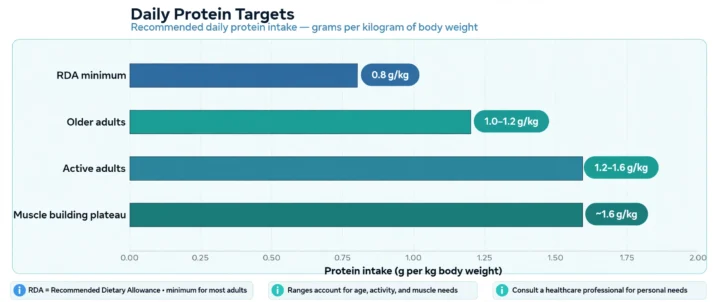
Daily protein targets in grams per kilogram of body weight, from the RDA minimum to the muscle-building plateau.
Is the official minimum enough?
For preventing deficiency in a healthy, younger adult, yes. For most other goals, the RDA is better treated as a floor. Reviews of protein and aging note that intakes below the RDA worsen age-related loss of muscle size, quality, and function in older adults, while intakes at or moderately above the RDA — especially when at least one meal contains enough protein to strongly stimulate muscle building — better support muscle and function.
That distinction matters for jaw and general health readers alike: muscle is not only about sport. It supports chewing strength, balance, recovery from illness, and independence with age. If you are also thinking about overall eating patterns, our guide to anti-inflammatory eating and jaw pain covers how to build meals that are both nourishing and jaw-friendly.
About 1.6 g/kg — the point where muscle-building gains plateau in the research summarised for this article. Above that, extra protein adds little for most people training to build muscle.
How does the target change by age, activity, and goal?
Older adults: more protein, not less
Aging muscle responds less strongly to protein, a pattern researchers call anabolic resistance. The PROT-AGE Study Group recommends at least 1.0–1.2 g/kg/day for adults over 65, at least 1.2 g/kg for those who exercise, and 1.2–1.5 g/kg for most older adults with acute or chronic illness. The exception noted by that group is severe kidney disease without dialysis, where protein may need to be limited — see the kidney section below.

A protein-rich breakfast — eggs and yogurt with fruit — is one practical way for older adults to start the day closer to their target.
Active adults and muscle building
Sports-nutrition guidance summarised in recent reviews puts muscle-building intake at about 1.4–2.0 g/kg/day, with gains plateauing around 1.6 g/kg/day. In practical terms, an active adult usually does well in the 1.2–1.6 g/kg range, and heavy resistance training pushes toward the top of it. Chasing far higher intakes rarely adds benefit and can crowd out fibre, fruit, vegetables, and other foods you also need.
Weight loss
When calories drop, some of the weight lost is muscle. Reviews summarised for this article suggest moderately higher protein — about 1.2–1.6 g/kg/day — helps preserve lean muscle during weight loss. If you are using a GLP-1 medicine, protein and resistance training deserve particular attention; our article on GLP-1 medicines and jaw clenching covers a related question readers ask.
How much protein should each meal contain?
Your daily total matters most, but distribution helps, especially after 65. A review of per-meal research concluded that aiming for about 0.4 g/kg per meal across meals reaches at least 1.6 g/kg/day, and pooled data in older men found about 0.40 g/kg in a single meal was needed to maximise muscle protein synthesis. For a 70 kg adult, 0.4 g/kg is about 28 grams per meal — roughly a palm-sized portion of chicken or fish, a cup of Greek yogurt with eggs at breakfast, or a bean-and-grain bowl with tofu at lunch.
Meal prep — portioning chicken, beans, and vegetables ahead of time — makes the per-meal target easier to hit on busy days.
If supplements are part of your routine, read labels carefully and favour food first. Our earlier explainer on protein powder and lead — what you need to know covers product-safety questions that total-protein guides usually skip.
Can too much protein harm my kidneys?
For healthy adults, the reviews summarised here report that moderately higher protein intake does not appear to negatively affect kidney function. Kidney disease is different. The American Diabetes Association Standards of Care advise that people with non-dialysis-dependent stage 3 or higher chronic kidney disease aim for about 0.8 g/kg/day, and that higher intakes — above about 1.3 g/kg/day in that group — have been associated with increased albuminuria and more rapid loss of kidney function and should be avoided. People on dialysis are advised to consider higher intakes, about 1.0–1.2 g/kg/day, because protein-energy wasting is a major risk in dialysis care.
The practical rule is simple: if you have kidney disease, diabetes with kidney involvement, or you have been told to limit protein, do not adopt a high-protein target from the internet. Ask your care team what target fits your stage and treatment.
How can I hit my target without overhauling my diet?
Start by estimating what you eat now for two or three ordinary days, then close the gap with one change at a time. Add a protein food to the meal where you currently get the least — for many people that is breakfast. Keep a protein anchor in each meal: eggs, yogurt, milk or a fortified alternative, fish, poultry, beans, lentils, tofu, or nuts and seeds. Spread it out rather than saving it all for dinner, and pair the change with resistance exercise if your clinician agrees, because training is what tells muscle to use the protein you eat.
If chewing is painful, choose softer protein foods during a flare — yogurt, eggs, fish, lentils, and smooth nut butters — and seek dental or orofacial pain care if jaw pain persists. Protein advice never replaces care for an ongoing symptom.
Frequently asked questions
How much protein do i need if I weigh 150 pounds?
Divide 150 by 2.2 to get about 68 kg. At the RDA minimum of 0.8 g/kg you need about 54 grams a day. At 1.2 g/kg — a common practical target for active or older adults — you need about 82 grams. Use the row in the table that matches your age, activity, and health, and confirm medical situations with your clinician.
Is 100 grams of protein a day too much?
For many adults, no. Whether 100 grams is appropriate depends on your body weight and situation: it is about 1.4 g/kg for a 70 kg adult, inside the active range, but it would be above the roughly 0.8 g/kg target advised for stage 3 or higher chronic kidney disease without dialysis. Weight and kidney status decide, not the round number alone.
Can I build muscle on plant protein?
Yes, provided your total intake meets your target and your meals contain enough essential amino acids across the day. Combining foods such as beans with grains, and including soy foods, yogurt or eggs if you eat them, helps cover the amino-acid pattern. The targets in g/kg are the same; plant-based eaters may need to plan portions more deliberately to reach them.
When should I talk to a clinician about protein?
Talk to a clinician or dietitian if you have kidney disease, are on dialysis, are recovering from illness or surgery, are losing weight unintentionally, or are over 65 and losing strength. Those situations change the target — illness in older adults can raise it to 1.2–1.5 g/kg, while kidney disease without dialysis usually aims at about 0.8 g/kg with professional guidance.
Conclusion
So, how much protein do i need? Treat 0.8 g/kg/day as the floor, aim for 1.0–1.2 g/kg after 65, use 1.2–1.6 g/kg if you are active, training, or losing weight, and remember that muscle-building gains plateau at about 1.6 g/kg. Spread protein across meals at roughly 0.4 g/kg per meal, and set your target with your care team if you have kidney disease. A target you can hit with ordinary food, most days, beats a perfect number you abandon in a week.
Sources
- Nutritional Interventions: Dietary Protein Needs and Influences on Skeletal Muscle of Older Adults, Journals of Gerontology review (PMC) — RDA 0.8 g/kg, older-adult muscle evidence. pmc.ncbi.nlm.nih.gov/articles/PMC10272976
- Protein and Aging: Practicalities and Practice, Nutrients 2025 review (PMC) — 1.0–1.2 g/kg for healthy older adults, 1.2–1.5 g/kg with illness, about 25–30 g (0.4 g/kg) per meal. pmc.ncbi.nlm.nih.gov/articles/PMC12348035
- Chronic Kidney Disease and Risk Management: Standards of Care in Diabetes — 2026, American Diabetes Association (PMC) — about 0.8 g/kg for stage G3 or higher CKD, 1.0–1.2 g/kg on dialysis, avoid above about 1.3 g/kg in non-dialysis CKD. pmc.ncbi.nlm.nih.gov/articles/PMC12690176
Medical disclaimer: This article is educational information only and is not medical advice. Protein needs vary with age, activity, illness, and kidney function. Discuss your personal target with your clinician or a registered dietitian, especially if you have kidney disease, diabetes, or another medical condition.



0 Comments