
Educational information · Not medical advice
In brief
TMJ eye pain, pressure behind the eye, and eye twitching: what the evidence actually shows, the red flags that need an eye exam first, and what helps.
In this article
- Can TMJ cause eye pain? The short answer
- Why are the jaw and the eye area linked?
- What does the evidence actually show?
- What about pressure behind the eye?
- Can TMJ cause eye twitching?
- What else causes pain or pressure around the eye?
- What helps if your jaw is part of the picture?
- When does eye pain need help right away?
- Frequently asked questions
- Conclusion
- Sources
Key Takeaways
- tmj eye pain is usually referred pain: pain from the jaw joint and chewing muscles that is felt around or behind the eye, not damage inside the eye itself.
- The jaw and the eye area share the trigeminal nerve, which is why jaw pain can be felt in the forehead, temple, and eye socket.
- The research linking jaw disorders to visual problems is very low certainty — a 2025 systematic review found the evidence insufficient to establish that a jaw disorder causes visual impairment.
- Most eyelid twitching is explained by fatigue, stress, caffeine, and dry or irritated eyes, per the American Academy of Ophthalmology and MedlinePlus — a jaw cause is not established.
- Intense eye pain, any change in vision, or a very red, watery eye needs an eye doctor or emergency care first, not jaw treatment, per the National Eye Institute.
An ache behind your eye is a strange symptom to trace back to your jaw — yet tmj eye pain is one of the most common questions people with jaw problems ask. The pain feels like it is in the eye. It can throb when you chew, build through a stressful day of clenching, and sit alongside a sore temple and a stiff jaw. So is the jaw really involved, or is something in the eye itself wrong?
This article gives the honest version of the answer. Yes, jaw pain can be felt around the eye, and there is a clear anatomical reason for it. But the evidence that a jaw disorder causes problems inside the eye is weak, eye twitching is usually explained by simpler triggers, and some eye symptoms should never be attributed to the jaw without an eye examination first. If your symptoms also include blurred sight, read our guide to TMJ and blurry vision alongside this one.
Can TMJ cause eye pain? The short answer
The short answer on tmj eye pain is: a temporomandibular disorder (TMD) can produce pain that is felt in and around the eye, but that is different from the jaw damaging the eye. TMJ refers to the temporomandibular joint itself; TMD refers to the disorders. The National Institute of Dental and Craniofacial Research (NIDCR) describes TMDs as a group of more than 30 conditions that cause pain and dysfunction in the jaw joint and the muscles that control jaw movement, and it lists pain that spreads to the face or neck among their symptoms.
When people describe tmj eye pain, they are usually describing that spread: a dull, aching pain or pressure around the eye socket or behind the eye, on the same side as a sore jaw, that rises and falls with jaw use. The eye itself, examined on its own, is typically normal. That distinction matters, because pain felt at the eye and disease of the eye need different responses — and because a normal eye examination is valuable information, not a wasted visit.
Why are the jaw and the eye area linked?
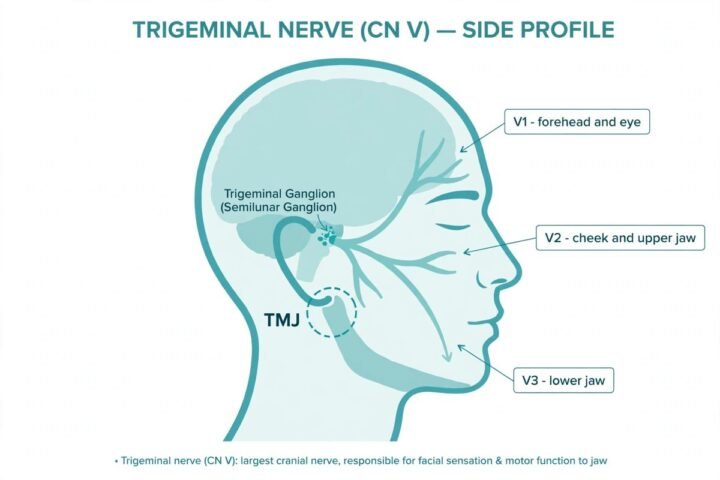
The link is wiring. Sensation from the face, teeth, and jaw travels through the trigeminal nerve, the main sensory nerve of the face, which has three branches: one serving the forehead and eye area, one the cheek and upper jaw, and one the lower jaw and the jaw joint. Signals from those branches converge in the brainstem, and the brain does not always localise a signal precisely. Clinicians call pain felt somewhere other than its source referred pain.
Muscles add a second route. The temporalis muscle fans across the side of the head, above and in front of the ear and toward the temple and brow. When chewing muscles are overworked — from clenching, grinding, or a jaw joint problem — their ache is commonly felt in the temple and around the eye socket, even though the muscle, not the eye, is the source. This is the same overlap that makes jaw, tooth, sinus, and ear pain so easy to confuse, as our symptom checker for TMJ, tooth, sinus, or ear pain shows.
What does the evidence actually show?
Here the honest answer is: less than many websites claim. A systematic review published in the Journal of Orthodontic Science in 2025 searched the literature from 1946 to March 2025 for studies of dental occlusion, TMD, and visual function. Only ten studies met its criteria. It found reported associations — including vergence (eye-teaming) disorders and abnormal pupillary responses in people with TMD — but rated the overall body of evidence very low certainty: every study carried a high risk of bias, sample sizes were small at 20 to 150 people, most were cross-sectional, and most came from a single research group. Its conclusion was that the evidence is insufficient to establish causality or clinical significance.
That does not make your symptom imaginary. Referred pain from the jaw and chewing muscles to the face is a recognised TMD pattern in NIDCR’s own symptom list, and an ache around the eye fits it. What the evidence does not support is the stronger claim — that a jaw disorder impairs the eye itself, or that fixing the jaw restores vision. Treat any source that promises that with caution, and treat a splint, exercise programme, or surgery sold as a vision treatment as a red flag in itself. Our comparison of TMJ vs trigeminal neuralgia covers the related question of when facial pain is a nerve problem rather than a jaw problem.
What about pressure behind the eye?
Pressure is the most common form tmj eye pain takes: a heavy, full feeling behind or around one eye, often with temple ache and jaw soreness on the same side. When it tracks jaw use — worse after chewing, clenching, or a long day, better after rest, heat, and softer food — a jaw or muscle source is plausible. Temple and chewing-muscle tension is a believable generator of that heavy feeling, in the same way tension elsewhere in the head produces pressure-like pain.
But pressure behind the eye is not specific to the jaw. Sinus congestion, eye strain, migraine, and raised pressure inside the eye can all produce it, and they do not announce which one is responsible. Our overview of causes and relief for pressure behind the eyes walks through those alternatives. The pattern is the clue: pressure that arrives with congestion and worsens bending forward leans sinus; pressure with light sensitivity and nausea leans migraine; pressure that changes when you chew leans jaw. If the pattern does not fit, or the symptom is new and one-sided, get it examined rather than guessing harder.
Can TMJ cause eye twitching?
Eye twitching is where the jaw explanation is weakest. An eyelid twitch (myokymia) is a small, involuntary spasm of the eyelid muscle. MedlinePlus lists the most common triggers plainly: fatigue, stress, caffeine, and excessive alcohol intake, with irritation of the surface of the eye or the membranes lining the eyelids as another cause. The American Academy of Ophthalmology (AAO) gives the same everyday list — sleep deprivation, stress, too much caffeine, and dry or irritated eyes — and notes that most common eyelid twitches are harmless, slight, and do not affect vision.
Stress is the honest overlap: stress drives jaw clenching, and stress also triggers eyelid twitches, so the two often appear together without the jaw causing the twitch. There is no good evidence that treating a jaw disorder stops eyelid twitching. Start with the established triggers instead — sleep, caffeine, alcohol, and dry-eye care. MedlinePlus advises an appointment with your doctor or eye doctor if twitching does not go away within a week, completely closes your eyelid, involves other parts of your face, or comes with redness, swelling, discharge, or a drooping upper eyelid. The AAO adds that less common neurological conditions such as blepharospasm and hemifacial spasm tend to close the eyelids more fully and for longer, and can limit or block vision — another reason a persistent twitch deserves an examination, not a mouthguard.
What else causes pain or pressure around the eye?
Because tmj eye pain is a pattern, not a diagnosis, it helps to see the main alternatives side by side. None of these can be separated by a symptom list alone, but the table shows which clues push in which direction.
| Clue | More likely jaw / muscle | More likely eye, sinus, or headache |
|---|---|---|
| What changes it | Chewing, yawning, clenching, opening wide | Bending forward (sinus), bright light (migraine), reading or screens (eye strain) |
| What travels with it | Jaw clicking, stiffness, sore chewing muscles, morning jaw ache | Congestion, red or watery eye, light sensitivity, nausea, vision change |
| Eye itself | Looks and feels normal; vision unchanged | Redness, discharge, blur, halos, or pain inside the eye |
| First provider | Dentist or clinician familiar with TMD | Eye doctor, or primary care for sinus and headache patterns |
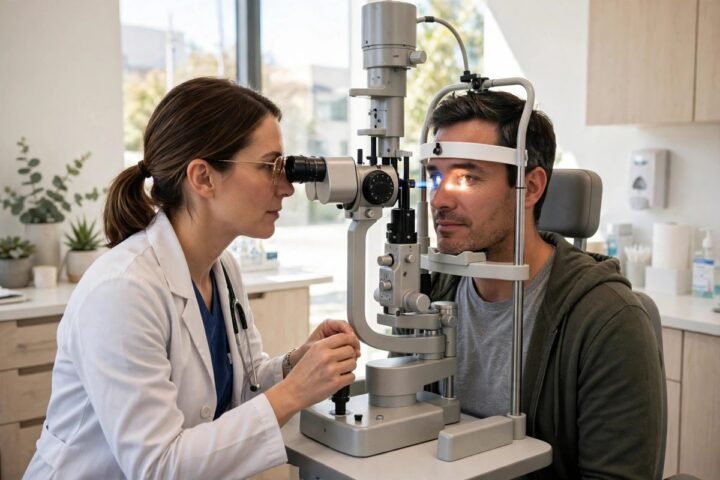
The National Eye Institute (NEI) notes that corneal conditions alone — scratches, infections such as keratitis, allergies, and dry eye — commonly cause eye pain, blurry vision, red or watery eyes, and sensitivity to light. In other words, pain that is truly in the eye has plenty of eye-level causes, and they are common. A jaw explanation should be what remains after those are considered, not the first label applied.
What helps if your jaw is part of the picture?
If an examination supports a jaw contribution, NIDCR’s guidance is deliberately conservative, because many TMDs are temporary and go away without treatment, and evidence for many treatments is limited. Its first steps are simple: eat soft foods, apply heat or cold to the face alongside gentle exercises to stretch and strengthen the jaw muscles, take over-the-counter pain medicines such as NSAIDs as directed, and reduce habits such as jaw clenching, gum chewing, and nail biting. Physical therapy, self-management, and behavioural approaches such as cognitive behavioural therapy and biofeedback may be recommended if simple steps are not enough.
NIDCR is equally clear about what to avoid: treatments that permanently change the jaw joints, teeth, or bite, and surgery, should not be early moves. On intraoral appliances such as night guards and splints, it notes there is not a lot of evidence that they improve TMD pain; if one is suggested, it should not be designed to permanently change your bite, and you should stop and consult your dentist if it causes pain. If your eye-area ache eases as the jaw settles, that is reassuring — but keep the logic straight: jaw treatment helping jaw pain does not prove the eye symptom was caused by the jaw, and it is never a substitute for an eye examination when eye symptoms persist.
When does eye pain need help right away?
Some eye symptoms should bypass the jaw question entirely. The NEI advises going to the eye doctor or the emergency room if you have intense eye pain, a change in vision, blurry vision, very red and watery eyes, an object stuck in your eye, or a serious eye injury such as being hit hard in the eye. Do not drive yourself with impaired vision, and do not spend weeks trialling jaw exercises while a new vision change goes unexamined.
Book promptly, rather than urgently, when eye-area pain keeps recurring without a clear pattern, when an eyelid twitch lasts beyond a week or starts closing the eye, or when a presumed jaw ache keeps escalating despite conservative care. It is also reasonable to need two examinations — one dental, one eye — because these conditions coexist. Tell each clinician what the other found; a normal eye exam genuinely narrows the search, and a normal jaw exam does the same in reverse.
Frequently asked questions
Can TMJ cause pain behind one eye only?
Yes, one-sided pain is typical of the jaw pattern. TMD pain usually affects the side with the sore joint or chewing muscles, and referred pain follows that side into the temple and around the eye. One-sided eye pain still has other causes, including migraine and eye conditions, so a new, severe, or changing one-sided pain — especially with any vision change — should be examined rather than assumed to be tmj eye pain.
Can TMJ cause dry eyes?
There is no good evidence that a jaw disorder causes dry eye. Dry eye is its own common condition — the NEI describes it as the eyes not making enough tears to stay wet, causing discomfort and sometimes vision problems — and the AAO lists dry or irritated eyes as a trigger for eyelid spasms. If your eyes feel dry, gritty, or watery, have that assessed as an eye problem in its own right.
Will a night guard fix my eye pain?
Not reliably, and it should not be sold to you that way. NIDCR notes there is not a lot of evidence that intraoral appliances such as night guards improve TMD pain. A guard may be reasonable for protecting teeth from grinding, but if it causes pain, stop and consult your dentist — and never let a guard substitute for an eye examination when the symptom is in or around your eye.
How long does an eyelid twitch last?
Most common eyelid twitches come and go off and on for a few days and then disappear; MedlinePlus notes that in most cases the twitches stop within a week, often once sleep, stress, caffeine, and alcohol are addressed. Book an appointment if a twitch lasts longer than a week, completely closes your eyelid, spreads to other parts of your face, or comes with redness, swelling, discharge, or a drooping eyelid.
Conclusion
tmj eye pain is real as a pattern and limited as an explanation. The jaw and the eye area share the trigeminal nerve, and overworked chewing muscles refer pain to the temple and eye socket — so a dull ache or pressure around the eye that rises and falls with jaw use can genuinely be jaw pain felt at the eye. But the research linking jaw disorders to problems inside the eye is very low certainty, eyelid twitching is usually explained by fatigue, stress, caffeine, and dry eyes, and no jaw treatment should be presented as a way to restore vision.
The practical order is: eye red flags first, eye examination for anything in the eye itself, and conservative jaw care when the pattern and an examination point to the jaw. If your story does not fit the label you were given, ask for the differential to be revisited — with your eye doctor, your dentist, or an orofacial pain specialist.
Medical disclaimer: This article is educational information only and is not medical advice. It does not diagnose or treat any condition. Discuss your symptoms and any treatment decisions with your own dentist, doctor, or eye specialist, and seek urgent care for the red-flag symptoms described above.
Sources
- National Institute of Dental and Craniofacial Research (NIDCR). TMD (Temporomandibular Disorders) — more than 30 conditions, pain spreading to the face or neck, about 5% of U.S. adults, no standard test, and conservative treatment guidance including the limited evidence for intraoral appliances. Read this run.
- Alshehri FS et al. The relationship between dental occlusion and visual dysfunctions: A literature review. Journal of Orthodontic Science, 2025 — systematic review of ten studies; evidence rated very low certainty and insufficient to establish causality. Read this run.
- National Eye Institute (NEI). Corneal Conditions — eye pain, blurry vision, red or watery eyes and light sensitivity as corneal symptoms, dry eye definition, and the “when to get help right away” list. Read this run.
- American Academy of Ophthalmology (AAO). Eye Twitching Causes and Treatment — sleep deprivation, stress, caffeine, and dry eyes as common culprits; blepharospasm and hemifacial spasm as less common causes that close the eyelids more fully. Read this run.
- MedlinePlus, U.S. National Library of Medicine. Eyelid twitch — fatigue, stress, caffeine, and alcohol as the most common triggers; most twitches stop within a week; when to make an appointment. Read this run.





0 Comments