
Educational information · Not medical advice
In brief
TMJ vs trigeminal neuralgia: electric, seconds-long attacks vs a dull jaw ache. Learn the triggers, tests, and treatments that separate them clearly now.
In this article
- What is the short answer on tmj vs trigeminal neuralgia?
- How does the pain feel in each condition?
- What triggers the pain?
- What other signs point one way or the other?
- What causes each condition?
- How do clinicians tell them apart?
- Why does treatment differ so much?
- When should you seek care promptly?
- Frequently asked questions
- Conclusion
- Sources
Key Takeaways
- In tmj vs trigeminal neuralgia, timing is the biggest clue: trigeminal neuralgia attacks last seconds to two minutes, while TMJ pain is usually a longer, dull ache.
- Light touch — brushing teeth, washing your face, a breeze — can trigger trigeminal neuralgia. TMJ pain is tied to jaw use: chewing, yawning, and clenching.
- Clicking, stiffness, and limited opening point toward a jaw disorder. A normal jaw exam with electric, one-sided attacks points toward a nerve problem.
- Neither condition has a single standard test. Clinicians use your history and exam, and trigeminal neuralgia workups usually include an MRI.
- Getting the label right matters, because the first-line treatments are completely different.
Face and jaw pain can look like one problem from the outside and be two very different problems underneath. That is why the tmj vs trigeminal neuralgia question matters so much: one is a disorder of the jaw joint and the muscles that move it, and the other is a disorder of the nerve that carries feeling from the face. Treating one as if it were the other can waste months.
This article walks through tmj vs trigeminal neuralgia side by side — how the pain feels, what sets it off, what else comes with it, how clinicians tell them apart, and why the treatments diverge. If you are still working out which kind of pain you have, our symptom checker for TMJ, tooth, sinus, or ear pain is a useful companion read.
What is the short answer on tmj vs trigeminal neuralgia?
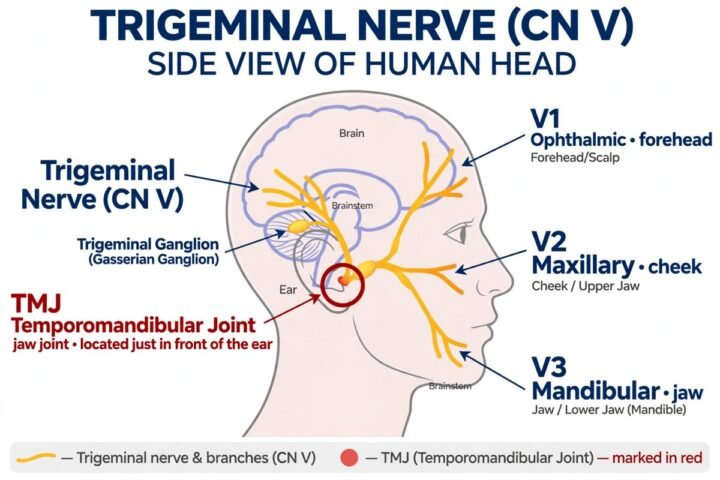
The short answer on tmj vs trigeminal neuralgia is this: TMJ pain — more precisely, a temporomandibular disorder, or TMD — comes from the jaw joint and chewing muscles. The National Institute of Dental and Craniofacial Research (NIDCR) describes TMDs as a group of more than 30 conditions that cause pain and dysfunction in the jaw joint and the muscles that control jaw movement. Trigeminal neuralgia, by contrast, is a neuropathic pain disorder of the trigeminal nerve, the fifth cranial nerve, which provides feeling to parts of the head and face, according to the National Institute of Neurological Disorders and Stroke (NINDS).
In practical terms, tmj vs trigeminal neuralgia is a muscle-and-joint problem versus a nerve problem. That one difference explains almost everything else in this article: the feel of the pain, its triggers, the exam findings, and the treatment.
Seconds to 2 minutes — that is how long a typical trigeminal neuralgia attack lasts, per NINDS. TMJ pain, by contrast, usually lingers as an ache during and after jaw use, rather than arriving and vanishing in seconds.
How does the pain feel in each condition?
Pain quality is the clearest separator in tmj vs trigeminal neuralgia. NINDS describes trigeminal neuralgia pain as sudden and intense, often shock-like or stabbing, typically on one side of the face. Attacks typically last only a few seconds, can last up to two minutes, and may repeat several times a day. Between attacks, some people notice burning, throbbing, numbness, tingling, or a dull ache, and pain rarely occurs during sleep.
TMJ pain feels different. NIDCR lists pain in the chewing muscles and/or jaw joint as the most common TMD symptom, and it is usually described as dull, aching, or tender rather than electric. It tends to build with use — a long meal, a stressful day of clenching — and ease with rest, rather than firing in brief, explosive bursts out of nowhere.
Location overlaps, which is why the two get confused. The trigeminal nerve has three branches covering the forehead, the cheek and upper jaw, and the lower jaw, so trigeminal neuralgia in the lower branch can feel like jaw pain. TMJ pain is centred in front of the ear and in the chewing muscles, and it often spreads to the face or neck, per NIDCR.
What triggers the pain?
Triggers separate tmj vs trigeminal neuralgia almost as sharply as pain quality. For trigeminal neuralgia, NINDS lists everyday, harmless contact: vibration or contact with the cheek such as shaving, washing the face, or applying makeup, plus brushing teeth, blowing the nose, eating, drinking, talking, and exposure to wind. The trigger is light touch, not effort.
For TMJ disorders, the trigger is load. Chewing firm food, opening wide to yawn, clenching during stress, or grinding at night stresses the joint and muscles, and the ache follows that use. If your pain reliably follows jaw work and settles when the jaw rests, that pattern favours TMJ. If a breeze or a toothbrush sets off a shock, that pattern favours a nerve problem. Our guide to a TMJ flare-up and its 48-hour plan covers the jaw-load pattern in more detail.
What other signs point one way or the other?
TMJ disorders usually bring mechanical signs that trigeminal neuralgia does not. NIDCR lists jaw stiffness, limited movement or locking of the jaw, painful clicking, popping, or grating when opening or closing the mouth, and a change in how the upper and lower teeth fit together. It also notes that clicking or popping without pain is common, considered normal, and does not require treatment.
Trigeminal neuralgia usually brings none of those joint signs. The jaw opens normally, the muscles are not the tender centre of the problem, and the story is dominated by the attacks themselves. NINDS notes trigeminal neuralgia occurs most often in people over age 50 and is more common in women than in men. NIDCR notes TMD affects about 5% of adults in the United States and is about twice as common in women, especially women aged 35 to 44 — so age and sex alone cannot separate them, but a new electric facial pain after 50 deserves a nerve workup.
| Feature | TMJ disorder (TMD) | Trigeminal neuralgia |
|---|---|---|
| Pain feel | Dull, aching, tender | Sudden, shock-like or stabbing |
| Attack length | Lingers during and after jaw use | Seconds, up to 2 minutes, repeating |
| Typical trigger | Chewing, yawning, clenching | Light touch, brushing teeth, wind |
| Jaw signs | Clicking, stiffness, locking, limited opening | Usually none; jaw movement is normal |
| Usual workup | History and jaw exam; imaging only if needed | History, neurological exam, and MRI |
What causes each condition?
The causes behind tmj vs trigeminal neuralgia are unrelated. For trigeminal neuralgia, NINDS separates three types. In classical trigeminal neuralgia, the most common type, a blood vessel — usually the superior cerebellar artery — pushes on part of the trigeminal nerve root. Secondary trigeminal neuralgia, about 15% of cases, is caused by another disorder such as multiple sclerosis, a tumour, or an arteriovenous malformation, and people with it are more likely to be younger and to have pain on both sides. Idiopathic trigeminal neuralgia is the least common type, where no clear cause is found even after a workup. Our overview of trigeminal neuralgia causes goes deeper on each type.
For TMDs, NIDCR says injury to the joint can lead to some cases, but in most cases the exact cause is not clear, and symptoms often seem to start for no obvious reason. Research suggests a combination of genes, psychological and life stressors, and how a person perceives pain may play a part. NIDCR also notes research does not support the belief that a bad bite or orthodontic treatment causes TMDs.
How do clinicians tell them apart?
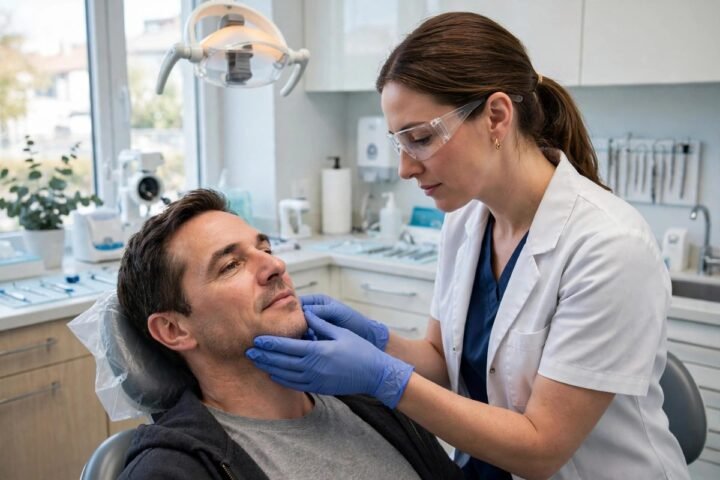
There is no single test that settles tmj vs trigeminal neuralgia, so the history does most of the work. For TMDs, NIDCR says there is no widely accepted standard test; a doctor or dentist notes your symptoms, takes a detailed medical history, and examines the head, neck, face, and jaw for tenderness, clicking or popping, or difficulty with movement. Imaging such as an X-ray, MRI, or CT may be recommended, mainly when the diagnosis is in doubt, and other conditions may need to be ruled out first.
For suspected trigeminal neuralgia, NINDS says a provider conducts a physical examination, reviews the full medical history, and considers the symptoms, and the workup usually includes a neurological examination and MRI to look for structural abnormalities such as compression of the nerve, or other disorders that could cause facial pain. That MRI step matters: it is how secondary causes such as multiple sclerosis or a tumour are looked for, rather than assumed absent. If you are deciding who to book first, our guide to who treats TMJ explains the dentist, doctor, and specialist routes, and our article on trigeminal neuralgia and ear pain covers one common overlap symptom.
Why does treatment differ so much?
Treatment is where a wrong label costs the most in tmj vs trigeminal neuralgia. For TMDs, NIDCR emphasises that signs and symptoms go away without treatment for many people, evidence for many treatments is limited, and experts recommend conservative care — soft foods, heat or cold with gentle exercises, over-the-counter pain medicines such as NSAIDs, and reducing habits such as clenching, gum chewing, or nail biting — while avoiding treatments that permanently change the jaw joints, teeth, or bite, or involve surgery.
For trigeminal neuralgia, NINDS says medication is generally the first line, but a different kind: anticonvulsant medicines, which block pain signals, can reduce the frequency of attacks, with carbamazepine and oxcarbazepine among the options listed, alongside others a specialist may consider. NINDS also notes common pain relievers such as aspirin and ibuprofen, and opioid medicines, are not usually helpful for trigeminal neuralgia — one reason a nerve problem mislabelled as a jaw problem can feel untreatable. If medication cannot relieve pain or causes intolerable side effects, surgery may be considered. Never start, stop, or swap these medicines on your own; they need a prescriber who knows your history.
When should you seek care promptly?
Seek care promptly for facial pain that is new, electric, or triggered by light touch, for pain on both sides of the face, or for numbness or weakness — patterns that, per NINDS, are more likely with secondary trigeminal neuralgia, which is also more likely in younger people, and deserve a neurological workup rather than watchful waiting. Also get checked if your jaw locks, if you cannot open your mouth normally, if pain follows an injury, or if a presumed TMJ ache keeps escalating despite conservative care. A changing pattern is information, and it should change the plan.
Frequently asked questions
Can TMJ cause nerve pain?
TMJ disorders cause pain in the jaw joint and chewing muscles, which can spread to the face or neck, but that is not the same as trigeminal neuralgia, a nerve disorder with brief, shock-like attacks. Because the conditions overlap in location, persistent or electric facial pain should be examined rather than assumed to be jaw pain.
How do I know if my jaw pain is trigeminal neuralgia?
Look at timing and triggers. Trigeminal neuralgia attacks last seconds to two minutes, feel shock-like or stabbing, affect one side, and can be set off by brushing teeth, washing your face, or wind. TMJ pain is a duller ache tied to chewing, yawning, or clenching, often with clicking or stiffness.
Can you have both TMJ and trigeminal neuralgia?
Yes, it is possible to have a jaw disorder and a nerve problem at the same time, because they have unrelated causes. That is one reason clinicians examine the jaw, teeth, and nerves and rule out other conditions before settling on a diagnosis, instead of stopping at the first plausible label.
What test confirms trigeminal neuralgia?
No single test confirms it. Diagnosis rests on your history, symptoms, and a neurological examination, and the workup usually includes an MRI to look for a blood vessel pressing on the nerve or another disorder such as multiple sclerosis or a tumour that could explain the pain.
Conclusion
The tmj vs trigeminal neuralgia distinction comes down to pattern, not intensity. Both can hurt a great deal. But a dull, use-related ache with clicking and stiffness points to the jaw joint and muscles, while brief, electric, touch-triggered attacks on one side point to the trigeminal nerve. The exam, the MRI decision, and the first-line treatment all flow from that pattern.
If your story does not fit the label you were given — especially if jaw treatment is not helping, or the pain is electric and seconds-long — ask for the differential to be revisited, and discuss it with your dentist, doctor, or an orofacial pain or neurology specialist.
Medical disclaimer: This article is educational information only and is not medical advice. It does not diagnose or treat any condition. Discuss your symptoms and any treatment decisions with your own dentist, doctor, or specialist.
Sources
- National Institute of Neurological Disorders and Stroke (NINDS). Trigeminal Neuralgia — definition, attack duration and triggers, classical, secondary and idiopathic types, MRI workup, and first-line anticonvulsant treatment. Read this run.
- National Institute of Dental and Craniofacial Research (NIDCR). TMD (Temporomandibular Disorders) — more than 30 conditions, symptoms, about 5% of U.S. adults, no standard test, exam-based diagnosis, and conservative treatment guidance. Read this run.





0 Comments