Educational information · Not medical advice
In brief
Migraine aura without headache explained: zigzag vision, tingling and speech trouble that build over minutes, how it differs from stroke, and red flags.
In this article
- What is migraine aura without headache?
- What does an aura without headache feel like?
- How is aura without headache different from a stroke or TIA?
- When should you worry and seek urgent care?
- How is migraine aura without headache diagnosed?
- Can aura without headache be treated or prevented?
- Frequently asked questions
- Conclusion
- Sources
Key Takeaways
- Migraine aura without headache is a real migraine attack in which the aura phase happens but the headache phase never follows.
- Typical aura builds gradually over at least 5 minutes, each symptom lasts 5–60 minutes, and everything fully reverses.
- Stroke and TIA usually start suddenly and take function away; aura tends to build, spread, and add sensations such as zigzag lights or tingling.
- A first-ever episode, weakness, symptoms over 60 minutes, or anything unlike your usual pattern needs urgent medical assessment — never self-diagnose a first episode.
- There is no treatment approved specifically for aura without headache; frequent or disabling attacks are managed case by case with a clinician.
Migraine aura without headache sounds like a contradiction: how can it be migraine if your head never hurts? Yet that is exactly what some people experience — zigzag lights creeping across their vision, tingling marching up one hand, or words briefly refusing to come — and then, instead of the expected headache, nothing. Because there is no pain, many people dismiss the episode, or frighten themselves searching symptoms that also belong to stroke. This article explains what this kind of attack is, how clinicians separate it from a transient ischemic attack (TIA) or stroke, and which episodes should never be waved away.
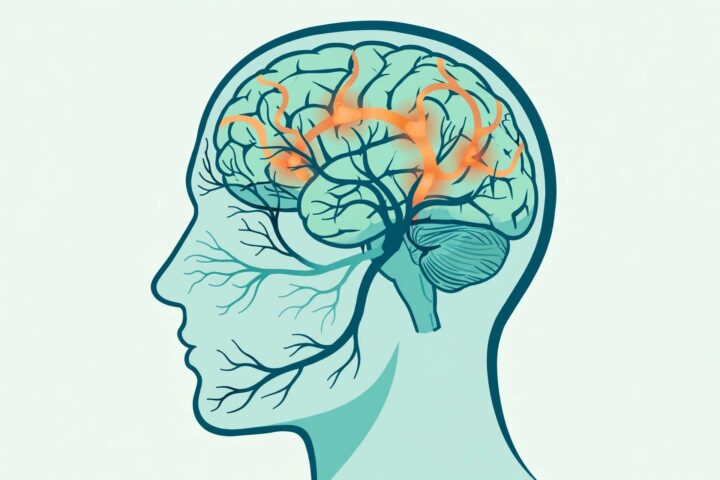
A quick note on terms: an aura is a temporary, fully reversible set of neurological symptoms — most often visual, sensory, or speech and language symptoms. Migraine is the underlying brain disorder. As our overview of how migraine works in the brain explains, aura is linked to a slowly spreading wave of altered brain activity, which is why its symptoms tend to build and move rather than switch on all at once.
1. What Is Migraine Aura Without Headache?
The American Migraine Foundation (AMF) describes migraine aura without headache as exactly what the name says: a migraine aura that lacks the accompanying headache. Older names include “acephalgic migraine,” and it is still sometimes called “silent migraine,” although the AMF notes that “silent” is no longer the preferred term — it can make a disabling attack sound trivial, and aura on its own can be extremely disruptive. In the International Classification of Headache Disorders, third edition (ICHD-3), the diagnosis is coded as “typical aura without headache”: attacks that meet the criteria for typical aura, with no headache accompanying the aura or following it within 60 minutes.
“Typical” matters. A typical aura consists of fully reversible visual, sensory, and/or speech and language symptoms, with no motor weakness, no brainstem symptoms, and no symptoms from just one retina. Aura is not rare within migraine generally — Cleveland Clinic notes that about 30% of people with migraine experience auras — but most auras are followed by headache. An aura that arrives alone is the less common pattern, and it can appear in people who previously had aura with headache, as well as in people who never get the headache phase at all.
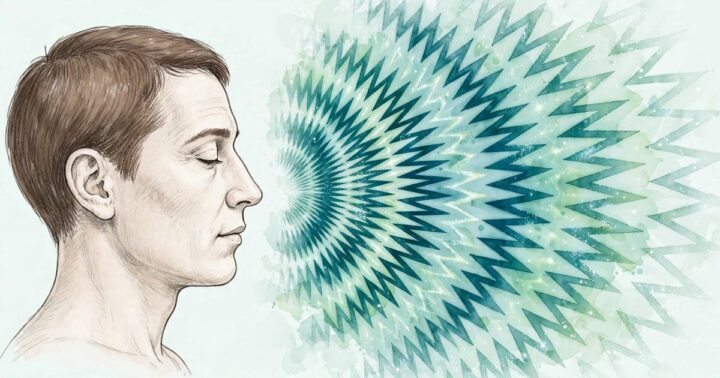
A shimmering zigzag aura pattern expanding across a dark background, similar to what a migraine visual aura looks like
2. What Does an Aura Without Headache Feel Like?
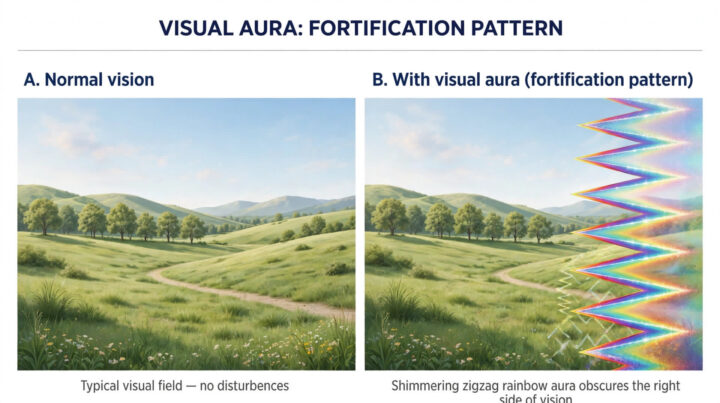
Visual symptoms are by far the most common. People describe flashing or flickering lights, bright spots or lines, a shimmering zigzag pattern that expands slowly across the visual field — sometimes called a fortification pattern — or a blind spot (scotoma) that grows and drifts before fading. Sensory aura is usually pins and needles that start in one hand, spread gradually up the arm, and may reach the face or tongue on the same side, sometimes followed by numbness. Speech and language aura can mean struggling to find words or to get a sentence out clearly, even though you know what you want to say.
The timing is the signature. Per the AMF, aura symptoms usually develop gradually, evolve over several minutes, and generally last between five and 60 minutes each. ICHD-3 describes the same pattern: at least one aura symptom spreads gradually over five minutes or more, individual symptoms last 5–60 minutes, symptoms are often one-sided, and everything is fully reversible. Other migraine features can still show up without pain — nausea and sensitivity to light or sound may accompany the aura, as the AMF notes — which is one clue that the episode belongs to migraine rather than to the eye itself.
3. How Is Aura Without Headache Different From a Stroke or TIA?
This is the question that matters most, because aura, TIA, and stroke can share symptoms: visual change, numbness, and speech difficulty. The AMF highlights one of the most significant differences — onset. Stroke symptoms typically arrive suddenly, at full strength. Aura slowly ramps up, building and spreading over minutes. Aura also tends to add things — flashing lights, zigzags, tingling that travels — while stroke and TIA more often take things away: vision lost rather than decorated, an arm that will not lift, speech that is suddenly gone or slurred. And ICHD-3 is explicit that a diagnosis of typical aura without headache requires that a transient ischemic attack has been excluded.
| Feature | Typical migraine aura | Stroke / TIA |
|---|---|---|
| Onset | Gradual — builds and spreads over at least 5 minutes | Sudden — often at maximum from the start |
| Vision | Added effects: zigzags, flashing or shimmering lights, an expanding blind spot | Loss: sudden loss or dimming of vision, often without added patterns |
| Sensation / movement | Tingling that marches slowly, e.g. hand to arm to face; no true weakness in typical aura | Sudden numbness or weakness on one side; face drooping; arm drifting down |
| Duration | Each symptom typically 5–60 minutes, fully reversible | Variable — a TIA can also resolve in minutes, which is why it still counts as an emergency |
| Headache | May follow within 60 minutes — in aura without headache, it does not | May be absent, or sudden and severe |
Treat that table as orientation, not a home diagnostic test. The patterns overlap, and a TIA by definition goes away — which makes “it passed, so it was nothing” a dangerous conclusion. If there is any doubt, the safe move is emergency assessment.
4. When Should You Worry and Seek Urgent Care?
Seek emergency care immediately — call your local emergency number and do not drive yourself — for any episode that includes weakness on one side, face drooping, trouble speaking or understanding speech, sudden loss of vision, loss of balance or severe dizziness, confusion, or a sudden severe headache unlike anything before. The same applies when symptoms are sudden rather than gradual, last longer than 60 minutes, do not fully resolve, or are simply unlike your established pattern.
A first-ever aura-like episode always deserves prompt medical evaluation, even if it fades completely. The diagnosis is, in part, one of exclusion: a clinician first has to rule out TIA, stroke, seizure, and eye causes. That caution applies especially to a first episode later in life, or in someone with stroke risk factors. The AMF also notes that migraine with aura — with or without headache — is associated with a higher risk of stroke, although the overall risk remains low, and that estrogen-containing hormone treatments are associated with higher stroke risk in people with aura, particularly at higher doses. Those are conversations for your own clinician, not reasons to panic — and not details to leave out of the history.
5. How Is Migraine Aura Without Headache Diagnosed?
There is no single test that proves it. Diagnosis rests on the history matching the ICHD-3 pattern — at least two attacks of fully reversible visual, sensory, or speech and language symptoms, spreading gradually, lasting 5–60 minutes each, with no headache during the aura or within 60 minutes after it — and on other diagnoses being excluded. A clinician will ask about the order symptoms arrived in, how they spread, how long each lasted, and whether anything was lost rather than added. First, atypical, or late-onset episodes may prompt brain imaging, eye examination, or other workup to exclude TIA, stroke, seizure, and retinal causes.
You can make that history far more useful with a simple diary. Note when the episode started, which symptom came first and how it moved, how long each part lasted, whether any headache followed, and possible triggers such as poor sleep, missed meals, or stress let-down. A diary also protects you in a second way: if you do get headaches on other days and treat them often, the diary shows your treatment days — the pattern behind medication-overuse headache, when pain relief makes headaches worse.
6. Can Aura Without Headache Be Treated or Prevented?
Honestly, treatment is limited, and good sources say so. The AMF notes that treating aura without headache can be difficult: many as-needed medicines, such as oral triptans and NSAIDs, take longer to work than the aura lasts, so some people take nothing for the aura itself, while associated symptoms such as nausea or light sensitivity may still improve if treated. There are no large, good studies to guide treatment for this specific pattern, and nothing has FDA approval for this indication; care is managed case by case. Smaller studies and case reports have explored magnesium, aspirin, and lamotrigine, but that is early, small-scale evidence — not a self-treatment plan.
During an episode, the practical steps are safety steps: stop what you are doing, do not drive, sit or lie down somewhere quiet, and let the symptoms pass. If attacks are frequent or disabling, a clinician may discuss preventive approaches used for migraine more broadly — Cleveland Clinic lists options providers may consider, including certain blood-pressure medicines, antiseizure medicines, CGRP-targeted treatments, and supplements such as riboflavin or CoQ10 — alongside trigger management: regular sleep, hydration, regular balanced meals, and reducing stress where you can. Our guides to migraine medicines, from triptans to CGRP treatments and to the CGRP revolution in migraine treatment explain that wider landscape. Do not borrow a treatment plan from those pages on your own — what is reasonable depends on your stroke risk, other conditions, and medicines.
Frequently Asked Questions
Can you have a migraine aura and never get a headache?
Yes. In migraine aura without headache — coded in ICHD-3 as typical aura without headache — the aura happens but no headache accompanies it or follows within 60 minutes. It was previously called acephalgic migraine and is still sometimes called silent migraine. Aura symptoms such as zigzag vision, tingling, or word-finding difficulty develop gradually, last 5–60 minutes each, and fully reverse.
How long does an aura without headache usually last?
Each individual aura symptom typically lasts between five and 60 minutes, according to both ICHD-3 criteria and the American Migraine Foundation. Symptoms usually develop gradually over at least five minutes and may occur one after another, so a whole episode can run longer than a single symptom. Anything lasting beyond 60 minutes, or not fully resolving, needs urgent medical assessment.
How can I tell aura from a stroke or TIA?
Pattern helps but never proves it. Aura tends to build and spread gradually over minutes and adds sensations — flashing zigzags, tingling that marches up a limb. Stroke and TIA usually begin suddenly and take function away: weakness, lost vision, slurred speech. A first episode, sudden onset, weakness, or symptoms unlike your usual pattern should be treated as an emergency.
Do I need treatment if there is no headache?
Often no medicine is taken for a brief aura, partly because oral medicines usually take longer to work than the aura lasts. The American Migraine Foundation notes there is no FDA-approved treatment specifically for aura without headache and care is case by case. Frequent, prolonged, or disabling attacks — or any change in pattern — are reasons to discuss prevention with a clinician.
Conclusion
Migraine aura without headache is a genuine migraine attack that skips the headache phase: temporary visual, sensory, or speech symptoms that build gradually, last minutes, and reverse completely. Its gradual march and “added” symptoms help distinguish it from stroke and TIA, which usually strike suddenly and take function away — but the overlap is real enough that the diagnosis requires TIA to be excluded, and a first or changed episode always belongs in front of a clinician, urgently if there is weakness, speech trouble, lost vision, or anything sudden.
If your episodes match the typical pattern and a clinician has confirmed the diagnosis, a diary, trigger basics, and a case-by-case plan are usually the management. If they do not match — or you have never had one checked — start there, not with reassurance from an article.
This article is for educational purposes only and is not medical advice. It is general information, not a diagnosis or a recommendation for any individual. Aura-like symptoms can be caused by stroke, TIA, seizure, or eye problems: seek emergency care for a first episode, sudden symptoms, weakness, speech difficulty, vision loss, or symptoms that do not fully resolve, and discuss recurrent episodes with your own clinician.
Sources
- American Migraine Foundation — Silent Migraine: A Guide (updated September 23, 2021): definition and naming; aura develops gradually, lasts 5–60 minutes; no FDA-approved treatment for this indication, case-by-case care; aura vs. stroke onset; stroke-risk discussion — americanmigrainefoundation.org/resource-library/silent-migraine
- International Headache Society — ICHD-3 (2018), criteria as summarised in the Journal of the Ceylon College of Physicians supplementary file (2024): 1.2.1.2 Typical aura without headache — no headache accompanying or following within 60 minutes; typical aura is fully reversible visual, sensory and/or speech/language symptoms, no motor, brainstem or retinal symptoms — jccp.sljol.info (PDF)
- Cleveland Clinic — Migraine Aura (medically reviewed, updated February 13, 2026): aura lasts five to 60 minutes and happens gradually; about 30% of people with migraine experience auras; prevention options and lifestyle measures — my.clevelandclinic.org/health/diseases/22131-migraine-aura
- He et al. — Typical aura without headache: a case report and review, Journal of Medical Case Reports, 2015: ICHD criteria, gradual spread, TIA must be excluded — link.springer.com (PDF)
About this information
Consult the sources listed in the article. This notice does not certify an individual clinical review.
This article is for education only and is not medical advice. Talk to a qualified clinician about your own symptoms.
0 Comments