
Educational information · Not medical advice
In brief
Oral appliance therapy for sleep apnea explained: how advancing the jaw opens the airway, how it compares with CPAP, and the TMJ and bite risks to monitor.
In this article
- How does jaw position affect breathing during sleep?
- What is oral appliance therapy for sleep apnea?
- How does an oral appliance compare with CPAP?
- Can an oral appliance cause TMJ pain or bite changes?
- Who is a candidate — and who is not?
- What follow-up and monitoring should you expect?
- Frequently asked questions
- Conclusion
- Sources
Key Takeaways
- Oral appliance therapy for sleep apnea holds the lower jaw forward at night, which can enlarge the upper airway and reduce its collapse.
- The 2015 AASM and AADSM guideline recommends oral appliances rather than no therapy for adults with obstructive sleep apnea who cannot tolerate CPAP or prefer an alternative, and recommends a custom, titratable appliance fitted by a qualified dentist.
- Jaw and tooth side effects are real: a 2025 systematic review found more pain-related TMD in the short term, with no long-term increase in TMJ or muscle pain — monitoring matters, especially early on.
- An oral appliance is not a night guard and not a boil-and-bite guard. Diagnosis, fitting, titration, and follow-up sleep testing are part of the treatment.
If you wake up despite a full night in bed, snore loudly, or have been told you pause in your breathing during sleep, jaw position may be part of the story — and part of the treatment. Oral appliance therapy for sleep apnea uses a custom device worn in the mouth at night to hold the lower jaw forward. That forward position is the whole idea: it changes the space behind the tongue and soft palate, where the airway narrows or closes in obstructive sleep apnea (OSA).
This article explains how that mechanism works, what the guideline evidence actually recommends, how an appliance compares with continuous positive airway pressure (CPAP), and — because this site is about jaw health — what an appliance can do to the temporomandibular joint (TMJ), the chewing muscles, and your bite. A quick note on terms: TMJ is the joint in front of each ear; TMD means temporomandibular disorder, problems with the joint, the muscles, or both. A mandibular advancement device (MAD) is the most common type of oral appliance for OSA.
How does jaw position affect breathing during sleep?
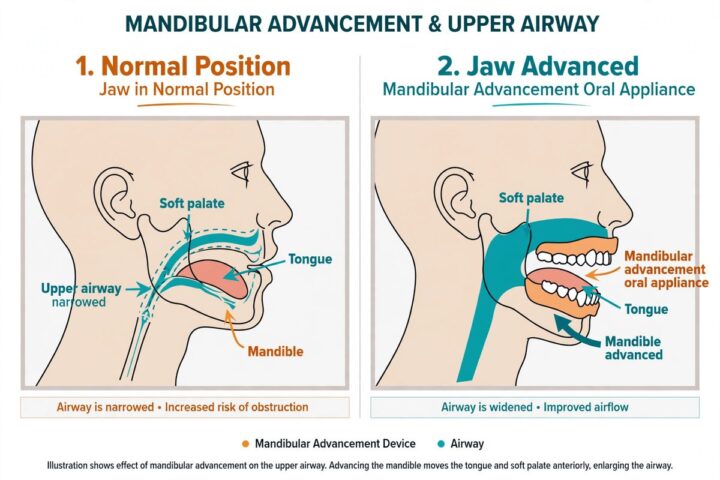
During sleep, the muscles that keep the upper airway open relax. In OSA, the airway behind the tongue and soft palate repeatedly narrows or collapses, reducing or stopping airflow, fragmenting sleep, and lowering oxygen. The lower jaw is not a bystander in that anatomy. The tongue is attached to the mandible, so when the jaw sits back — or falls back, for example when sleeping on your back — the tongue and surrounding soft tissues can sit further back as well, leaving less room for air to pass.
Holding the mandible forward does the opposite. Advancing the jaw moves the tongue forward, tenses tissues around the airway, and can widen the space in the oropharynx. That is the mechanism described for mandibular advancement devices: repositioning the lower jaw to increase airway space and improve airflow. It does not cure the underlying reasons an airway is collapsible, and it does not work equally well for everyone. Anatomy, OSA severity, body position during sleep, and how far the jaw can comfortably advance all affect the result — which is why a follow-up sleep test with the appliance in place, not just how you feel, is used to confirm whether it is working.
Sleeping position can change jaw strain overnight, as our guide to TMJ sleeping position explains — but position alone is not a treatment for diagnosed OSA.
What is oral appliance therapy for sleep apnea?
Oral appliance therapy for sleep apnea is prescription treatment, not a shopping category. In the pathway set out in the 2015 clinical practice guideline from the American Academy of Sleep Medicine (AASM) and the American Academy of Dental Sleep Medicine (AADSM), a sleep physician diagnoses OSA and prescribes the appliance, and a qualified dentist fits and oversees it. The guideline suggests a custom, titratable appliance over a non-custom device: custom means made for your teeth and jaw, and titratable means the amount of advancement can be adjusted gradually over time rather than fixed on the first night.
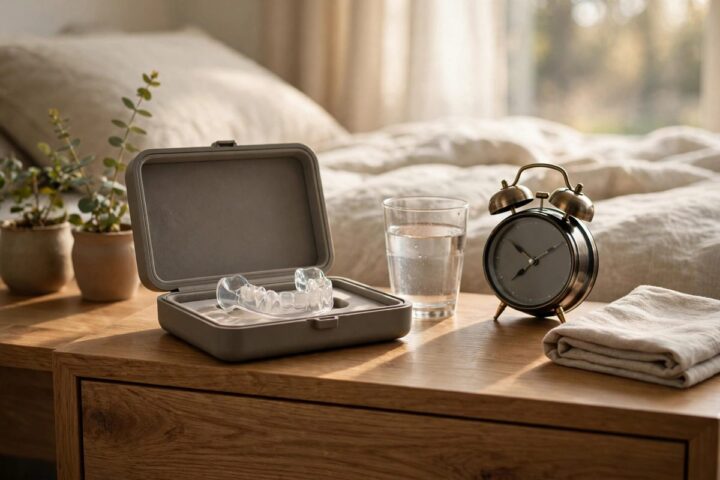
That distinction matters because an appliance for OSA looks deceptively similar to other mouth devices. It is not the same as a TMJ splint or night guard: a guard mainly protects teeth or provides a stable biting surface, while a mandibular advancement device is deliberately built to posture the jaw forward all night and is then titrated against sleep-testing results. A boil-and-bite guard bought for grinding has not been fitted, advanced, or tested for apnea at all — and using one in place of assessed treatment can leave OSA untreated while giving the impression that something has been done.
What the guideline recommends, in one place
- Prescribe an oral appliance rather than no therapy for adults who request treatment for primary snoring without OSA.
- Consider an oral appliance rather than no treatment for adults with OSA who are intolerant of CPAP or prefer an alternative.
- Use a custom, titratable appliance, fitted by a qualified dentist, over a non-custom device.
- Provide dentist oversight and follow-up sleep testing, and instruct patients to return for periodic visits with both the dentist and the sleep physician.
Source: Ramar et al., AASM/AADSM guideline, 2015 — see Sources.
How does an oral appliance compare with CPAP?
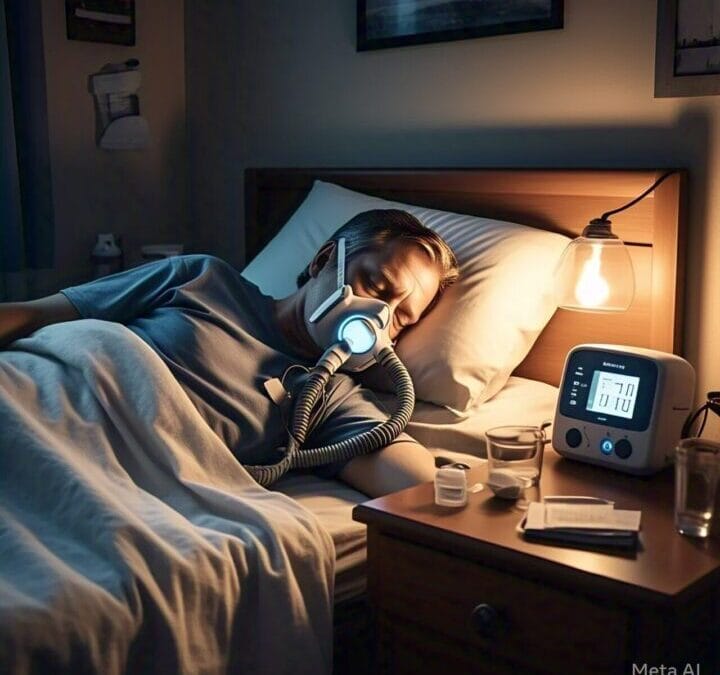
CPAP remains the reference treatment for OSA: it splints the airway open with air pressure and, when it is used consistently, it is highly effective at reducing apnea events. The practical problem the guideline is responding to is use — some people cannot tolerate the mask or pressure, or strongly prefer an alternative, and an untreated severe problem is worse than a treated one. An oral appliance trades some of that pressure-driven efficacy for a device many people find easier to live with, and the guideline therefore frames it as a recommended alternative for CPAP-intolerant patients, not as a universal replacement for CPAP.
| CPAP | Custom oral appliance (MAD) | |
|---|---|---|
| How it works | Air pressure through a mask keeps the upper airway open | Holds the lower jaw forward, enlarging the airway behind the tongue |
| Who provides it | Sleep physician and equipment provider | Sleep physician prescribes; qualified dentist fits, titrates and reviews |
| Best-established role | Reference treatment across OSA severity, especially moderate to severe | Primary snoring, and OSA when CPAP is not tolerated or an alternative is preferred |
| Proof it is working | Machine data plus follow-up assessment | Follow-up sleep testing with the appliance in place |
| Main burdens | Mask, pressure, noise and travel burden; adherence can be difficult | Jaw, muscle and tooth side effects; bite changes over time; dental follow-up needed |
The two are also linked by a condition this site covers often: sleep bruxism. Grinding and apnea frequently occur together, and treating breathing can change grinding — and vice versa. Our overview of the bruxism and sleep apnea connection explains that overlap. It is one more reason the fitting clinician needs to know about jaw pain, clicking, locking, or heavy grinding before an advancement device is made, not after problems start.
Can an oral appliance cause TMJ pain or bite changes?
Yes, it can — particularly at first — and that should be discussed before treatment, not discovered afterwards. Holding the jaw forward for hours every night loads the TMJ, the ligaments around it, and the chewing muscles in a position they do not occupy during the day. Reported side effects in the literature and in clinical reviews include TMJ pain, chewing-muscle pain, tooth pain, salivation changes, dry mouth, gum irritation, joint sounds, and a morning feeling that the bite does not meet normally. Longer-term, tooth movement and occlusal (bite) changes have been reported, which is why the guideline specifically calls for dentist oversight to survey for dental side effects and occlusal changes and reduce their incidence.
The most directly relevant synthesis is a systematic review and meta-analysis published in the Journal of Prosthodontic Research (Liu et al., 2025; journal issue 2026). It included 14 clinical studies of MAD therapy in OSA, with an average follow-up of 18.4 months, and rated the overall certainty of the evidence as very low. In short-term follow-up (under 6 months), pain-related TMD increased: the odds ratio was 4.49 (95% CI 1.46 to 13.81) for pain-related TMD and 2.90 (95% CI 1.26 to 6.71) for pain in the TMJ or masticatory muscles. In long-term follow-up (1 year or more), the odds of pain in the TMJ or muscles were lower (OR 0.21; 95% CI 0.05 to 0.89). The authors concluded that MAD therapy did not cause long-term adverse effects on the TMJ or masticatory muscles in those studies, but that short-term use may result in pain-related TMD, highlighting the need to monitor and manage symptoms during that early period.
Read that carefully: very low certainty, a real early signal, and no long-term increase in that dataset — not a guarantee for an individual jaw. A jaw with pre-existing disc displacement, frequent locking, active joint pain, or marked muscle tenderness starts from a different place than a healthy jaw, and advancement amount and speed of titration are decisions for the fitting dentist together with the sleep physician. Morning bite changes deserve the same seriousness: tell the fitting dentist if your teeth still do not meet normally well after you get up, if a tooth becomes persistently sore, or if jaw pain is building week on week rather than settling as you adapt.
Who is a candidate — and who is not?
Based on the guideline, the clearest candidates are adults diagnosed with OSA who cannot tolerate CPAP or prefer an alternative therapy, and adults seeking treatment for primary snoring without OSA. The appliance route requires enough healthy teeth and jaw function for a custom device to fit and advance safely — the AASM’s summary of advances in these devices notes, for example, that patients without teeth (edentulous patients) are not candidates for a typical MAD. It also requires a jaw that can be assessed for TMD first: an appliance should not be fitted over unexplained jaw locking, acute joint pain, or an unassessed bite problem and simply hoped for the best.
It is not a do-it-yourself diagnosis. A sleep study ordered through a sleep physician separates primary snoring from mild, moderate, or severe apnea, and that severity shapes whether an appliance is a primary option, an alternative when CPAP fails, or not enough on its own.
What follow-up and monitoring should you expect?
Good oral appliance therapy for sleep apnea has a follow-up structure, and its absence is a warning sign. Expect, from the guideline: oversight by a qualified dentist rather than no follow-up, so dental side effects and bite changes are surveyed; follow-up sleep testing by the sleep physician to confirm the appliance is actually treating the apnea, rather than assuming it from reduced snoring; and periodic office visits with both the dentist and the sleep physician for as long as you use the device. Titration — gradually increasing advancement — happens over that period, balancing better airway effect against jaw, muscle, and tooth symptoms.
Between visits, your own monitoring is simple and specific. Note jaw pain on waking and how long it lasts, muscle soreness, tooth soreness, whether your bite feels normal by breakfast, any new clicking or locking, and whether a partner still hears pauses or gasping. Bring that list to follow-up. Persistent or worsening jaw pain, a bite that stays changed, a tooth that stays sore, or continued witnessed apneas are reasons to contact the fitting team promptly, not to advance the device further on your own or to abandon assessed treatment silently and return to no therapy.
Frequently asked questions
Can an oral appliance replace CPAP for sleep apnea?
For some adults, yes — the AASM and AADSM guideline recommends considering an oral appliance rather than no treatment when a person with obstructive sleep apnea cannot tolerate CPAP or prefers an alternative. It is not a universal replacement: severity, anatomy, and follow-up sleep testing with the appliance in place decide whether it is controlling the apnea well enough for you.
Will a sleep apnea oral appliance give me TMJ problems?
It can cause jaw or muscle pain, especially early on. A 2025 systematic review of 14 studies found more pain-related TMD in the first months of mandibular advancement therapy, but no long-term increase in TMJ or muscle pain, with very low certainty overall. A pre-treatment jaw assessment, gradual titration, and dentist follow-up reduce — but do not eliminate — that risk.
Is a boil-and-bite guard the same as a sleep apnea appliance?
No. The guideline suggests a custom, titratable appliance fitted by a qualified dentist over non-custom devices. A boil-and-bite guard has not been custom-fitted, cannot be titrated in the same way, and has not been sleep-tested as apnea treatment. It may separate the teeth, but that is not oral appliance therapy for sleep apnea.
How will I know if my oral appliance is actually working?
Not from snoring alone. The guideline suggests follow-up sleep testing to confirm treatment efficacy with the appliance in place, alongside periodic visits with the sleep physician and the fitting dentist. Less snoring and better mornings are encouraging signs, but the sleep test is the check that the apnea itself — pauses, oxygen, and fragmentation — has improved.
Conclusion
Jaw position and breathing are mechanically linked: holding the mandible forward can enlarge the upper airway, and for the right person that makes oral appliance therapy for sleep apnea a legitimate, guideline-supported treatment — particularly when CPAP cannot be tolerated. The same forward position that helps the airway loads the jaw joint, the chewing muscles, and the teeth, and the evidence says early pain-related symptoms are common enough to plan for, even though longer-term studies have not shown a lasting increase in TMJ or muscle pain.
So the decision is not appliance versus nothing in the abstract. It is a diagnosed sleep problem, a custom titratable device, a jaw assessed before it is advanced, and follow-up that includes both a dentist watching the bite and a sleep physician checking the apnea. If you are considering this route, start with a sleep assessment and bring your jaw history — pain, clicking, locking, grinding, and any bite changes — to both appointments.
This article is for educational purposes only and is not medical advice. It is general information, not a diagnosis or a recommendation for any individual. Discuss sleep apnea, snoring, jaw pain, or any appliance decision with your own sleep physician, dentist, or clinician, and stop using any appliance that causes pain until it has been checked.
Sources
- Ramar K, et al. Clinical Practice Guideline for the Treatment of Obstructive Sleep Apnea and Snoring with Oral Appliance Therapy: An Update for 2015. Journal of Clinical Sleep Medicine, 2015;11(7):773–827. AASM and AADSM — aasm.org
- Liu S, et al. Short- and long-term effects of mandibular advancement device therapy for obstructive sleep apnea on temporomandibular disorders: a systematic review and meta-analysis. Journal of Prosthodontic Research, 2026;70(2):159–172 (published online 2025). PMID 40707237 — pubmed.ncbi.nlm.nih.gov
- American Academy of Sleep Medicine. Technological advances in mandibular advancement devices — custom, titratable devices, efficacy assessment, and candidacy notes — aasm.org
About this information
Consult the sources listed in the article. This notice does not certify an individual clinical review.
This article is for education only and is not medical advice. Talk to a qualified clinician about your own symptoms.


0 Comments