
Educational information · Not medical advice
In brief
Who treats TMJ? Start with a dentist or doctor, learn what an orofacial pain specialist and an oral surgeon do, and know when to ask for a referral today.
In this article
Key Takeaways
- Who treats TMJ depends on the problem, not on one title: most people should start with their general dentist or their doctor, whoever they can see first.
- TMJ is the joint; TMD is the disorder. The National Institute of Dental and Craniofacial Research (NIDCR) counts more than 30 TMD conditions, which is why no single provider owns every case.
- Conservative, reversible care comes first. An orofacial pain specialist is the referral expert for persistent, complex, or unclear jaw and face pain.
- An oral surgeon is a last-resort provider, not a first stop, and orthodontic treatment to change the bite is not a proven TMD treatment.
Your jaw aches, clicks, or locks, and the first question is a practical one: who treats TMJ — a doctor or dentist? The honest answer is that who treats TMJ well depends on what is driving your symptoms, and the safest first step is usually the clinician who already knows you. This article explains who treats TMJ at each stage, what each provider can and cannot do, and when a referral changes the outcome.
First, the terms. TMJ is the temporomandibular joint in front of each ear. TMD is a temporomandibular disorder affecting that joint and the muscles that move it. NIDCR describes TMDs as a group of more than 30 conditions that cause pain and dysfunction in the jaw joint and chewing muscles, affecting about 5% of adults in the United States and about twice as many women as men. A group that large will never belong to one specialty alone.
Who treats TMJ first — a dentist or a doctor?
For most people, either starting point is reasonable, and NIDCR’s own advice is to consult a dentist or doctor. A general dentist is a natural first call when the pain sits in the jaw or teeth, when you clench or grind, or when symptoms began after dental work. Our guide to jaw pain after dental work explains the timelines that matter there. A doctor is a natural first call when jaw pain comes with headache, ear symptoms, fever, swelling, numbness, or a history of other pain conditions, because those features widen the list of possible causes.
What matters more than the door you enter is what happens inside it. NIDCR describes diagnosis as a detailed history — where and when the pain occurs, what makes it better or worse, whether it spreads — plus an examination of the head, neck, face, and jaw for tenderness, clicking, and limited movement. Imaging such as an X-ray, MRI, or CT scan may be recommended in selected cases. There is no single standard test for TMD, and a careful clinician may first need to rule out tooth infection, sinus or ear problems, and nerve pain before naming a TMD.
Be cautious about anyone who treats TMJ with a large, irreversible plan at the first visit. NIDCR is explicit: because evidence for many TMD treatments is limited, experts recommend conservative treatment and avoiding treatments that permanently change the jaw joints, teeth, or bite, or that involve surgery. Many TMDs are temporary and improve on their own, and painless clicking alone is normal and does not need treatment.
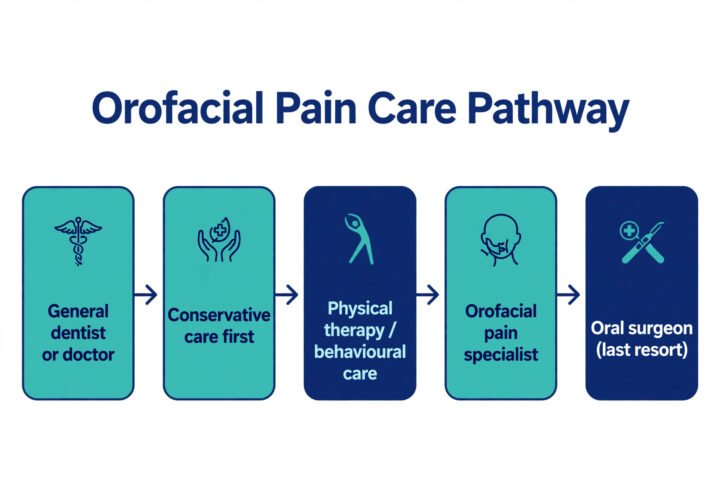
What does each provider who treats TMJ actually do?
Think of care as a ladder. The first rung is self-management and simple, reversible care, whoever prescribes it: softer foods for a short period, heat or cold combined with gentle jaw stretching and strengthening exercises, short-term over-the-counter pain medicines such as NSAIDs where appropriate for you, and reducing habits such as jaw clenching, gum chewing, and nail biting. NIDCR lists exactly those steps as the usual starting point.
The next rung adds targeted help. A physical therapist works on movement and function; NIDCR notes that manual therapy, in which a therapist uses their hands to stretch the soft tissues and muscles around the joint, can help improve function and relieve pain. A psychologist or behavioural-health clinician may offer cognitive behavioural therapy or biofeedback, which NIDCR lists among approaches that can help manage TMDs, especially when stress and daytime clenching are part of the picture. A dentist may fit an intraoral appliance — a night guard or stabilisation splint — which protects the teeth and may help with habit reversal, but does not change the teeth or bite. NIDCR also notes there is not a lot of evidence that appliances improve TMD pain, so fit and follow-up matter; our comparison of a TMJ splint vs. a night guard and our evidence review of physical therapy vs. splint vs. Botox for TMJ lay out those trade-offs.
More than 30 conditions, about 5% of adults — NIDCR counts more than 30 TMD conditions across joint, muscle, and TMD-related headache categories, affecting about 5% of U.S. adults. That is why who treats TMJ is a matching question — matching the provider to your specific condition — not a search for one TMJ doctor for everyone.
Medicines sit on this rung too, prescribed by a doctor or dentist. NIDCR lists over-the-counter NSAIDs and, in selected cases, prescription options, while warning that evidence for which medicine works best is limited and that some carry serious side effects or addiction risk. Our overview of muscle relaxers for TMJ explains what to ask before accepting one. Whoever treats TMJ for you should explain why a medicine fits your case, how long to take it, and when to stop or review it.
| Provider | What they mainly do | Best first for | Limit to know |
|---|---|---|---|
| General dentist | Examines teeth, bite, and jaw; rules out dental causes; may fit a splint or night guard | Jaw or tooth-area pain, clenching, symptoms after dental work | Training in complex facial pain varies widely |
| Doctor (primary care) | Takes a full medical history, rules out ear, sinus, nerve, and other medical causes; prescribes and refers | Jaw pain with headache, ear, fever, swelling, or other symptoms | May refer on for dental or jaw-specific care |
| Physical therapist | Manual therapy, jaw and neck exercises, movement retraining | Muscle pain, stiffness, limited opening | Usually needs a referral; does not diagnose dental disease |
| Orofacial pain specialist | Diagnoses and manages jaw, mouth, face, head, and neck pain disorders, usually without surgery | Persistent, complex, or unclear pain; a second opinion before irreversible care | Fewer specialists, so waits and travel can be longer |
| Oral and maxillofacial surgeon | Procedures inside the joint, including arthrocentesis, arthroscopy, and open surgery | Structural joint damage or severe symptoms after conservative care has failed | Surgery makes permanent changes and is a last resort |
What is an orofacial pain specialist?
If one title comes closest to a TMJ specialist, it is this one. The American Academy of Orofacial Pain (AAOP) defines orofacial pain as the specialty of dentistry that encompasses the diagnosis, management, and treatment of pain disorders of the jaw, mouth, face, and associated regions, including temporomandibular muscle and joint disorders, jaw movement disorders, neuropathic and neurovascular pain, headache, and sleep disorders. In March 2020, orofacial pain was formally recognised in the United States as dentistry’s twelfth specialty.
That breadth is the point. An orofacial pain specialist is trained to separate muscle pain from joint pain, TMD headache from migraine, and TMD from nerve pain that only mimics it — and then to coordinate the conservative care described above rather than defaulting to a procedure. NIDCR specifically suggests considering a second opinion from an orofacial pain specialist before irreversible treatments such as surgery, TMJ implants, or treatments that permanently change the teeth, bite, or jaw joints. If your pain has lasted for months, no one has given you a clear diagnosis, or you are being offered permanent treatment, this is usually the referral to ask for by name.
A practical caution: in many places anyone may advertise TMJ treatment, and a weekend course is not specialty training. Ask what training the clinician completed, whether they offer conservative options first, and what would make them refer you on. A provider who treats TMJ well can answer all three plainly.
When do an oral surgeon or an orthodontist fit in?
An oral and maxillofacial surgeon is the provider for procedures inside the joint, and that role is real but narrow. NIDCR describes arthrocentesis, in which fluid is pushed through the joint with a needle, as helping pain relief and mouth opening in some people whose disc is out of place, with inconsistent results across studies. Arthroscopy works moderately well for pain and function in selected cases. Open surgery makes permanent changes, has no long-term research studies on safety or effectiveness for TMD symptoms, and should only be considered when there is joint destruction that cannot be fixed another way or severe symptoms despite other treatment. Our explainer on TMJ arthrocentesis covers the least invasive of these options, its recovery, and its costs.
The orthodontist question needs a myth cleared up. NIDCR states plainly that research does not support the belief that a bad bite or orthodontic treatment such as braces causes TMDs, and that occlusal treatments — placing crowns, grinding down teeth, or using orthodontics to change tooth position — have insufficient evidence for treating TMDs and in some cases make the problem worse. An orthodontist may still be part of your dental care for orthodontic reasons, but straightening teeth should not be sold to you as a TMD cure. The same caution applies to full bite reconstruction offered as a first answer to jaw pain.
When should you ask for a referral or a second opinion?
Ask sooner rather than later when any of these apply: pain persists or keeps returning despite a consistent period of conservative care; your jaw locks, or opening keeps shrinking; no clinician has been able to name which TMD you have; pain spreads, or comes with numbness, weakness, fever, swelling, or unexplained weight loss; or you are being advised to have surgery, implants, or treatment that permanently changes your teeth, bite, or jaw. NIDCR advises getting second opinions from qualified medical or dental specialists before complex procedures, and asking the recommending clinician to explain, in detail and in plain language, how the procedure would help your specific TMD and what its risks are.
Bring information that makes any appointment more useful: when the pain started, where it sits and where it spreads, what makes it better or worse, what you have already tried and for how long, and every medicine you take. That history is not paperwork — NIDCR describes it as the core of TMD diagnosis. And keep one coordinator in mind: even when several providers who treat TMJ are involved, one clinician should hold the whole picture, so treatments do not pull in opposite directions.
Frequently asked questions
Who treats TMJ — a doctor or a dentist?
Either can be the right first step, and NIDCR advises consulting a dentist or a doctor. Choose a dentist first for jaw or tooth-area pain, clenching, or symptoms after dental work, and a doctor first when jaw pain comes with headache, ear symptoms, fever, swelling, or numbness. What matters most is a careful history and examination, conservative care first, and a referral when the picture is complex or unclear.
What kind of specialist treats TMJ best?
An orofacial pain specialist is the clinician trained specifically in diagnosing and managing pain disorders of the jaw, mouth, face, head, and neck, including TMD. The specialty was formally recognised in U.S. dentistry in 2020. These specialists usually manage TMD without surgery and coordinate physical therapy, appliances, medicines, and behavioural care. They are a particularly good referral for persistent, complex, or undiagnosed pain, or for a second opinion before irreversible treatment.
Can a general dentist treat TMJ, or do I need a specialist straight away?
A general dentist can start care for most people, and many TMDs are temporary and improve on their own or with simple, reversible steps such as softer foods, heat or cold with gentle exercises, and reducing clenching habits. You do not usually need a specialist first. Ask for a referral if pain persists despite consistent conservative care, your jaw locks or opening shrinks, the diagnosis stays unclear, or permanent treatment is proposed.
Should I see an oral surgeon or an orthodontist for TMJ?
Only in specific roles. An oral surgeon is for procedures inside the joint, such as arthrocentesis, arthroscopy, or, as a last resort, open surgery for structural damage or severe symptoms after other treatment has failed. An orthodontist should not be your TMD treatment: NIDCR says evidence does not show that a bad bite or braces cause TMDs, and bite-changing occlusal treatments lack evidence and can make symptoms worse.
Conclusion
Who treats TMJ is not a contest between a doctor and a dentist. Start with the clinician you can see — your general dentist or your doctor — expect a careful history and examination rather than an instant procedure, and begin with conservative, reversible care. Add physical therapy, behavioural support, an appliance, or medicines only for a named reason, and ask for an orofacial pain specialist when pain persists, the diagnosis is unclear, or permanent treatment is on the table. Keep the oral surgeon in reserve for the small number of structural cases that genuinely need one. That sequence protects you twice: it gives simple problems the simple care they usually need, and it keeps irreversible decisions behind the second opinion NIDCR recommends.
Sources
- National Institute of Dental and Craniofacial Research (NIDCR), National Institutes of Health — TMD (Temporomandibular Disorders): more than 30 conditions, about 5% of U.S. adults, diagnosis by history and examination, conservative-first treatment, appliance, physical therapy and medicine evidence, surgery cautions, and the recommendation to consider a second opinion from an orofacial pain specialist. Read this run.
- National Institute of Dental and Craniofacial Research (NIDCR) — Summary of Treatments for Temporomandibular Disorders (text alternative): simplest treatments first, complex and permanent treatments last, and why occlusal treatments and botulinum toxin are not listed as proven options. Read this run via search results.
- American Academy of Orofacial Pain (AAOP) — Orofacial Pain is Now the 12th ADA-Recognized Dental Specialty (2020): the specialty’s definition — diagnosis, management, and treatment of pain disorders of the jaw, mouth, face, and associated regions — and its formal recognition on March 31, 2020. Read this run via search results.
Medical disclaimer: This article is educational information only and is not medical or dental advice. It does not diagnose any condition or prescribe treatment. Discuss your symptoms, medicines, and treatment options with your own dentist, doctor, or specialist.





0 Comments