
Educational information · Not medical advice
In brief
TMJ surgery cost varies by procedure and facility. Compare published prices, what insurance covers, recovery time, and when surgery is worth considering.
In this article
- When is TMJ surgery actually considered?
- What does TMJ surgery cost, procedure by procedure?
- What does insurance cover, and what will you pay without it?
- How long is TMJ surgery recovery, by procedure?
- What are the risks and limits of TMJ surgery?
- Is TMJ surgery worth it? A decision checklist
- Frequently asked questions
- Conclusion
- Sources
Key Takeaways
- TMJ surgery cost is not one price: tmj surgery cost ranges from about a thousand dollars for a needle washout at a clinic to tens of thousands — and, at hospital prices for joint replacement, far more. The procedure and the facility drive the bill.
- The National Institute of Dental and Craniofacial Research (NIDCR) places surgery, including TMJ implants, in its most complex, last-resort category, and advises a second opinion before it.
- Insurance, when it covers surgery at all, usually requires documented structural joint disease on imaging and a failed trial of non-surgical care first.
- Recovery scales with invasiveness: days after arthrocentesis, one to two weeks of soft diet and exercises after arthroscopy, and weeks to months after open surgery or joint replacement.
- Surgery is most defensible when a specific structural problem matches a specific procedure — not for muscle pain, painless clicking, or pain that has never had a fair trial of reversible care.
If a surgeon has mentioned an operation for your jaw, the practical questions arrive quickly: what does tmj surgery cost, will insurance pay any of it, and how long will you be recovering? There is no single tmj surgery cost, because “TMJ surgery” covers four very different procedures — a needle washout, a camera procedure inside the joint, open joint surgery, and total joint replacement. This article separates them, uses one practice’s published prices to show how wide the range really is, and sets out the questions that decide whether surgery is worth it for you.
A note on terms: TMJ is the temporomandibular joint in front of each ear. TMD means temporomandibular disorder, the group of conditions affecting that joint and the chewing muscles. Surgery on the joint itself is different from treatment for muscle pain, and that distinction decides almost everything that follows.
When is TMJ surgery actually considered?
The NIDCR organises TMD treatment from simplest to most complex. Simple care — soft foods, heat or cold, jaw exercises, short-term over-the-counter anti-inflammatory medicines, and self-management — comes first. Prescription medicines, physical therapy, behavioural approaches, and oral appliances are the intermediate step. Arthrocentesis and arthroscopy are classed as moderately complex, with a “proceed with caution” note, because they involve entering the joint with needles or instruments. Surgery, including TMJ implants, sits in the most complex group: only consider it if a clinician recommends it as a last resort, and ask for a second opinion.
Mayo Clinic describes the same order in plain language: surgery is usually a last resort after conservative measures have failed, although surgical treatments may help some people. In practice, a surgical conversation usually needs three things together. First, persistent pain or a real functional limit — a jaw that locks, will not open far enough to eat, or a bite that is changing. Second, examination and imaging findings that explain those symptoms with a structural problem, such as a displaced disc that does not reduce, advanced joint degeneration, or ankylosis, where the joint has fused. Third, a specific procedure that can address that specific problem.
Just as important is what surgery is not for. Muscle-driven jaw pain, headache related to muscle tension, and clicking without pain or limited movement are not surgical problems. Our overview of TMJ surgery procedures, indications, and outcomes makes the same point: persistent symptoms alone do not establish that an operation is appropriate. If you have not yet had a fair trial of reversible care, our comparison of physical therapy vs splint vs Botox for TMJ is the more relevant starting point.
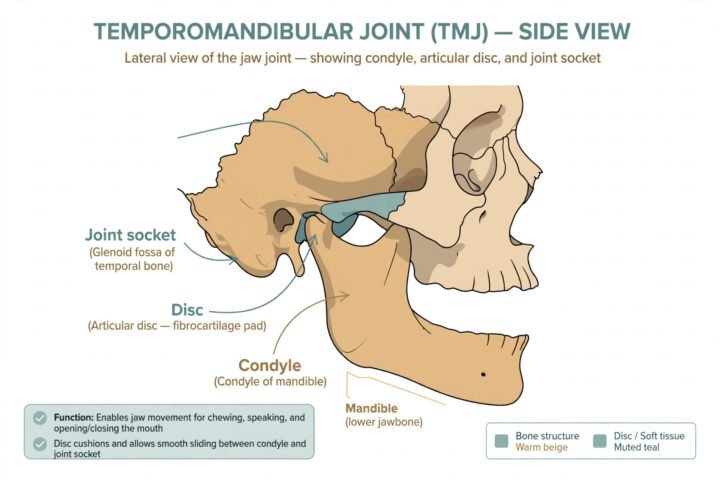
The structures surgery acts on: the condyle of the jawbone, the articular disc, and the joint socket. Labelled diagram for education.
What does TMJ surgery cost, procedure by procedure?
Start with the honest answer: published prices vary so widely that any single “average” tmj surgery cost would mislead you. Two things move the price most. The first is the procedure itself, from least to most invasive. The second is where it is done — the same operation can cost several times more in a hospital than in a clinic or surgery centre, because facility and anaesthesia fees are added on top of the surgeon’s fee.
The clearest illustration is a single US practice that publishes its prices openly, Seattle Jaw Surgery. Its published arthrocentesis price is $1,258 for one side, including intravenous sedation. Its arthroscopy price is $6,650 for one side at clinic prices, but about $27,895 at hospital prices for the same side. Arthroplasty — open joint surgery — is listed at $10,160 at clinic prices and about $30,352 at hospital prices for one side. Total joint replacement is listed at $37,619 at clinic prices, including the implant, and about $197,139 at hospital prices for one side. Those are one practice’s published figures, not a national average and not a prediction of your bill — but they show why asking “what is the tmj surgery cost?” without naming the procedure and the facility cannot produce a useful answer.
Our own article on TMJ arthrocentesis gives the same order of magnitude from the other end: roughly $1,000 to $3,000 for the washout in one US clinic guide, well below arthroscopy and open surgery. A quote for your case should itemise the surgeon’s fee, the facility fee, anaesthesia, any implant, pre-operative imaging, and follow-up visits. If a quote bundles everything into one unexplained number, ask for the breakdown before you compare it with another surgeon’s quote.
| Procedure | What it involves | Typical setting | Published price example |
|---|---|---|---|
| Arthrocentesis | Needles flush fluid through the joint to remove debris and inflammatory byproducts and free fine adhesions | Outpatient or clinic, local anaesthesia with or without sedation | $1,258 for one side (Seattle Jaw Surgery published price, including IV sedation) |
| Arthroscopy | A small camera and instruments inside the joint; scar tissue can be released and inflamed tissue removed under vision | Usually operating room, general anaesthesia | $6,650 clinic vs about $27,895 hospital, one side (same source) |
| Open joint surgery (arthroplasty) | Direct access through an incision to repair, reposition, or remove joint structures | Operating room, general anaesthesia | $10,160 clinic vs about $30,352 hospital, one side (same source) |
| Total joint replacement | Damaged joint components are replaced with a prosthetic joint | Hospital, specialised centre | $37,619 clinic vs about $197,139 hospital, one side, including implant (same source) |
Price examples are one practice’s published prices, cited to show range and the effect of facility fees. Your quote will differ by procedure, side or sides treated, geography, facility, and insurance.
About $1,258 to about $197,139. That is the spread between the cheapest and most expensive published one-side prices cited above — for procedures that are all called “TMJ surgery.” The label tells you almost nothing about cost; the procedure and the facility tell you almost everything.
What does insurance cover, and what will you pay without it?
TMJ treatment sits awkwardly between medical and dental insurance, and coverage for surgery is inconsistent. When a medical plan does cover a TMJ operation, it typically does so under medical-necessity criteria, not on request. One large US insurer’s published clinical guideline, for example, considers surgical procedures medically necessary only when imaging — CT, MRI, or X-ray — documents a structural joint disorder, and the person has a significant functional impairment that has not responded to non-surgical treatment, with at least six months of non-surgical care in that guideline’s criteria. Other plans differ, and some exclude TMJ surgery altogether, so the guideline is an example of the pattern, not a promise about your plan.
Three practical steps protect you. First, get pre-authorisation in writing before the operation is scheduled, and keep the procedure codes the surgeon’s office submits. Second, ask whether the plan is treating the claim as medical or dental, because that decides which deductible and out-of-pocket maximum apply. Third, if you are paying without insurance, ask for a written, itemised, all-in quote — surgeon, facility, anaesthesia, implant, imaging, and follow-up — and ask what a second procedure or a follow-on treatment would cost if the first does not hold. Without insurance, tmj surgery cost is the full published or negotiated price, and the facility choice is the largest single lever you control.
How long is TMJ surgery recovery, by procedure?
Recovery follows the same ladder as cost. After arthrocentesis, recovery is usually measured in days: a soft diet for a few days, gentle movement exercises started early, and soreness or swelling that typically settles quickly. After arthroscopy, expect a soft diet and guided jaw exercises for one to two weeks in most discharge plans, with opening improving over the following weeks as exercises continue. Open joint surgery usually means a longer soft-diet period, a structured exercise programme, and weeks before chewing feels normal. After total joint replacement, recovery is measured in weeks to months, with a prolonged soft diet and a long exercise and follow-up programme.

Early recovery at home is usually soft foods, cold or heat as advised, and gentle movement exercises. Photo-style image for context; it is not a real patient or a clinical result.
Those timelines are general patterns, not a schedule for you — your surgeon’s discharge instructions govern your case. Two rules apply at every level. Exercises are not optional extras: a procedure can free a stuck joint, but movement practice is what helps keep the opening. And escalating symptoms are not normal recovery. Fever, swelling that increases after the first days, a bite that feels increasingly wrong, or pain that is getting worse instead of better warrant a call to the clinic the same day.
What are the risks and limits of TMJ surgery?
Every step up the ladder adds risk as well as capability. Mayo Clinic notes that TMJ arthroscopy has fewer risks and complications than open-joint surgery, which is one reason the least invasive procedure that can address the problem is usually tried first. Risks across the surgical options include infection, bleeding, injury to nearby nerves — the facial nerve runs close to the joint — a change in how the teeth meet, and the possibility that pain persists or returns and further surgery is discussed. For implants, the US Food and Drug Administration (FDA) information summarised in our surgery overview lists ongoing pain, swelling, infection, restricted movement, excess bone formation, and the need for further surgery among reported problems.
There is also an evidence limit to state plainly. For total joint replacement in degenerative or inflammatory joint disease, a 2025 systematic review found that, across 579 participants, average maximum mouth opening improved from about 24.3 mm before surgery to about 40.7 mm afterwards, and participants reported less pain and a return to more solid foods. That is encouraging for carefully selected, end-stage cases — the population in those studies. It does not show that replacement, or any operation, helps the average person with jaw pain, and the review could not identify the best timing for replacement. A success percentage only means something with its diagnosis, procedure, and follow-up attached.
Is TMJ surgery worth it? A decision checklist
Surgery is most likely to be worth its cost and recovery when you can answer yes to most of these questions. Is there a named structural diagnosis, supported by examination and imaging, rather than pain alone? Has a fair trial of reversible care — self-care, physical therapy, medication review, and an appliance if appropriate — been tried and documented? Does the proposed procedure match the diagnosis, and is it the least invasive option that can do the job? Have you had, or been offered, a second opinion, as the NIDCR advises before the most complex treatments? And do you have a written, itemised quote and a written statement of what insurance will and will not pay?
If several answers are no, the cheaper and safer move is usually to complete the missing step first. That is not delay for its own sake: each previous jaw operation can make the next one harder, so the first operation should be the right one, done for the right reason. A surgeon who welcomes these questions, and who can tell you what happens if you wait, is giving you information a sales pitch cannot.
Frequently asked questions
How much does TMJ surgery cost without insurance?
Without insurance you pay the full price, and the range is very wide. In the published prices cited in this article, a one-side arthrocentesis was $1,258 including sedation, arthroscopy was $6,650 at clinic prices, and total joint replacement was $37,619 at clinic prices including the implant — with hospital prices for the same procedures far higher. Get an itemised, all-in written quote for your procedure and facility before deciding.
Does insurance cover TMJ surgery?
Sometimes, under medical insurance, when the plan’s medical-necessity criteria are met. Insurers that publish criteria typically require imaging that documents a structural joint disorder and a functional impairment that has not responded to non-surgical treatment first. Some plans exclude TMJ surgery, and dental plans rarely cover joint operations. Pre-authorisation in writing, with the procedure codes, is the only reliable way to know what your plan will pay.
How long does TMJ surgery recovery take?
It depends on the procedure. Arthrocentesis recovery is usually days, with a soft diet and gentle exercises started early. Arthroscopy usually involves one to two weeks of soft diet and exercises. Open surgery takes weeks, and total joint replacement takes weeks to months, with a long soft-diet and exercise programme. Your surgeon’s discharge plan sets your timeline; worsening pain, fever, or increasing swelling should be reported the same day.
Is TMJ surgery worth it?
It can be, for a specific structural problem that has not responded to reversible care — a locked joint from a displaced disc, advanced degeneration, or a fused joint, for example. In a 2025 systematic review of joint replacement for degenerative disease, opening and pain improved substantially in selected end-stage cases. It is not worth it for muscle pain, painless clicking, or pain that has never had a proper trial of non-surgical care.
Conclusion
TMJ surgery cost makes sense only procedure by procedure: a needle washout and a joint replacement share a label and almost nothing else, in price, recovery, or risk. The NIDCR’s ladder — reversible care first, surgery as a last resort with a second opinion — is both the safest order and, usually, the cheapest. If surgery is on the table for you, pin down the structural diagnosis, the least invasive procedure that matches it, an itemised quote, and written insurance pre-authorisation. Those four documents will tell you more about whether it is worth it than any average price can.
This article is educational information only and is not medical advice. It does not replace an examination or advice from your own dentist, doctor, or oral and maxillofacial surgeon. If you have severe, worsening, or urgent symptoms, seek care promptly.
Sources
- National Institute of Dental and Craniofacial Research (NIDCR) — Summary of Treatment for Temporomandibular Disorders (TMDs): treatment ladder from simple care to surgery including implants as the most complex, last-resort category.
- Mayo Clinic — TMJ disorders: Care at Mayo Clinic, and Mayo Clinic TMJ disorders treatment summary via search: surgery as a last resort, arthrocentesis, arthroscopy, and open-joint surgery descriptions.
- Seattle Jaw Surgery — Published pricing: arthrocentesis, arthroscopy, arthroplasty, and total joint replacement prices at clinic and hospital rates, cited as one practice’s published examples.
- Anthem Clinical UM Guideline CG-SURG-09, Temporomandibular Disorders — surgical medical-necessity criteria requiring documented structural joint pathology on imaging and functional impairment refractory to non-surgical treatment.
- TMJ Replacement in Degenerative Disease: A Systematic Review, Journal of Clinical Medicine 2025 (MDPI) — 579 participants with degenerative or inflammatory disease; average opening improved from 24.32 mm to 40.74 mm after replacement.





0 Comments