
Educational information · Not medical advice
In brief
Jaw locked closed or stuck open? Learn what to do in the first hour, what never to force, and the warning signs that mean same-day emergency care today.
In this article
- Is your jaw locked closed or locked open?
- Why does a jaw locked closed happen?
- Why does a jaw get stuck open?
- What should you do in the first hour?
- What should you never force or try at home?
- How is a locked jaw diagnosed?
- What treatment follows after the first day?
- When is a locked jaw an emergency?
- Frequently asked questions
- Conclusion
- Sources
Key Takeaways
- A jaw locked closed and a jaw stuck open are opposite problems: closed lock is usually a displaced disc blocking opening, while open lock is usually a dislocation blocking closing.
- Do not force either one. Forcing a jaw locked closed can aggravate the joint, and pushing up on a dislocated jaw can jam it harder.
- In the first hour: stop, rest the jaw, use soft food or liquids, apply heat or cold as described below, and arrange prompt dental or medical care.
- A jaw stuck open, a lock after trauma, or locking with swelling, fever, or inability to swallow needs same-day emergency care.
- Most closed locks improve with conservative care first — education, gentle movement within a pain-free range, and time — not surgery first.
Your jaw locked closed at breakfast, or it stuck open mid-yawn and will not close. Either way, a jaw locked closed or a jaw locked open is frightening — and the right first move is the same: do not force it. This article separates the two problems, explains why each happens, sets out what to do in the first hour, and names the warning signs that mean you need same-day emergency care rather than watchful waiting.
Nothing here can diagnose you, and no home maneuver replaces an examination. What it can do is stop you making the lock worse in the next hour, and help you describe exactly what happened — closed or open, sudden or gradual, after a yawn, dental work, or a blow — when you speak to a clinician.
Is your jaw locked closed or locked open?
Start with direction, because direction points to the cause. If you cannot open beyond a small gap, that is a closed lock. If you cannot close, your mouth stays open, speech is difficult, and drooling is common, that is an open lock — usually a dislocation. The National Institute of Dental and Craniofacial Research (NIDCR) lists limited movement or locking of the jaw among the symptoms that may signal a temporomandibular disorder (TMD), a group of more than 30 conditions affecting the jaw joint and the muscles that move it.
A useful test is what changed. Many people with a jaw locked closed can name the exact moment it happened, and they often had clicking or popping before that has now stopped. A quieter joint that suddenly opens less is a classic closed-lock story. An open lock, by contrast, usually follows one wide movement — a big yawn, laughing, a long dental appointment, or vomiting — and the chin may jut forward, or to one side if only one joint is dislocated.
Muscle spasm can mimic both. After dental work, an injection, or during a stressful period, the chewing muscles can guard so tightly that opening shrinks even though the joint itself is not blocked. That is one reason the examination matters more than the label you give it at home.
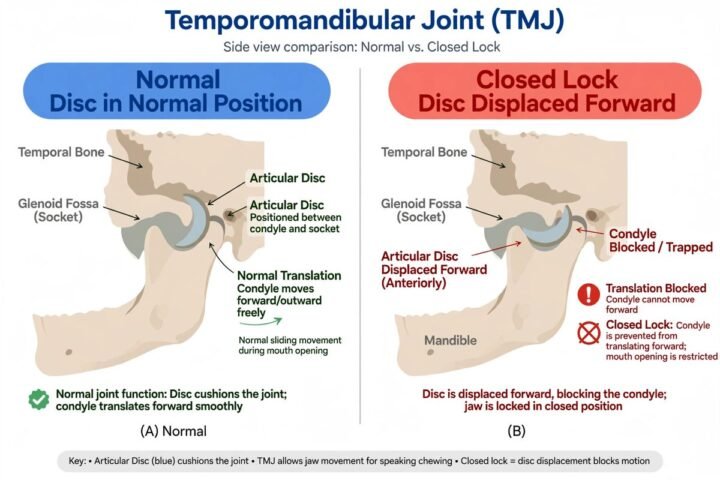
Above: in a closed lock the disc sits forward of the condyle and blocks its forward slide, so opening stops short. In a normal joint the disc stays between the condyle and the socket.
Why does a jaw locked closed happen?
The most common cause of a jaw locked closed is disc displacement without reduction. Inside each temporomandibular joint (TMJ), a small disc normally sits between the condyle — the rounded end of the lower jaw — and its socket, and moves with it. When the disc slips forward and does not slip back as you open, it mechanically obstructs the condyle. Clinicians call that pattern a closed lock.
The Journal of the Canadian Dental Association (JCDA) guide to closed lock describes the typical picture: maximum assisted opening of less than 40 mm including the vertical overlap of the front teeth, deflection of the jaw toward the affected side on opening, restricted movement to the opposite side, and no click — because there is no longer a disc slipping back into place to make one. Pain, when present, is often in front of the ear and sharpest at the point where movement stops.
Less than 40 mm
Maximum assisted opening below 40 mm, including the front-teeth overlap, is the examination threshold the JCDA uses for closed lock with limited opening. A normal jaw opens substantially wider — if you can fit only one or two knuckles between your front teeth, opening is limited.
Not every jaw locked closed is a disc. The JCDA differential for limited opening also includes chewing-muscle pain and inflammation, TMJ osteoarthritis, and less common causes such as ankylosis (a fused joint), coronoid hyperplasia, infection, fracture, and growths. A review of conservative treatment for disc displacement without reduction in Advances in Clinical and Experimental Medicine notes that the natural course is often self-limiting, with many people regaining opening over time as the joint adapts — which is why first treatment is deliberately gentle.
If your jaw locked closed after dental work rather than out of the blue, muscle spasm and joint overload move up the list. Our guide to a TMJ flare-up and its 48-hour plan covers that post-procedure pattern, and jaw pain after dental work explains when stiffness is expected and when to call the dentist back.
Why does a jaw get stuck open?
An open lock is usually a dislocation, not a disc problem. When the mouth opens very wide, the condyle slides forward onto a bony ridge called the articular eminence. In a dislocation it slides in front of that ridge, and spasm in the chewing muscles locks it there. StatPearls' review of mandibular dislocation describes the result: inability to close the mouth, drooling, difficulty with speech and chewing, severe pain in front of the ear, and a hollow you can feel in front of the ear where the condyle should sit.
Triggers are wide opening itself — yawning, laughing, singing, a big bite — plus dental treatment, intubation, and seizures. A blow to the chin while the mouth is open can also dislocate the jaw, but trauma changes the rules: a fracture must be excluded with imaging before anyone tries to put the jaw back. Certain medicines that can cause dystonia, an involuntary muscle contraction, can also mimic or cause an open lock and are treated differently, so tell the clinician every medicine you take.
Unlike a jaw locked closed, an open dislocation does not usually settle on its own and should not wait days. It is typically reduced promptly by a trained clinician, pressing down and then back so the condyle clears the ridge — never by pushing the chin straight up, which jams the condyle harder against it. The longer a dislocation is left, the harder reduction becomes, and a prolonged dislocation may need sedation or general anaesthesia.
What should you do in the first hour?
For a jaw locked closed, the first hour is about load reduction, not unlocking tricks. Stop chewing, rest the jaw with your lips together and teeth apart, and switch to liquids or very soft food you do not have to chew. The JCDA advises people with an acute closed lock to avoid hard foods, stop clenching, grinding, gum chewing, and nail biting, and to keep to gentle, controlled jaw movement within a pain-free range rather than stretching to the limit.

Heat or cold? NIDCR's first steps for jaw discomfort are soft foods, heat or cold to the face alongside gentle exercises, over-the-counter pain relief such as a nonsteroidal anti-inflammatory drug (NSAID) if it is safe for you, and cutting back on clenching and gum chewing. The JCDA adds a timing detail for closed lock: moist heat or ice can be applied in front of the ear, but heat should not be used in the first 72 hours after an acute injury. If in doubt after a fresh injury, start with cold and ask the clinician.
Then arrange care promptly — the same day for an open lock, and within a day or so for a new jaw locked closed, sooner if pain is severe or opening is shrinking. If you are unsure which professional to call first, our guide to who treats TMJ walks through dentist, doctor, oral surgeon, and orofacial pain specialist. Note the details a clinician will ask: when it locked, what you were doing, whether clicking stopped, how far you can open, and whether the jaw deviates to one side.
For an open lock, do less, not more. Support the jaw lightly if that is comfortable, do not try to force it shut, do not eat, and go to urgent care, an emergency department, or an emergency dentist now. Reduction is a trained, hands-on procedure — it is not a home remedy, and this article deliberately does not teach it as one.
What should you never force or try at home?
Do not pry a jaw locked closed open with your fingers, spoons, or wedges. The JCDA specifically warns that many patients try to force their mouths wider, aggravating the tissues inside the joint and potentially producing more pain. Gentle movement inside a comfortable range helps maintain mobility; force works against it.
Do not let a friend, partner, or unqualified practitioner manipulate your jaw, and do not attempt a dislocation reduction you saw in a video. After trauma especially, moving a jaw that may be fractured can cause harm. Likewise, do not start a leftover muscle relaxer, sedative, or someone else's prescription to try to unlock the jaw — medicines for TMD have limited evidence and real side effects, and NIDCR advises discussing benefits and risks with your own clinician.
Finally, do not ignore the mimics. Limited opening with fever, facial swelling, a bad taste, or a painful tooth suggests infection, not a disc. Inability to swallow, drooling you cannot manage, or any breathing difficulty is an emergency in its own right, whatever the jaw is doing.
How is a locked jaw diagnosed?
There is no single standard test for TMDs. NIDCR notes that diagnosis rests on your history and an examination of the head, neck, face, and jaw — tenderness, sounds, and how movement is limited. For closed lock, the JCDA examination adds two discriminating checks: gentle downward pressure on the lower front teeth produces little or no extra opening in a true disc block (a hard end feel), whereas a muscle cause usually allows a little more opening with mild passive pressure (a soft end feel), and loading the affected joint is often painful.
Imaging is selective. The JCDA confirms closed lock on magnetic resonance imaging (MRI), which shows the disc in front of the condyle both closed and on full opening. For a dislocation after trauma, StatPearls stresses imaging to exclude a mandibular or condylar fracture, and notes that infections around the throat, tetanus, and an acute closed lock itself can all be mistaken for dislocation — history, examination, and imaging together separate them. If a procedure is later considered, our explainer on TMJ arthrocentesis describes the least invasive surgical step.
| Feature | Jaw locked closed (disc) | Jaw locked open (dislocation) | Muscle spasm / trismus |
|---|---|---|---|
| Core problem | Disc displaced forward, blocking opening | Condyle in front of the eminence, blocking closing | Chewing muscles guarding; joint mechanics intact |
| Typical trigger | Often sudden; prior clicking that stopped | Wide yawn, long dental visit, seizure | Dental work, injection, stress, infection |
| Mouth position | Nearly closed; opens less than 40 mm | Stuck open; cannot close | Tight and painful; opening reduced but variable |
| First step | Rest, soft diet, prompt dental review | Same-day emergency reduction by a clinician | Heat, gentle movement, dental review |
What treatment follows after the first day?
For an acute jaw locked closed — one week or less — the JCDA pathway is referral to an oral medicine specialist or oral and maxillofacial surgeon, consideration of skilled manual manipulation to restore the disc–condyle relationship, and, if that succeeds, a short period with an anterior positioning appliance followed by nighttime use. If it does not respond, a minimally invasive procedure such as arthrocentesis or arthroscopy may be considered, followed by conservative support. That support is the backbone for everyone: education, soft diet, habit change, gentle exercises, a short course of NSAIDs when appropriate, a stabilization appliance for nighttime use, and physical therapy with a clinician experienced in TMD.
The conservative-first order is not a delay tactic. The Advances in Clinical and Experimental Medicine review concludes that the first-choice methods should be minimally invasive — education and counselling, manipulation, splint therapy, exercise therapy, and pharmacotherapy — with surgery considered only after conservative therapy has failed. NIDCR gives the same direction for TMDs generally: because evidence for many treatments is limited, start conservative and avoid treatments that permanently change the joint, teeth, or bite. Our comparison of physical therapy vs splint vs Botox for TMJ shows how those options stack up in trial evidence.
For a reduced dislocation, aftercare protects the result: limit wide opening for several weeks, support your chin when yawning, eat a soft diet for about a week, and use warm compresses and NSAIDs as advised, with dental or oral surgery follow-up — especially if it recurs. Recurrent dislocation, and chronic closed lock that has failed conservative care, both need specialist review rather than repeated home attempts.
Expect recovery to be measured in weeks, not hours, for a closed lock. The JCDA reassures patients that long-term consequences are usually minimal, with the majority regaining at least some of their original opening, and the conservative-treatment review suggests reassessment if there is no significant improvement after about 12 weeks. Keep follow-up even as it improves — a jaw that adapts still deserves a plan.
When is a locked jaw an emergency?
Go the same day — urgent care, emergency department, or emergency dentist — if your jaw is stuck open and will not close, if the lock followed trauma or a blow, if you cannot swallow or are drooling uncontrollably, or if there is any difficulty breathing. Those presentations need hands-on assessment, and trauma needs imaging before any reduction attempt.
Seek urgent care the same day, too, for locking with fever, facial or neck swelling, severe or worsening pain, a mouth that is opening less and less, or stiffness after a dental infection or extraction that is getting worse instead of better. Infection and fracture are the causes that must not be missed, and neither is a wait-and-see problem.
A new jaw locked closed without those red flags is still prompt-care, not no-care: book within a day or so, rest the jaw meanwhile, and escalate sooner if pain spikes, opening shrinks further, or the jaw deviates more. If episodes repeat — locking closed again after unlocking, or dislocating more than once — that pattern itself warrants specialist referral.
Frequently asked questions
Can a jaw locked closed unlock on its own?
Often, yes, at least partly. Reviews describe disc displacement without reduction as frequently self-limiting, with many people regaining useful opening over weeks as the joint adapts, even if the disc does not return to its original position. That is not a reason to skip assessment: an examination confirms the cause, rules out fracture or infection, and sets up the conservative care that helps recovery.
How long does a jaw locked closed last?
There is no single timeline. An acute closed lock is defined in guidance as one week or less; improvement commonly continues over the following weeks with rest, soft diet, and gentle movement. Reviews suggest reassessment if there is no significant improvement after about 12 weeks of conservative care. A jaw that is getting worse, not slowly better, should be reviewed sooner rather than waiting out any deadline.
Should I try to pop my jaw back in myself?
No. Forcing a jaw locked closed can aggravate the joint tissues and increase pain, and reducing a dislocated jaw is a trained procedure that must first exclude fracture after trauma. Videos make reduction look simple; they cannot examine you, feel for a fracture, or manage sedation and spasm. Rest the jaw, protect it from wide opening, and let a clinician who can examine and image you do any manipulation.
Is a locked jaw the same as lockjaw from tetanus?
No, although the words overlap. Lockjaw is the historical name for trismus in tetanus, where a toxin causes sustained spasm of the chewing muscles. Most locked jaws today are mechanical — a displaced disc, a dislocation, or muscle spasm after dental work — not tetanus. Because tetanus and throat infections can mimic a dislocation, clinicians ask about injuries, vaccination, fever, and sore throat before treating the jaw alone.
Conclusion
A jaw locked closed and a jaw stuck open look similar in the mirror — a mouth that will not do what you ask — but they are opposite mechanical problems with different urgency. Closed lock is usually a disc that has slipped forward and stayed there; open lock is usually a condyle trapped in front of its ridge. Both punish force and reward a calm first hour: rest, soft food, heat or cold used correctly, and prompt professional care.
If your jaw is stuck open, followed trauma, or comes with swelling, fever, or swallowing trouble, treat it as an emergency today. If it locked closed without red flags, rest it and book promptly — most closed locks improve with conservative care, and early guidance protects that recovery. Discuss your specific situation with your dentist or clinician before starting, stopping, or changing any treatment.
Sources
- National Institute of Dental and Craniofacial Research (NIDCR), NIH — TMD (Temporomandibular Disorders): more than 30 conditions, locking as a symptom, and conservative-first treatment including soft foods, heat or cold, NSAIDs, and habit reduction.
- Klasser GD, Epstein JB — How to Manage "Closed Lock" Disc Displacement Without Reduction With Limited Opening, Journal of the Canadian Dental Association: less-than-40 mm opening, hard end feel, acute vs chronic pathways, and the do-not-force warning.
- Miernik M, Więckiewicz W — The Basic Conservative Treatment of Temporomandibular Joint Anterior Disc Displacement Without Reduction, Advances in Clinical and Experimental Medicine 2015;24(4):731–735: self-limiting course, 12-week reassessment, minimally invasive first.
- Prechel U et al. / StatPearls — Mandible Dislocation, StatPearls via NCBI Bookshelf: inability to close, drooling and speech difficulty, fracture exclusion after trauma, and closed reduction principles.
Medical disclaimer: This article is educational information only and is not medical or dental advice, diagnosis, or treatment. Jaw locking can have causes that need urgent in-person assessment. If you cannot close your mouth, cannot swallow, have swelling, fever, or difficulty breathing, or your jaw locked after trauma, seek emergency care now. Otherwise, discuss your symptoms promptly with your own dentist or clinician.




0 Comments