Educational information · Not medical advice
In brief
Best night guard for clenching? Compare soft vs hard, boil-and-bite vs custom — what the evidence says about fit, protection, and when to see a dentist.
In this article
- What does a night guard actually do — and what does it not do?
- Soft vs hard: which material is the best night guard for clenching?
- How does a boil-and-bite guard compare with a custom guard?
- What do the guard types look like side by side?
- Who should skip the drugstore and go straight to custom?
- How should a good guard fit and feel?
- How do you care for a guard, and when do you replace it?
- When is a guard not enough for jaw pain?
- Frequently asked questions
- Conclusion
- Sources
Key Takeaways
- The best night guard for clenching is the one that protects your teeth every night without changing your bite or causing pain — for most heavy clenchers, that is a custom, full-arch, hard acrylic guard made and checked by a dentist.
- A guard is a barrier, not a cure. It separates the teeth so grinding wears the guard instead of your enamel; it does not reliably stop the clenching itself, and the evidence that guards relieve jaw-joint pain is limited.
- Soft guards feel comfortable at first, but in a small classic study a soft splint increased nighttime muscle activity in half the wearers, while a hard splint reduced it in most. A 2025 review of soft vs hard trials found the overall results similar and any superiority inconclusive.
- Boil-and-bite guards are a reasonable short stopgap. The American Dental Association says a custom guard gives the closest, most comfortable fit, and store-bought guards may not provide the same protection.
- Stop rule from the National Institute of Dental and Craniofacial Research: if an appliance causes pain, stop using it and consult your dentist or doctor — and never use a guard designed to permanently change your bite.
If you wake with a tight jaw, sore teeth, or a dull morning headache, you have probably already searched for the best night guard for clenching — and found dozens of products that all claim to be it. The honest answer is less tidy than the marketing: the best night guard for clenching depends on how hard you grind, what you need to protect, and whether the guard fits well enough to wear every night. This guide compares soft, hard, boil-and-bite, and custom guards on the evidence, so you can choose with your eyes open.
One distinction matters before any shopping. Clenching and grinding during sleep — sleep bruxism — is common. A 2024 systematic review and meta-analysis put the global prevalence of sleep bruxism at 21% and awake bruxism at 23%, with sleep bruxism highest in North America at 31%. A guard does not treat the reasons you clench. What it can do, when it is chosen and fitted well, is stand between your teeth and the force. If your main problem is jaw pain rather than tooth wear, start with our comparison of a TMJ splint vs. a night guard, because a pain splint and a protective guard are prescribed for different jobs.
What does a night guard actually do — and what does it not do?
A night guard — also called an intraoral appliance, occlusal splint, or bruxism splint — is a removable device that fits over the upper or lower teeth. The National Institute of Dental and Craniofacial Research (NIDCR) describes these appliances plainly: they fit over the teeth, protect the teeth, and may help with habit reversal such as jaw clenching — and they do not change the teeth or bite. In other words, the guard is the surface that takes the wear. Your enamel, fillings, and crowns are spared the direct tooth-to-tooth contact while the jaw muscles do whatever they were going to do anyway.
That framing sets realistic expectations. A 2024 systematic review of different occlusal splint types for sleep bruxism — 15 studies and 529 people drawn from 808 screened articles — describes splints the same way, as protective barriers whose primary purpose is to obstruct tooth-to-tooth contact during sleep. Some designs reduced bruxism episodes in some trials, but the effects on muscle activity varied, and in one comparison both a stabilization splint and a palatal control device reduced episodes only temporarily, with the effect not persisting beyond a few weeks. Splint therapy was judged a viable approach for managing sleep bruxism — viable for protection and management, not a switch that turns grinding off.
The pain question needs the same honesty. The NIDCR states directly that there is not a lot of evidence on whether intraoral appliances improve temporomandibular disorder (TMD) pain. So if a product promises that the best night guard for clenching will also fix your jaw-joint pain, treat that as marketing, not evidence. A guard can be the right purchase for protecting teeth while being the wrong expectation for pain — and our article on why you clench your jaw at night covers the stress, medication, and sleep-apnea drivers that a piece of plastic cannot address.
About 1 in 5
About 1 in 5 adults worldwide — 21% in the 2024 meta-analysis by Zieliński and colleagues — grind or clench during sleep, rising to 31% in North America. Most do not know it until a dentist spots worn, chipped, or cracked teeth.
Soft vs hard: which material is the best night guard for clenching?
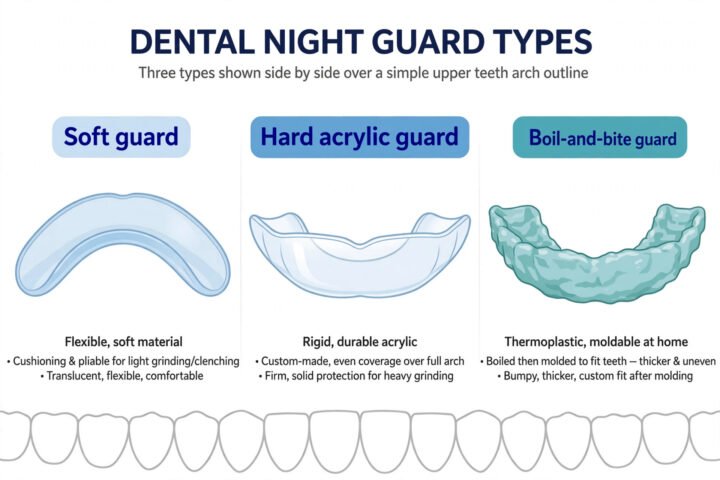
Material is the first real fork in the road. Soft guards are made from flexible material such as silicone. The 2024 splint-types review notes they are renowned for comfort and provide a cushioning mechanism that mitigates the impact of clenching and grinding. That comfort is real, and for a light, occasional clencher with no heavy wear, a soft guard can be a sensible, inexpensive start. Traditional hard guards are made from acrylic. The same review notes that traditional acrylic splints exhibit durability and can endure the stresses exerted during bruxism episodes — which is why hard acrylic is the default for heavy grinders, who can chew through soft material.

The caution about soft guards comes from muscle activity, not durability. In a small 1987 study in the Journal of the American Dental Association, Okeson recorded nighttime muscle activity in ten participants wearing first a hard and then a soft occlusal splint. The hard splint significantly reduced muscle activity in eight of the ten participants. The soft splint significantly reduced muscle activity in only one participant — and significantly increased it in five. The study is old and tiny, so it is a caution, not a verdict: some people appear to clench into a chewy surface the way you might bite into a stress ball. If your jaw feels more tired after a few weeks in a soft guard, that pattern is a plausible explanation, and a hard guard is the usual next step to discuss.
Newer head-to-head evidence is more even-handed. A 2025 systematic review of randomized trials comparing soft and hard occlusal splints for TMD and bruxism found that both types effectively reduced pain, improved mandibular movement, and alleviated symptoms — and concluded that the results for both types were similar in all aspects, so the reported superiority of either type over the other is inconclusive. Read together, the fair summary is this: hard acrylic has the longer track record, the durability, and the one classic study in its favor; soft has comfort and no proven overall inferiority in recent trials. For heavy clenching with visible tooth wear, most dentists still start hard. For light clenching where comfort decides whether you wear anything at all, soft can win on adherence — a guard in a drawer protects nothing.
How does a boil-and-bite guard compare with a custom guard?
The second fork is how the guard is made. A boil-and-bite guard is a thermoplastic tray you soften in hot water and mold to your teeth at home. A stock guard skips even that step and is worn as sold. A custom guard is made from a mold or digital scan of your own teeth, usually by a dental lab, and your dentist checks and adjusts the fit.
The American Dental Association (ADA), through its MouthHealthy patient site, is direct about the ranking: your dentist may recommend a night guard to protect your teeth while you sleep; a custom guard, made from a special mold that your dentist creates, will give you the closest, most comfortable fit; and night guards sold online and in stores may not provide the same protection as a guard made just for you. The ADA also draws a line shoppers often miss: night guards are not the same as sports guards. A sports mouthguard has extra cushioning for impact, which probably will not feel comfortable for sleep — do not repurpose one as a night guard.
None of that makes a boil-and-bite guard useless. It is available tonight, it costs a fraction of a custom guard, and some protection is better than none while you wait for a dental appointment — especially during a flare, when the self-care steps in our 48-hour TMJ flare-up plan are running alongside it. Its limits are fit and follow-up: the thickness ends up wherever your bite pushed it, it can feel bulky, it can loosen as it wears, and nobody professional ever checks what it is doing to your bite. Treat it as a bridge, not a destination — and bring it to your next dental visit so the fit can be looked at.
What do the guard types look like side by side?
The table below pulls the comparison together. Prices vary widely by region, dental plan, and lab, so the table compares fit, protection, and supervision rather than quoting costs that would be wrong for most readers by next year.
| Guard type | How it fits | Protection | Best suited to | Who checks it |
|---|---|---|---|---|
| Stock guard (ready-made) | Worn as sold; no molding | Least reliable coverage; can feel loose and bulky | Emergency one-or-two-night cover only | Nobody, unless you bring it in |
| Boil-and-bite guard | Softened in hot water and molded at home | Some protection; ADA notes store guards may not protect as well as a custom guard | Short-term stopgap while awaiting a dental visit | Nobody by default — ask your dentist to check it |
| Custom soft guard | Made from your mold or scan; flexible material | Good tooth coverage with cushioning; can wear through under heavy grinding | Light clenchers who need comfort to stay consistent | Your dentist, at fitting and checkups |
| Custom hard acrylic guard | Made from your mold or scan; rigid, full-arch, even contacts | Most durable barrier; the most studied design for heavy bruxism | Heavy clenchers and grinders, and anyone protecting crowns or implants | Your dentist, who can adjust the bite contacts |
Two rows deserve emphasis. First, coverage: the conservative choice across the evidence is a full-arch guard. A device that covers only some teeth leaves the uncovered teeth free to shift over months of wear, which is one route to the bite changes the NIDCR warns against. Second, supervision: the custom rows are the only ones where a professional verifies the fit, watches your teeth for wear, and adjusts the appliance. That follow-up is a large part of what the higher price actually buys.
Who should skip the drugstore and go straight to custom?
Some situations make the custom route the clear first choice rather than an upgrade to consider later:
- Heavy wear or damage already present. Flattened, chipped, or cracked teeth — the signs the ADA says dentists and hygienists often spot first — mean the forces are already doing harm, and protection needs to be exact.
- Expensive dental work to protect. Crowns, veneers, and implants concentrate the cost of grinding. A guard made to your bite is cheap insurance by comparison.
- A soft or store guard made things worse. More morning soreness, a bite that feels off, or a guard you keep spitting out at night are fit problems, not willpower problems.
- Jaw pain, locking, or limited opening alongside the clenching. That combination needs a diagnosis before an appliance, not after — our guide to who treats TMJ explains which clinician to book.
- Possible sleep apnea. Loud snoring, witnessed pauses, or unrefreshing sleep change the appliance conversation entirely; a guard is not an apnea device, and the ADA notes a sleep study may be suggested when poor sleep is suspected.
Conversely, a boil-and-bite guard is a reasonable first step if your dentist has confirmed mild clenching with no significant wear, you need something tonight, and you have a checkup booked where the guard — and your teeth — will be reviewed.
How should a good guard fit and feel?
Whichever type you choose, run the same fit check. The guard should seat fully and feel snug without pinching. It should not rock when you press it, should not put sharp pressure on one tooth, and your bite should meet it evenly rather than landing on a single high spot. Expect an adjustment period of a few nights: a bulky feeling and extra saliva are common at first, and mild awareness of the appliance is normal.
What is not normal is pain. The NIDCR’s two guardrails are the ones to memorize: make sure the appliance is not designed to permanently change your bite, and stop using it and consult your dentist or doctor if it causes pain. Add three practical stop signals of your own: a bite that still feels wrong an hour after you take the guard out in the morning, new gum soreness that does not settle within a few nights, and visible cracking or a hole worn through the material. Any of those means the guard needs professional eyes, not more perseverance.
How do you care for a guard, and when do you replace it?
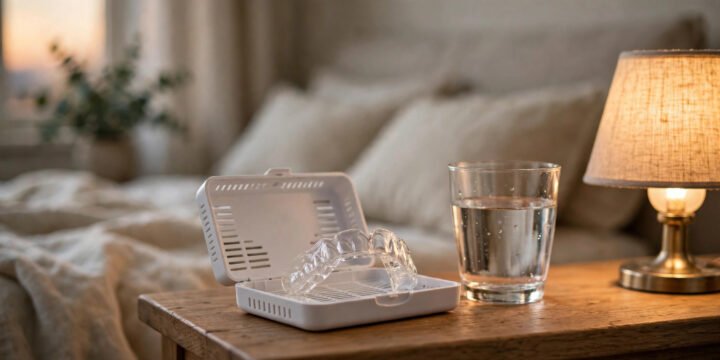
Daily care is simple and it protects both the guard and your mouth. Rinse the guard with cool water when you take it out, brush it gently with a soft brush, and let it dry before storing it in its vented case — a closed, damp case is where odor and bacteria thrive. Keep it away from heat, which can warp thermoplastic and acrylic alike, and out of reach of pets, for whom a guard is apparently an excellent chew toy. Bring the guard to every dental checkup: your dentist will check its wear pattern, which is itself diagnostic information about how hard and where you clench.
Replace a guard when it cracks, wears thin or through, no longer seats the way it did, or survives a change in your teeth — a new crown, a filling, or orthodontic movement all change the surface the guard was made for. A boil-and-bite guard typically reaches that point far sooner than a custom acrylic guard, which is part of the honest cost comparison: the cheapest guard bought repeatedly can approach the price of one custom guard that is checked and adjusted for years.
When is a guard not enough for jaw pain?
Because this site covers jaw pain as well as tooth protection, the boundary needs stating plainly. If your main complaint is chronic jaw pain — pain lasting three months or more — a guard is not the guideline-backed first move. The 2023 BMJ clinical practice guideline for chronic pain associated with TMD, built on a network meta-analysis of randomized trials, issued strong recommendations in favor of cognitive behavioral therapy, therapist-assisted mobilization, manual trigger point therapy, supervised postural exercise, supervised jaw exercise and stretching, and usual care such as home exercises and education — and a conditional recommendation against reversible occlusal splints for that chronic-pain population. The guideline does not apply to acute TMD pain, and a conditional recommendation against is not a ban; it is a ranking. Exercises, therapy, and education come first for chronic pain; tooth protection is a separate decision you and your dentist can still make on its own merits.
So the best night guard for clenching earns its place by protecting teeth — full stop. If pain is the problem, get the pain diagnosed and treated with the approaches the guideline ranks highest, and let the guard do the narrower job it is actually good at.
Frequently asked questions
What is the best night guard for clenching if I grind heavily?
For heavy grinding, a custom hard acrylic guard is usually the best night guard for clenching: it is made from a mold or scan of your teeth, covers the full arch evenly, withstands strong forces far longer than soft material, and can be adjusted by your dentist. The ADA says a custom guard gives the closest, most comfortable fit, while store-bought guards may not provide the same protection.
Is a soft or hard night guard better for TMJ?
Neither is proven better overall. A 2025 systematic review of randomized trials found soft and hard splints produced similar results for pain, jaw movement, and symptoms, calling any superiority inconclusive. One small 1987 study found a hard splint reduced nighttime muscle activity in 8 of 10 people while a soft splint increased it in 5 of 10. If a soft guard leaves your jaw more tired, ask about hard acrylic.
Can a night guard stop me clenching my jaw?
No guard reliably stops the clenching itself. The NIDCR describes intraoral appliances as devices that fit over the teeth and protect them, and notes there is not a lot of evidence that they improve TMD pain. Your jaw muscles may still clench against the guard; the guard’s job is to make sure the force wears plastic or acrylic instead of your enamel, fillings, and crowns.
How long does a night guard last?
It depends on the material and how hard you grind. A boil-and-bite guard typically wears out fastest, a custom soft guard lasts longer, and a custom hard acrylic guard is the most durable — often years with checkups and adjustments. Replace any guard that cracks, wears through, stops seating properly, or no longer matches your teeth after new dental work, and bring it to checkups so wear can be assessed.
Conclusion
The best night guard for clenching is not a brand; it is a fit, a material, and a follow-up plan matched to how hard you grind. Heavy clenchers protecting worn teeth or costly dental work are best served by a custom, full-arch, hard acrylic guard made and checked by a dentist. Light clenchers may do well with a custom soft guard they actually enjoy wearing. A boil-and-bite guard is a sensible bridge for a few weeks — not a long-term substitute, and never a sports guard pressed into night duty.
Hold every option to the NIDCR’s two rules: the guard must not be designed to permanently change your bite, and if it causes pain, stop and get it checked. And if jaw pain, rather than tooth wear, is your main problem, treat the guard as protection only — and pursue the exercise, therapy, and education approaches the evidence ranks first for pain, with a clinician who can diagnose which problem you actually have.
Medical disclaimer: This article is educational information only and is not medical or dental advice. It does not diagnose or treat any condition. Talk with your dentist or doctor about your own symptoms, especially if you have jaw pain, locking, a changing bite, or signs of sleep apnea.
Sources
- National Institute of Dental and Craniofacial Research (NIDCR). Temporomandibular Disorders (TMD) — intraoral appliances protect the teeth, evidence for TMD pain relief is limited, appliances must not permanently change the bite, and users should stop and consult a clinician if an appliance causes pain. nidcr.nih.gov/health-info/tmd
- American Dental Association, MouthHealthy. Teeth Grinding — a custom guard made from a dentist’s mold gives the closest, most comfortable fit; store-bought guards may not provide the same protection; night guards differ from sports guards. mouthhealthy.org/all-topics-a-z/teeth-grinding
- Busse JW et al. Management of chronic pain associated with temporomandibular disorders: a clinical practice guideline. BMJ 2023;383:e076227 — strong recommendations for CBT, mobilization, and supervised jaw exercise for chronic TMD pain; conditional recommendation against reversible occlusal splints in that population. bmj.com
- Okeson JP. The effects of hard and soft occlusal splints on nocturnal bruxism. J Am Dent Assoc 1987;114(6):788-91 — in ten participants, the hard splint significantly reduced nighttime muscle activity in eight; the soft splint reduced it in one and increased it in five. pubmed.ncbi.nlm.nih.gov/3475357
- Zieliński G, Pająk A, Wójcicki M. Global prevalence of sleep bruxism and awake bruxism: a systematic review and meta-analysis. J Clin Med 2024;13(14):4259 — global sleep bruxism 21%, awake bruxism 23%, sleep bruxism 31% in North America. pmc.ncbi.nlm.nih.gov/articles/PMC11278015
- Comparative analysis of different types of occlusal splints for the management of sleep bruxism: a systematic review. BMC Oral Health 2024 — 15 studies, 529 participants; splints function as protective barriers; acrylic durable, soft splints cushioning and comfortable; effects on bruxism episodes varied. link.springer.com





0 Comments