Educational information · Not medical advice
In brief
Does seasonal depression lift with a SAD lamp? What 10,000-lux light therapy trials show, morning timing, who should skip it, and what else helps in winter.
In this article
- What is seasonal depression, and how is it different from the winter blues?
- Why does seasonal depression hit in winter?
- Do SAD lamps actually work for seasonal depression?
- How should you use a light box, if you try one?
- Who should check with a clinician before using bright light?
- What else helps besides light therapy?
- Frequently asked questions
- Conclusion
- Sources
Key Takeaways
- Seasonal depression is a recurrent type of depression with a seasonal pattern — for most people symptoms start in late fall or early winter and lift in spring, lasting about 4 to 5 months, says the National Institute of Mental Health (NIMH).
- Bright light therapy has been a mainstay treatment for winter-pattern seasonal depression since the 1980s, and meta-analyses of randomized trials find it improves symptoms compared with control light — though trials are mostly small and varied.
- The best-studied setup is a 10,000-lux light box used for about 30 to 45 minutes, usually first thing in the morning, with the light filtering out ultraviolet light.
- Light is not risk-free for everyone: people with bipolar disorder, certain eye diseases, or medicines that increase sensitivity to sunlight should use it only with medical supervision.
- Talk therapy adapted for seasonal depression, antidepressant medication, and — where deficiency is present — vitamin D are the other main options NIMH lists, and they can be combined with light.
If your mood, sleep and appetite change in the same way every fall, seasonal depression may be part of the story. Seasonal depression is not simply disliking cold weather. It is a pattern of depressive symptoms that returns with the season, eases when the season changes, and can affect how you feel, think and handle daily activities, according to NIMH.
This article explains what seasonal depression is, why shorter days are thought to drive it, and what the evidence actually shows for SAD lamps — including the specs that matter, the timing that matters more, and who should not start bright light on their own. It is educational information only, not a diagnosis.
What is seasonal depression, and how is it different from the winter blues?
Seasonal depression — clinically called seasonal affective disorder, or SAD — is a type of depression characterized by a recurrent seasonal pattern, NIMH explains. In most cases symptoms start in late fall or early winter and go away in spring and summer; NIMH calls this winter-pattern SAD. A less common summer-pattern form starts in spring or summer.
General depression symptoms can include a persistent sad, anxious or empty mood, loss of interest in activities, low energy, difficulty concentrating, and changes in sleep, appetite or weight. For winter-pattern seasonal depression, NIMH lists additional features: oversleeping, overeating particularly with a craving for carbohydrates and weight gain, and social withdrawal — sometimes described as feeling like hibernating.
That pattern is different from the “holiday blues.” NIMH notes that winter-pattern SAD should not be confused with sadness or anxiety brought on by holiday stresses: the depression in SAD is related to changes in daylight hours, not the calendar. A clinician diagnosis also looks for a repeated pattern — depressive episodes during a specific season for at least 2 consecutive years, and seasonal episodes that are more frequent than episodes at other times of year, NIMH says.
If low mood is new, severe, or does not lift, do not self-label it. Similar tiredness and withdrawal can appear in other conditions, including burnout vs depression, and a clinician can help separate them.
Why does seasonal depression hit in winter?
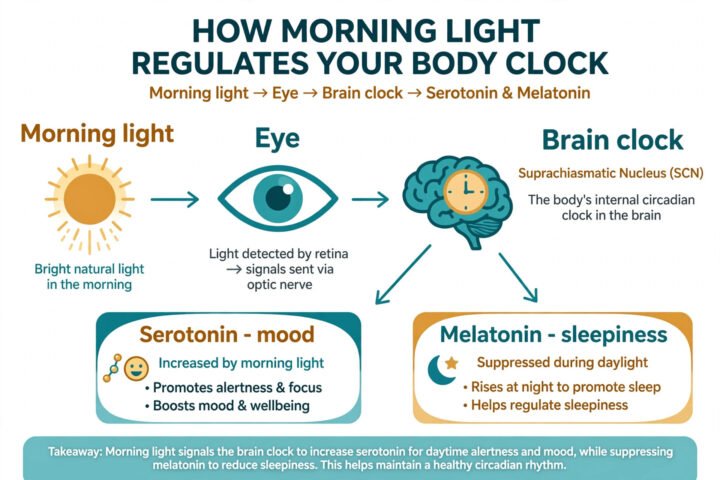
Researchers are still determining the exact cause, NIMH says, and most work has focused on the winter pattern. Two brain systems are discussed most often: serotonin and melatonin. NIMH summarizes studies indicating that people with SAD, especially winter-pattern SAD, have reduced levels of serotonin, a brain chemical that helps regulate mood, and that sunlight affects molecules that help maintain normal serotonin levels. Shorter daylight may prevent those molecules from functioning properly.
Melatonin — a hormone important for the normal sleep-wake cycle — is the second piece. NIMH notes that people with winter-pattern SAD may produce too much melatonin, which can increase sleepiness and lead to oversleeping. Together, changes in serotonin and melatonin can disrupt the body’s daily rhythm tied to the seasonal night-day cycle, so a person can no longer adjust as easily to changes in day length.
Vitamin D may add to the picture for some people. NIMH notes that vitamin D is believed to promote serotonin activity, and with less daylight in winter people with SAD may have lower vitamin D levels. That does not prove that a supplement fixes mood — as discussed below, the trial results for vitamin D in SAD have been mixed.
Geography and personal history matter too. NIMH says SAD occurs much more often in women than in men, begins most often in young adulthood, and is more common in people living farther north, where winter daylight hours are shorter. It is also more common in people with depression or bipolar disorder. None of those factors alone diagnoses seasonal depression; they describe who is more likely to experience it.
About 4 to 5 months — the length of time NIMH says SAD symptoms typically last out of the year. A brief low week in December and a recurrent 4-to-5-month pattern are not the same clinical picture.
Do SAD lamps actually work for seasonal depression?
For winter-pattern seasonal depression, the honest answer is: bright light has real trial support, with real limits. NIMH calls light therapy a mainstay for winter-pattern SAD since the 1980s, aiming to make up for diminished natural sunlight in darker months. A 2019 meta-analysis of randomized controlled trials in Psychotherapy and Psychosomatics found bright light therapy superior to placebo conditions for depression ratings in SAD. A 2024 network meta-analysis in the Journal of Affective Disorders likewise described phototherapy as a promising first-line non-drug treatment for SAD.
Both reviews come with cautions that should stay in the article, not in a footnote. The trials are mostly small, use different devices and control conditions, and blinding bright light is inherently difficult — you can see whether a lamp is bright. Evidence quality is therefore described as limited or low in parts of this literature, and long-term prevention of recurrence is less certain than short-term symptom improvement. Light therapy should be presented as a supported option to discuss with a clinician, not as a guaranteed cure.
How does that compare with other options? NIMH reports that when researchers directly compared cognitive behavioral therapy adapted for SAD (CBT-SAD) with light therapy, both were equally effective in improving SAD symptoms, although some symptoms improved slightly faster with light therapy, and in a longer follow-up the benefits of CBT-SAD seemed to last longer. That comparison matters: a lamp is one route, not the only evidence-based route.
It also helps to separate a proper light box from ordinary lamps and from wellness gadgets. A brighter kitchen, a sunrise alarm, or a walk at lunch may support a routine, but they are not the same dose studied in trials. The dose below is the part most marketing leaves vague.
How should you use a light box, if you try one?
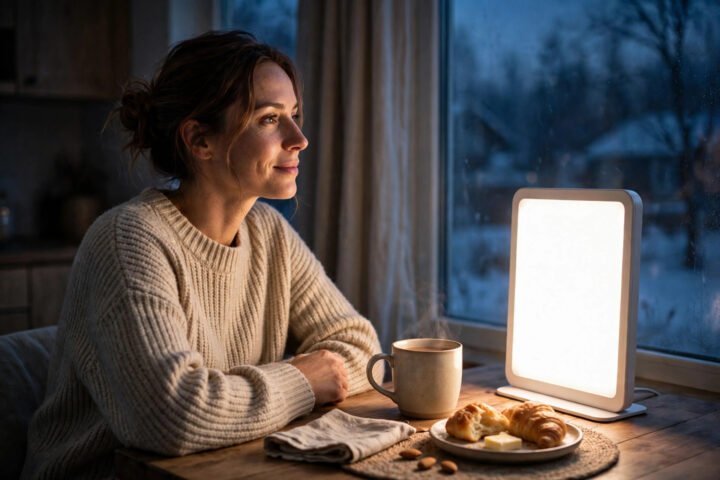
NIMH describes the standard approach plainly: sit in front of a very bright light box — 10,000 lux — every day for about 30 to 45 minutes, usually first thing in the morning, from fall to spring. The box is about 20 times brighter than ordinary indoor light and filters out potentially damaging ultraviolet light, which NIMH says makes it a safe treatment for most people when used as directed.
Three practical points follow from that description. First, lux is measured at a stated distance: a box rated 10,000 lux only delivers that dose at the distance in its instructions, so sitting much farther away for the same minutes is a smaller dose. Second, timing is morning for the winter pattern in the NIMH description — using bright light late in the evening is not the studied routine and can work against sleep. Third, you do not stare directly into the light; you sit near it with your eyes open, for example while eating breakfast or working, following the device instructions.
Morning outdoor light is a useful companion habit, and our guide to morning light and your body clock explains the circadian routine in more detail. Outdoor light varies hugely by season, weather and latitude, however, so it should not be assumed to equal a 10,000-lux box dose on a dark winter morning.

| Option | What it is | Evidence note |
|---|---|---|
| 10,000-lux light box | Bright, UV-filtered box, about 30–45 minutes in the morning | Mainstay since the 1980s per NIMH; meta-analyses find benefit vs control light, with small, varied trials |
| CBT-SAD | Talk therapy adapted for SAD, typically twice-weekly group sessions for 6 weeks per NIMH | Equally effective as light in a head-to-head comparison per NIMH; benefits seemed to last longer at follow-up |
| Antidepressant medication | Prescription treatment for depression, including SSRIs; extended-release bupropion is FDA-approved to prevent seasonal episodes in some people | Listed by NIMH as a main treatment category; prescriber decision, usually 4–8 weeks to work |
| Ordinary indoor lamp | Household lighting, far dimmer than a light box | Not the dose studied in SAD trials; do not assume it substitutes for a 10,000-lux box |
Who should check with a clinician before using bright light?
Bright light is often described as harmless because it is not a drug. That framing is too loose. NIMH specifically warns that people with certain eye diseases, or people taking certain medications that increase sensitivity to sunlight, may need alternative treatments or light therapy only under medical supervision.
Bipolar disorder deserves separate emphasis. Reviews of light therapy note that bright light can, rarely, precipitate hypomania or mania in people with bipolar disorder, so it should be used only with clinician guidance and monitoring in that group. NIMH also notes SAD is more common in people with bipolar disorder, especially bipolar II — which makes this caution directly relevant, not theoretical.
Get prompt help rather than starting a lamp if mood is severe, functioning is collapsing, or there are thoughts of death or suicide. NIMH directs people who are struggling or having thoughts of suicide to call or text 988 in the United States to reach the Suicide and Crisis Lifeline, or call 911 in life-threatening situations. Seasonal depression is a form of depression, and severe symptoms need the same urgency as any other depression.
Side effects in general use are usually described as mild and dose-related — for example headache or eye strain — and lowering the light dose or distance is a common response described in reviews. If symptoms worsen, sleep becomes markedly reduced with unusually high energy, or eye symptoms appear, stop and seek medical advice rather than pushing through.
What else helps besides light therapy?
NIMH lists four main treatment categories for SAD: light therapy, psychotherapy, antidepressant medication, and vitamin D. Light therapy and vitamin D are described as treatments for winter-pattern SAD, while psychotherapy and antidepressants treat depression in general, including both winter- and summer-pattern SAD. There are no treatments specific to summer-pattern SAD.
Psychotherapy for SAD has a specific form. CBT-SAD, NIMH explains, is typically conducted in two weekly group sessions for 6 weeks, focuses on replacing negative thoughts related to the season, and uses behavioral activation — identifying and scheduling pleasant, engaging indoor or outdoor activities to offset loss of interest. That activity scheduling overlaps with habits that also help anxiety and withdrawal; see our guides to breathwork for anxiety and health anxiety for adjacent coping tools, while recognizing they are not SAD treatments themselves.
On vitamin D, be precise: NIMH says many people with winter-pattern SAD have vitamin D deficiency and supplements may help, but studies have produced mixed results — some indicating an effect comparable to light therapy and others finding no effect. Testing and supplementation are therefore a clinician conversation, not a self-prescribed substitute for light or therapy.
Because onset is predictable, NIMH notes that people with a history of SAD might benefit from starting treatment before fall, to help prevent or reduce episodes — while noting that few studies have investigated prevention directly. A personalized plan, including timing, is best discussed with a health care provider before symptoms peak.
Frequently asked questions
Can seasonal depression be diagnosed from one bad winter?
No — NIMH criteria look for a recurrent pattern, including depressive episodes during a specific season for at least 2 consecutive years and seasonal episodes occurring more often than episodes at other times. One difficult winter is a reason to talk with a clinician, but it does not by itself establish seasonal depression or rule out other causes of low mood, fatigue and sleep change.
How long does a SAD lamp session need to be?
NIMH describes sitting in front of a 10,000-lux light box for about 30 to 45 minutes every day, usually first thing in the morning, from fall to spring. Dimmer devices require longer at their stated distance, which is why lux, distance and minutes need to be read together. Follow the specific device instructions and any clinician guidance rather than improvising a shorter, farther routine.
Do SAD lamps work for non-seasonal depression too?
The strongest and longest-standing use described by NIMH is winter-pattern seasonal depression, where light therapy has been a mainstay since the 1980s. Research on bright light for non-seasonal depression exists, but it is a separate question with a different evidence base. Do not assume a lamp replaces assessment or treatment for depression that does not follow a seasonal pattern; discuss the pattern you actually have with a clinician.
Is vitamin D as good as light therapy for seasonal depression?
The evidence is mixed. NIMH says vitamin D studies in winter-pattern SAD have produced conflicting results, with some indicating an effect as strong as light therapy and others finding no effect. Many people with winter-pattern SAD do have low vitamin D, so testing may be worthwhile, but a supplement should not be presented — or used — as a proven equal substitute for light therapy or other care.
Conclusion
Seasonal depression is a recurrent, daylight-linked form of depression, not a character flaw and not just the holiday blues. For the winter pattern, SAD lamps have a genuine evidence base: meta-analyses find bright light improves symptoms compared with control light, and NIMH has described light therapy as a mainstay since the 1980s — at a specific dose, 10,000 lux for about 30 to 45 minutes in the morning, from a UV-filtered box.
The limits matter as much as the headline. Trials are small and varied, prevention evidence is thinner, vitamin D results are mixed, and people with bipolar disorder, eye disease or light-sensitizing medicines need supervision first. If the pattern sounds familiar, the most useful next step is a conversation with a clinician about diagnosis, light, therapy and timing — ideally before the darkest weeks, not after them. For related reading on mood and daily rhythms, see social anxiety and what helps.
Medical disclaimer: This article is educational information only and is not medical advice, diagnosis or treatment. Talk with your clinician, dentist or mental health professional about your own symptoms and treatment options. If you or someone you know is having thoughts of suicide, call or text 988 in the United States or call 911 in an emergency.
Sources
- National Institute of Mental Health. Seasonal Affective Disorder — symptoms, diagnosis criteria, causes (serotonin, melatonin, vitamin D), and treatments including 10,000-lux light therapy for about 30–45 minutes in the morning, CBT-SAD, antidepressants and vitamin D.
- Pjrek E, et al. The Efficacy of Light Therapy in the Treatment of Seasonal Affective Disorder: A Meta-Analysis of Randomized Controlled Trials. Psychotherapy and Psychosomatics. 2019. PMID 31574513 — meta-analysis finding bright light therapy superior to placebo for depression ratings in SAD, with heterogeneity cautions.
- Treatment measures for seasonal affective disorder: a network meta-analysis. Journal of Affective Disorders. 2024 — network meta-analysis describing phototherapy as a promising first-line non-pharmacological treatment for SAD while emphasizing low evidence quality and need for larger trials.
- Galima SV, et al. Seasonal Affective Disorder: Common Questions and Answers. American Family Physician. 2020 — describes light therapy (2,500 to 10,000 lux for 30 to 60 minutes daily) as a first-line treatment for SAD, alongside CBT and antidepressants.




0 Comments