
Educational information · Not medical advice
In brief
Social anxiety help that works in daily life: why small talk feels exhausting, how self-focus and safety behaviours keep it going, and CBT steps that help.
In this article
- What is social anxiety, and how is it different from shyness?
- Why does small talk feel so exhausting with social anxiety?
- What keeps social anxiety going during a conversation?
- How can you make small talk easier, step by step?
- How do you stop replaying conversations afterwards?
- What treatment gives the strongest social anxiety help?
- When should you seek help promptly?
- Frequently asked questions
- Conclusion
- Sources
Key Takeaways
- Small talk is exhausting with social anxiety not because you lack social skills, but because your attention turns inward — monitoring your voice, face, and hands leaves little attention for the actual conversation.
- The National Institute of Mental Health (NIMH) estimates about 7.1% of U.S. adults had social anxiety disorder in the past year, and about 12.1% experience it at some point in their lives.
- Safety behaviours — rehearsing every sentence, avoiding eye contact, asking questions only to deflect attention, checking your phone — feel protective but prevent the learning that the feared judgement usually does not happen.
- The strongest social anxiety help is individual cognitive behavioural therapy (CBT) designed specifically for social anxiety, which the UK NICE guideline puts first, usually up to 14 sessions over about four months.
- Practical first steps are small and specific: shift attention outward, drop one safety behaviour at a time, run brief behavioural experiments, and time-limit the post-conversation replay.
A two-minute chat about the weather should not leave anyone drained, yet for many people it does. If you are looking for social anxiety help, small talk is often the place the problem shows up first: you walk away exhausted, replaying every sentence, convinced you sounded strange. The conversation itself was brief. The work your mind did during and after it was not.
This article explains why. It separates social anxiety from ordinary shyness and introversion, shows how self-focused attention and safety behaviours turn a short exchange into a performance you feel you must survive, and sets out the steps that form the core of effective social anxiety help — including the treatment guidelines recommend first, and when to seek it promptly.
What is social anxiety, and how is it different from shyness?
The NIMH describes social anxiety disorder as a common anxiety disorder in which a person feels anxiety or fear in situations where they may be scrutinised, evaluated, or judged by others — speaking in public, meeting new people, dating, a job interview, answering a question in class, asking for help, or talking to a cashier in a store. Everyday situations, in other words, not only stages.
For a diagnosis, the NIMH notes, the fear must be strong, bring avoidance or intense discomfort, last at least six months, and interfere with daily life such as work, school, or relationships. People in those situations may blush, sweat, or tremble, feel a rapid heart rate, feel their mind going blank, have a rigid posture, or speak in an overly soft voice. Social anxiety usually starts during childhood or adolescence and may resemble extreme shyness at first.
About 7 in 100 — about 7.1% of U.S. adults had social anxiety disorder in the past year, according to NIMH figures from the National Comorbidity Survey Replication; about 12.1% experience it at some point in their lives, with past-year rates of 8.0% in women and 6.1% in men.
Shyness and introversion are different. A shy person may warm up slowly and then relax. An introvert may simply prefer smaller groups and need quiet time afterwards to recharge, without fearing judgement. Social anxiety is defined by the fear itself — of being watched, judged, embarrassed, or rejected — and by what that fear makes you avoid or endure. If exhaustion after social events comes mainly from replay and dread rather than from the company itself, that distinction matters, because the response differs. The wider pattern of worry taking over the evening is also familiar to readers of our article on health anxiety and googling symptoms at 2 AM — a different worry, the same reassurance loop underneath.
Why does small talk feel so exhausting with social anxiety?
Small talk looks light from the outside, but it is unstructured. There is no agenda, no script, and no clear moment when you have done it correctly. For a mind scanning for judgement, that openness is the difficulty: every pause can feel like evidence, and every response has to be produced while you are also watching yourself produce it.
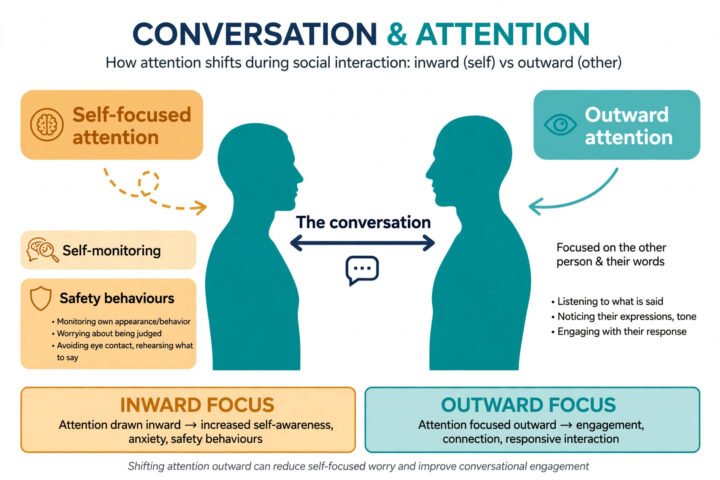
Psychologists David Clark and Adrian Wells, whose model underpins the most effective CBT for social anxiety, describe what happens when a feared situation begins. Attention shifts inward. Instead of listening to the other person, you monitor yourself — are my hands shaking, is my face red, am I making sense — and you build a picture of how you must appear, based mainly on how anxious you feel. That picture is usually far harsher than how you actually come across, but because your attention is inward, you miss the ordinary external evidence — a nod, a smile, a conversation continuing normally — that would correct it.
That split attention is the exhaustion. You are effectively doing two jobs at once: holding a conversation, and running a continuous commentary on your own performance. It is also why stress from social days often shows up in the body; our guide to anxiety, jaw clenching, and the stress–pain loop explains how sustained tension during concentration and worry can settle in the jaw.
What keeps social anxiety going during a conversation?
Three habits, all understandable, keep the cycle running. Naming them is a central part of social anxiety help, because each one can be changed in practice, not just understood in theory.
Safety behaviours. To prevent the feared outcome, people rehearse sentences before speaking, speak very little or very quickly, avoid eye contact, grip a cup to hide shaking hands, stay close to someone familiar, ask question after question so attention stays on the other person, or check a phone to escape a pause. Each behaviour brings short-term relief. The cost is learning: if the conversation goes acceptably, the safety behaviour gets the credit, so the belief that disaster was narrowly avoided survives intact.
Self-focused attention. Monitoring yourself amplifies the very sensations you fear are visible — heat in the face, a faster heart — and consumes the attention you need to follow what is actually being said. Missing parts of the conversation then creates real awkward pauses, which feel like further evidence.
Post-event processing. After the event, the mind replays it in detail, searching for mistakes. The replay is selective: it stores the stumble and discards the ordinary majority, so the memory you carry into the next conversation is worse than the event was. Anticipatory worry before the next event then starts from that edited memory.
None of this means you are bad at conversation. It means a threat system is running during conversation. When exhaustion and low mood spread beyond social situations into work and rest generally, our comparison of burnout vs depression can help you describe that wider pattern accurately to a clinician.
How can you make small talk easier, step by step?
The steps below are drawn from the CBT approaches guidelines recommend. They are skills to practise in low-stakes situations first, not tests to pass at the hardest event of your year.
1. Shift attention outward, deliberately. Give your attention a specific external job: listen for what the other person is actually saying, notice the content of their answer, their expression and tone. When you notice attention drifting back to your own voice or face — it will, repeatedly — return it to the conversation without criticising yourself for drifting. Attention training in CBT for social anxiety is exactly this repeated, practical redirection.
2. Drop one safety behaviour at a time. Choose a single, small change: let a pause happen without reaching for your phone, or say the sentence you have instead of rehearsing a perfect one, or allow ordinary eye contact rather than fixing your gaze elsewhere. Dropping safety behaviours is what lets a behavioural experiment work — you find out what happens when you do not protect yourself, and the result is usually far more ordinary than predicted.
3. Run the experiment like an experiment. Before a brief interaction, write a specific prediction: what you fear will happen, and how you will know. Afterwards, write what actually happened. CBT calls these behavioural experiments, and they produce more durable change than reassurance because they collect evidence your own experience generated, in the situations you actually fear.
4. Keep it brief and repeatable. A hierarchy helps: start with milder challenges — a greeting to a cashier, one question in a familiar group — and progress as confidence grows, rather than beginning with a large party or a presentation. Repetition in ordinary settings is the point; small talk is a volume skill, not a performance.
5. Lower arousal without making it a ritual. A slow breath out before you join a conversation can settle your body enough to start. Our comparison of breathwork for anxiety: box breathing, 4-7-8, and cyclic sighing covers what the trials found. Use breathing as a starting aid, not as another safety behaviour you must complete perfectly before you are allowed to speak.

How do you stop replaying conversations afterwards?
Post-event processing feels like learning from experience, but its selectivity makes it the opposite: it manufactures a worse record than the event deserves. A practical response has three parts.
First, notice and name it. When the replay starts, label it — this is post-event processing, not a debrief — and return attention to a concrete task. Second, time-limit any genuine reflection: if there is something specific you would do differently, write that one point down and close the review. A single written lesson ends; an open-ended replay does not. Third, check the evidence you actually have: did the conversation continue, did the person respond normally, did anyone say anything critical? Use what was observable, not how anxious you felt, as the record.
If the replay regularly keeps you awake, treat sleep protection as part of the plan — a regular wind-down, the phone outside the bedroom if late-night searching or messaging fuels the loop, and a note pad for the one-line lesson so your mind can let it go until morning.
What treatment gives the strongest social anxiety help?
The UK National Institute for Health and Care Excellence (NICE) guideline on social anxiety disorder (CG159) is clear about the order. The first treatment adults should be offered is individual CBT specifically designed for social anxiety — either the Clark and Wells model or the Heimberg model — rather than generic group CBT in preference. NICE describes Clark and Wells CBT as up to 14 sessions of about 90 minutes over approximately four months, including education about social anxiety, experiential exercises showing the effects of self-focused attention and safety behaviours, video feedback to correct distorted self-imagery, training in externally focused attention, behavioural experiments, work on pre- and post-event processing, and relapse prevention.
If a person declines CBT, NICE sets out the next options in order: CBT-based supported self-help; then, for someone who prefers medication after discussing their reasons, a selective serotonin reuptake inhibitor (SSRI) — escitalopram or sertraline are the guideline examples — prescribed and monitored by a clinician; and short-term psychodynamic psychotherapy designed for social anxiety as a further option. The NIMH likewise lists psychotherapy, including CBT, and medication such as SSRIs and serotonin-norepinephrine reuptake inhibitors (SNRIs) as the main treatment categories, decided with a health care provider.
Medication decisions belong with a prescriber who knows your history. Do not start, stop, or change a prescribed medicine because of social anxiety symptoms without discussing it, and mention new physical symptoms such as jaw clenching after a medicine change — prescribers need that detail. What the guideline order tells you, usefully, is that therapy designed for social anxiety is not a last resort after medication; on the evidence, it is the starting point, and its skills are retained after treatment ends.
When should you seek help promptly?
Book an appointment with a primary care clinician or mental health professional if fear of judgement is making you avoid work, school, relationships, or everyday tasks such as asking for help; if anticipatory worry occupies days before ordinary events; or if you are turning down opportunities you actually want. The NIMH diagnostic picture — strong fear lasting at least six months and interfering with daily life — is a useful prompt, not a test you must pass before asking.
Seek help sooner if anxiety comes with persistent low mood, loss of interest, panic, or increasing use of alcohol to get through social situations, or if avoidance is narrowing your life month by month. If you ever have thoughts of harming yourself, seek urgent help immediately — in the United States, call or text 988 for the Suicide and Crisis Lifeline.
You do not need to decide whether what you have counts as a disorder before seeking social anxiety help. Describing the pattern accurately — which situations, what you avoid, what it costs — is enough for a clinician to assess and to discuss whether CBT for social anxiety, medication, or both fit.
Frequently asked questions
Is social anxiety just shyness?
No. Shyness is a temperament that usually eases as a situation becomes familiar, and introversion is a preference for quieter settings. Social anxiety disorder involves persistent, intense fear of being judged or scrutinised, avoidance or intense discomfort, lasting at least six months and interfering with work, school, or relationships, as the NIMH describes. The fear and its cost — not sociability — are the defining features.
Why do I replay every conversation afterwards?
That replay is post-event processing, a core maintaining habit in the Clark and Wells model of social anxiety. The mind reviews the event searching for mistakes, remembers the awkward moments selectively, and stores a version worse than what others saw. That edited memory then fuels worry before the next event. CBT for social anxiety works on it directly, with time-limited reflection and a return to observable evidence.
Can social anxiety be treated without medication?
Yes, for many people. NICE recommends individual CBT designed specifically for social anxiety as the first treatment for adults, ahead of medication, usually up to 14 sessions over about four months. Medication, typically an SSRI prescribed and monitored by a clinician, is an option for people who prefer it, who do not respond fully to therapy, or whose clinician advises it. The choice is individual and belongs in a clinical conversation.
What is the fastest way to calm down before small talk?
There is no instant switch, but two things help in the minutes before: slow your breathing with a longer exhale, and give your attention an external job — listening for what the other person says first. Avoid adding rituals you must complete perfectly, such as rehearsing an opening line repeatedly, because rehearsal is a safety behaviour that raises self-monitoring. Brief, repeated practice in low-stakes settings builds calm more reliably than any single technique.
Conclusion
Small talk feels exhausting with social anxiety because the conversation is only half the work. The other half — monitoring yourself, protecting yourself with safety behaviours, and replaying it all afterwards — is invisible, tiring, and, crucially, changeable. The Clark and Wells model names each part, and the CBT built on it changes each part in practice: attention outward, safety behaviours dropped one at a time, predictions tested against what actually happens, and the replay closed instead of indulged.
If you take one step from this article, make it a small experiment this week: one brief, ordinary interaction, a written prediction beforehand, one safety behaviour left out, and an honest written record afterwards. And if the fear is already costing you work, relationships, or opportunities, bring that record to a clinician and ask specifically about CBT for social anxiety. That is where the strongest social anxiety help starts.
Medical disclaimer: This article is educational information only and is not medical advice, diagnosis, or treatment. It cannot tell you whether you have social anxiety disorder or another condition. Discuss your symptoms with your clinician or mental health professional, and seek urgent help if you have thoughts of harming yourself.
Sources
- National Institute of Mental Health. Social Anxiety Disorder: What You Need to Know — definition, situations, symptoms, diagnosis (at least six months, interference with daily life), and treatment categories including CBT and SSRIs/SNRIs.
- National Institute of Mental Health. Social Anxiety Disorder statistics — past-year prevalence 7.1% of U.S. adults (8.0% women, 6.1% men), lifetime prevalence 12.1%, from the National Comorbidity Survey Replication.
- National Institute for Health and Care Excellence. Social anxiety disorder: recognition, assessment and treatment (CG159), treatments for adults — individual CBT (Clark and Wells or Heimberg) first, up to 14–16 sessions; CBT-based supported self-help, SSRI (escitalopram or sertraline), and short-term psychodynamic psychotherapy as subsequent options.
- Clark, D.M. & Wells, A. (1995) cognitive model of social phobia, as described in the NICE guideline and the Oxford experimental psychology literature — self-focused attention, safety behaviours, distorted self-imagery, and post-event processing as maintaining factors, and the CBT techniques built to change them.





0 Comments