
Educational information · Not medical advice
In brief
TMJ Ozempic concerns explained: is there evidence GLP-1 drugs cause jaw clenching, what may help indirectly, and when to see a dentist or prescriber first.
In this article
- Is there direct evidence that Ozempic or Zepbound causes TMJ?
- How could a GLP-1 drug affect your jaw indirectly?
- Could these drugs help jaw clenching indirectly?
- Is it the drug, or something else?
- What should you do if your jaw starts hurting?
- How do you protect your jaw and teeth in the meantime?
- Frequently asked questions
- Conclusion
- Sources
Key Takeaways
- There is no direct trial evidence that Ozempic (semaglutide) or Zepbound (tirzepatide) causes temporomandibular disorder (TMD) or jaw clenching. Searches for tmj ozempic describe a real question, but the published oral-health evidence is indirect and scarce.
- The plausible links are indirect: nausea and vomiting, reflux, dry mouth, eating less, and rapid weight change can all strain oral health or change how a sore jaw feels.
- There is also an indirect path the other way: Zepbound is approved for moderate to severe obstructive sleep apnea in adults with obesity, and better-treated sleep may matter for some people who clench at night — although a 2024 meta-analysis did not confirm that sleep apnea itself raises the odds of sleep bruxism.
- Never stop a GLP-1 drug because your jaw hurts. Bring the timeline to your prescriber and your dentist, and protect your teeth while you wait.
If you started a GLP-1 medicine and your jaw began to ache, click, or feel tight in the morning, it is natural to connect the two. People searching tmj ozempic or tmj zepbound are usually asking a simple question: can this drug cause jaw clenching or TMJ pain? The honest answer is that a direct cause has not been shown — but there are several indirect ways these medicines could make a vulnerable jaw feel worse, and one indirect way treatment could eventually help.
First, the names. Ozempic is semaglutide, a glucagon-like peptide-1 (GLP-1) receptor agonist first approved for type 2 diabetes. Zepbound is tirzepatide, a dual GIP/GLP-1 drug approved for weight management and, since December 2024, for obstructive sleep apnea in adults with obesity. TMJ is the temporomandibular joint in front of each ear; TMD means temporomandibular disorder, the group of more than 30 conditions affecting the jaw joint and the muscles that move it, as the National Institute of Dental and Craniofacial Research (NIDCR) defines them.
Is there direct evidence that Ozempic or Zepbound causes TMJ?
No direct evidence, in the strict sense. A 2026 narrative review in the Journal of Clinical Medicine on the oral health implications of GLP-1 receptor agonists and other incretin-based therapies searched the major databases and concluded that human data with oral-health endpoints remain scarce. Much of what exists is preclinical, indirect, or drawn from case-level and pharmacovigilance reports — not trials that measured jaw pain, clenching, or TMD as an outcome.
That matters for how to read online claims. Jaw pain is not listed among the most common adverse reactions on the U.S. Ozempic label. The label’s most common reactions, reported in at least 5% of treated patients, are nausea, vomiting, diarrhea, abdominal pain, and constipation. The label also warns about severe gastrointestinal reactions and says Ozempic is not recommended in patients with severe gastroparesis. A symptom can still matter to you without being a proven drug effect — it just should not be presented as one.
So the tmj ozempic question currently sits in the “possible, unproven, worth investigating in you” category. That is different from a documented pattern such as antidepressant-associated bruxism, where case literature and labelling do link a drug class to clenching. Our article on jaw clenching on Zoloft or Lexapro shows what that stronger evidence pattern looks like — GLP-1 drugs do not have an equivalent body of case reports for bruxism yet.
How could a GLP-1 drug affect your jaw indirectly?
Indirect does not mean imaginary. The same 2026 oral-health review describes a cluster of patient-reported complaints sometimes called “Ozempic mouth”: gastrointestinal effects such as nausea, vomiting, and belching, reduced fluid intake, and possible salivary changes, alongside facial soft-tissue changes after rapid weight loss. Each of those can touch the jaw or mouth in a practical way.
Vomiting and reflux load the mouth with acid. Repeated vomiting or reflux can erode enamel and irritate oral tissues. That is a tooth and gum risk first, but a mouth that is sore and sensitive can change how you chew and how much you clench.
Dry mouth changes the oral environment. Less saliva means less natural protection for teeth, and a dry, uncomfortable mouth can make existing jaw and facial discomfort harder to ignore. If you are also drinking less because you feel nauseated, that effect can compound.
Eating much less can cost nutrition. Appetite suppression is the point of these drugs, but a sharply reduced intake over months can leave gaps if meals become very small or narrow. That is a reason to keep meals nutritionally complete — and to keep them soft on sore-jaw days, as our guide to anti-inflammatory eating and jaw pain explains — not a reason to add supplement stacks without advice.
Rapid facial change can change fit and feel. Significant weight loss changes facial soft tissue. A night guard or oral appliance fitted before a large weight change may not sit the same way afterwards, and a guard that no longer fits well can itself become a source of morning jaw pain. If the timing matches, ask your dentist to check the fit rather than assuming the drug is acting on the joint.
Deliberately relaxing the jaw — lips together, teeth apart — is a useful daytime habit while you and your clinicians work out the cause. Short muted looping clip; photo-style footage, not a real patient or a clinical result.
Could these drugs help jaw clenching indirectly?
Possibly, for some people, through sleep — but do not over-read this. On 20 December 2024 the U.S. Food and Drug Administration approved Zepbound to treat moderate to severe obstructive sleep apnea (OSA) in adults with obesity, the first medication approved for that condition. In the two 52-week SURMOUNT-OSA trials, published in the New England Journal of Medicine in 2024 in 469 adults, the apnea-hypopnea index fell by 25.3 events per hour in the trial without positive airway pressure and by 29.3 events per hour in the trial with it, compared with falls of about 5 events per hour on placebo.
The temptation is to complete the chain: less apnea, therefore less nighttime clenching, therefore less jaw pain. The middle link is not proven. A 2024 systematic review and meta-analysis in Sleep Medicine Reviews, covering 14 studies, found the odds of sleep bruxism in people with OSA did not differ significantly from controls (odds ratio 1.23, 95% CI 0.47 to 3.20), and the authors noted the underlying studies were mostly low quality. In other words, apnea and grinding often travel together, but treating apnea has not been shown to be a bruxism treatment.
What is solid is narrower: if you have diagnosed OSA, treating it matters for your health in its own right, and any jaw benefit would be a bonus, not a promise. Sleep and jaw position already interact in established treatment, as our overview of oral appliance therapy for sleep apnea explains. Do not stop CPAP or an appliance because a GLP-1 drug has been added — that decision belongs to your sleep clinician, usually after repeat sleep testing.
Ozempic and Zepbound compared for the jaw question
| Ozempic (semaglutide) | Zepbound (tirzepatide) | |
|---|---|---|
| Drug type | GLP-1 receptor agonist | Dual GIP/GLP-1 receptor agonist |
| Main approved uses discussed here | Type 2 diabetes (weight-loss semaglutide is a separate brand) | Weight management; moderate to severe OSA in adults with obesity |
| Direct TMJ or clenching evidence | None from trials; oral-health data scarce and indirect | None from trials; oral-health data scarce and indirect |
| Most relevant indirect issues | Nausea, vomiting, reflux, dry mouth, eating less | Same gastrointestinal and oral cluster, plus a proven OSA benefit that is not a proven bruxism benefit |
Is it the drug, or something else?
Often, something else — or several things at once. The NIDCR notes that in most TMD cases the exact cause is not clear, and that a combination of genes, psychological and life stressors, and how a person perceives pain may play a part. A new drug also tends to arrive alongside other changes: a new diet, new exercise, disrupted sleep during dose increases, and the stress of a major health change. All of those can drive clenching on their own, a loop our article on anxiety, jaw clenching, and the stress–pain loop covers in detail.
Timing is still useful information. Note when the jaw symptoms started, when you started the drug, and when the dose last increased. Morning jaw pain and headache that are new, a partner newly hearing grinding, or tooth wear your dentist flags as new are all worth reporting with dates. One-sided tooth pain, pain on biting one tooth, swelling, fever, or a jaw that locks needs a dental assessment regardless of medication — those signs point somewhere specific, not to a drug class.
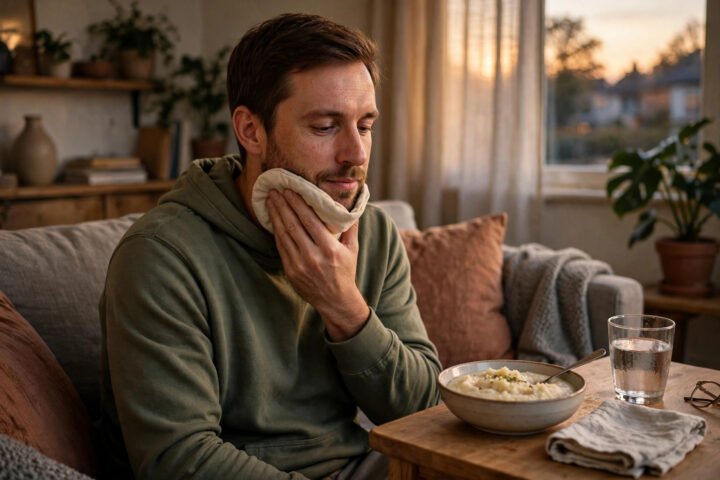
A warm compress and a soft meal at home on a sore-jaw day. Photo-style image for context; it is not a real patient or a clinical result.
What should you do if your jaw starts hurting?
Start with two conversations, not one. Your prescriber owns the drug question: whether symptoms fit a known pattern, whether dose timing matters, and whether any change is safe for the condition being treated. Your dentist owns the jaw question: tooth wear, guard or appliance fit after weight change, joint and muscle examination, and whether this looks like TMD at all.
Bring specifics to both: the drug and dose, the start and dose-increase dates, when the jaw symptoms began, and what they are doing to your sleep, eating, and teeth. That timeline is the single most useful thing you can hand a clinician for a tmj ozempic concern, because without it every visit starts from guesswork.
Do not stop the drug on your own to test the theory. Stopping can undo the diabetes or weight treatment it was prescribed for, and a self-run experiment rarely proves anything — jaw pain fluctuates for many reasons, so improvement after stopping would still not confirm the cause.
How do you protect your jaw and teeth in the meantime?
The NIDCR’s conservative first steps for TMD apply here: eat soft foods while symptoms are active, apply heat or cold, gently stretch, use short-term over-the-counter pain relief only if it is appropriate for you, and reduce habits such as clenching and gum chewing. Experts recommend conservative, reversible care and avoiding treatments that permanently change the jaw, teeth, or bite.
During the day, practise the resting jaw position — lips together, teeth slightly apart — whenever you notice your teeth touching. Keep water nearby if your mouth is dry, and tell your dentist promptly about vomiting or reflux, because enamel protection may need attention even while the jaw question is being worked out. If you wear a night guard, take it to your next appointment after any large weight change and ask directly whether it still fits.
Frequently asked questions
Can Ozempic cause TMJ?
There is no direct trial evidence that Ozempic causes TMD, and jaw pain is not among its most common labelled reactions, which are gastrointestinal. Indirect effects such as vomiting, reflux, dry mouth, and eating much less could aggravate a vulnerable jaw or mouth. New jaw pain after starting is still worth reporting to your prescriber and dentist, with dates.
Can Zepbound cause jaw clenching?
A direct clenching effect has not been shown for tirzepatide either. The oral-health review of incretin therapies found human oral-endpoint data scarce and mostly indirect. Zepbound does have a proven benefit in obstructive sleep apnea, but a 2024 meta-analysis did not confirm that apnea itself raises sleep bruxism odds, so an apnea benefit is not a proven clenching benefit.
Should I stop my GLP-1 drug if my jaw hurts?
No — do not stop a prescribed GLP-1 drug on your own because of jaw pain. Stopping can compromise the diabetes, weight, or sleep apnea treatment it was prescribed for, and it would not prove the drug caused the pain. Book the prescriber and dentist conversations promptly, protect your teeth in the meantime, and seek urgent care for swelling, fever, or a locked jaw.
Why does my jaw hurt more in the morning on these drugs?
Morning jaw pain usually points to nighttime clenching or grinding, whatever its trigger. Dose changes, disrupted sleep, stress, reflux, and untreated sleep apnea can all fragment sleep and coincide with more clenching. Note whether sore mornings follow dose-increase weeks, mention it with dates, and ask your dentist to check tooth wear and guard fit.
Conclusion
The evidence-based answer to the tmj ozempic and Zepbound question is deliberately unspectacular: no direct cause has been shown, the oral-health data are scarce and indirect, and the believable pathways run through the stomach, saliva, eating, weight change, and sleep — not through a proven action on the jaw joint. That is enough to take new jaw pain seriously, and not enough to blame or credit the drug without an assessment.
Keep the timeline, talk to both your prescriber and your dentist, protect your teeth and enamel while you wait, and use conservative jaw care in the meantime. If pain persists, locks, or interferes with eating or sleep, let the assessment lead — not the search results, and not this article.
This article is for educational purposes only and is not medical advice. It is general information, not a diagnosis or a recommendation for any individual. Do not start, stop, or change any prescription medication based on this article. Discuss jaw pain and medication concerns with your own prescriber and dentist.
Sources
- Oral Health Implications of GLP-1 Receptor Agonists and Other Incretin-Based Therapies, Journal of Clinical Medicine, 2026 (narrative review: human oral-health-endpoint data scarce; gastrointestinal effects, reduced fluid intake, and possible salivary changes underlie the “Ozempic mouth” cluster) — MDPI full text
- U.S. Food and Drug Administration. Ozempic (semaglutide) prescribing information, revised 10/2025 (most common adverse reactions: nausea, vomiting, diarrhea, abdominal pain, constipation; severe gastrointestinal reactions; not recommended in severe gastroparesis) — FDA label
- Malhotra A et al. Tirzepatide for the Treatment of Obstructive Sleep Apnea and Obesity (SURMOUNT-OSA), New England Journal of Medicine, 2024; and FDA approval of Zepbound for moderate to severe OSA in adults with obesity, 20 December 2024 (AHI changes -25.3 and -29.3 events/hour vs about -5 on placebo) — summarised at SURMOUNT-OSA summary
- Sleep bruxism may not be associated with obstructive sleep apnea: a systematic review and meta-analysis, Sleep Medicine Reviews, 2024 (14 studies; OR 1.23, 95% CI 0.47-3.20; study quality mostly low) — PubMed
- National Institute of Dental and Craniofacial Research (NIDCR). Temporomandibular Disorders (TMD) (more than 30 conditions; cause often unclear; conservative, reversible care recommended) — NIDCR TMD


0 Comments