
Educational information · Not medical advice
In brief
Shingles: first signs, how contagious it is, treatment timing, and who should get the two-dose Shingrix vaccine — CDC-based guide to rash and nerve pain.
In this article
Key Takeaways
- Shingles is a painful rash caused when the chickenpox virus, varicella-zoster virus, reactivates later in life, the CDC says.
- The first signs are often pain, itching, or tingling on one side of the body or face, a few days before a blistering rash appears in a single stripe.
- You cannot catch shingles from someone else, but a person who never had chickenpox can catch chickenpox from shingles blister fluid.
- Antivirals work best when started as soon as possible — the CDC clinical overview says treatment is most effective within 72 hours of symptom onset.
- CDC recommends two doses of Shingrix for adults 50 and older, and for adults 19 and older with weakened immune systems.
Pain or tingling on one side of your ribs, back, or face — before any rash is visible — is how shingles often announces itself. Shingles can be easy to miss in those first days, and easy to worry about once the blisters appear: is it contagious, how long will it last, and should you have had the vaccine?
This article explains what shingles is, what the first signs feel like, how contagious it really is, how treatment timing matters, and who the CDC recommends for the shingles vaccine, using the CDC's current shingles guidance.
What is shingles?
Shingles, also called herpes zoster, is a painful rash illness caused by varicella-zoster virus (VZV), the same virus that causes chickenpox, according to the CDC. After a person has chickenpox, the virus stays in the body, dormant in nerve tissue. Years later it can reactivate and cause shingles.
The CDC estimates about 1 million people get shingles each year in the United States, and its clinical overview says about 1 in 3 people will develop shingles during their lifetime. Most people have it only once, but shingles can recur, so a past episode does not make you immune for life.
Risk rises with age and with a weakened immune system. The CDC says risk increases as you get older, and is higher in people with conditions that keep the immune system from working properly — such as leukemia, lymphoma, and HIV — and in people taking drugs that suppress the immune system, like steroids and medicines given after an organ transplant. The clinical overview adds that risk sharply increases after age 50, as virus-specific immunity declines.
What are the first signs of shingles?
The first signs of shingles are usually felt, not seen. The CDC says people with shingles can have pain, itching, or tingling in the area where the rash will develop — sometimes described as burning or shooting pain — and that this can come before the rash itself. Fever, headache, chills, and upset stomach can also occur.
When the rash appears, it is usually on one side only. The CDC clinical overview says the rash appears in one or two adjacent dermatomes — the band of skin supplied by a single nerve — most commonly on the trunk along a thoracic dermatome or on the face, and it usually does not cross the body's midline. It starts as a painful, red rash and develops into fluid-filled blisters.
That one-sided stripe is the pattern clinicians look for. A widespread rash that looks like chickenpox is uncommon and, the CDC notes in related guidance, usually occurs in people with weakened immune systems. If pain arrives without any rash, diagnosis is harder — the CDC clinical overview says a clinical diagnosis may not be possible in the absence of a rash, and laboratory testing, most helpfully a PCR test for VZV, can confirm cases.
| Stage | What you may notice | What the CDC says |
|---|---|---|
| Before the rash | Pain, itching, or tingling on one side; sometimes fever or headache | Symptoms occur in the area where the rash will develop |
| Rash and blisters | A single stripe of blisters on one side of the body or face | Rash is in one or two adjacent dermatomes and usually does not cross the midline |
| Scabbing | Blisters dry and crust over | People cannot spread the virus after the rash scabs over |
| Healing | Rash clears, pain usually eases | The rash generally heals in 2 to 4 weeks |
How long does shingles last?
The CDC clinical overview says the shingles rash generally heals in 2 to 4 weeks. Blisters typically scab over before that healing completes, and once the rash has scabbed, a person can no longer spread the virus to others.
Pain does not always follow the same timeline as the skin. For most people pain eases as the rash heals, but the most common complication of shingles — long-term nerve pain called postherpetic neuralgia, or PHN — can continue after the rash is gone. That difference is why early treatment and prevention matter, even though shingles itself is usually time-limited.
About 1 in 3 — the CDC's estimate for how many people in the United States will develop shingles during their lifetime. Risk rises sharply after age 50.
Is shingles contagious?
This is the question readers ask most, and the CDC's answer has two parts. You cannot get shingles from someone who has shingles. But you can get chickenpox from someone who has shingles if you never had chickenpox and never got the chickenpox vaccine — and you could then develop shingles later in life yourself.
The virus spreads from the blisters. The CDC says people who never had chickenpox or the vaccine can be infected through direct contact with fluid from shingles rash blisters, or by breathing in virus particles that come from the blisters. People with chickenpox are more likely to spread the virus than people with shingles, and a person with shingles cannot spread it before the blisters appear or after the rash scabs over.
Until the rash scabs, the CDC advises covering the rash, avoiding touching or scratching it, and washing hands often for at least 20 seconds. Avoid contact, until the rash scabs over, with pregnant women who never had chickenpox or the vaccine, premature or low birth weight infants, and people with weakened immune systems. Those precautions are similar in spirit to the stay-home window for other infections, such as the one we explain for strep throat.
How is shingles treated?
Shingles is treated with antiviral medicines. The CDC lists three: acyclovir, valacyclovir, and famciclovir. These medicines shorten the length and severity of the illness, and the CDC clinical overview says they accelerate resolution of lesions, reduce the development of new lesions and viral shedding, and decrease the severity of acute pain.
Timing matters. The CDC says antivirals work best when taken as soon as the rash appears, and its clinical overview states treatment is most effective within 72 hours of symptom onset. That is a reason to contact a clinician promptly when a one-sided blistering rash appears, rather than waiting to see whether it spreads — do not wait for a perfect diagnosis at home.
For comfort, the CDC notes pain relief medicine may help, and wet compresses, calamine lotion, and warm oatmeal baths may help relieve itching. Those measures ease symptoms; they do not replace antivirals. There is no home remedy proven to cure shingles, and this article will not present one as if there were.
What complications can shingles cause?
The most common complication is postherpetic neuralgia (PHN), long-term nerve pain in the area of the rash that continues after the rash heals, the CDC says. Older adults and people who are immunocompromised are at higher risk for shingles complications, according to the CDC clinical overview.
The CDC clinical overview lists other complications: hearing or vision loss, encephalitis (inflammation of the brain), and pneumonia. Shingles on the face deserves particular care, because eye involvement can threaten vision — the clinical overview urges early diagnosis and treatment to prevent progressive corneal involvement and potential vision loss.
Serious outcomes are uncommon but real. The clinical overview cites a study estimating 96 deaths a year in the United States where herpes zoster was the underlying cause, with almost all deaths in older adults or people with weakened immune systems.
Who should get the shingles vaccine?
The CDC recommends two doses of recombinant zoster vaccine (RZV, Shingrix) to prevent shingles and related complications in adults 50 years and older. Shingrix is also recommended for adults 19 years and older who have weakened immune systems because of disease or therapy. The CDC says the best way to prevent shingles is by getting two doses of the vaccine — one dose is not the full series.
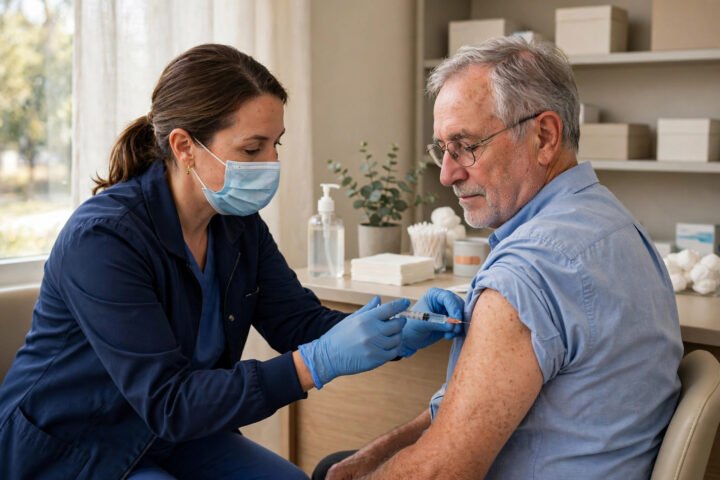
Shingrix is given as two doses. Ask your clinician or pharmacist when your second dose is due.
What about side effects? This article relies on CDC guidance for eligibility, and readers should expect the vaccine information statement at the clinic or pharmacy to list current reactions and precautions, including what to do after a reaction to a first dose. If you have had a severe allergic reaction to a vaccine component, are currently experiencing shingles, or are pregnant, raise that with the clinician before vaccination rather than assuming eligibility.
Vaccination is prevention, not treatment: Shingrix is for people who do not currently have shingles. If you already had shingles once, it can recur, so ask your clinician whether and when vaccination is appropriate for you. Staying up to date on fluids and general health helps recovery from illness in general — see our guide to how much water you should drink — but no diet or supplement is a substitute for the vaccine the CDC recommends.
When should shingles be seen promptly?
Contact a clinician as soon as possible if you think you have shingles, the CDC advises — early contact is what makes antiviral treatment within its most effective window possible. Seek prompt care if the rash is on your face or near your eye, if you have eye pain, redness, or vision changes, if the rash is widespread, or if you have a weakened immune system.
Also seek care if pain is severe, the rash shows signs of bacterial infection, or nerve pain persists long after the rash has healed — that persistent pain may be postherpetic neuralgia and has its own treatment discussion. Mood and sleep can suffer during a painful illness that lasts weeks; if low mood follows a seasonal pattern as well, our guide to seasonal depression and SAD lamps explains a separate, treatable pattern.
Frequently asked questions
Is shingles contagious by touch or airborne?
Shingles itself is not passed from person to person, the CDC says. But varicella-zoster virus can spread from shingles blisters through direct contact with blister fluid, or by breathing in virus particles from the blisters, and can cause chickenpox in someone who never had chickenpox or its vaccine.
What does shingles feel like when it first starts?
At first, shingles often feels like pain, itching, or tingling in one area on one side of the body or face, before any rash is visible, the CDC says. Some people also have fever, headache, chills, or upset stomach. A blistering rash in a single stripe usually follows in the same area.
How long is shingles contagious?
A person with shingles can spread varicella-zoster virus while the rash is in the blister phase. The CDC says people with shingles cannot spread the virus before the blisters appear or after the rash scabs over. Covering the rash lowers the risk of spreading the virus to others.
Who should get the shingles vaccine, and how many doses?
The CDC recommends two doses of Shingrix for adults 50 years and older, and for adults 19 years and older who have weakened immune systems because of disease or therapy. Two doses are the series the CDC recommends to prevent shingles and its complications, including postherpetic neuralgia.
Conclusion
Shingles is the chickenpox virus returning, usually decades later, as a painful one-sided rash. Its first signs are often pain or tingling before anything is visible, its blisters can give a susceptible person chickenpox — not shingles — and its rash generally heals in 2 to 4 weeks, though nerve pain can outlast it.
If a one-sided blistering rash appears, contact a clinician promptly: antivirals are most effective within 72 hours. If you are 50 or older, or 19 or older with a weakened immune system, ask about the two-dose Shingrix series the CDC recommends. Early treatment and prevention are the two levers that actually change the course of shingles.
Sources
- Centers for Disease Control and Prevention. About Shingles (Herpes Zoster) — what shingles is, signs, who is at risk, how varicella-zoster virus spreads from blisters, covering the rash, antiviral medicines, and the two-dose Shingrix recommendation cited throughout.
- Centers for Disease Control and Prevention. Clinical Overview of Shingles (Herpes Zoster) (June 27, 2024) — dermatome pattern, 2-to-4-week healing, 1-in-3 lifetime risk, complications including postherpetic neuralgia, PCR testing, and treatment most effective within 72 hours.
- MedlinePlus (U.S. National Library of Medicine). Shingles — summary of symptoms, blisters scabbing in 7 to 10 days in its patient summary, complications, and Shingrix prevention for adults 50 and older and immunocompromised adults over 19.
Medical disclaimer: This article is educational information only and is not medical advice. It does not diagnose or prescribe treatment for any individual. If you think you may have shingles, contact a clinician promptly, especially if the rash is near your eye or you have a weakened immune system.



0 Comments