Educational information · Not medical advice
In brief
Does a weighted vest build bone, or just burn more calories on a walk? See what the trials found, the joint and back risks, and who should skip it safely.
In this article
- What is a weighted vest, and why are walkers wearing one?
- Does a weighted vest build bone density?
- How many more calories does weighted vest walking burn?
- Are weighted vests safe for your joints and back?
- Who should skip a weighted vest?
- If you try a weighted vest, how do you start safely?
- Frequently asked questions
- Conclusion
- Sources
Key Takeaways
- The largest trial of a weighted vest for bone health — 150 older adults followed for 12 months in the 2025 INVEST trial — found the vest did not prevent hip bone loss during weight loss, and neither did resistance training in that trial.
- The study most often cited in favour of vests paired the vest with jumping exercise, not walking, and included only 18 women over five years — promising, but not proof that walking in a vest builds bone.
- A weighted vest does raise the effort of walking: in treadmill studies, a load of about 10% of body weight raised oxygen use by roughly 7–11%, so the extra calorie burn is real but modest, not dramatic.
- Added load also means added force through the spine, hips, and knees. People with osteoporosis, significant back or knee problems, balance problems, or recent surgery should discuss it with a clinician first — or skip it.
- This article endorses no product. If you try a vest, start far lighter than the marketing suggests, build up slowly, and stop if pain appears.
A weighted vest has become the walking accessory of the moment. Add one to your usual walk, the pitch goes, and you will protect your bones and burn more calories without changing anything else. It is an appealing idea — especially if you are worried about bone density and do not want a gym routine.
So what does a weighted vest actually do? This article checks the two main claims — bone and calories — against the trials that tested them, states plainly where the evidence is small or mixed, and covers the joint and back risks and who should avoid vests altogether. It does not endorse any product.
What is a weighted vest, and why are walkers wearing one?
A weighted vest is a close-fitting garment with pockets or plates that add a set amount of weight — often described as a percentage of your body weight — spread across your torso. Unlike a backpack, the load sits front and back and moves with you, which is why walkers prefer it to carrying hand weights.
The logic behind the trend is simple. Bone responds to mechanical load, and walking is already a weight-bearing exercise: the National Institute of Arthritis and Musculoskeletal and Skin Diseases (NIAMS) lists brisk walking among the weight-bearing exercises that make bones work harder, alongside resistance training and balance training. Adding a vest, in theory, turns the load up. The question is whether turning it up in this particular way — a modest extra load, repeated for thousands of ordinary steps — is the kind of signal that changes bone, and what it costs your joints to deliver it.
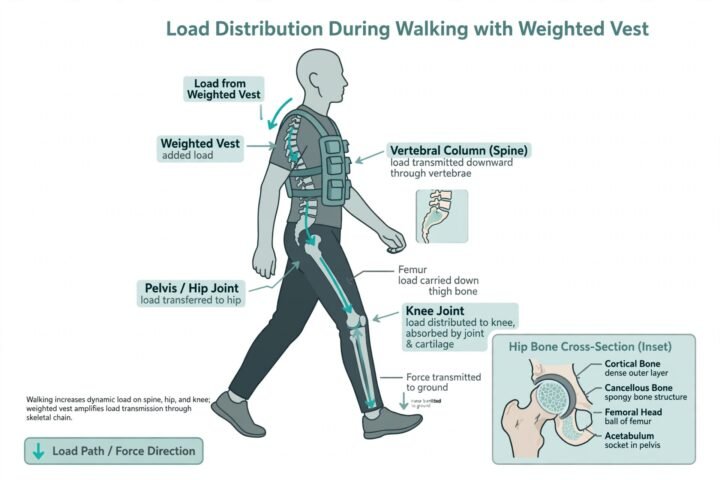
Load from a weighted vest travels through the spine, pelvis, hip, and knee on every step — which is both the proposed benefit for bone and the source of the joint and back cautions.
Does a weighted vest build bone density?
The strongest test so far says no — at least not in the situation it tested. The INVEST in Bone Health trial, published in JAMA Network Open in 2025, randomised 150 older adults with obesity (mean age about 66) to twelve months of weight loss alone, weight loss plus a weighted vest, or weight loss plus supervised resistance training. The vest group wore the vest for an average of 7.1 hours a day, with the load adjusted to replace about 78% of the weight they lost — a generous test of the idea that replacing lost load protects bone.
All three groups lost a similar 9% to 11% of their body weight. Hip bone density fell in all three groups, by about 1.2% to 1.9% on the trial's main computed-tomography measure, and the vest group's loss was not significantly different from weight loss alone (P = .13). Resistance training did not prevent the hip loss in this trial either. The authors concluded that other or additional strategies are needed to prevent bone loss when older adults lose weight.
150 adults, 12 months, 7.1 hours a day — In the 2025 INVEST trial, wearing a weighted vest loaded to replace most of the weight participants lost did not prevent hip bone density loss compared with weight loss alone. That is the largest and most direct test of the bone claim to date.
What about the study usually cited in favour of vests? In 2000, Snow and colleagues reported a five-year programme of weighted vest exercise plus jumping in postmenopausal women. After five years, exercisers had gained 1.54% at the femoral neck while controls lost 4.43%, and total hip loss was 0.82% versus 3.80% in controls. Those are striking numbers — with two large caveats. The trial included only 18 women in total, nine per group, and the vest was combined with jumping, a high-impact load very different from walking. It shows a vest can be part of a bone programme; it does not show that walking in a vest, on its own, builds bone.
Read together, the evidence is small and mixed: one tiny, long trial of vest-plus-jumping was positive, and one large, modern trial of vest use during weight loss was not. NIAMS guidance points to the broader pattern that does have support — a combination of weight-bearing exercise, resistance training, and balance training — rather than any single accessory. Bone health also depends on adequate protein and calcium; our guide to how much protein you actually need covers the targets by age and activity, and our evidence check on collagen supplements explains why a supplement is not a shortcut around that programme.
How many more calories does weighted vest walking burn?
Here the claim holds up — with modest numbers. Carrying more mass costs more energy, and treadmill studies can measure by how much. In one study of 30 adults walking at 3.5 mph, oxygen consumption rose from 16.7 ml/kg/min with no vest to 17.8 with a vest at 5% of body weight and 18.5 at 10% — roughly 7% and 11% higher, with heart rate and perceived exertion rising too, and no measurable change in gait. An earlier multi-speed treadmill study likewise found that vests at 10% of body weight or more significantly increased metabolic cost and exercise intensity, with the effect clearer at faster speeds.
Translated into a walk, that means a vest at about 10% of body weight might add on the order of a tenth to the calories of that walk — helpful, but not a transformation, and it shrinks if the extra load makes you walk more slowly or cut the walk short. Walking further, walking a hill, or adding the resistance and balance work NIAMS recommends are all competing uses of the same effort. Staying hydrated matters on longer walks either way; see how much water you should drink for the intake evidence.
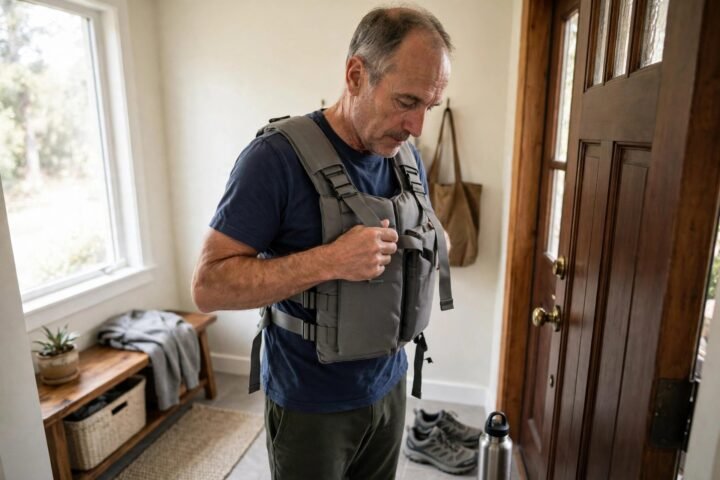
Fitting matters: a vest should sit snugly and evenly front and back. Trying one on and adjusting the straps at home, before a first short walk, is the sensible first step — not a long walk at full load.
Are weighted vests safe for your joints and back?
The same studies that show a metabolic benefit also show why caution is warranted: a vest increases the loading of the skeletal system during walking, including ground reaction forces. That extra force passes through the spine, hips, knees, and ankles on every step. For healthy joints, a light load, built up gradually, is a reasonable experiment for many people. For a joint that is already arthritic, a back that is already painful, or bones that are already fragile, the calculation changes — the load you are adding is exactly the load those tissues struggle with.
It is telling who the big trial left out. The INVEST trial excluded people with osteoporosis and people with severe arthritis or back pain that would prevent vest use or exercise. In other words, the safety picture in the best trial does not cover the very people most tempted by the bone claim. NIAMS gives the general rule: if you have low bone density, osteoporosis, or other physical limitations, talk to a health care provider before starting an exercise programme, and people with osteoporosis should protect the spine and avoid activities that carry a fall or fracture risk. Pain that appears after you add a vest — in the back, knee, hip, or foot — is a stop signal, not something to push through.
| Claim | What the evidence shows |
|---|---|
| Builds or protects bone density | Not shown for walking or daily wear: the 150-person INVEST trial (2025) found no protection against hip bone loss during weight loss. A small 18-person trial of vest plus jumping (2000) was positive, but that is a different, high-impact programme. |
| Burns more calories | Yes, modestly: about 7–11% higher oxygen use at loads of 5–10% of body weight in treadmill studies — roughly a tenth more for the same walk, if pace and distance hold. |
| Safe for everyone | No: added load raises skeletal loading and ground reaction forces, and the main trial excluded people with osteoporosis, severe arthritis, and significant back pain. |
| A substitute for resistance and balance training | No: NIAMS recommends a combination of weight-bearing, resistance, and balance exercise for bone health; a vest is, at most, an addition to that mix. |
Who should skip a weighted vest?
Skip it — or clear it with your clinician first — if any of these apply: you have osteoporosis or low bone density; you have significant knee, hip, ankle, or back problems, or arthritis that flares with load; you have balance problems or a history of falls; you have had recent surgery, a fracture, or a joint replacement and have not been cleared for loaded exercise; or you are pregnant, have uncontrolled blood pressure or heart disease, or any condition for which your clinician has advised against added load. This list reflects the exclusions and cautions in the trial and NIAMS guidance above, not a marketing checklist.
If bone density is your main worry, the better-supported path is unglamorous: regular weight-bearing walks (vest or no vest), resistance training at least twice a week, balance work, adequate protein, calcium, and vitamin D, and a bone-density discussion with your clinician. Our review of omega-3s from food versus supplements makes the same point in another area — the food and movement basics usually carry more evidence than the add-on product.
If you try a weighted vest, how do you start safely?
If none of the cautions above apply and you want to try one, treat it like any new training load. Start much lighter than the loads used in studies — a few pounds, or roughly 5% of body weight at most — for a short, flat walk, and see how your back, knees, and feet feel during the walk and the next day. Add weight or distance one at a time, not both, and only when the current level feels easy. Keep the vest snug and evenly loaded so it does not bounce or pull to one side, wear supportive shoes, and skip the vest on days when a joint is already sore. Stop and get checked if you develop persistent back, knee, hip, or foot pain, numbness, or unsteadiness. None of this requires a particular brand, and no vest needs to be expensive to test whether loaded walking suits you.
Frequently asked questions
Does a weighted vest build bone density?
It has not been shown to for walking or daily wear. The largest trial, INVEST (2025), randomised 150 older adults and found a weighted vest worn about seven hours a day did not prevent hip bone loss during weight loss. A much smaller, older trial that paired vests with jumping exercise was positive, but jumping — not walking — may have driven that result.
How much weight should a weighted vest be?
Studies typically used loads around 5–10% of body weight, and even those were supervised or screened settings. For a first try, start at the low end or below — a few pounds — for a short walk, and increase slowly only if your joints and back stay comfortable. Heavier is not automatically better, and more load means more joint force.
How many extra calories does a weighted vest burn?
Modestly more. In treadmill studies, oxygen use rose by roughly 7% at a 5% body-weight load and about 11% at 10%, so expect on the order of a tenth more calories for the same walk at the same pace — and less if the vest slows you down or shortens your walk.
Are weighted vests safe with arthritis or osteoporosis?
They need individual advice. The main bone trial excluded people with osteoporosis and severe arthritis or back pain, so its results do not establish safety in those groups. NIAMS advises people with low bone density or osteoporosis to talk to a health care provider before starting an exercise programme. Do not start loaded walking on a painful joint without that conversation.
Conclusion
A weighted vest makes walking harder, and that part is real: the effort and calorie cost of a walk rise by roughly a tenth at the loads studied. The bone claim — the reason many people buy one — is not supported by the best current trial, and the one positive study behind it tested vest plus jumping in just 18 women. Evidence for vests is therefore small and mixed, and it should be stated that plainly.
If you are healthy, enjoy walking, and have no joint, back, balance, or bone-density concerns, a light vest, started slowly, is a reasonable way to make walks feel more challenging. If bone protection is the goal, put the proven combination first — weight-bearing exercise, resistance training, balance work, adequate protein and calcium, and clinician guidance — and treat any vest as an optional extra, never as the treatment.
This article is educational information only and is not medical advice. Talk to your clinician or physical therapist about exercise choices for your own bones, joints, and health conditions.
Sources
- Beavers KM, et al. Weighted Vest Use or Resistance Exercise to Offset Weight Loss–Associated Bone Loss in Older Adults: A Randomized Clinical Trial (INVEST in Bone Health). JAMA Network Open, 2025. jamanetwork.com
- Snow CM, Shaw JM, Winters KM, Witzke KA. Long-term Exercise Using Weighted Vests Prevents Hip Bone Loss in Postmenopausal Women. Journal of Gerontology: Medical Sciences, 2000 (18 women, five years, vest plus jumping). researchgate.net
- National Institute of Arthritis and Musculoskeletal and Skin Diseases (NIAMS). Exercise for Your Bone Health — weight-bearing, resistance, and balance exercise; talk to a provider first with low bone density or osteoporosis. niams.nih.gov
- Becerra N, Smith JD. Changes in VO2, HR, & Gait while Walking with a Weighted Vest. International Journal of Exercise Science: Conference Proceedings, 2026 (VO2 16.7 vs 17.8 vs 18.5 ml/kg/min at 0%, 5%, and 10% loads). digitalcommons.wku.edu
- Puthoff ML, et al. The Effect of Weighted Vest Walking on Metabolic Responses and Ground Reaction Forces — vests at 10% of body mass or more significantly increased metabolic cost, exercise intensity, and skeletal loading. researchgate.net




0 Comments