
Educational information · Not medical advice
In brief
TMJ and EDS: why a hypermobile jaw clicks, slips out of place, and aches — and the stability-first care that helps protect it safely every single day.
In this article
- Why does Ehlers-Danlos syndrome affect the jaw joint?
- How common are jaw problems when tmj and eds occur together?
- What is the difference between jaw subluxation and dislocation?
- What symptoms does a hypermobile jaw cause?
- What treatment is safest for tmj and eds?
- How can you make dental visits safer with a hypermobile jaw?
- When should jaw instability be checked promptly?
- Frequently asked questions
- Conclusion
- Sources
Key Takeaways
- When tmj and eds occur together, loose ligaments let the jaw move too far — clicking, slipping partly out of place (subluxation), and muscle pain are common.
- In one 2023 study of 259 people with classical or hypermobile EDS, 84.9% reported pain in the chewing muscles and 46.3% already had a diagnosed temporomandibular disorder.
- Safe care for tmj and eds is stability-first: controlled movement, strengthening and proprioception work, and avoiding aggressive stretching or wide opening.
- Surgery is a last resort in EDS because fragile connective tissue heals less predictably; conservative, multidisciplinary care comes first.
If your jaw clicks loudly, slips sideways, or feels as if it might pop out when you yawn, and you also live with Ehlers-Danlos syndrome (EDS), the two are probably connected. The combination of tmj and eds is common, under-recognised, and managed differently from ordinary jaw pain — because the problem is not a tight joint that needs stretching, but a loose joint that needs stability.
This article explains why EDS affects the temporomandibular joint (TMJ, the jaw joint), how often jaw problems occur, what subluxation and dislocation feel like, and which treatments are safest when tmj and eds occur together, based on peer-reviewed studies and the GeneReviews guidance on hypermobile EDS.
Why does Ehlers-Danlos syndrome affect the jaw joint?
The Ehlers-Danlos syndromes are a group of inherited connective-tissue disorders. The current classification recognises 13 subtypes, of which the hypermobile (hEDS) and classical (cEDS) subtypes are the most prevalent, according to Willich and colleagues in the Orphanet Journal of Rare Diseases (2023). They are characterised by joint hypermobility, soft or hyperextensible skin, and fragile tissue — all consequences of altered collagen, the protein that gives ligaments and joint capsules their strength.
The jaw joint depends on those same tissues. The TMJ is held in its socket by a capsule and ligaments, and a small disc sits between the jaw bone (mandibular condyle) and the skull. When you open your mouth, the condyle first rotates and then slides forward. If the ligaments are lax, that slide can go too far: the condyle travels beyond its usual limit, the disc can shift with it, and the chewing muscles have to work harder to keep the joint centred. GeneReviews, in its hypermobile EDS chapter (updated February 2024), lists temporomandibular joint laxity and dysfunction among the manifestations that may need orthodontic, maxillofacial, and ENT management.
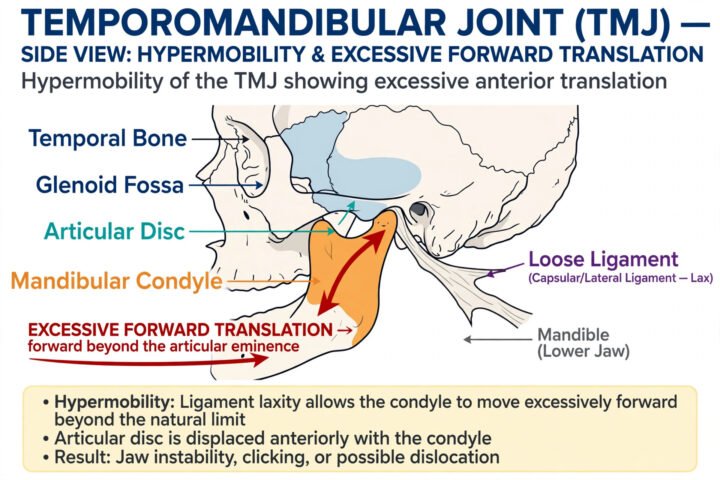
Schematic: in a hypermobile jaw, ligament laxity lets the condyle translate too far forward, which can cause clicking, instability, or dislocation.
That extra movement explains the paradox many people notice: the jaw can be both too mobile and painful or stiff-feeling at the same time. The joint itself moves too much, while the overworked muscles around it ache, fatigue, and sometimes spasm to protect it.
How common are jaw problems when tmj and eds occur together?
Very common, on the available evidence. Willich and colleagues surveyed 259 participants with classical or hypermobile EDS (2023). At least 49.2% reported painful or restricted jaw movements, at least 84.9% had pain in the masticatory (chewing) muscles, and 46.3% already had a diagnosed temporomandibular disorder (TMD). Having a diagnosed TMD was associated with a 2.5-fold higher risk of chronic pain in their analysis.
84.9%
of 259 people with classical or hypermobile EDS reported pain in the chewing muscles (Willich et al., 2023).
A second questionnaire study, by Yekkalam and colleagues in the Journal of Oral Rehabilitation (2024), looked at 185 women with confirmed hypermobile EDS in Finland and Sweden. Nearly all (98%) reported TMD symptoms: TMD pain in 95%, TMJ clicking in 90%, jaw fatigue in 80%, and TMJ luxation — the jaw coming out of place — in 44%. Both studies are questionnaire-based, so they describe symptoms in diagnosed groups rather than the whole population, but together they show that jaw involvement in EDS is the rule rather than the exception. The authors of both studies argue that management needs a multidisciplinary approach.
What is the difference between jaw subluxation and dislocation?
A subluxation is a partial dislocation: the condyle slips too far forward but returns on its own, often with a clunk. A dislocation (luxation) is a full displacement, where the jaw stays stuck — usually stuck open — and cannot close until the joint is guided back. University College London Hospitals’ patient guidance on managing dislocations and subluxations in hypermobile EDS and hypermobility spectrum disorders makes the same distinction for joints generally: a dislocation is a full separation of the joint surfaces, and a subluxation is a partial one.
GeneReviews notes that in hypermobile EDS, subluxations, dislocations, and soft-tissue injury are common, may occur spontaneously or with minimal trauma, and can be acutely painful. For the jaw, typical triggers are a wide yawn, a big bite, laughing, or a long dental appointment with the mouth held open. If your jaw ever locks open and will not close, our guide to a jaw locked closed or open explains what to do right now and when it is an emergency.
Controlled, small-range jaw movement — the opposite of wide stretching — is the pattern stability-focused therapy aims for.
What symptoms does a hypermobile jaw cause?
Symptoms overlap with ordinary TMD, but the instability features stand out. People commonly report loud clicking or popping, the jaw shifting to one side on opening, episodes of the jaw slipping partly or fully out of place, chewing-muscle pain and fatigue, headaches around the temples, and pain in front of the ear. Mitakides and Tinkle, writing on oral and mandibular manifestations in EDS for the American Journal of Medical Genetics (2017), list similar examination findings, including the jaw stuck to the side, limitation of opening, inability to chew, pain in front of the ear, and temple or jaw-side headaches.
Symptoms often flare after the jaw has been loaded or held wide — dental work, a long yawn, chewy food — and settle with rest, warmth, and soft food. That flare pattern is similar to other TMJ flare-ups; our 48-hour TMJ flare-up plan covers the first two days of self-care. What differs in EDS is the recurrence: because the ligaments stay lax, episodes can repeat unless daily habits and muscle control change.
What treatment is safest for tmj and eds?
The safest approach for tmj and eds is conservative and stability-first. Mitakides and Tinkle state that prevention of TMJ injury should be paramount in EDS, that posture, upper back, and neck issues need to be addressed, and that surgery should be limited to extreme cases. GeneReviews gives the same direction for hypermobile joints generally: tailored exercise to increase muscle strength and tone, proprioception (joint position sense), and joint stability; braces and splints to improve alignment and control where appropriate; and avoidance of high-impact activity that raises the risk of acute subluxation or dislocation.
In practice, that usually means working with a physical therapist who understands hypermobility. Therapy focuses on controlled opening (often practising with the tongue on the roof of the mouth to limit forward slide), strengthening the muscles that centre the joint, and neck and posture work — not on aggressive jaw stretching, which can make a loose joint looser. For chronic TMD pain more broadly, the 2023 BMJ clinical practice guideline gave strong recommendations in favour of approaches such as cognitive behavioural therapy, therapist-assisted mobilisation, manual trigger point therapy, and supervised jaw exercise and postural exercise, and strong recommendations against irreversible treatments such as irreversible splints and discectomy. Our comparison of physical therapy vs splint vs Botox for TMJ walks through what that evidence means for each option.

Small bites of soft food and a warm compress are simple ways to lower jaw load during a flare.
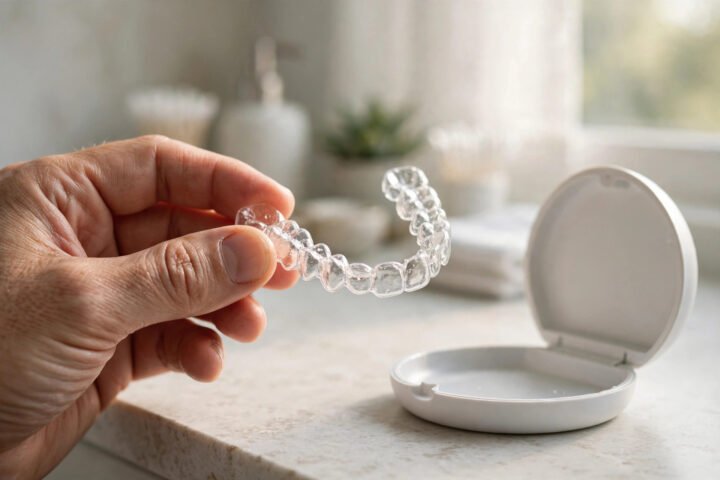
Day to day, the habits that protect a hypermobile jaw are unglamorous but effective: cut food into small bites, avoid very wide opening (support your jaw with a hand when yawning), favour softer foods during flares, and avoid chewing gum and other repetitive loading. A stabilization splint may be considered by your dentist to protect the teeth and reduce muscle load, but it should be fitted and reviewed by someone who knows your EDS — a guard that changes the bite irreversibly is not appropriate. Medicines for pain or muscle spasm are sometimes used short-term; discuss choices with your clinician, especially because people with EDS often take medicines for other manifestations too, a caution Mitakides and Tinkle also raise. If you are unsure which professional to see first, our guide to who treats TMJ explains the roles of dentists, oral surgeons, and orofacial pain specialists.
How can you make dental visits safer with a hypermobile jaw?
Tell your dental team about your EDS before treatment starts, and agree a plan: shorter appointments or scheduled rest breaks, a bite block used carefully rather than prolonged wide opening, a signal to pause, and support for the jaw during extractions or long procedures. Ask the team to avoid forcing the jaw wider than comfortable. Afterwards, expect some muscle soreness; soft food, warmth, and rest for a day or two usually help, and persistent locking, swelling, or a bite that feels changed should be reported back to the practice promptly.
When should jaw instability be checked promptly?
Get prompt care if your jaw is stuck open or closed and does not release, if you cannot close your mouth or swallow comfortably, if there is new numbness, marked swelling, or pain after an injury, or if episodes of dislocation are becoming frequent. Recurrent subluxation also deserves a planned review even when each episode resolves: a clinician who understands both TMD and hypermobility can check the disc and joint, review your splint and therapy plan, and coordinate with the team managing your EDS overall.
Frequently asked questions
Can Ehlers-Danlos syndrome cause TMJ problems?
Yes. EDS affects collagen in the ligaments and capsule that stabilise the jaw joint, so the joint can move too far and its muscles overwork. In a 2023 study of 259 people with classical or hypermobile EDS, 84.9% reported chewing-muscle pain and 46.3% had a diagnosed temporomandibular disorder, so jaw involvement is very common.
What should I do if my jaw pops out of place?
Stay calm, stop opening, support the jaw, and let the muscles relax; many subluxations slip back on their own. UCLH guidance for hypermobile joints advises calm breathing, pain relief as directed by your prescriber, supporting the joint, warmth, and gentle massage rather than forcing it. If the jaw stays stuck, or there is numbness or a colour change, seek urgent care.
Are jaw exercises safe when tmj and eds occur together?
Stability-focused exercises prescribed by a therapist who understands hypermobility are a core part of care: GeneReviews recommends exercise to improve muscle strength, proprioception, and joint stability in hypermobile EDS. Aggressive stretching or repeatedly forcing wide opening is different — it can worsen a loose joint — so get an individual programme rather than copying generic jaw-stretching routines.
Will a night guard or splint fix a hypermobile jaw?
A stabilization splint can protect teeth and reduce muscle load for some people, but it does not tighten ligaments, and it should be fitted and monitored by a clinician who knows your EDS. The 2023 BMJ guideline for chronic TMD pain recommends against irreversible splints and irreversible bite changes, so any appliance should be reversible and reviewed regularly.
Conclusion
A hypermobile jaw is one of the most common — and most manageable — parts of EDS, once it is recognised for what it is: an instability problem, not a stiffness problem. The evidence points the same way from several directions: protect the joint from wide opening and overload, build muscle strength and control around it, treat flares early with rest and soft food, and reserve surgery for extreme cases. If your jaw clicks, slips, or locks and you have EDS or suspected hypermobility, ask for care from clinicians who understand both conditions, and bring this stability-first picture with you.
Medical disclaimer: This article is educational information only and is not medical advice. It does not diagnose or prescribe treatment for any individual. Discuss your symptoms and options with your own clinician, dentist, or orofacial pain specialist.
Sources
- Willich L, et al. Prevalence and quality of temporomandibular disorders, chronic pain and psychological distress in patients with classical and hypermobile Ehlers-Danlos syndrome. Orphanet Journal of Rare Diseases 2023;18:294. Full text (PDF)
- Hakim A. Hypermobile Ehlers-Danlos Syndrome. GeneReviews, updated 22 February 2024. GeneReviews (PDF)
- Mitakides J, Tinkle BT. Oral and mandibular manifestations in the Ehlers-Danlos syndromes. American Journal of Medical Genetics Part C 2017;175C:220–225 (non-expert summary, The Ehlers-Danlos Society). Summary (PDF)
- University College London Hospitals NHS Foundation Trust. Managing dislocations and subluxations (patient information for hypermobile EDS and HSD). UCLH patient guidance
- Yekkalam N, et al. Risk factors associated with symptoms of temporomandibular disorders among women with hypermobile Ehlers-Danlos syndrome. Journal of Oral Rehabilitation 2024. Findings as reported in the journal article summary read this run.
- Busse JW, et al. Management of chronic pain associated with temporomandibular disorders: a clinical practice guideline. BMJ 2023;383:e076227. Recommendations as summarised in the guideline summary read this run.



0 Comments