
Educational information · Not medical advice
In brief
TMJ arthrocentesis recovery explained: what the joint washout involves, how long healing usually takes, success rates, costs, and risks to discuss first.
In this article
- What is TMJ arthrocentesis?
- Who is arthrocentesis usually offered to?
- What happens during the procedure?
- What does TMJ arthrocentesis recovery actually involve?
- How well does it work?
- What are the risks and side effects?
- How much does TMJ arthrocentesis cost?
- How does it compare with arthroscopy and open surgery?
- Frequently asked questions
- Conclusion
- Sources
Key Takeaways
- Arthrocentesis is a minimally invasive washout (lavage) of the upper TMJ space through needles — no camera and no open incision — usually offered after conservative care has not relieved a painful, stuck, or locked jaw.
- TMJ arthrocentesis recovery is usually measured in days, not weeks: a soft diet for a few days, gentle movement exercises started early, and soreness or swelling that typically settles quickly.
- A 2024 systematic review found arthrocentesis reduced pain more than conservative treatment in the short and intermediate term, while the gain in mouth opening was smaller and may not be clinically important on its own.
- Serious complications are uncommon. The effects most often reported are temporary: swelling, a temporary change in how the teeth meet, bruising, or brief facial weakness from the local anaesthetic.
- It sits in the middle of the treatment ladder — more invasive than a splint or physical therapy, far less invasive than open joint surgery — which is why the exact diagnosis matters before anyone recommends it.
If your jaw has locked, opening hurts, and months of softer food, a splint, and exercises have not moved things, arthrocentesis is often the next option a specialist raises. Understandably, the first questions are practical: what is it, will it help, and what is tmj arthrocentesis recovery really like? The short answer is that it is a joint washout done through needles under local anaesthesia, sometimes with sedation, and most people are back to a soft normal routine within days — but the evidence, the risks, and the alternatives deserve a slower look before you decide.
A note on terms: TMJ is the temporomandibular joint in front of each ear. TMD means temporomandibular disorder, the group of conditions affecting that joint and the chewing muscles. Arthrocentesis (pronounced ar-thro-sen-TEE-sis) simply means puncturing a joint to wash it out. It was first described for the TMJ by Nitzan in 1991.
What is TMJ arthrocentesis?
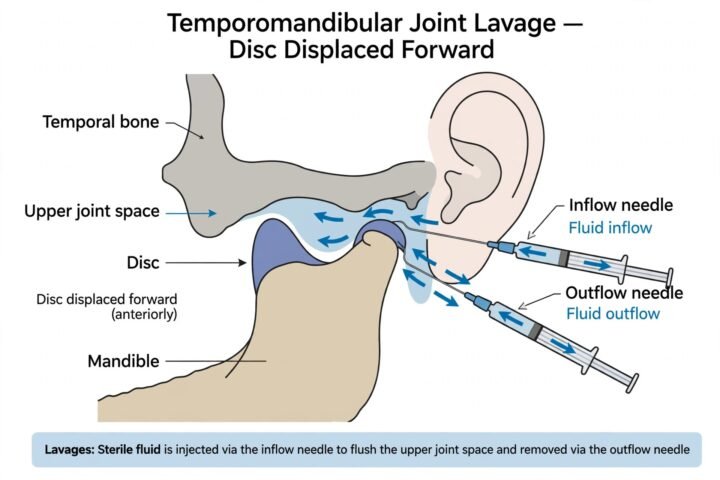
Arthrocentesis is lavage — flushing — of the upper joint space of the TMJ. Two needles, or a needle and a cannula, are placed into that space. Sterile fluid such as saline or Ringer’s lactate is pumped in through one needle and drains out through the other. Reviews of the procedure describe three intended effects: washing out inflammatory substances such as cytokines, lowering pressure inside the joint, and using the hydraulic pressure of the fluid to break up fine adhesions that can tether the disc and limit movement.
Some clinicians inject a substance into the joint at the end of the washout — for example hyaluronic acid, a corticosteroid, or a platelet concentrate. That add-on is not the arthrocentesis itself, and the evidence for each add-on differs. A 2025 systematic review of irrigation fluids found that saline, Ringer’s lactate, and ozonated water were all associated with less pain and better opening, with no irrigant proven clearly superior in the larger pooled analysis — a useful reminder that the washout, rather than a magic fluid, is the core of the procedure.
Arthrocentesis is not arthroscopy, and it is not open surgery. There is no camera inside the joint and no incision to repair or replace joint structures. Our overview of TMJ surgery procedures, indications, and outcomes places arthrocentesis at the least invasive end of the surgical options for exactly that reason.
Who is arthrocentesis usually offered to?
The classic indication, repeated across reviews, is disc displacement without reduction — the disc has slipped forward and does not slip back as the jaw moves, so the jaw feels stuck, opening is limited, and it hurts. People often call this a closed lock. Arthrocentesis is also used for painful osteoarthritis of the joint, for some inflammatory joint conditions, and for persistent joint pain that has not responded to non-invasive care such as physical therapy, oral appliances, and medication.
That sequence matters. Arthrocentesis is generally suggested for patients who have not responded to conservative therapy first — it is a step up the ladder, not a first treatment for new jaw pain. If you have not yet tried the reversible options, our comparison of physical therapy vs splint vs Botox for TMJ is the more relevant starting point, and a TMJ splint or night guard may still have a role alongside any procedure.
It is also the wrong tool for some problems. Pain that is mainly muscular, pain with a cause outside the joint, or a joint with severe structural damage that needs reconstruction may not benefit from a washout. That judgement needs an examination and, usually, imaging — not a symptom list alone.
What happens during the procedure?
Beforehand, the clinician documents how far you can open (maximum mouth opening), how the jaw moves, and where it hurts, so change can be measured afterwards. The procedure is commonly done in an outpatient or dental-chair setting under local anaesthesia, with or without intravenous sedation, with the skin in front of the ear cleaned and marked.
Two needles are placed into the upper joint compartment. Fluid is flushed through — published technique descriptions note that 100 to 200 mL of lavage is now commonly considered sufficient, down from the 500 mL used in early descriptions. While the fluid flows, the clinician may gently move the jaw to help free a stuck disc. If an injection add-on is planned, it is given into the joint space at the end. There are no stitches in the usual two-needle technique, and the appointment itself is typically short compared with operating-room surgery, though exact times vary by clinic and by whether sedation is used.
What does TMJ arthrocentesis recovery actually involve?
Most tmj arthrocentesis recovery advice is deliberately unglamorous, because the first days decide comfort more than anything high-tech does. Post-procedure guidance in the literature is consistent: keep to a soft diet for a few days, start gentle range-of-movement exercises early and continue them for several days, and use pain relief as advised by your clinician. The exercises are not optional extras — a washout can free a stuck joint, but movement practice is what helps keep that opening.

In practical terms, tmj arthrocentesis recovery usually looks like this. The day of the procedure, expect numbness while the local anaesthetic wears off, some soreness in front of the ear, and possibly swelling. Over the next few days, swelling and soreness should trend down, eating stays soft, and wide yawning, chewy food, and gum are poor ideas. Many people notice pain relief or easier opening within days to weeks, though improvement can also build over the following weeks as exercises continue. If you had sedation, follow the clinic’s instructions about driving and rest for that day.
A simple recovery checklist
- Soft diet for a few days, then reintroduce firmer food gradually as comfort allows.
- Gentle opening and movement exercises, started early, as instructed — little and often beats forcing the jaw.
- Cold pack against the jaw on the first day if your clinician advises it, for swelling.
- Call the clinic promptly for fever, worsening swelling after the first days, a bite that feels increasingly wrong, new weakness that does not fade, or pain that is getting worse instead of better.
When should you worry during tmj arthrocentesis recovery? Temporary effects are expected; escalating ones are not. Increasing pain, spreading swelling, fever, discharge, or an inability to open that is worse than before the procedure all warrant a call the same day rather than waiting for a routine review.
How well does it work?
The fairest summary is: it helps pain, it helps opening a little, and it is not a guarantee. A systematic review with meta-analyses and trial sequential analyses, published in 2024, compared arthrocentesis with conservative treatment across randomised trials. Arthrocentesis was superior for pain reduction in the short term (mean difference 14.5 points, 95% CI 9.7 to 19.4; 9 RCTs, 545 patients) and at intermediate follow-up (mean difference 14.2 points; 9 RCTs, 547 patients). For maximum mouth opening, the advantage was much smaller — about 2.4 mm short term and 2.2 mm at intermediate follow-up — which the authors judged clinically relevant for pain, but not for mouth opening. Long-term data were lacking or too varied to pool.
Success rates quoted in individual series depend heavily on who was treated. Reviews report success of up to 91% when arthrocentesis is used for anterior disc displacement without reduction, and a separate comparative review reported 70 to 90% effectiveness for closed lock, with an average overall success rate of 83.5% across studies of internal derangement. Those figures come from selected patients in specialist centres, with different definitions of success — treat them as a range for a well-chosen case, not a promise for yours. A 2026 narrative review adds a caution worth hearing: improvement also happens with conservative care and with time in disc displacement without reduction, so part of what any single series credits to the procedure may reflect natural recovery too.
What are the risks and side effects?
Reviews consistently describe arthrocentesis as having few major complications, and most effects that do occur are temporary and managed conservatively. The list reported in a 2025 review includes temporary swelling of the tissues around the joint or the ear canal, a temporary open bite on the treated side (the teeth meeting differently for a while), temporary weakness of the forehead or eyelid muscles, bruising in front of the ear (a preauricular haematoma), and, more rarely, vertigo during or shortly after the procedure. Many of these are explained by the local anaesthetic or by irrigation fluid escaping into nearby soft tissue during the washout.
Less common but more serious problems — such as infection or injury to nearby structures — are why the procedure belongs with a clinician trained in the anatomy in front of the ear, where the facial nerve, blood vessels, and ear canal are all close. Ask directly what complications that clinician has seen, how often, and what the plan is if the washout does not help. As background, the evidence on Botox for TMJ shows the same pattern as arthrocentesis: a plausible, sometimes helpful intervention whose benefit depends on matching it to the right kind of pain.
How much does TMJ arthrocentesis cost?
There is no single price, and any figure needs its context. Costs depend on the country and clinic, whether sedation or an operating facility is involved, imaging beforehand, and whether an injection add-on is used. One US clinic guide lists arthrocentesis at roughly $1,000 to $3,000, well below the $5,000 to $30,000 or more it lists for arthroscopy and open surgery — useful as an order-of-magnitude comparison, not as a quote. Insurance coverage for TMJ treatment is inconsistent, and whether a plan treats this as medical or dental can change what you pay, so confirm coverage, in writing if possible, before booking.
Two questions protect you from surprise bills: is the fee all-in (consultation, imaging, sedation, follow-up), and what does a repeat procedure or a follow-on treatment cost if the first washout does not hold? A cheaper quote that excludes imaging and follow-up may not be cheaper in the end.
How does it compare with arthroscopy and open surgery?
| Option | What it involves | Typical setting | Best understood as |
|---|---|---|---|
| Arthrocentesis | Needle washout of the upper joint space; no camera | Outpatient, local anaesthesia with or without sedation | First minimally invasive step for a painful, stuck joint that has not responded to conservative care |
| Arthroscopy | Small camera and instruments inside the joint; adhesions can be released under vision | Usually operating room, general anaesthesia | A step up when seeing and treating inside the joint is needed; more equipment and cost |
| Open joint surgery | Direct access to repair, reposition, or replace joint structures | Operating room, general anaesthesia | Reserved for severe structural disease or failed lesser procedures |
A systematic review comparing arthroscopy with arthrocentesis found arthroscopy produced greater improvement in mouth opening and a statistically greater pain reduction in pooled analysis — but it also requires an operating room, general anaesthesia, and more cost, and reviews report no severe complications requiring hospitalisation for either approach in the studies examined. In practice, that is why arthrocentesis is usually tried first for a suitable case: if a washout is enough, the bigger operation was never needed.
Frequently asked questions
How long does TMJ arthrocentesis recovery take?
Most tmj arthrocentesis recovery is measured in days. Soreness and swelling usually settle over the first few days on a soft diet, gentle movement exercises start early, and many people are back to normal routines within about a week. Pain relief and opening can keep improving over the following weeks. Worsening pain, fever, or increasing swelling is not normal recovery — contact your clinic promptly.
Is TMJ arthrocentesis painful?
The procedure is done under local anaesthesia, with sedation offered in some clinics, so most people feel pressure and movement rather than sharp pain. Afterwards, soreness in front of the ear and aching when opening are common for a few days and are usually managed with the pain relief your clinician advises, a soft diet, and rest for the jaw between exercises.
Can arthrocentesis fix a locked jaw?
It is one of the main reasons the procedure is offered. For disc displacement without reduction — a closed lock — reviews report high success in selected cases, including figures up to 91% in one systematic review summary and 70 to 90% effectiveness for closed lock in another. It does not help every lock, especially where structural damage is advanced, which is why imaging and examination come first.
Will I need arthrocentesis more than once?
Sometimes. Reviews note the procedure can be repeated under local anaesthesia with minimal downtime, and a repeat washout is one option if symptoms return. But needing repeated procedures is also information: it may mean the diagnosis, an add-on treatment, or a step up to arthroscopy needs reconsidering with your specialist rather than simply repeating the same washout indefinitely.
Conclusion
Arthrocentesis earns its place as the middle step in TMJ care: more than conservative treatment, much less than open surgery. The best evidence says it reduces pain more than conservative care alone in the short and intermediate term, adds only a small gain in opening, and carries mostly temporary risks when done for the right diagnosis — a painful, stuck, or osteoarthritic joint that has not settled with reversible care. TMJ arthrocentesis recovery is usually brief, but it is active: soft food, early gentle movement, and attention to warning signs.
If it has been suggested for you, the most useful next step is a specific conversation: what exactly is wrong inside my joint, what change do we expect and by when, what will it cost all-in, and what happens if it does not work? Bring those answers, not a success percentage from the internet, to your decision.
This article is for educational purposes only and is not medical advice. It is general information, not a diagnosis or a recommendation for any individual. Discuss jaw pain, locking, or treatment options with your own dentist or clinician.
Sources
- Tang YH, van Bakelen NB, Gareb B, et al. Arthrocentesis versus conservative treatments for temporomandibular joint disorders: a systematic review with meta-analyses and trial sequential analyses (2024) — pain and mouth-opening meta-analyses cited above. visualize.jove.com
- Is arthrocentesis effective for temporomandibular joint disorders? Acta Cirurgica Brasileira, 2025 — mechanism, indications, and complications review. pmc.ncbi.nlm.nih.gov
- Miskinyte M, et al. Clinical effectiveness of different irrigation agents in temporomandibular arthrocentesis: systematic review and meta-analysis. Journal of Clinical Medicine, 2025. mdpi.com
- National Institute of Dental and Craniofacial Research (NIDCR) — Temporomandibular Disorders (TMD): conservative-first care and when to seek assessment. nidcr.nih.gov
About this information
Consult the sources listed in the article. This notice does not certify an individual clinical review.
This article is for education only and is not medical advice. Talk to a qualified clinician about your own symptoms.



0 Comments