
Educational information · Not medical advice
In brief
Melatonin for sleep: what dose and timing the trials support, why 10 mg is usually too much, who should skip it, and when CBT-I works better instead today.
In this article
- What is melatonin, and what does it actually do?
- Does melatonin for sleep actually work for insomnia?
- How much melatonin should you take?
- When should you take melatonin for sleep?
- Where does melatonin help most — and where does it help least?
- Who should skip melatonin, or ask a clinician first?
- Can you trust the dose on the label?
- Frequently asked questions
- Conclusion
- Sources
Key Takeaways
- Melatonin for sleep is a timing signal, not a sedative. It tells your body clock that night is coming; it does not knock you out like a sleeping pill.
- For ordinary chronic insomnia, the average gain in trials is small — about 7 minutes faster to fall asleep — and the American Academy of Sleep Medicine suggests clinicians not use melatonin for sleep-onset or sleep-maintenance insomnia in adults.
- Timing usually matters more than dose. Johns Hopkins guidance discussed in this article is 1 to 3 mg about two hours before bedtime for occasional difficulty, with “less is more” as the rule.
- The evidence is strongest for jet lag and for delayed sleep phase — problems of clock timing — not for long-standing insomnia, where CBT-I is the first-line treatment.
- Labels can be wrong: in a 2023 JAMA study, 22 of 25 melatonin gummy products (88%) were inaccurately labelled.
Melatonin for sleep is one of the most bought sleep aids in the United States, and one of the most misunderstood. It is sold in 5 mg and 10 mg tablets and gummies as if more must mean stronger, taken at bedtime as if it were a sedative, and used night after night for chronic insomnia — the one use the evidence supports least. Used for the right problem, at a low dose, at the right time, melatonin for sleep can help. Used the usual way, it often disappoints.
This article separates what melatonin actually does from what marketing implies, gives the dose and timing the evidence supports, and names who should skip it. If your main problem is waking in the night rather than falling asleep, our guide to why you wake up at 3 AM covers that pattern, and if insomnia has become chronic, our explainer on what CBT-I is covers the first-line therapy.
What is melatonin, and what does it actually do?
Melatonin is a hormone your brain makes in response to darkness. Johns Hopkins sleep expert Luis F. Buenaver, PhD, explains it plainly: your body produces melatonin naturally, it does not make you sleep, but as levels rise in the evening it puts you into a state of quiet wakefulness that helps promote sleep. In other words, melatonin is a clock signal. It tells the rest of the body that night has arrived, so sleep can follow at the right time.
That distinction explains almost everything else in this article. A sedative forces sleep regardless of timing. A timing signal only helps if timing is the problem, or if the signal is given at the hour that moves the clock in the direction you want. Bright light in the evening can suppress your own melatonin rise and delay that signal, which is why dimming lights and reducing bright screens in the last part of the evening are not just folk advice — they protect the signal melatonin for sleep is meant to reinforce.
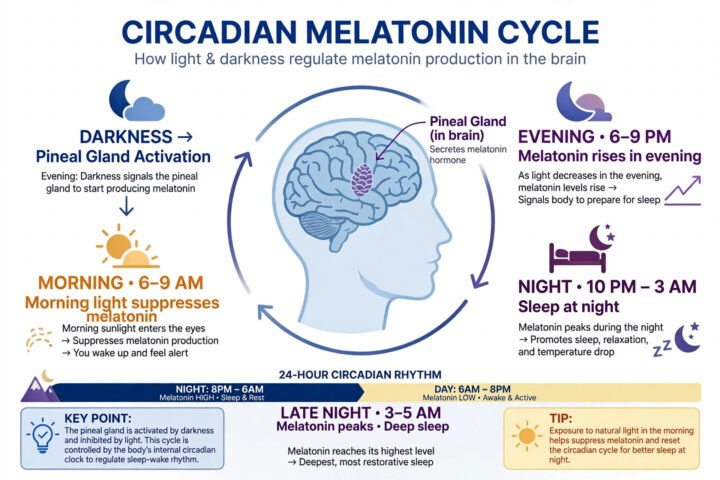
Your own melatonin levels typically rise about two hours before your usual bedtime, peak during the night, and fall by morning as light returns. A supplement taken at the wrong hour can push that rhythm later instead of earlier, or leave extra melatonin active into the morning, which is one reason some people feel groggy after a large bedtime dose.
Does melatonin for sleep actually work for insomnia?
For chronic insomnia, the honest answer is: a little, on average, and guidelines do not recommend it as a treatment. A widely cited meta-analysis by Ferracioli-Oda and colleagues in 2013 pooled 19 placebo-controlled trials with 1,683 people with primary sleep disorders. Compared with placebo, melatonin shortened the time to fall asleep by about 7.06 minutes and increased total sleep time by about 8.25 minutes. Those effects are real in a statistical sense, but most readers lying awake for an hour will not experience seven minutes as a solution.
About 7 minutes
That is the average reduction in time to fall asleep with melatonin versus placebo in the 2013 meta-analysis of 19 trials (1,683 participants) cited in this article — a real but small effect for ordinary insomnia.
The American Academy of Sleep Medicine (AASM), in its 2017 clinical practice guideline for the pharmacologic treatment of chronic insomnia in adults, suggests that clinicians not use melatonin to treat sleep-onset or sleep-maintenance insomnia in adults. That is a weak recommendation based on very low-quality evidence — it means the evidence is too thin to recommend it, not that melatonin has been proved useless for everyone. The National Center for Complementary and Integrative Health (NCCIH) summarises the same position: there is not enough strong evidence on effectiveness or safety for chronic insomnia to recommend it, and the American College of Physicians instead strongly recommends cognitive behavioural therapy for insomnia (CBT-I) as the first treatment.
So if you have had insomnia at least three nights a week for months, melatonin for sleep is unlikely to be the answer on its own. It may still have a role for a short spell of occasional difficulty, or for the timing problems covered below — but persistent insomnia deserves assessment for causes such as sleep apnoea, anxiety, medicines, caffeine, and alcohol, rather than a steadily rising supplement dose. Our article on why you clench your jaw at night shows how sleep problems and jaw pain can feed each other overnight.
How much melatonin should you take?
There is no official recommended dose of melatonin for sleep in the United States, because it is sold as a dietary supplement, not as an approved drug with a standard dose. That is why shop shelves range from 0.5 mg to 10 mg and beyond, with no agreement on the label.
The guidance most often cited from a major academic centre is deliberately low. Johns Hopkins recommends, for occasional insomnia, taking 1 to 3 milligrams two hours before bedtime, with Buenaver’s phrase “less is more.” If melatonin for sleep is not helping after a week or two, Johns Hopkins advises stopping it and talking with a health care provider, rather than escalating. If it does seem to help, the same guidance says it is safe for most people to take nightly for one to two months — a short-term frame, not an open-ended one.
Why not 10 mg? Trials have mostly used much lower doses, and higher doses have not been shown to produce proportionally better sleep. A larger dose is more likely to still be active the next morning, causing daytime drowsiness, headache, dizziness, or nausea — the side effects NCCIH lists for melatonin supplements. Starting low also makes it possible to tell whether melatonin is doing anything at all: if 1 mg at the right time does nothing, 10 mg at the wrong time is rarely the fix.
This section is general information about doses discussed in guidelines and trials, not a personal prescription. Your own medicines, medical conditions, age, and pregnancy status can change whether melatonin is appropriate at all, as the next sections explain.
When should you take melatonin for sleep?
Timing is the part most people get wrong. Because your natural melatonin rise begins about two hours before bedtime, Johns Hopkins places the supplement at that same point: about two hours before bed, not in bed after an hour of tossing and turning. Taken in response to lying awake, it arrives too late for that night’s sleep onset and may still be active when you need to wake.

For clock-shifting uses, timing is even more specific and depends on the direction you need to move. NCCIH notes that for jet lag, melatonin taken close to the target bedtime at the destination can reduce jet lag, particularly after crossing several time zones, while melatonin taken early in the day can cause sleepiness and delay adjustment to local time. For delayed sleep phase — falling asleep very late and waking late — the aim is to advance the clock earlier, which again depends on taking it in the evening before the desired bedtime, under guidance if the pattern is entrenched.
A practical evening routine supports the same signal: dim the lights, keep a consistent bedtime and wake time, and avoid bright light late at night. Melatonin for sleep works with that routine; it does not replace it. If you use oral appliances for sleep apnoea, timing and jaw comfort also matter overnight — see our overview of oral appliances, jaw position, and sleep apnoea.
Where does melatonin help most — and where does it help least?
The pattern across NCCIH, Johns Hopkins, and the AASM is consistent: melatonin helps most when the problem is timing, and least when the problem is chronic insomnia without a timing shift.
| Problem | What the evidence and guidelines say | Bottom line |
|---|---|---|
| Jet lag | NCCIH: studies show melatonin may help with jet lag; participants reported less jet lag than placebo. | Strongest everyday use; timing at destination matters. |
| Delayed sleep phase | Johns Hopkins notes bigger benefits for delayed sleep phase syndrome; NCCIH reports AASM support, as a weak recommendation, for strategically timed melatonin in this disorder. | A timing problem, so a timing signal fits. |
| Occasional difficulty falling asleep | Johns Hopkins discusses 1 to 3 mg two hours before bed for occasional insomnia, stopping if no help in a week or two. | Reasonable short trial for some adults; keep dose low. |
| Chronic insomnia | AASM 2017 suggests clinicians not use melatonin for sleep-onset or sleep-maintenance insomnia; average gain about 7 minutes in pooled trials. | Not first-line; CBT-I is recommended first. |
Notice what is not on the strong-evidence list: staying asleep all night, fixing sleep apnoea, or cancelling out late caffeine, alcohol, pain, or anxiety. If those are driving your nights, treating them directly will do more than any dose of melatonin.
Who should skip melatonin, or ask a clinician first?
NCCIH says short-term use of melatonin supplements appears to be safe for most people, but information on long-term safety is lacking, and there is not enough information about high-dose side effects to have a clear overall picture. Side effects are uncommon but can include drowsiness, headache, dizziness, and nausea.
Ask a clinician before using melatonin for sleep if you take medicines, because supplements can interact with them. NCCIH specifically says people with epilepsy and people taking blood thinners need medical supervision when taking melatonin. Johns Hopkins advises not using melatonin if you are pregnant or breastfeeding, or if you have an autoimmune disorder, a seizure disorder, or depression, and notes that melatonin may raise blood-sugar and blood-pressure levels in some people taking certain hypertension medicines — so people with diabetes or high blood pressure should discuss it first.
Children need particular caution. NCCIH notes uncertainties about dose, timing, long-term effects, and whether benefits outweigh risks in children, and because melatonin is a hormone, possible effects on hormonal development cannot be ruled out with current evidence. It advises working with a health care provider if you are considering melatonin for a child. The AASM guideline cited by NCCIH also recommends against melatonin use by people with dementia. Older adults should be cautious too, because melatonin may remain active longer and contribute to daytime drowsiness.
Can you trust the dose on the label?
Not always — and that matters when the difference between a low and a high dose is the point. In a research letter in JAMA in 2023, Cohen and colleagues tested 25 melatonin gummy products sold in the United States. Twenty-two of the 25 products (88%) were inaccurately labelled, and only 3 products contained a quantity within 10% of the declared amount. In products that contained melatonin, the actual quantity ranged from 74% to 347% of the labelled quantity. One product contained no detectable melatonin but did contain 31.3 mg of CBD.
That study tested gummies only, with one sample per product, so it does not prove every tablet is wrong. It does show why “I took 1 mg” may not mean what you think, especially with gummies, and why choosing a product verified by an independent programme such as USP, where available, and keeping the dose low, are sensible precautions. If a product seems to knock you out or leaves you heavily groggy, do not assume you are unusually sensitive — the dose may not have been the dose on the jar.
Frequently asked questions
Is melatonin for sleep a sleeping pill?
No. Melatonin is a hormone that signals darkness and timing to your body clock. Johns Hopkins describes it as putting you into quiet wakefulness that helps promote sleep, rather than making you sleep directly. That is why it helps timing problems more than chronic insomnia, and why dose and timing matter more than strength.
How much melatonin for sleep should I start with?
Guidance cited in this article starts low. Johns Hopkins discusses 1 to 3 mg about two hours before bedtime for occasional difficulty and stresses that less is more. There is no official standard dose in the United States. If it does not help within a week or two, stop and discuss it with a clinician instead of raising the dose.
Can I take melatonin every night?
Short-term use appears safe for most adults, according to NCCIH, but long-term safety information is lacking. Johns Hopkins says that if it helps, most people can take it nightly for one to two months. Needing it for longer is a reason to have insomnia itself assessed, because chronic insomnia has a first-line treatment — CBT-I — that melatonin does not replace.
Why do I feel groggy the morning after melatonin?
Grogginess can happen when the dose is higher than you need or taken too late, so melatonin is still active in the morning. NCCIH lists daytime drowsiness among possible effects, and notes melatonin may stay active longer in older people. A lower dose, taken earlier in the evening, or stopping it, are the usual responses to discuss with a clinician.
Conclusion
Melatonin for sleep is neither a miracle nor a myth. It is a timing hormone with a small average effect on ordinary insomnia, a clearer role in jet lag and delayed sleep phase, and a dose rule that runs opposite to marketing: low, early in the evening, and for a short, defined trial. If you try it, use the lowest dose that the guidance supports, take it about two hours before bed, protect the signal with dim evening light and a steady schedule, and stop if a week or two brings no benefit.
If poor sleep has lasted for months, if you snore heavily or wake unrefreshed, if jaw pain greets you in the morning, or if anxiety keeps your mind racing at night, book an assessment rather than buying a stronger gummy. Treating the actual driver — insomnia, apnoea, pain, or a shifted clock — is what restores sleep in the long run.
Sources
- National Center for Complementary and Integrative Health (NCCIH). Melatonin: What You Need To Know — effectiveness for jet lag, delayed sleep phase and insomnia, safety, side effects, and cautions for epilepsy, blood thinners, children, and dementia.
- Johns Hopkins Medicine. Melatonin for Sleep: Does It Work? — how melatonin works, 1 to 3 mg two hours before bedtime for occasional insomnia, “less is more,” and who should not use it.
- Sateia MJ et al. Clinical Practice Guideline for the Pharmacologic Treatment of Chronic Insomnia in Adults: An American Academy of Sleep Medicine Clinical Practice Guideline. Journal of Clinical Sleep Medicine. 2017 — AASM suggestion that clinicians not use melatonin for sleep-onset or sleep-maintenance insomnia in adults.
- Ferracioli-Oda E, Qawasmi A, Bloch MH. Meta-Analysis: Melatonin for the Treatment of Primary Sleep Disorders. PLoS ONE. 2013 — 19 trials, 1,683 participants; sleep onset about 7.06 minutes faster and total sleep about 8.25 minutes longer versus placebo.
- Cohen PA et al. Quantity of Melatonin and CBD in Melatonin Gummies Sold in the US. JAMA. 2023;329(16):1401-1402 — 22 of 25 gummy products inaccurately labelled; actual content 74% to 347% of labelled quantity.
Disclaimer: This article is for educational information only and is not medical advice. It does not diagnose or prescribe treatment for any individual. Discuss supplements, medicines, and persistent sleep problems with your clinician, dentist, or pharmacist, especially if you are pregnant, take prescription medicines, or care for a child with sleep problems.





0 Comments