
Educational information · Not medical advice
In brief
What is CBT-I? How CBT-I for insomnia works step by step, what trials found, how it beats pills and hygiene alone, and how to access it in person or online.
In this article
- What is CBT-I?
- Why do guidelines put CBT-I first, ahead of sleeping pills?
- What are the components of CBT-I, step by step?
- What results does CBT-I actually produce?
- How does CBT-I compare with sleeping pills and sleep hygiene?
- How can you access CBT-I, in person or digitally?
- Who should get assessed before starting CBT-I?
- Frequently asked questions
- Conclusion
- Sources
Key Takeaways
- CBT-I for insomnia is a short, structured therapy — usually 4 to 8 sessions — that changes the behaviours and thoughts keeping insomnia going. It is not sleeping pills, and it is not just sleep-hygiene advice.
- The American College of Physicians recommends CBT-I as the initial treatment for all adults with chronic insomnia, and the American Academy of Sleep Medicine gives multicomponent CBT-I its strong recommendation.
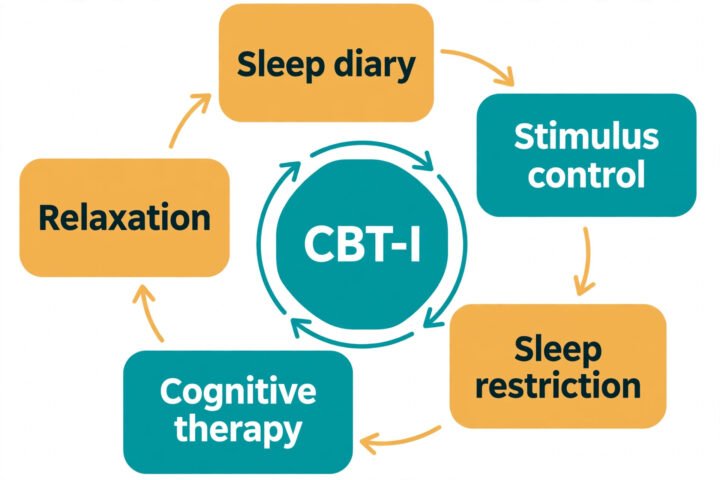
- Its working parts are a sleep diary, stimulus control, sleep restriction, cognitive therapy, and relaxation — used together as a package, not picked apart.
- In a meta-analysis of 20 trials, CBT-I cut the time to fall asleep by about 19 minutes and time awake in the night by about 26 minutes, with gains that seemed to last.
If you have searched for help with insomnia, you have probably been offered a list of hygiene tips and, eventually, a pill. The treatment guidelines actually put first is neither. CBT-I for insomnia — cognitive behavioural therapy for insomnia — is a short programme that retrains how you sleep, and it is the first-line therapy most people with chronic insomnia have never been offered.
This article explains what CBT-I is, walks through each component step by step, shows what the trials found, and explains how to access CBT-I for insomnia in person, by telehealth, or through a regulated digital programme. If you are waking in the night as well as struggling to fall asleep, our article on waking up at 3 AM every night covers that pattern in depth.
What is CBT-I?
CBT-I stands for cognitive behavioural therapy for insomnia. It is a structured, time-limited therapy built specifically for insomnia — not general talk therapy, and not a discussion of your childhood. A course of CBT-I for insomnia typically runs 4 to 8 sessions, and the National Heart, Lung, and Blood Institute (NHLBI) describes it as a 6- to 8-week plan to help you fall asleep faster and stay asleep longer.
The idea behind it is simple. Insomnia often starts with a trigger — stress, illness, pain, a new baby — but it persists because of what happens next: you spend longer in bed trying to catch sleep, you lie awake frustrated, the bed itself becomes linked with wakefulness and worry, and unhelpful beliefs ("one bad night will ruin tomorrow") keep your mind alert at exactly the wrong time. CBT-I targets those maintaining factors, one by one.
Insomnia is considered chronic when it occurs 3 or more nights a week and lasts for 3 months or longer, according to the NHLBI — and it is chronic insomnia that CBT-I is designed and tested for. Short-term insomnia after a stressful week usually settles on its own and does not need a full programme.
Why do guidelines put CBT-I first, ahead of sleeping pills?
Two major guidelines agree on the order. The American College of Physicians (ACP), in its 2016 clinical practice guideline on chronic insomnia disorder, recommends that all adult patients receive CBT-I as the initial treatment for chronic insomnia disorder — a strong recommendation based on moderate-quality evidence. Only if CBT-I alone does not succeed does the ACP suggest a shared decision-making discussion about adding short-term medication.
The American Academy of Sleep Medicine (AASM), in its 2021 guideline on behavioural and psychological treatments, gives multicomponent CBT-I its single strong recommendation — the grade clinicians should follow under most circumstances. Individual components used alone receive only conditional recommendations, which is why CBT-I for insomnia is delivered as a package rather than as one tip.
The reasoning is durability and harm. Sleeping pills can help in the short term, but their benefits generally stop when the pills stop, and they carry risks such as next-day drowsiness, tolerance, and dependence. CBT-I teaches skills that stay with you after the sessions end, which is why guidelines place it first and medication second.
What are the components of CBT-I, step by step?
1. A sleep diary. Everything in CBT-I starts from your own numbers. The NHLBI suggests keeping a sleep diary for 1 to 2 weeks: when you go to sleep, when you wake, when you nap, how sleepy you feel in the day, and when you have caffeine, alcohol, and exercise. Your therapist — or a digital programme — uses that diary to set your schedule and measure progress.
2. Stimulus control. This rebuilds the link between bed and sleep. The rules are consistent: use the bed for sleep, go to bed only when sleepy, keep a fixed wake time, and if you are awake for roughly 20 minutes and feeling alert or frustrated, get up to a dim, quiet place and return when drowsy. Lying in bed awake trains the opposite association.
3. Sleep restriction, also called sleep scheduling. Time in bed is temporarily matched more closely to the sleep you actually get, which rebuilds sleep pressure so sleep becomes deeper and less broken. As sleep consolidates, time in bed is gradually extended. This is often the most effective component and the hardest in the first week or two, and it is best done with guidance rather than improvised aggressively — especially if you drive for a living or have a condition where sleep loss is risky.
4. Cognitive therapy. This part tests the thoughts that spike alertness at 3 AM: catastrophising about tomorrow, clock-watching, and the belief that you must force eight hours. Replacing those with accurate, calmer expectations lowers the arousal that keeps you awake.
5. Relaxation and wind-down. A consistent pre-sleep routine and relaxation techniques lower physical and mental arousal before bed. Sleep hygiene — a cool, dark room, no late caffeine — sits here as sensible support, not as the treatment itself.

What results does CBT-I actually produce?
The clearest summary is a 2015 systematic review and meta-analysis by Trauer and colleagues in the Annals of Internal Medicine, which pooled 20 randomised trials with 1,162 adults with chronic insomnia. At the end of treatment, people receiving CBT-I fell asleep about 19 minutes faster on average, spent about 26 fewer minutes awake during the night, and spent about 10 percentage points more of their time in bed actually asleep. Total sleep time itself rose only slightly — CBT-I mainly makes sleep more solid, not dramatically longer — and the changes seemed to be sustained at later follow-up.
About 26 minutes — the average reduction in time spent awake during the night after CBT-I in the Trauer 2015 meta-analysis of 20 trials. Time to fall asleep fell by about 19 minutes over the same programmes.
Those are averages from sleep diaries, so some people do better and some do worse, and the trials in that review excluded people whose insomnia came with other major medical, sleep, or psychiatric disorders. Even so, the pattern — faster sleep onset, fewer long wakings, and benefits that persist after treatment ends — is the reason CBT-I for insomnia holds the first-line position rather than the medication-first approach many readers have experienced.
How does CBT-I compare with sleeping pills and sleep hygiene?
| Approach | Guideline position | What to expect |
|---|---|---|
| CBT-I for insomnia | First-line: ACP strong recommendation as initial treatment; AASM strong recommendation for multicomponent CBT-I | 4 to 8 sessions; effort up front, benefits that tend to persist after treatment |
| Sleeping pills | Second step: discuss short-term use if CBT-I alone has not succeeded (ACP) | Can help short-term; benefits usually stop when pills stop; risks include drowsiness, tolerance, dependence |
| Sleep hygiene alone | AASM suggests against using it as a single-component treatment for chronic insomnia | Sensible support for any plan, but usually not enough on its own for chronic insomnia |
The table also explains a common frustration: if you have "tried everything" and the everything was hygiene lists, you have not yet tried the treatment with the strongest backing. CBT-I for insomnia is a different intervention, not a stricter version of the same list.
How can you access CBT-I, in person or digitally?
Start with your primary care clinician and ask specifically about CBT-I — by name. Referral routes vary: a sleep medicine clinic, a behavioural sleep medicine specialist, or a psychologist trained in CBT-I may deliver it in person or by telehealth, individually or in a small group. Wait lists are a real barrier in many areas, which is one reason digital CBT-I has grown.
Digital CBT-I delivers the same core components — diary, sleep scheduling, stimulus control, cognitive work — through a structured programme. In the United States, two digital programmes are FDA-cleared as prescription treatments for insomnia: Somryst, cleared in 2020 for adults 22 and over, and SleepioRx, cleared in August 2024 for adults 18 and over as an add-on to usual care. Both need a clinician's order, so cost depends on your health plan rather than an app-store price. Free or low-cost CBT-I-based apps also exist, but they are not FDA-cleared treatments, and a programme that sets a sleep-restriction schedule for you is safer with clinician oversight if you have other health conditions.
Whichever route you choose, keep the diary honestly and give the programme its full course before judging it. The first week of sleep scheduling can feel worse before sleep consolidates — that dip is expected, and quitting in week one is the most common reason CBT-I for insomnia "didn't work." If pain is part of what keeps you awake, note that sleep and jaw pain feed each other; our overview of oral appliance therapy for sleep apnea and our article on why you clench your jaw at night cover the jaw side of broken sleep.
Who should get assessed before starting CBT-I?
CBT-I treats insomnia itself. It does not treat the conditions that can cause or mimic it, so get assessed first — or in parallel — if you have loud snoring with witnessed pauses in breathing, waking gasping or choking, or severe daytime sleepiness, which point to sleep apnea and need a sleep study. Our article on apnea and jaw position, linked above, explains one treatment route once apnea is diagnosed.
Also raise insomnia with your clinician before starting a self-directed sleep-restriction schedule if you have bipolar disorder, a seizure disorder, untreated sleep apnea, severe daytime sleepiness that affects driving, or a job where a week of extra sleepiness would be unsafe. A clinician can adapt the schedule — for example with a gentler sleep-compression approach — rather than skipping treatment altogether. And if insomnia arrives with low mood, anxiety, pain, reflux, or a recent medicine change, treat those in parallel; CBT-I works best when the drivers around it are not ignored.
Frequently asked questions
What is CBT-I in simple terms?
CBT-I is a short therapy that retrains sleep. Over 4 to 8 sessions you keep a sleep diary, reset how long you spend in bed, relearn to link the bed with sleep rather than wakefulness, and challenge the worried thoughts that keep you alert at night. It uses no medication, and its benefits tend to last after the sessions end.
Is CBT-I better than sleeping pills?
Guidelines put CBT-I first. The ACP recommends it as the initial treatment for all adults with chronic insomnia, with medication discussed only if CBT-I alone does not succeed. Pills can help short-term, but benefits usually stop when they stop. In trials, CBT-I cut time to fall asleep by about 19 minutes and night-time wakefulness by about 26 minutes, with gains that lasted.
How long does CBT-I take to work?
A course usually runs 4 to 8 sessions over about 6 to 8 weeks. Many people notice sleep becoming more solid within the first few weeks once the schedule is set from their diary, although the first week of sleep restriction can temporarily increase daytime sleepiness. Judge the programme at the end of the full course, not after the hardest first week.
Can I do CBT-I on my own or with an app?
Digital CBT-I can deliver the same components, and two US programmes — Somryst and SleepioRx — are FDA-cleared prescription treatments. Ask your clinician whether one fits you, especially if you have sleep apnea symptoms, bipolar or seizure disorders, or severe daytime sleepiness. In those situations, clinician-guided CBT-I is safer than a self-set sleep-restriction schedule.
Conclusion
CBT-I for insomnia is the treatment the guidelines actually recommend first: a short, practical programme — diary, stimulus control, sleep restriction, cognitive therapy, and relaxation — with trial evidence behind it and benefits that persist after it ends. It asks for effort over a few weeks rather than a pill every night.
If your insomnia has lasted 3 months or more, happens at least 3 nights a week, or is affecting your days, ask your clinician about CBT-I by name, in person or digitally. And if snoring, gasping, or heavy daytime sleepiness are part of your picture, get sleep apnea assessed as well — no behavioural programme can fix a collapsing airway.
Medical disclaimer: This article is educational information only and is not medical advice. It does not diagnose or prescribe. Discuss your symptoms, treatment options, and risks with your doctor or sleep clinician.
Sources
- National Heart, Lung, and Blood Institute (NHLBI), NIH: Insomnia — Diagnosis — chronic threshold of 3 or more nights a week for 3 months or longer, and the 1–2 week sleep diary; NHLBI treatment pages describe CBT-I as a 6- to 8-week plan.
- Qaseem A, et al. Management of Chronic Insomnia Disorder in Adults: A Clinical Practice Guideline From the American College of Physicians. Annals of Internal Medicine, 2016 — CBT-I recommended as the initial treatment for all adults with chronic insomnia (strong recommendation, moderate-quality evidence).
- Edinger JD, et al. Behavioral and psychological treatments for chronic insomnia disorder in adults: an American Academy of Sleep Medicine clinical practice guideline. Journal of Clinical Sleep Medicine, 2021 — strong recommendation for multicomponent CBT-I; conditional recommendation against sleep hygiene as a single-component treatment.
- Trauer JM, et al. Cognitive behavioral therapy for chronic insomnia: a systematic review and meta-analysis. Annals of Internal Medicine, 2015 — 20 trials, 1,162 participants: sleep onset improved by 19.03 minutes, wake after sleep onset by 26.00 minutes, sleep efficiency by 9.91%.
- US Food and Drug Administration device clearances, via published programme summaries — Somryst cleared 2020 (adults 22+); SleepioRx cleared August 2024 (adults 18+, adjunct to usual care).




0 Comments