Educational information · Not medical advice
In brief
Waking up at 3am every night? Why sleep lightens after midnight, what alcohol, caffeine and apnea do, and the CBT-I steps that help you stay asleep tonight.
In this article
- What is sleep maintenance insomnia?
- Why does sleep get lighter in the second half of the night?
- What are the most common reasons for waking up at 3am every night?
- How can you work out which cause is yours?
- What actually helps you stay asleep?
- When should you see a doctor about waking at night?
- Frequently asked questions
- Conclusion
- Sources
Key Takeaways
- Waking up at 3am every night is usually sleep maintenance insomnia: you fall asleep, but cannot stay asleep. Brief wakings between sleep cycles are normal — lying awake and worrying is the part that becomes a disorder.
- Sleep is deepest early in the night and lighter later, so the same noise, pain, or full bladder that would not wake you at midnight can wake you at 3 AM.
- Alcohol, late caffeine, stress, pain, and sleep apnea are the common drivers. A review of 27 studies found alcohol disrupted sleep in the second half of the night at every dose studied.
- The first-line treatment for chronic insomnia is CBT-I, not sleeping pills: the American College of Physicians recommends it as the initial treatment for all adults with chronic insomnia.
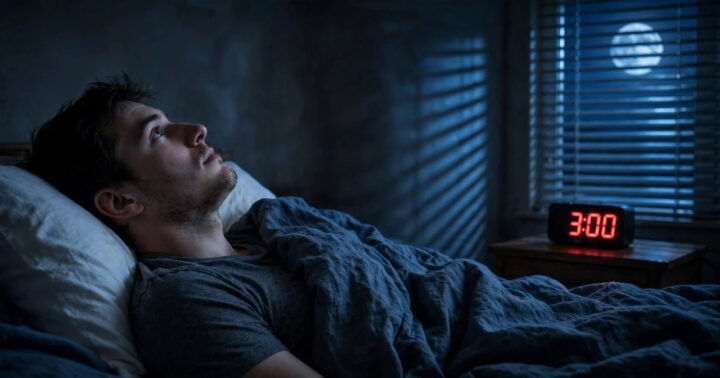
You fall asleep without much trouble. Then, like clockwork, you are awake at 3 AM, staring at the ceiling, doing the maths on how much sleep is left. If you are waking up at 3am every night, you are not unusual, and you are not broken. This pattern has a name — sleep maintenance insomnia — and it has identifiable causes and a treatment with strong evidence behind it.
This article explains why the 3 AM waking happens, how to work out which cause fits you, and what actually helps. It also covers the signs that point to something else, such as sleep apnea, that needs its own assessment rather than another sleep-hygiene list.
What is sleep maintenance insomnia?
Sleep maintenance insomnia means difficulty staying asleep: you wake during the night and struggle to get back to sleep, even though you had the time and a reasonable place to sleep. It is different from sleep-onset insomnia, where the problem is falling asleep in the first place, and from early-morning awakening, where you wake well before your alarm and cannot return to sleep at all. Many people have a mix.
Waking briefly is not the problem. Everyone surfaces between sleep cycles, usually without remembering it. The problem starts when the waking stretches out — twenty minutes, an hour, two hours — and the bed becomes a place for frustration and clock-watching. Over time, that association itself keeps the pattern going: you wake, you expect to lie awake, the expectation makes you alert, and you lie awake.
Insomnia becomes a clinical diagnosis, rather than a rough patch, when it is frequent and persistent. The National Heart, Lung, and Blood Institute (NHLBI) notes that insomnia may be diagnosed when someone has difficulty falling or staying asleep at least 3 nights a week, and that it is considered chronic when it occurs 3 or more nights a week and lasts for 3 months or longer. Daytime effects — tiredness, irritability, poor concentration — are part of the picture, not an afterthought.
Why does sleep get lighter in the second half of the night?
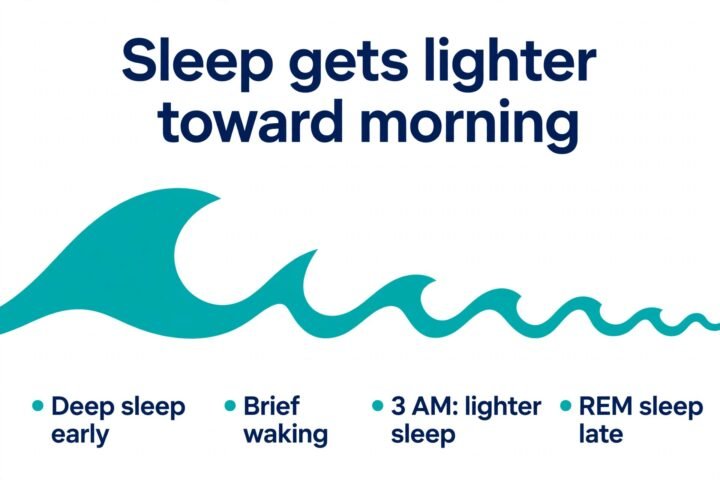
Sleep is not one uniform state. The NHLBI describes sleep as cycling between non-REM and REM sleep, with a new cycle starting roughly every 80 to 100 minutes — usually four to six cycles across a night. Deep, slow-wave sleep is concentrated in the first cycles. As the night goes on, cycles contain more light sleep and more REM sleep, the stage linked to vivid dreaming.
That architecture explains the timing. In the first half of the night, deep sleep is hard to interrupt. By around 3 AM, you are spending longer in lighter stages, closer to the surface — so a snoring partner, a sore jaw, a hot room, or a full bladder is far more likely to pull you fully awake. Waking up at 3am every night is often less about 3 AM itself and more about where 3 AM falls in your sleep cycles: if you fell asleep around 11 PM, 3 AM is roughly four hours in, deep into the lighter second half.
It also explains why the fix is rarely “try harder to sleep.” By the second half of the night, your sleep pressure — the built-up drive to sleep — has partly discharged. There is less physiological push carrying you back under, which is why the behavioural techniques below focus on rebuilding that drive and breaking the bed-equals-wakefulness association.
What are the most common reasons for waking up at 3am every night?
Alcohol. A nightcap makes falling asleep feel easier, and that part is real. The rest of the story is not. Ebrahim and colleagues reviewed 27 studies of alcohol and normal sleep in 2013 and found that alcohol at all doses reduced REM sleep and increased sleep disruption in the second half of the night. As the body metabolises alcohol, the sedative effect wears off and sleep fragments — often right around the 2 to 4 AM window. If you drink in the evening and are waking up at 3am every night, this is the first experiment worth running.
Caffeine, later than you think. Caffeine’s effects last far longer than the buzz. In a controlled study by Drake and colleagues, 400 mg of caffeine — roughly a large strong coffee — taken even 6 hours before bedtime reduced objectively measured sleep by more than an hour, and participants largely did not notice the loss themselves. An afternoon coffee can be a 3 AM problem you never connect.
More than 1 hour — the sleep lost in the Drake 2013 study when 400 mg of caffeine was taken a full 6 hours before bedtime. The participants’ own sleep diaries barely registered it; the sleep monitor did.
Stress and a racing mind. Stress is the classic trigger, and its timing makes sense: the distractions that keep worry at bay all day are gone at 3 AM. The waking may start with stress, but what maintains it is often the conditioned arousal described above — dread of the waking itself. Anxiety and jaw clenching travel with this pattern too; our article on anxiety, jaw clenching, and the stress–pain loop covers how night-time tension and poor sleep feed each other.
Pain and other symptoms. Back pain, reflux, a hot room, and the need to urinate can all surface you in light sleep. Waking often to urinate deserves a second look: the NHLBI lists waking often to urinate, loud snoring, and gasping for air among the symptoms of sleep apnea.
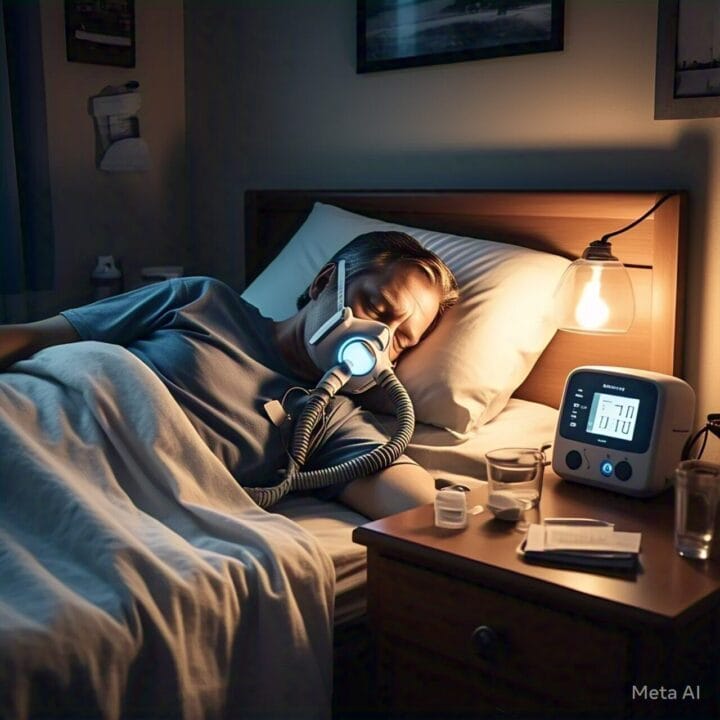
Sleep apnea and other sleep disorders. In obstructive sleep apnea, the airway repeatedly narrows or closes, and the brief arousals that restore breathing can become full wakings. Snoring, witnessed pauses, gasping, dry mouth, morning headaches, and strong daytime sleepiness are the pattern to take seriously. Our overview of oral appliance therapy for sleep apnea explains one treatment route, and our article on why you clench your jaw at night covers how grinding and apnea overlap. Restless legs and periodic limb movements are other medical causes a clinician can screen for.
How can you work out which cause is yours?
Guessing usually fails, because the causes feel identical at 3 AM. The tool clinicians actually use is a sleep diary. The NHLBI suggests keeping one for 1 to 2 weeks before seeing a doctor: write down when you go to sleep, when you wake, and when you nap, plus how sleepy you feel during the day, and when you have caffeine or alcohol and exercise.
Read the diary for patterns, not single nights. Do the worst wakings follow evening alcohol, even one drink? Do they cluster on work nights, pointing to stress and a racing mind? Are they worst after afternoon coffee? Is there snoring, gasping, or a partner’s report of pauses, pointing toward apnea testing instead? Two honest weeks of notes will usually narrow the list to one or two causes — and that shortlist is exactly what a clinician needs if you book an appointment.
One warning about tracking: do not check the clock repeatedly through the night or study a wearable’s sleep stages at 3 AM. That monitoring feeds the alertness you are trying to undo. Note the rough pattern in the morning; leave the night itself alone.
What actually helps you stay asleep?
For chronic insomnia, the treatment with the strongest backing is cognitive behavioural therapy for insomnia — CBT-I. The American College of Physicians’ 2016 guideline recommends CBT-I as the initial treatment for all adults with chronic insomnia, and the American Academy of Sleep Medicine’s 2021 guideline gives multicomponent CBT-I a strong recommendation. The AASM’s newer combination-treatment guideline reaffirms that CBT-I by itself is the most efficacious first-line treatment, while suggesting against routinely adding medication to it. Sleeping pills, by contrast, are not the recommended starting point.
CBT-I is practical, not abstract. Its core pieces include:
- Stimulus control: use the bed for sleep, go to bed when sleepy, and if you are awake for roughly 20 minutes, get up to a dim, quiet place and return when drowsy. This rebuilds the bed-equals-sleep association.
- Sleep restriction (sleep scheduling): temporarily match time in bed more closely to the sleep you actually get, which rebuilds sleep pressure so the second half of the night consolidates. This is best done with guidance, not improvised aggressively.
- A fixed wake time: the same rise time every day, including after a bad night, anchors the body clock more reliably than an early bedtime does.
- Cognitive work: challenging the catastrophic 3 AM thoughts (“tomorrow is ruined”) that spike alertness.
Sleep hygiene — a cool, dark room, no late caffeine, a wind-down routine — is sensible support, but the AASM advises against using it as the only treatment for chronic insomnia; on its own it is usually not enough. If alcohol is part of your pattern, run the simplest test first: two to three weeks with no evening alcohol, and let the diary judge. And if the apnea pattern is present, treat that as the priority: no behavioural programme fixes a collapsing airway, and waking up at 3am every night in that setting is a symptom to assess, not a habit to optimise.
When should you see a doctor about waking at night?
Book an appointment if the pattern happens 3 or more nights a week, has lasted 3 months or more, or is affecting your days — the NHLBI’s chronic-insomnia thresholds. You do not need to wait for the three-month mark if broken sleep is impairing your work, mood, or safety, including drowsy driving.
Seek assessment promptly if you have loud snoring with witnessed pauses in breathing, waking gasping or choking, severe daytime sleepiness, or morning headaches — that cluster points to sleep apnea and needs a sleep study, not self-help. Also raise repeated night wakings with your clinician if they come with new or worsening pain, reflux that is not controlled, frequent night-time urination, low mood, or a medicine change that matches when the wakings started. Bring the two-week diary; it turns a vague complaint into a workable diagnosis.
Frequently asked questions
Is waking up at 3 AM every night normal?
Brief wakings between sleep cycles are normal and usually forgotten. Lying awake for long stretches most nights is not something you have to accept: if it happens at least 3 nights a week for 3 months or more, it meets the NHLBI’s description of chronic insomnia, and the first-line treatment, CBT-I, has strong guideline support.
Why do I wake up at 3 AM specifically, and not another time?
Mostly because of where 3 AM falls in your night. If you fall asleep around 11 PM, 3 AM sits in the lighter second half of sleep, when deep sleep is scarce and REM and light sleep dominate. Triggers that would not disturb the deep first half — noise, pain, alcohol wearing off, a full bladder — can fully wake you then.
Can alcohol cause waking up at 3am every night?
Yes, it is a common and under-recognised cause. A 2013 review of 27 studies found alcohol reduced REM sleep and increased sleep disruption in the second half of the night at all doses studied. The sedative effect helps you fall asleep; the rebound as it clears fragments sleep a few hours later, often around 2 to 4 AM.
What should I do when I wake up at 3 AM and cannot get back to sleep?
Follow the stimulus-control rule used in CBT-I: if you have been awake for roughly 20 minutes and feel alert or frustrated, get up, go somewhere dim and quiet, do something calm, and return to bed when you feel drowsy. Avoid bright light, work, and clock-checking. Lying in bed awake trains the association you are trying to break.
Conclusion
Waking up at 3am every night is a pattern with mechanics, not a mystery. Sleep lightens in the second half of the night, and alcohol, caffeine, stress, pain, or apnea can turn a normal brief waking into a long one. A two-week sleep diary usually reveals which driver fits you.
If the pattern is chronic, ask about CBT-I — the first-line treatment in both the American College of Physicians and American Academy of Sleep Medicine guidelines — rather than reaching first for sleeping pills or another hygiene list. And if snoring, gasping, or heavy daytime sleepiness are in the picture, get sleep apnea assessed directly. The 3 AM club is large, but membership is not permanent.
Medical disclaimer: This article is educational information only and is not medical advice. It does not diagnose or prescribe. Discuss your symptoms, treatment options, and risks with your doctor or sleep clinician.
Sources
- National Heart, Lung, and Blood Institute (NHLBI), NIH: Insomnia — Diagnosis — the 3-nights-a-week and 3-month chronic thresholds, and the 1–2 week sleep diary.
- American Academy of Sleep Medicine: Combination treatment guideline for chronic insomnia — CBT-I by itself as the most efficacious first-line treatment; earlier AASM (2021) and pharmacologic (2017) guidelines.
- Qaseem A, et al. Management of Chronic Insomnia Disorder in Adults: A Clinical Practice Guideline From the American College of Physicians. Annals of Internal Medicine, 2016 — CBT-I recommended as the initial treatment for all adults with chronic insomnia.
- Ebrahim IO, et al. Alcohol and sleep I: effects on normal sleep. Alcoholism: Clinical and Experimental Research, 2013 — review of 27 studies: alcohol reduced REM sleep and increased second-half sleep disruption at all doses.
- Drake C, et al. Caffeine effects on sleep taken 0, 3, or 6 hours before going to bed. Journal of Clinical Sleep Medicine, 2013 — 400 mg of caffeine 6 hours before bed reduced objectively measured sleep by more than an hour.




0 Comments