Educational information · Not medical advice
In brief
Wondering how much fiber do i need each day? See the 25–38g targets by age and sex, why most adults get about 16g, and the easiest food swaps to try first.
In this article
- How much fiber do I need each day?
- Why do most adults get only about half?
- What is the difference between soluble and insoluble fiber?
- What are the easiest ways to close the gap?
- How fast should I increase fiber, and what about water?
- When should I talk to a clinician or dietitian first?
- Frequently asked questions
- Conclusion
- Sources
Key Takeaways
- If you are asking how much fiber do i need, the National Academy of Medicine targets are 25 grams a day for women age 50 or younger and 38 grams for men age 50 or younger, and 21 grams and 30 grams after age 50.
- Another way to state the target is 14 grams of fiber for every 1,000 calories you eat.
- Average intake in United States surveys is about 16 grams a day — roughly half the target for many adults.
- Increase fiber slowly, spread it across meals, and drink enough fluid, so gas and bloating are less likely to make you quit.
- You do not need a supplement first: beans, lentils, oats, fruit, vegetables, and whole grains close most of the gap.
If you are wondering how much fiber do i need, you are asking one of the most practical nutrition questions there is. Fiber is the part of plant foods your body does not digest in the usual way. It helps keep bowel movements regular, feeds gut bacteria, and — for the gel-forming kinds — can modestly lower LDL cholesterol and slow how fast sugar enters the bloodstream after a meal.
This article gives you the number by age and sex, explains why most adults land at about half that number, and shows the highest-yield food swaps that close the gap without a complete diet overhaul. It also covers the two mistakes that make people give up: increasing too fast, and adding fiber without enough fluid.
How much fiber do I need each day?
The clearest answer to how much fiber do i need comes from the National Academy of Medicine, formerly the Institute of Medicine. Its Adequate Intake is based on 14 grams of fiber for every 1,000 calories, a level linked in observational research to lower coronary heart disease risk. Translated into daily totals, that is 25 grams a day for women age 19 to 50, 21 grams for women over 50, 38 grams for men age 19 to 50, and 30 grams for men over 50.
Those are targets for generally healthy adults, not prescriptions. If you eat substantially more or fewer calories than average, the 14-grams-per-1,000-calories rule may fit you better than the fixed total. Pregnancy, breastfeeding, certain gut conditions, and some medicines can also change what is appropriate, which is why the last section covers when to check first.
| Group | Daily target | Rule behind it |
|---|---|---|
| Women, 19–50 | 25 g/day | 14 g per 1,000 calories |
| Women, over 50 | 21 g/day | Lower average energy intake |
| Men, 19–50 | 38 g/day | 14 g per 1,000 calories |
| Men, over 50 | 30 g/day | Lower average energy intake |
| Average U.S. adult (surveys) | About 16 g/day eaten | NHANES 2009–2010 mean |
Notice what the table does not say: more is not automatically better without limit. Very high intakes added suddenly often cause gas, bloating, and cramping, and fiber supplements can interfere with absorption of some medicines if taken at the same time. Aim for the target range from food first, and increase gradually.
For readers managing jaw pain as well, fiber-rich does not have to mean hard chewing. Lentils, beans, oats, and stewed fruit are soft as well as high in fiber — a point we return to in our guide to anti-inflammatory eating and jaw pain.
Why do most adults get only about half?
United States dietary surveys consistently find a gap. In What We Eat in America, NHANES 2009–2010, the average daily fiber intake for the population age 2 and older was 16 grams a day — 18 grams for males and 15 grams for females in that survey. Later NHANES analyses of adults from 1999 to 2010 found mean intakes in a similar 15.7 to 17.0 gram range. In other words, the typical adult is not a few grams short; they are roughly 10 to 20 grams short, depending on their target.
About 16 grams — the average fiber actually eaten per day in U.S. surveys, compared with targets of 25 to 38 grams for most adults under 50. Closing even half that gap is a meaningful change.
The reason is mostly the default food environment, not willpower. Refined grains have much of their fiber removed. Fruit juice has far less fiber than the whole fruit. Many convenience meals contain few legumes, vegetables, or whole grains. And portion sizes of the highest-fiber foods — beans and lentils in particular — are small in many everyday eating patterns, even though a single cup of cooked lentils or beans provides a large share of a day's target.
That framing matters. If how much fiber do i need feels impossibly far from what you eat now, the useful goal is not perfection tomorrow. It is closing the gap in steps you can keep: one high-fiber swap at breakfast, one at lunch, and one at dinner can add roughly 10 grams a day.
What is the difference between soluble and insoluble fiber?
Fiber is often split into soluble and insoluble kinds. Soluble fiber dissolves or disperses in water. The viscous, gel-forming soluble fibers — oat and barley beta-glucan, psyllium, and pectin in fruit — are the ones most consistently linked to lower LDL cholesterol and slower glucose absorption. Insoluble fiber does not dissolve; wheat bran, whole-grain skins, nuts, and vegetable skins mainly add bulk and help speed transit through the gut.
In practice, you do not need to sort every food into one column. Most plant foods contain both kinds, and whether a fiber forms a gel and whether gut bacteria ferment it predict its effects better than the soluble label alone. Fermentable fibers feed colonic bacteria, which produce short-chain fatty acids. That is one reason a varied, plant-rich pattern is usually recommended over chasing a single fiber type.
For constipation specifically, the best-tested options include psyllium, a soluble gel-forming fiber, alongside overall fiber, fluid, and activity. If constipation is new, persistent, or accompanied by blood in the stool, unexplained weight loss, or severe pain, do not simply add more fiber — get checked, as those symptoms need a medical explanation first.
Fiber also interacts with other nutrition goals. If you are also working out your protein target, see how much protein you actually need — beans, lentils, and soy foods help with both targets at once.
What are the easiest ways to close the gap?
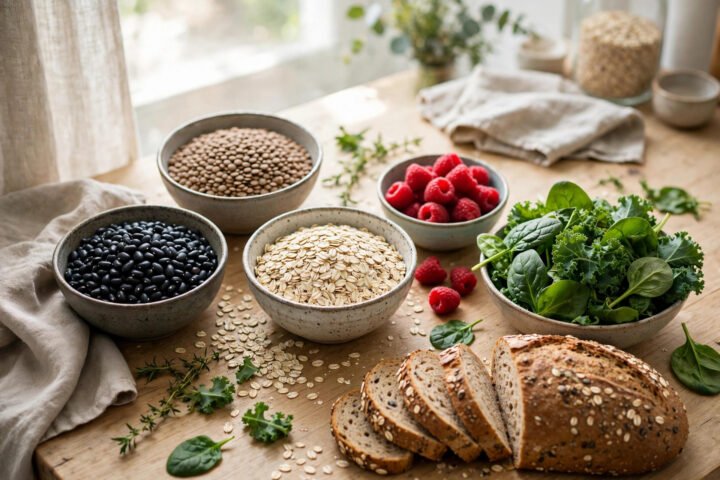
Start with foods that give you the most fiber for the least change in habit. Legumes are the highest-yield swap: lentils, black beans, chickpeas, and split peas deliver far more fiber per cup than most grains or vegetables. Berries, pears, and apples eaten with their skins, oats and other whole grains, and vegetables such as Brussels sprouts also contribute meaningfully, especially when they appear at more than one meal.
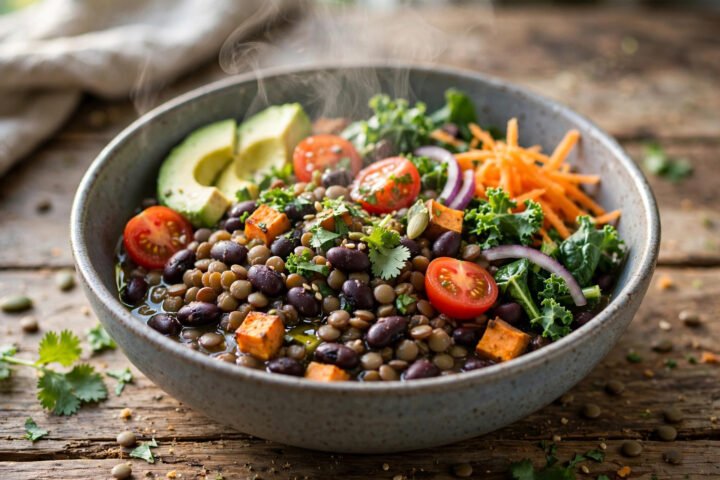
A practical day that approaches the target might look like this: oats and raspberries at breakfast, a lentil or bean bowl at lunch, a pear or a small handful of nuts as a snack, and vegetables plus a whole grain or beans at dinner. You do not need to follow that menu exactly. The pattern is what counts — a legume, a whole grain, a fruit, and vegetables spread across the day, rather than one large high-fiber meal.

Reading labels helps, because "wheat" or "multigrain" does not guarantee a whole grain or a high fiber content. Look for the fiber grams per serving and for a whole grain listed first in the ingredients. As a rough guide, foods with at least 3 grams of fiber per serving are a useful source, and those with 5 grams or more are high in fiber, but the total across the day matters more than any single label claim.
If you use a GLP-1 medicine and appetite is much smaller, fiber can be harder to fit in — smaller, planned portions of legumes, oats, fruit, and vegetables may help, and persistent nausea, vomiting, or constipation should be discussed with your prescriber. We cover jaw-related questions for those medicines in can Ozempic or Zepbound cause TMJ or jaw clenching?
How fast should I increase fiber, and what about water?
Increase slowly. Adding a large amount in a few days is the most common reason people conclude that "fiber does not agree with me." A steadier approach is to add roughly one high-fiber serving every few days, spread fiber across meals rather than loading it into one sitting, and give your gut a week or two to adapt at each step. Gas often settles as intakes stabilise and as the mix of foods becomes routine.
Fluid matters because gel-forming fiber holds water. Drinking enough so your urine is pale yellow is a practical guide for most healthy adults, though individual fluid needs vary with heat, exercise, and medical conditions. People told to restrict fluid — for example for some heart or kidney conditions — should follow their clinician's fluid target, not a general hydration rule.
Cooking helps tolerance too. Well-cooked lentils and beans, oats, and stewed or tinned legumes rinsed before use are often easier to tolerate than large raw salads, and they are also jaw-friendly. Chewing thoroughly and eating slowly reduce swallowed air, which can add to bloating.
When should I talk to a clinician or dietitian first?
Check before making a large increase if you have a bowel condition such as Crohn's disease, ulcerative colitis, a stricture, recent bowel surgery, gastroparesis, or a history of bowel obstruction; if you have chronic kidney disease or are on a fluid or potassium restriction; or if you take medicines whose absorption timing matters, such as some thyroid or diabetes medicines. A registered dietitian can tailor the target and the pace to your condition and your medicines.
Seek medical care promptly rather than self-treating with fiber if you have blood in the stool, black stools, unexplained weight loss, persistent vomiting, severe or worsening abdominal pain, or a major change in bowel habit that does not settle. Fiber is a nutrition tool, not a diagnosis, and those symptoms need evaluation.
For most other adults, though, the path is straightforward: know your number, add high-fiber foods gradually, drink enough fluid, and keep the changes you actually enjoy. That is how a target on paper becomes a habit that lasts.
Frequently asked questions
How much fiber do i need if I eat 2,000 calories a day?
Using the 14 grams per 1,000 calories rule, a 2,000-calorie pattern points to about 28 grams of fiber a day. That sits between the fixed targets of 25 grams for women under 50 and 38 grams for men under 50, which is why both the fixed total and the per-calorie rule are useful to know.
Can I get enough fiber without supplements?
Yes, most people can reach the target from food alone with legumes, whole grains, fruit, vegetables, nuts, and seeds spread across the day. Supplements such as psyllium can help some people, especially for regularity or cholesterol, but they do not provide the vitamins, minerals, and variety of whole foods, and they should be taken apart from some medicines.
Does cooking reduce the fiber in food?
Cooking does not destroy most fiber, though it softens it and can make high-fiber foods easier to chew and tolerate. Peeling fruit and vegetables removes some fiber, and juicing removes most of it. Choosing whole fruit over juice and leaving edible skins on where you enjoy them keeps more fiber in the meal.
Will eating more fiber help with weight or blood sugar?
Higher-fiber eating patterns are linked in research to greater fullness and slower glucose absorption, and gel-forming fibers have modest trial support for LDL cholesterol and blood-sugar measures. Fiber is not a weight-loss treatment on its own, and people with diabetes should discuss changes with their care team, especially if medicines may need adjustment.
Conclusion
So, how much fiber do i need? For most adults, 25 to 38 grams a day under age 50, and 21 to 30 grams after 50 — or about 14 grams for every 1,000 calories. Against an average intake of about 16 grams, that is a real gap, but it is a closable one: legumes, oats, whole grains, fruit, and vegetables, added gradually with enough fluid, get most people there without supplements or a diet overhaul.
Pick one swap this week, keep it, then add the next. If you have a gut, kidney, or heart condition, or take medicines where timing matters, set your personal target with your clinician or a dietitian first.
Sources
- Mayo Clinic Health System. How much fiber do you need? — National Academy of Medicine daily totals: 25 g for women and 38 g for men, lower after age 50.
- Hoy MK, Goldman JD. Dietary Fiber Intake of the U.S. Population, What We Eat in America, NHANES 2009–2010. USDA Dietary Data Brief No. 12, 2014 — mean intake 16 g/day.
- King DE et al. Dietary Fiber Intake and Cardiometabolic Risks among US Adults, NHANES 1999–2010. — Adequate Intake levels by age and sex, and mean intakes of 15.7–17.0 g/day.
Medical disclaimer: This article is educational information only and is not medical advice. It does not diagnose or treat any condition. Talk to your clinician, dentist, or a registered dietitian about your personal fiber target, especially if you have a bowel, kidney, or heart condition or take regular medicines.




0 Comments