
Educational information · Not medical advice
In brief
If your tmj worse after chiropractor visits, compare manual therapy, acupuncture, TENS and red light for TMJ — what helps, what to skip, and the safety checks.
In this article
- Why does TMJ feel worse after a chiropractor visit?
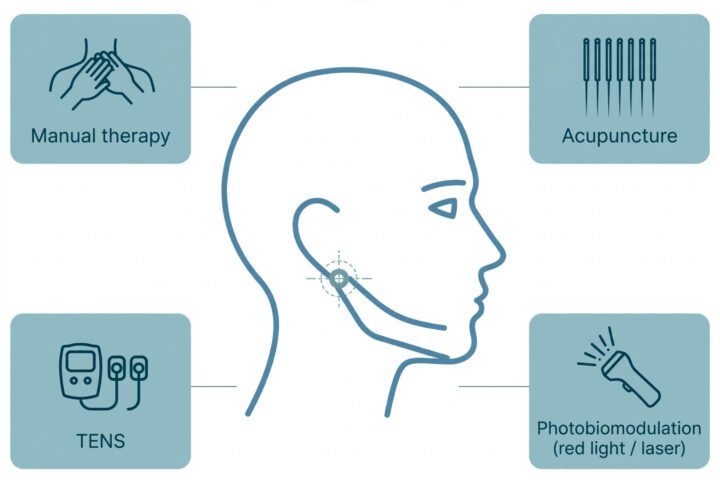
- What does the BMJ guideline say about these four options?
- Does chiropractic and manual therapy help TMJ?
- Does acupuncture help TMJ pain?
- Does TENS help TMJ pain?
- Does red light therapy help TMJ?
- How should you choose, trial, and stop safely?
- Frequently asked questions
- Conclusion
- Sources
Key Takeaways
- Feeling tmj worse after chiropractor care for a day or so is usually temporary soreness, stiffness, or headache — the same transient effects the National Center for Complementary and Integrative Health (NCCIH) describes for spinal manipulation, most resolving within 24 hours. Pain that keeps worsening, or any new numbness, weakness, dizziness, or vision change, is not a normal adjustment reaction and needs prompt medical care.
- For chronic temporomandibular disorder (TMD) pain lasting 3 months or more, the 2023 BMJ guideline gave a conditional recommendation in favour of manipulation and acupuncture, and a conditional recommendation against low-level laser therapy and transcutaneous electrical nerve stimulation (TENS).
- Acupuncture and TENS both show short-term pain relief in systematic reviews, but the evidence quality is low to moderate, the trials are small, and lasting benefit is unproven.
- Clinic photobiomodulation (low-level laser) is not the same as a home red light mask. Trial protocols varied widely, placebo groups often improved too, and no standard dose has been established.
- None of these four replaces conservative first-line care: soft foods, heat or cold, gentle jaw exercise, and habits that reduce clenching, as the National Institute of Dental and Craniofacial Research (NIDCR) recommends.
If you have searched tmj worse after chiropractor, you are probably in an uncomfortable spot: you paid for help, and your jaw hurts more, not less. That experience is common enough to have explanations, and it does not automatically mean damage was done — or that you should simply push through more sessions. This article works through what a short flare usually means, what should worry you, and how chiropractic and manual therapy compare with acupuncture, TENS, and red light therapy when the trial evidence, not the marketing, decides.
Temporomandibular disorders are a group of more than 30 conditions causing pain and dysfunction in the jaw joint and the muscles that control jaw movement, according to NIDCR. Because so many different problems share the TMJ label, a treatment that helps muscle pain may do nothing for a joint problem, which is one reason the evidence below is mixed for every option. If your pain is new, severe, or changing, start with our guide to who treats TMJ rather than shopping for devices.
Why does TMJ feel worse after a chiropractor visit?
The most common reason people report tmj worse after chiropractor treatment is a short-lived treatment reaction. NCCIH notes that spinal manipulation sometimes produces transient side effects such as increased pain or discomfort, stiffness, or headache, and that these symptoms usually go away within 24 hours. Hands-on work on tender jaw and neck muscles can leave the same kind of next-day soreness you would expect after a deep massage or a new exercise — the muscles were loaded, stretched, or pressed in ways they are not used to.
A second reason is timing, not treatment. Jaw pain fluctuates with stress, sleep, clenching, and chewing load, so a flare that was already building can land on the day after an appointment by coincidence. That is why a single bad day is weak evidence either way: what matters is the pattern over one to two weeks, not the morning after one session. Our 48-hour TMJ flare-up plan covers the ice-or-heat, soft-diet, and rest steps that help most short flares settle.
There are also reactions that should not be waited out. Get prompt medical care, rather than another adjustment, if pain keeps escalating over several days, your jaw locks open or closed and will not release, you cannot open your mouth normally, or you develop new numbness, weakness, slurred speech, severe dizziness, or vision changes. NCCIH describes serious side effects of spinal manipulation as very rare, but rare is not never, and neck symptoms with neurological signs need assessment first. If tmj worse after chiropractor care is your pattern after every visit, with no better days in between, that is useful information too: the approach, the force, or the diagnosis may be wrong for you, and a second opinion from a dentist or orofacial pain specialist is a reasonable next step.
What does the BMJ guideline say about these four options?
The clearest head-to-head framing comes from the clinical practice guideline for chronic pain associated with temporomandibular disorders published in The BMJ in December 2023. It was informed by a linked systematic review and network meta-analysis of 153 randomised trials with 8,713 participants, and it applies to chronic pain — pain lasting 3 months or more — not to a first short flare.
Compared with placebo or sham procedures, the panel issued conditional recommendations in favour of manipulation and in favour of acupuncture. Conditional means the panel judged that most informed patients would choose the treatment, but many would not — cost, visits, and personal preference legitimately change the decision. The same guideline issued conditional recommendations against low-level laser therapy and against transcutaneous electrical nerve stimulation for chronic TMD pain. It also strongly recommended approaches that promote coping and movement, including cognitive behavioural therapy, therapist-assisted mobilisation, manual trigger point therapy, and supervised jaw exercise and stretching.
153 trials, 8,713 participants — the evidence base behind the 2023 BMJ guideline for chronic TMD pain. Even with that volume, manipulation and acupuncture earned only conditional support, and laser and TENS drew conditional recommendations against, because trial quality and consistency were limited.
That pattern is the honest summary for this whole comparison: two options with modest, conditional support, and two where a major guideline advises against routine use for chronic jaw pain despite positive individual trials. The sections below explain why the individual reviews sometimes sound more upbeat than the guideline, so you can judge a clinic's claims for yourself. For a broader comparison of the core treatments, see physical therapy vs splint vs Botox for TMJ.
Does chiropractic and manual therapy help TMJ?
Chiropractic care for TMJ usually means manual therapy: hands-on mobilisation or manipulation of the jaw and neck, soft-tissue work on the chewing muscles, and often exercise advice. It is rarely a single crack of the jaw, and the profession matters less than the techniques used — physiotherapists, dentists, and osteopaths use overlapping methods.
A systematic review of upper cervical mobilisation and manipulation for TMJ dysfunction, covering 8 randomised trials with 437 participants, found manual therapy reduced pain compared with sham (mean difference −1.93 points) and compared with other interventions (−1.03 points), and improved maximum mouth opening by about 2 mm. The authors' conclusion was cautious: there appears to be limited benefit, and definitive conclusions cannot be made because of heterogeneity and imprecision. An earlier systematic review of manipulative and multimodal therapy rated the evidence for manual therapy for temporomandibular disorders as fair, in the short term, generally combined with exercise or other care rather than manipulation alone.
NIDCR takes a similar middle line: manual therapy, in which a therapist uses the hands to stretch the soft tissues and muscles around the joint, may improve function and relieve pain. That is a reasonable basis for a time-limited trial — a defined number of sessions, a pain and opening goal you both agree on, and a stop rule if you are not improving. It is not a basis for an open-ended prepaid plan. And if you repeatedly feel tmj worse after chiropractor sessions with no overall trend toward better, the trial has given you its answer.
Does acupuncture help TMJ pain?
Acupuncture has the largest trial base of the four options here, and the most consistent short-term signal — with consistent caveats. A 2024 systematic review and meta-analysis in BMC Oral Health included 11 randomised trials and found acupuncture was short-term helpful for reducing the severity of TMD pain of muscle origin, with acupuncture and laser acupuncture groups showing a higher efficacy rate than placebo. The same authors concluded that the evidence for acupuncture as a symptomatic treatment of TMD is limited and that further rigorous studies are required.
An earlier meta-analysis reached a similar place: across the acceptable-quality trials it combined, acupuncture was more effective than placebo for pain intensity, and the authors called it a reasonable adjunctive treatment for a short-term analgesic effect in painful TMD, while noting substantial bias in the studies. A 2023 meta-analysis of 32 trials likewise found improved outcomes versus controls, but rated the quality of evidence low to very low.
Practically, acupuncture fits best as an adjunct for muscle-based jaw pain — added to exercise, self-care, and clenching habits work, not instead of them. NCCIH describes acupuncture as generally considered safe when performed by an experienced practitioner using sterile, single-use needles. Ask who is providing it, whether needles are single-use, and what a trial course looks like, and agree in advance how you will judge whether it helped. A home acupuncture pen, which appears in many searches, is not acupuncture: it is a small electrical stimulation device, closer to TENS, with no comparable trial base.
Does TENS help TMJ pain?
TENS — transcutaneous electrical nerve stimulation — delivers a mild electrical current through pads on the skin, usually over the jaw or neck muscles. A systematic review of TENS for TMD retained 14 articles covering 532 patients and found that immediately after a session, studies reported significant relief of pain (ranging from 19.2% to 77% across studies), improved mouth opening, and reduced electrical activity in the jaw-closing muscles. Studies comparing TENS with other physical modalities such as ultrasound and laser reported equivalent results, and the authors called for more randomised comparative trials to define the best programmes and durations.
A meta-analysis in The Journal of Pain, covering 7 studies with 184 participants, found electrical stimulation reduced pain more than sham or control by about 1.12 cm on a pain scale, with moderate-quality evidence for TENS and high-voltage stimulation — but no significant effect on range of movement or muscle activity. Set against that, the BMJ guideline's conditional recommendation against TENS for chronic TMD pain reflects how small, short, and inconsistent the overall trial picture remains.
A woman breathing slowly with eyes closed and jaw relaxed
So where does that leave a home TENS unit? It may give short-term relief during or just after a session, which some people value during a flare, and it is non-invasive and reversible — qualities NIDCR favours in early care. It should not be sold, or bought, as a fix for the cause of jaw pain, and it should never be used over the front of the neck, over broken skin, or by anyone whose clinician has advised against electrical stimulation, for example with certain implanted devices. Follow the device instructions and your clinician's advice, and stop if it increases pain.
Does red light therapy help TMJ?
Red light therapy for TMJ usually refers to photobiomodulation — low-level laser or LED light applied to the jaw — and the first distinction matters: most trials used clinic laser devices with defined wavelengths and doses, not consumer red light masks or panels. Results from a clinic laser cannot be transferred to a home mask, however similar the glow looks. Our overview of what red light therapy actually does explains that device gap in more detail.
The trial results are genuinely mixed. An updated systematic review of photobiomodulation for TMD, including 40 studies, reported that 27 studies showed a reduction in pain intensity in photobiomodulation groups compared with controls, and suggested infrared diode laser protocols looked promising. A later systematic review focused on trials using formal diagnostic criteria found a less tidy picture: pain decreased in most groups, but placebo groups often improved comparably, between-group superiority was less consistent, protocols were markedly heterogeneous, and certainty was low for muscle-based TMD and very low for joint-based TMD. The authors concluded photobiomodulation should be considered a complementary option rather than a standalone therapy, and that no preferred dosing protocol is established.
That uncertainty is why the BMJ guideline landed on a conditional recommendation against low-level laser therapy for chronic TMD pain, even though individual reviews report pain reductions. If you try clinic photobiomodulation, treat it like the other options here: a defined trial, a measurable goal, and no large prepaid package. For a home mask bought mainly for TMJ, the evidence does not support the purchase — the devices most people can buy are not the devices most trials tested.
How should you choose, trial, and stop safely?
Start from the diagnosis, not the device. Muscle pain, a joint problem, and pain driven mainly by clenching or poor sleep respond differently, and NIDCR emphasises conservative, reversible care first: soft foods, heat or cold, gentle stretching and strengthening exercises, over-the-counter pain relief as directed, and cutting down clenching, gum chewing, and nail biting. The jaw exercise guidance on this site is a sensible companion to any of the four options.
Then trial one change at a time, with rules agreed in advance:
- Define the trial: a set number of sessions or weeks, not an open-ended plan.
- Pick one measure: average pain, mouth opening, or headache days — and record it before you start.
- Set a stop rule: no meaningful improvement by the end of the trial means stop or change approach, not buy a bigger package.
- Watch the reaction pattern: brief soreness after hands-on care can be normal; feeling tmj worse after chiropractor or any other session, repeatedly and without better intervals, is a reason to reassess.
- Keep the base care going: exercise, sleep, and clenching habits are the treatments with guideline support; these four are additions, not replacements.
Finally, be wary of any pitch that requires a large prepayment before a trial, promises a permanent cure, or discourages a second opinion. NIDCR advises getting more than one opinion before treatments that permanently change the jaw, teeth, or bite — none of the four options in this article should involve permanent change.
| Option | What the evidence shows | BMJ 2023 guideline (chronic TMD pain) | Main cautions |
|---|---|---|---|
| Chiropractor / manual therapy | Small short-term pain and opening gains in trials; limited benefit, heterogeneous evidence | Conditional in favour of manipulation | Transient soreness, stiffness, headache; stop if repeatedly worse |
| Acupuncture | Short-term pain relief for muscle-based TMD in reviews; evidence limited, low to very low quality in places | Conditional in favour | Use a trained practitioner with sterile single-use needles; adjunct, not a replacement |
| TENS | Immediate post-session pain relief reported; meta-analysis found about 1.12 cm pain advantage over sham, no movement benefit | Conditional against | Short-term relief only is proven; follow device and clinician safety advice |
| Red light / photobiomodulation | Mixed clinic laser results; placebo groups often improved too; no standard dose established | Conditional against (as low-level laser therapy) | Home masks are not the clinic lasers tested; do not buy on TMJ evidence alone |
Frequently asked questions
Is it normal to feel tmj worse after chiropractor treatment?
A day of extra soreness, stiffness, or headache after hands-on care can be a normal, transient reaction — NCCIH says such effects of manipulation usually resolve within 24 hours. Pain that escalates for days, a jaw that locks, or any numbness, weakness, dizziness, or vision change is not normal and needs prompt assessment. If every session leaves you worse with no better days between, ask for a reassessment or a second opinion.
Which is better for TMJ, acupuncture or a chiropractor?
Neither has strong evidence. The 2023 BMJ guideline gave both manipulation and acupuncture conditional recommendations in favour for chronic TMD pain, meaning either can be a reasonable time-limited trial depending on your diagnosis, cost, and preference. Acupuncture reviews emphasise short-term relief for muscle-based pain; manual therapy trials show small pain and opening gains. Choose one, trial it with a stop rule, and keep exercise and self-care going either way.
Can a home TENS unit or red light mask fix TMJ?
No home device has been shown to fix TMJ. TENS trials mostly measured immediate, short-term pain relief, and the BMJ guideline conditionally recommends against TENS for chronic TMD pain. Photobiomodulation trials used clinic lasers with varied protocols, not consumer masks, and certainty was low. A device may ease symptoms briefly for some people, but it is not a substitute for diagnosis, exercise, and clenching-habit care.
How many sessions should I try before deciding?
There is no validated session count, which is exactly why you should agree a trial length and a measurable goal before starting — for example, a small set of sessions over a few weeks, with pain or mouth opening recorded at the start. If there is no meaningful improvement by the end of that trial, stopping or changing approach is the evidence-based move. Be cautious of large prepaid packages sold before any trial has shown benefit.
Conclusion
Feeling tmj worse after chiropractor care is most often a brief, explainable reaction — but it is also information, and repeated worsening should change the plan, not be explained away. Across all four options, the pattern is the same: acupuncture and manual therapy have modest, conditional guideline support for chronic jaw pain; TENS and clinic laser have positive individual trials but drew conditional recommendations against from the BMJ panel; and home devices inherit far less evidence than their marketing suggests.
Whichever option you explore, keep it reversible, time-limited, and measured, on top of the conservative care NIDCR recommends first. If tmj worse after chiropractor visits keeps happening, or your symptoms are new, severe, or changing, see a dentist, doctor, or orofacial pain specialist for a diagnosis before buying more treatment. This article is educational information only and is not medical advice.
Sources
- Busse JW et al. Management of chronic pain associated with temporomandibular disorders: a clinical practice guideline. BMJ 2023;383:e076227. bmj.com
- National Institute of Dental and Craniofacial Research (NIDCR). Temporomandibular Disorders (TMD). nidcr.nih.gov
- National Center for Complementary and Integrative Health (NCCIH). Spinal Manipulation: What You Need To Know; and Acupuncture: What You Need To Know. nccih.nih.gov
- Di Francesco F et al. Efficacy of acupuncture and laser acupuncture in temporomandibular disorders: a systematic review and meta-analysis of randomized controlled trials. BMC Oral Health 2024;24:174. pmc.ncbi.nlm.nih.gov
- Fertout A et al. Management of temporomandibular disorders with transcutaneous electrical nerve stimulation: a systematic review. Cranio 2022;40(3):217-228. pubmed.ncbi.nlm.nih.gov
- The Effect of Photobiomodulation on Temporomandibular Pain and Functions in Patients With Temporomandibular Disorders: An Updated Systematic Review. J Lasers Med Sci 2023;14:e24. pmc.ncbi.nlm.nih.gov
- The Effect of Upper Cervical Mobilization/Manipulation on Temporomandibular Joint Pain, Maximal Mouth Opening, and Pressure Pain Thresholds: A Systematic Review and Meta-Analysis. Arch Rehabil Res Clin Transl 2022. pmc.ncbi.nlm.nih.gov
Medical disclaimer: This article is for general educational information only and is not medical advice, diagnosis, or treatment. Talk with your dentist, doctor, or other qualified clinician about your own symptoms and treatment choices.




0 Comments