
Educational information · Not medical advice
In brief
Does sugar cause inflammation? Feeding trials show the food source and extra calories matter more than sugar alone. See the evidence and daily limits.
In this article
- What do researchers mean by inflammation in these studies?
- What do controlled feeding trials show?
- Why does the food source matter more than sugar alone?
- How is liquid sugar different from solid food?
- How much added sugar is too much per day?
- What are practical ways to cut back without a detox?
- Frequently asked questions
- Conclusion
- Sources
Key Takeaways
- When people ask does sugar cause inflammation, controlled feeding trials give a narrower answer than social media: swapping sugar for other carbohydrates at the same calories did not, on its own, raise CRP in the largest pooled analysis.
- The food source mattered: mixed sources containing sugar-sweetened beverages increased CRP, while fruit decreased CRP and TNF-alpha in the same 2022 analysis of 64 trials.
- Extra calories are part of the story — sugar added on top of a usual diet is a different test from sugar replacing something else.
- The American Heart Association suggests no more than 36 grams of added sugar a day for men and 25 grams for women.
- You do not need a detox: cutting sugary drinks first, reading the Added Sugars label line, and keeping whole fruit are the highest-yield steps.
Does sugar cause inflammation? It is one of the most repeated nutrition claims online, usually stated as settled fact. The honest answer from controlled human studies is more specific: sugar by itself, calorie for calorie, has not been shown to raise the main inflammatory markers, but the foods and drinks that carry a lot of added sugar — especially when they add extra calories and replace fiber-rich foods — can be part of a pattern linked to higher inflammation.
This article separates what feeding trials actually tested from what observational studies suggest, explains why a soda and an apple are not the same exposure even though both contain sugar, and gives the daily limits major guidelines use. If you are also thinking about overall eating patterns, our guide to anti-inflammatory eating and jaw pain covers the broader plate, not just sugar.
What do researchers mean by inflammation in these studies?
Inflammation is the immune system’s response to injury or infection. Short-lived inflammation helps healing. The concern with diet is different: low-grade, long-term inflammation that stays slightly raised for months or years and is linked in research to cardiovascular disease and type 2 diabetes.
Researchers cannot feel that kind of inflammation, so they measure blood markers. The most common is C-reactive protein (CRP), made by the liver when inflammation rises. Two others you will see are interleukin-6 (IL-6) and tumor necrosis factor-alpha (TNF-alpha). When a headline says a food “causes inflammation,” it usually means a study found a change — or did not find a change — in one of those markers. That distinction matters, because a single marker moving in a short trial is not the same as proving a food causes a disease.
It also helps to separate three kinds of sugar. Added sugars are sugars put into foods and drinks during making or at the table — sucrose and high-fructose corn syrup in soda are examples. Free sugars, the term the World Health Organization uses, include added sugars plus sugars in honey, syrups, and fruit juice. Naturally occurring sugars are the sugars inside whole fruit, vegetables, and plain milk, packaged by the food itself with fiber, water, and other nutrients. The question does sugar cause inflammation is mostly a question about the first two kinds.
What do controlled feeding trials show?
Controlled feeding trials are the strongest test here because researchers control what people eat and can compare sugar with something else at the same calorie level. Two pooled analyses are central.
The first, by Della Corte and colleagues in Nutrients in 2018, pooled 13 intervention studies with 1,141 participants lasting at least two weeks. It found no difference in CRP between fructose and glucose groups — the pooled difference was -0.03 mg/L, with a confidence interval that crossed zero — and no difference between high-fructose corn syrup and sucrose. The authors rated the quality of evidence for those comparisons as low and concluded the limited evidence did not support the idea that fructose, alone or in high-fructose corn syrup, contributes more to subclinical inflammation than other sugars.
The second and larger analysis, by Qi and colleagues in Nutrients in 2022, pooled 64 controlled feeding trials with 4,094 participants over a median of six weeks. Total fructose-containing sugars had no effect on CRP in substitution, subtraction, or ad libitum trials, and no effect on TNF-alpha or IL-6 at any level of energy control. In other words, when sugar replaced other carbohydrates rather than being simply added, does sugar cause inflammation was not supported for those markers in that pooled result. The certainty of evidence was moderate to low for most analyses, which is a reason for care in both directions — neither “sugar is proven harmless” nor “sugar is proven inflammatory” fits.
64 trials, 4,094 participants — In the 2022 Qi et al. pooled analysis, total fructose-containing sugars showed no effect on CRP in substitution trials and no effect on TNF-alpha or IL-6 at any energy level. The signal, where it appeared, tracked the food source.
Observational studies tell a different-looking story, and both can be true. People who drink more sugar-sweetened beverages tend, on average, to have higher CRP and higher rates of several chronic conditions. But people with high sugary-drink intake also tend to eat less fiber, drink less water, sleep less, and differ in income and other habits. Observational data can show a pattern; it cannot isolate sugar as the cause the way a controlled swap can.
Why does the food source matter more than sugar alone?
Qi and colleagues found evidence that the food source changed the result. In substitution trials, mixed sources that contained sugar-sweetened beverages increased CRP, while sweetened dairy alternative (soy) and 100% fruit juice decreased it. In addition trials, fruit decreased CRP and TNF-alpha, and sweets and desserts — in that analysis, dark chocolate — decreased IL-6.
That pattern points to the food matrix: what comes with the sugar. Whole fruit brings fiber that slows absorption, plus polyphenols and other compounds. A soda brings sugar in water, quickly absorbed, with essentially nothing else. Replacing a fiber- and nutrient-rich food with a sugary drink removes protective parts of the diet at the same time as it adds sugar, so a rise in CRP in that swap may track what was lost as much as what was added.

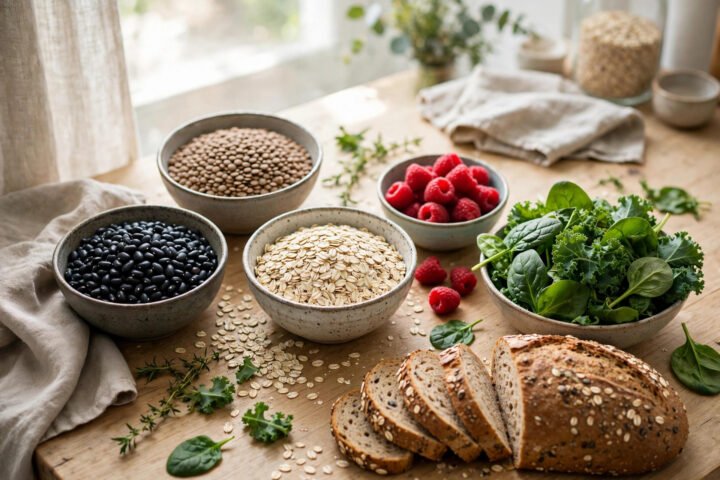
Whole fruit contains sugar, but it also contains fiber and other nutrients — one reason trials treat food sources differently.
This is also why our other nutrition guides focus on totals rather than single ingredients. How much fiber you need explains the gap most adults face, and how much protein you actually need gives the targets by age and activity — both shape the overall pattern that inflammatory markers reflect.
How is liquid sugar different from solid food?
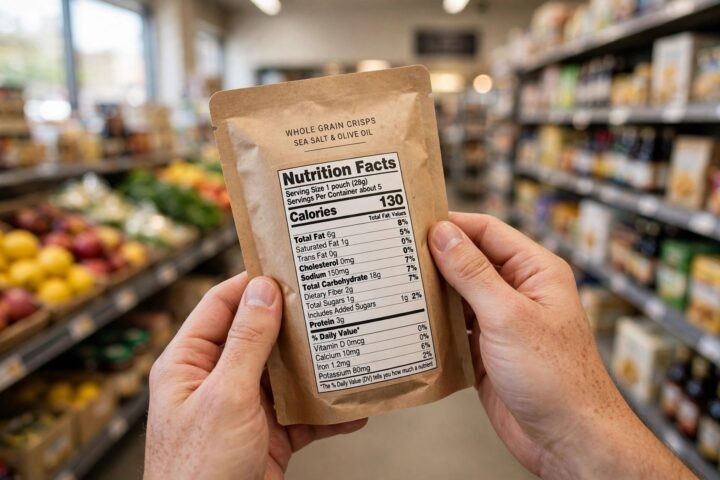
Liquid sugar is the clearest practical concern, even if the trial picture is nuanced. The American Heart Association notes that a 12-ounce can of soda contains about 10 teaspoons, or 42 grams, of added sugar — more than its suggested daily limit for women and more than the limit for men, in one drink. Sugar in liquid form is easy to consume quickly, does not produce the same fullness as chewing solid food, and is a common way extra calories are added on top of a usual diet rather than replacing something else.
That addition-versus-substitution difference is key to reading the research. A trial that swaps sugar for starch at equal calories tests the molecule. A real-life habit of adding a large soda to a meal tests the molecule plus extra energy, plus what the drink displaced — often water. Weight gain itself is linked to higher inflammatory markers, so a habit that steadily adds calories can raise inflammation indirectly even if a calorie-matched swap does not.
| Source | What trials found | Practical takeaway |
|---|---|---|
| Sugar swapped for other carbs, same calories | No effect on CRP, TNF-alpha, or IL-6 in the 2022 pooled analysis | Sugar alone is not proven to raise these markers calorie for calorie |
| Mixed sources with sugar-sweetened beverages | Increased CRP in substitution trials | Sugary drinks are the first place to cut |
| Whole fruit | Decreased CRP and TNF-alpha in addition trials | Do not cut whole fruit over sugar fears |
| Fructose vs glucose; HFCS vs sucrose | No difference in CRP in the 2018 pooled analysis, low-quality evidence | No single sweetener is proven uniquely inflammatory |
How much added sugar is too much per day?
Guidelines do not wait for a perfect inflammation answer, because added sugar is also linked to dental cavities, weight gain, and cardiometabolic risk, and it provides calories without essential nutrients. The American Heart Association suggests keeping added sugars below 6% of calories a day: no more than 36 grams, about 9 teaspoons or 150 calories, for men, and no more than 25 grams, about 6 teaspoons or 100 calories, for women. It notes that people ages 2 and older in the United States get about 12% to 13% of daily calories from added sugars on average — about double that suggestion.
The AHA lists sugar-sweetened beverages as about 24% of total added sugars in the U.S. diet, and desserts and sweet snacks as about 19%. Coffee and tea with added sweeteners, candy, and sweetened cereals and bars are other common sources. That ranking is useful: you do not have to hunt every gram. Drinks and desserts account for a large share for most people.
For a jaw-pain reader, there is an added practical point: frequent sugary drinks and sticky sweets also raise cavity risk, and dental pain is often confused with jaw pain. Our overview of omega-3s from fish versus supplements makes a similar food-first point in a different cluster — whole foods and supplements are not interchangeable there either.
What are practical ways to cut back without a detox?
Claims that quitting sugar for a set number of days will “reset” inflammation go beyond what the feeding studies show. The trials lasted a median of six weeks in the 2022 analysis, measured blood markers rather than how people felt day to day, and did not test detox products. A steadier approach works with the evidence:
- Start with drinks. Replace one sugary drink a day with water or unsweetened tea. That single swap can remove 40 grams or more of added sugar.
- Read the Added Sugars line. U.S. labels list added sugars in grams and as a percent of daily value, separate from total sugars. Honey, maple syrup, coconut sugar, and corn syrup all count as added sugar — the AHA is explicit that added sugar is added sugar whatever it is called.
- Keep whole fruit. The trial signal for fruit was in the opposite direction from sugary drinks. Cutting fruit while keeping sweetened drinks would invert the evidence.
- Shrink, do not just swap sweeteners. The 2018 analysis found no CRP advantage for one caloric sweetener over another. A smaller portion helps more than a different syrup.
- Watch the pattern, not a single food. If most days include several sugary drinks, large desserts, and little fiber, that pattern — not one cookie — is what to change, ideally with a registered dietitian if you have diabetes or another condition.
If you have persistent pain, unexplained weight loss, fever, or other concerning symptoms, do not attribute them to sugar and self-treat. Inflammation has many causes, and a clinician can check what is actually driving it.
Frequently asked questions
Does sugar cause inflammation in everyone?
No single answer fits everyone, and the trials do not show that. In controlled feeding trials pooled in 2022, total fructose-containing sugars had no effect on CRP in most designs and no effect on TNF-alpha or IL-6. Effects differed by food source, and the evidence certainty was moderate to low, so individual responses and overall diet patterns still matter.
Is fruit sugar inflammatory?
The feeding-trial evidence points the other way for whole fruit. In the Qi et al. 2022 analysis, fruit decreased CRP and TNF-alpha in addition trials. Whole fruit contains fiber and other nutrients that slow absorption and change the exposure compared with added sugar in drinks or sweets, which is why guidelines do not advise cutting whole fruit over inflammation fears.
How long does it take for cutting sugar to affect inflammation?
There is no proven timeline. The controlled trials in the 2022 analysis ran a median of six weeks and measured blood markers, not symptoms, and they did not test short detoxes. If cutting added sugar helps you, it is most likely through a sustained change — fewer sugary drinks, less extra energy, and a higher-fiber pattern — rather than a brief reset.
Is honey better than sugar for inflammation?
There is no good trial evidence that honey is better for inflammatory markers. The American Heart Association lists honey among added sugars and advises that added sugar is added sugar whatever it is called. Honey counts toward the same daily added-sugar limits — 36 grams for men and 25 grams for women — so portion matters more than the source name.
Conclusion
So, does sugar cause inflammation? The controlled evidence says: not clearly, on its own, calorie for calorie — and that answer is more useful than a blanket yes or no. It tells you where the real leverage is. Sugary drinks, especially in mixed diets that replace fiber-rich foods and add extra calories, are the source most consistently linked to higher CRP. Whole fruit is not. No caloric sweetener is proven uniquely worse than the others.
Use the daily limits as a practical guide, start with drinks, read the Added Sugars label line, and judge your overall pattern over weeks, not a single meal. If inflammation or pain is an ongoing concern for you, discuss it with your clinician or dentist rather than relying on a sugar rule alone.
Medical disclaimer: This article is educational information only and is not medical advice. It does not diagnose or treat any condition. Talk with your clinician, dentist, or registered dietitian about your own diet, inflammatory markers, and health conditions.
Sources
- Qi X, et al. Effect of Important Food Sources of Fructose-Containing Sugars on Inflammatory Biomarkers: A Systematic Review and Meta-Analysis of Controlled Feeding Trials. Nutrients. 2022;14(19):3986. PMC9572084
- Della Corte KW, et al. Effect of Dietary Sugar Intake on Biomarkers of Subclinical Inflammation: A Systematic Review and Meta-Analysis of Intervention Studies. Nutrients. 2018;10(5):606. PMC5986486
- American Heart Association. How Much Sugar Is Too Much? heart.org



0 Comments