Educational information · Not medical advice
In brief
TMJ after Invisalign or braces is a common worry. Reviews find orthodontics does not cause or cure TMD — here is what studies show and what to do next.
In this article
- Can Invisalign or braces actually cause TMJ disorders?
- What do the long-term studies of braces show?
- What about clear aligners like Invisalign specifically?
- Why might jaw pain start during orthodontic treatment?
- Should orthodontics be used to treat TMD?
- What should you do if symptoms start mid-treatment?
- Frequently asked questions
- Conclusion
- Sources
Key Takeaways
- Systematic reviews of orthodontic treatment find no evidence that braces cause TMD — and no evidence that straightening teeth prevents or cures it either.
- Reports of tmj after invisalign usually describe temporary muscle soreness or bite changes during treatment, not proof the aligners damaged the joint.
- TMD symptoms commonly first appear in the same teens-to-40s age range when most orthodontic treatment happens, so timing alone can make treatment look like the cause.
- A jaw that locks, cannot open fully, or pain that keeps escalating is not a normal part of treatment — tell your orthodontist promptly and ask about an orofacial pain referral.
Worried about tmj after invisalign or braces? You are not alone — jaw pain, clicking, or stiffness that shows up during orthodontic treatment makes many people wonder whether moving their teeth is damaging their jaw joints. TMJ here refers to the temporomandibular joint; the disorders affecting the joint and the muscles around it are called temporomandibular disorders, or TMD.
The reassuring headline from decades of research is that orthodontic treatment has not been shown to cause TMD. But the full picture has some honest nuance: symptoms can still appear or flare during treatment, aligner-specific research is younger and thinner than the braces literature, and orthodontics is not a treatment for TMD either. This article walks through what the studies actually found, why symptoms and treatment so often coincide, and what to do if your jaw starts hurting mid-treatment.
Can Invisalign or braces actually cause TMJ disorders?
On the evidence available, no — orthodontic treatment has not been shown to cause TMD. The National Institute of Dental and Craniofacial Research (NIDCR) states it directly: research does not support the belief that a bad bite or orthodontic treatment such as braces causes TMDs. The review literature agrees. Leite and colleagues’ literature review in the Dental Press Journal of Orthodontics (2013) found that every included study reported orthodontic treatment did not provide risk for developing signs and symptoms of TMD, regardless of technique. A 2015 systematic review by Fernández-González and colleagues in the Journal of Clinical and Experimental Dentistry found no deleterious effect of orthodontic treatment on the temporomandibular joint in any selected article, and concluded there is no evidence for a cause-effect relationship — in either direction.
That does not mean nobody develops jaw symptoms during treatment — they do, and the sections below explain why. It means that when researchers compare treated and untreated people over time, orthodontic treatment does not emerge as the thing that created the disorder. If you are searching for information about tmj after invisalign, it helps to separate “symptoms started while I was in treatment” from “treatment caused a joint disorder.” The research supports the first as a real experience; it does not support the second as a general claim.
What do the long-term studies of braces show?
Braces have the longest track record. Macfarlane and colleagues followed a British cohort of more than 1,000 children from age 11–12 into their early thirties, in a study published in the American Journal of Orthodontics and Dentofacial Orthopedics in 2009. As summarised in later reviews of that cohort, there was no association between orthodontic treatment and new or persistent TMD: treatment neither caused nor prevented it. The predictors of TMD in young adulthood were female sex and having had TMD symptoms in adolescence — not orthodontics.
A large adolescent study points the same way. A 2023 cross-sectional analysis of 11,776 adolescents in South Korea, published in Scientific Reports, found no significant relationship between orthodontic treatment experience and TMD symptoms. Studies of this size cannot rule out every individual reaction, but they make a common, strong causal effect very unlikely: if braces routinely damaged jaw joints, a signal would be hard to hide in samples this large and follow-up this long.
By the numbers: 11,776 adolescents in the 2023 Korean national analysis — and no significant relationship between orthodontic treatment experience and TMD symptoms.
What about clear aligners like Invisalign specifically?
Clear aligners are newer, so the evidence base is smaller and shorter-term — an honest limitation worth stating plainly. A 2024 systematic review by Almalki and colleagues in BMC Oral Health gathered the six studies that met its criteria on clear aligners and the chewing muscles. Its finding: aligners did change muscle activity and discomfort in the initial days after an appliance was placed, but the effect was temporary, with no significant changes at later follow-up; bite force also dipped. A 2025 systematic review in the Journal of Clinical Medicine reached the matching conclusion for TMD itself — current evidence does not support a causal relationship between aligners and TMD. What the literature describes is transient muscle soreness and short-lived occlusal changes — your bite feeling “off” as teeth move — rather than lasting joint damage.

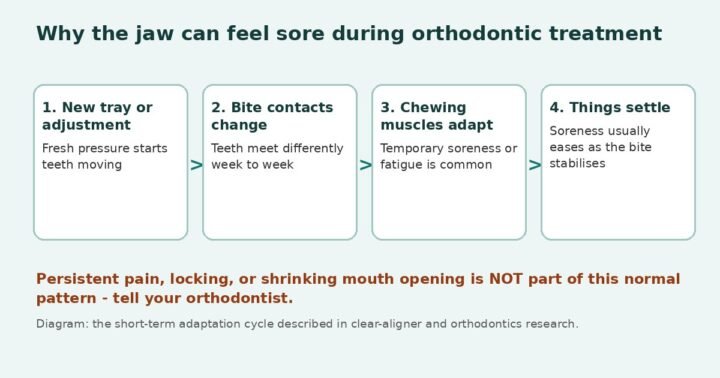
That pattern fits how aligners work. Each new tray applies fresh pressure, teeth are actively moving, and the way your teeth meet changes week to week. Soreness in the chewing muscles around a tray change, or a bite that feels uneven for a few days, is a plausible short-term response to that process. It is also why reports of tmj after invisalign treatment often cluster around new trays or refinements. Persistent pain, a jaw that locks, or steadily shrinking mouth opening is a different story — that is not an expected part of aligner treatment and deserves prompt attention, as the last section explains.
One more aligner-specific point: a night guard and an aligner are not the same device, and wearing one does not do the other’s job. If you clench or grind, ask your orthodontist how that interacts with your trays rather than assuming the plastic protects you like a splint would — our comparison of a TMJ splint vs. a night guard explains how those appliances differ.
Why might jaw pain start during orthodontic treatment?
If orthodontics does not cause TMD, why do symptoms so often seem to start during it? Several overlapping reasons:
- Age overlap. The National Institute of Dental and Craniofacial Research (NIDCR) notes that TMD is most commonly reported in people in their teens through their 40s, and that women report it more often than men. That is exactly the population most likely to be wearing braces or aligners, so some first episodes of TMD will land during treatment by coincidence of timing alone.
- A moving bite. Mid-treatment, your bite is deliberately unsettled. Teeth are halfway to their targets, contacts are uneven, and chewing muscles have to adapt repeatedly. Temporary muscle fatigue or soreness during that process is unsurprising.
- Pre-existing, quiet TMD. Joint clicking and mild muscle tenderness are common and often unnoticed until treatment focuses attention on the mouth — or until longer appointments with the mouth held open aggravate an already-irritable jaw, much like the flares described in our guide to how long a TMJ flare-up lasts.
- Stress and clenching. Treatment often coincides with stressful life periods, and stress-driven clenching loads the jaw muscles regardless of what is on the teeth. If you suspect night-time clenching, our article on why you clench your jaw at night covers the main drivers.
Should orthodontics be used to treat TMD?
No — and this cuts against a persistent myth. The same reviews that clear orthodontics of causing TMD also find no evidence that it prevents or cures it: Leite and colleagues noted that long-term follow-up studies concluded orthodontic treatment would not be preventive or a treatment option for TMD. NIDCR makes the same point from the treatment side — there is insufficient evidence that occlusal treatments work to treat TMDs, and its list of those treatments includes using orthodontic treatment to change the position of teeth.
So if a provider proposes braces or aligners primarily as a cure for jaw pain, that is a claim the evidence does not support, and it is reasonable to ask for the reasoning — or a second opinion. TMD care usually starts with education, self-care, and reversible approaches, with referral to an orofacial pain specialist when symptoms persist. Our guide to who treats TMJ explains which provider fits which situation.
| Appliance | Purpose | What the evidence says about TMD |
|---|---|---|
| Braces (fixed orthodontics) | Move teeth with brackets and wires | Long-term studies find no increased — and no decreased — TMD risk |
| Clear aligners (e.g. Invisalign) | Move teeth with removable trays | No causal link shown; temporary muscle soreness and bite changes reported |
| TMJ splint / stabilisation appliance | Protect teeth and ease muscle/joint load, usually at night | A TMD management tool — a different job from moving teeth |
What should you do if symptoms start mid-treatment?
Start by telling your orthodontist — early, not at the next routine visit if pain is building. New jaw symptoms during treatment are common enough that orthodontic teams have standard responses, which can include checking the bite, adjusting the treatment pace, or pausing active movement while things settle. Keep a simple note of when pain started, which tray or adjustment it followed, and what makes it better or worse; that timeline is genuinely useful clinically.
While you wait to be seen, the standard self-care measures for a jaw flare apply: softer foods, avoiding wide yawning and gum, warm compresses on sore muscles, and not “testing” a clicking jaw repeatedly. Get in touch promptly — and ask about referral to an orofacial pain specialist or a dentist experienced in TMD — if any of the following apply:
- Your jaw locks open or closed, or you cannot open your mouth fully.
- Pain keeps escalating rather than settling within days of an adjustment or tray change.
- Symptoms persist for weeks despite simple measures, or you had significant TMD symptoms before treatment that are clearly worsening.
One caution on workarounds: do not stop wearing aligners, double up trays, or switch to a store-bought night guard over your trays without asking your orthodontist first. Unplanned changes can stall or distort tooth movement and make both problems harder to sort out.
Frequently asked questions
Can Invisalign cause TMJ?
Current evidence does not show that clear aligners cause temporomandibular disorders. Reviews of aligner therapy find temporary chewing-muscle changes in the first days of a new appliance that settle afterwards, and no causal relationship with TMD. Persistent pain or locking is not expected and should be raised with your orthodontist promptly.
Is jaw soreness normal with a new aligner tray?
Mild muscle soreness and a bite that feels “off” for a few days after a tray change are commonly reported while teeth are moving, and they usually settle. Soreness that keeps escalating, lasts for weeks, or comes with limited opening or locking is different — report it rather than pushing through, and ask whether treatment should pause or be adjusted.
Can braces fix TMJ pain?
There is no evidence that orthodontic treatment prevents or cures TMD, and specialist guidance does not list orthodontics among TMD management options. If braces or aligners are proposed mainly as a jaw-pain cure, ask for the evidence behind the plan or seek a second opinion from an orofacial pain specialist before committing.
Should I stop orthodontic treatment if my jaw starts hurting?
Not on your own. Tell your orthodontist promptly; they may check your bite, slow or pause active tooth movement, or refer you for a TMD assessment while treatment continues. Stopping aligners or skipping trays without a plan can let teeth drift and complicate both the orthodontics and the jaw problem.
Conclusion
The fear behind searches about tmj after invisalign or braces is understandable, but the research points the other way: systematic reviews and long-term cohort studies find no evidence that orthodontic treatment causes TMD — and equally no evidence that it cures it. What treatment can do is coincide with symptoms, through a bite in transition, sore chewing muscles around adjustments, and the simple fact that TMD most often first appears in the same age groups who wear braces and aligners.
If symptoms start during your treatment, treat them on their own terms: tell your orthodontist early, use simple self-care while you wait, and push for an orofacial pain referral if pain persists, opening shrinks, or your jaw locks. Straight teeth and a comfortable jaw are both reasonable goals — they just come from different toolkits.
Medical disclaimer: This article is educational information only and is not medical or dental advice. It does not diagnose or treat any condition. If you have jaw pain or other symptoms, discuss them with your orthodontist, dentist, or another qualified clinician.
Sources
- National Institute of Dental and Craniofacial Research (NIDCR). Temporomandibular Disorders (TMD) — research does not support the belief that a bad bite or orthodontic treatment causes TMDs; insufficient evidence that occlusal treatments, including orthodontics, treat TMDs. nidcr.nih.gov
- Leite RA, et al. Is orthodontic treatment able to determine temporomandibular disorders? Dental Press Journal of Orthodontics, 2013. PubMed
- Fernández-González FJ, et al. Is orthodontic treatment able to determine temporomandibular disorders? A systematic review. Journal of Clinical and Experimental Dentistry, 2015. PMC
- Almalki SA, et al. Clear aligner therapy and masticatory muscle activity: a systematic review. BMC Oral Health, 2024. PMC
- Macfarlane TV, et al. Twenty-year cohort study of orthodontic treatment and temporomandibular disorders. American Journal of Orthodontics and Dentofacial Orthopedics, 2009 (findings as summarised in the 2015 systematic review above).
- Clear aligner therapy and temporomandibular disorders: a systematic review. Journal of Clinical Medicine, 2025. PMC
- Association between orthodontic treatment and temporomandibular disorder symptoms in adolescents (Korean national cross-sectional study, n=11,776). Scientific Reports, 2023.





0 Comments