
Educational information · Not medical advice
In brief
Do collagen supplements work? See what trials show for skin, joints and gut, why funding matters, and the protein-first alternative worth trying first.
In this article
- What is collagen, and what do supplements actually contain?
- Do collagen supplements work for skin?
- Do collagen supplements work for joint pain?
- Do collagen supplements work for gut health?
- Is collagen a good protein source?
- Are collagen supplements safe, and who should skip them?
- So should you buy collagen supplements?
- Frequently asked questions
- Conclusion
- Sources
Key Takeaways
- If you are asking do collagen supplements work, the skin answer changed in 2025: pooled trials looked positive, but trials without company funding and high-quality trials showed no effect on hydration, elasticity, or wrinkles.
- For knee osteoarthritis, pooled trials show a small pain signal, but heterogeneity is high and many trials are at high risk of bias — a possible modest benefit, not a proven treatment.
- For gut health, there is no direct human trial evidence that collagen repairs the gut lining; the claims rest mostly on cell and animal work and one small study without a placebo group.
- Collagen is an incomplete protein — it lacks tryptophan — so it should not replace complete protein foods or a protein powder that covers all essential amino acids.
- Side effects in trials were usually mild and gut-related, but supplements are not tightly regulated, and people with fish, shellfish, or egg allergies, and people who are pregnant, should check the source and discuss use with a clinician first.
Collagen powder is in coffee, smoothies, and gummies everywhere, usually with a promise for skin, joints, or gut health in the same sentence. So do collagen supplements work — for any of those?
The honest answer depends on which outcome you mean, and on which trials you trust most. This article separates skin, joint, and gut claims, explains why a 2025 analysis that split trials by who funded them matters so much, and shows the cheaper protein-first alternative. It does not endorse any product.
What is collagen, and what do supplements actually contain?
Collagen is the most abundant protein in the human body and a structural part of skin, cartilage, bone, tendons, and the gut lining. Your body makes it from amino acids — especially glycine, proline, and hydroxyproline — with vitamin C needed for normal collagen formation.
Supplements usually contain hydrolyzed collagen, also called collagen peptides: collagen from cattle, pig, fish, or chicken tissue that has been broken into smaller pieces so it dissolves in drinks. A second, different form is undenatured type II collagen, taken in a much smaller dose (often 40 mg a day in trials) and not interchangeable with a scoop of peptides. When a headline says do collagen supplements work, check which form, which dose, and which outcome the trial actually tested — the answers do not transfer automatically between forms.
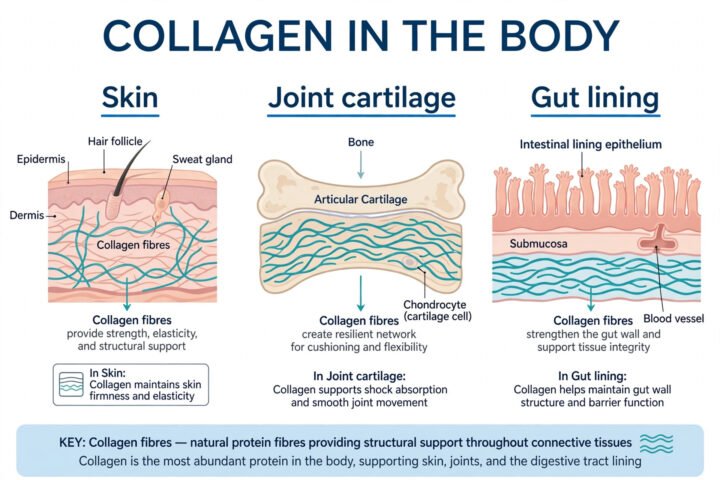
Collagen fibres provide structure in skin, joint cartilage, and the gut lining — which is why one supplement is marketed for all three, even though the trial evidence differs sharply by outcome.
Do collagen supplements work for skin?
This is where the evidence picture changed most recently. Earlier pooled analyses were positive. A 2021 meta-analysis of 19 randomized trials with 1,125 participants found improvements in skin hydration, elasticity, and wrinkles over about 90 days. A 2023 meta-analysis of 26 randomized trials with 1,721 participants also found better hydration and elasticity, while noting biases in the included trials.
Then, in 2025, Myung and Park published a meta-analysis in The American Journal of Medicine that did something earlier reviews had not: it split the trials by funding source and by quality. It pooled 23 randomized trials with 1,474 participants. With all trials together, collagen significantly improved hydration, elasticity, and wrinkles — the familiar headline. But in studies that did not receive funding from pharmaceutical companies, there was no effect on any of the three outcomes, while company-funded studies did show significant effects. High-quality studies likewise showed no significant effect in any category, while low-quality studies showed an improvement in elasticity only. The authors concluded there is currently no clinical evidence to support the use of collagen supplements to prevent or treat skin aging.
23 trials, 1,474 participants — In the 2025 American Journal of Medicine meta-analysis, the pooled skin benefit disappeared in trials without company funding and in high-quality trials. That funding split is the single most important fact in the skin evidence.
Funding does not prove a trial is wrong, and industry funds much supplement research. But when a benefit appears only in funded and lower-quality trials and disappears in independent, higher-quality ones, you should not present it as settled. If you are asking do collagen supplements work for wrinkles or elasticity, the fairest current answer is: not proven, despite positive pooled headlines.
Do collagen supplements work for joint pain?
The joint evidence is different — there is a signal, but it is modest and messy. An updated systematic review and meta-analysis published in Clinical and Experimental Rheumatology in 2025 pooled 11 randomized trials with 870 participants with knee osteoarthritis (451 on collagen, 419 on placebo). It found improvements favouring collagen in function (mean difference −6.46) and pain scores (mean difference −13.63), but heterogeneity was very high — I² of 75% for function and 88% for pain — meaning the trials disagreed with each other a lot.
An earlier 2023 meta-analysis in the Journal of Orthopaedic Surgery and Research, pooling 4 trials with 507 patients, found a pain difference favouring collagen peptides (standardized mean difference −0.58), while noting that all of the included trials were considered at high risk of bias and that well-designed trials are still needed. In that analysis there was no significant difference in adverse events versus placebo, though the evidence for safety was rated very low quality.
Outside diagnosed osteoarthritis, results are weaker. A trial in active people with self-reported knee pain — not osteoarthritis — found collagen peptides reduced pain no more than placebo. So do collagen supplements work for joint pain in general? No. The signal, if real, is specific to knee osteoarthritis, is based on trials with important limitations, and should not replace exercise, weight management where relevant, physical therapy, or clinician-guided osteoarthritis care. Our guide to how much protein you actually need covers the nutrition basics that support muscle around a painful joint.
| Claim | What pooled trials show | The caveat that matters |
|---|---|---|
| Skin hydration, elasticity, wrinkles | Positive when all trials are pooled (2021, 2023, and 2025 reviews) | No effect in non-company-funded or high-quality trials in the 2025 analysis |
| Knee osteoarthritis pain | Small-to-moderate pain and function improvements in 2025 and 2023 meta-analyses | Very high heterogeneity; many trials at high risk of bias |
| General knee pain without osteoarthritis | No benefit over placebo in an active-people trial cited in reviews | Do not transfer osteoarthritis results to general aches |
| Gut lining / “leaky gut” | No direct human trial showing gut-lining repair | Claims rest mainly on cell/animal work and a small study without placebo |
Do collagen supplements work for gut health?
Here the answer is the clearest: there is no good human evidence yet. Collagen is part of the gut lining’s structure, which makes the marketing story sound plausible — but plausibility is not a trial.
The human study most often cited for gut symptoms gave 20 grams of collagen peptides a day to 14 women for 8 weeks and reported less bloating. It had no placebo group, so the improvement could reflect placebo effects, time, or other changes — gut symptoms are especially prone to placebo response. Other gut-lining claims come from cell and animal studies, which can guide research questions but cannot prove a supplement seals or repairs a human gut. If you are asking do collagen supplements work for gut health, the evidence-based answer today is that it has not been shown in people.
That does not mean gut symptoms should be ignored. Persistent bloating, diarrhoea, constipation, blood in the stool, or unexplained weight loss need medical evaluation, not a supplement trial. For everyday gut support from food, our guide to how much fiber you need covers an intervention with much stronger human evidence, and does sugar cause inflammation separates a related gut-adjacent claim from what feeding trials actually found.
Is collagen a good protein source?
Collagen counts as protein on a label, but it is an incomplete protein: it lacks the essential amino acid tryptophan and is low in several others needed for muscle building. That is why collagen should not be your main protein strategy, even if you choose to take it for another reason.
A protein-first approach usually costs less and does more that is proven: meet your daily protein target from complete sources — dairy, eggs, fish, meat, soy, or combinations of plant proteins — spread across meals. See how much protein you actually need for targets by age and activity (for example, gains with resistance training plateau at about 1.6 g/kg a day in the research summarised there). Food also brings collagen-building nutrients directly: protein foods provide the amino acids, and fruit and vegetables provide vitamin C. Our fish oil vs eating fish comparison makes the same food-versus-capsule point in another cluster — a nutrient in food and the same nutrient in a supplement are not automatically equivalent.

Foods such as fish, eggs, and broth, eaten as part of a protein-adequate diet with vitamin C-rich produce, supply the building blocks your body uses to make its own collagen.
Are collagen supplements safe, and who should skip them?
In the trials summarised above, adverse events were generally not significantly different from placebo, and reported side effects were usually mild — digestive symptoms such as bloating, a feeling of heaviness, heartburn, or diarrhoea, and an unpleasant taste are described for gelatin/collagen-type products in MedlinePlus. That short-trial picture is not the same as proven long-term safety for every product.
Three cautions matter. First, source and allergy: collagen comes from cattle, pig, fish, or chicken, so check the source if you have a fish, shellfish, or egg allergy, follow a vegetarian or vegan diet, or avoid certain animal products for religious reasons. Second, regulation: dietary supplements are not approved by the FDA for efficacy before sale, and Cleveland Clinic clinicians have noted concerns about inaccurate labelling and contamination in the supplement industry — choose third-party-tested products if you use one, and be wary of products that promise drug-like results. Third, evidence gaps: MedlinePlus notes there is not enough reliable information for medicinal amounts in pregnancy and breastfeeding, so the cautious course is food amounts only and a conversation with your clinician.
Tell your clinician or pharmacist about any supplement you take, especially if you take regular medicines, are pregnant, or are treating a joint or skin condition — a supplement should never delay care for those conditions.
So should you buy collagen supplements?
Use the claim-by-claim verdict, not the jar’s front label. For skin aging, the best current analysis says there is no clinical evidence to support use once funding and quality are accounted for — spending is a gamble, not an evidence-based step. For knee osteoarthritis, a modest benefit is possible but unproven in high-quality trials; if you try it, set a time limit (trials typically ran 8–12 weeks or longer), track pain and function honestly, and keep proven care in place. For gut health, there is no human evidence to justify buying it for that purpose.
If the real goal is more protein, better skin habits, or healthier joints, put the money first toward things with stronger support: adequate complete protein, sunscreen and not smoking for skin, strengthening exercise and physical therapy advice for joints, and a fiber-rich eating pattern for gut health. That ordering is not anti-supplement — it is simply what the evidence supports first.
Frequently asked questions
How long does collagen take to work, if it works at all?
Trials that reported skin or joint changes typically ran at least 8 to 12 weeks, and some joint trials ran longer. That timeline comes from trial design, not proof that waiting longer creates a benefit. If you and your clinician decide to try collagen for knee osteoarthritis, agree a review point at about 12 weeks and stop if pain and function have not meaningfully improved.
What dose of collagen was used in trials?
Hydrolyzed collagen peptide trials for skin commonly used about 2.5 to 10 grams a day, and joint trials often used about 10 grams a day, while undenatured type II collagen trials used 40 mg a day — a completely different form and dose. A dose matching a trial does not guarantee the trial’s result, especially where the trial was company-funded or at high risk of bias.
Is marine collagen better than bovine collagen?
No good head-to-head human trial proves marine (fish) collagen is better than bovine collagen for skin, joints, or gut outcomes. Reviews note hydration effects varied by source in some analyses, but that is not the same as a proven ranking. Choose by allergy, diet, source transparency, and third-party testing rather than a marine-versus-bovine marketing claim.
Can I get collagen from food instead?
You get collagen directly from foods such as bone broth, meat cooked with skin or connective tissue, and fish with skin, and — more importantly — your body makes collagen when you eat enough total protein and vitamin C. Food will not replicate a trial dose of peptides, but for general health a protein-adequate, varied diet is the approach with the broader evidence behind it.
Conclusion
So, do collagen supplements work? For skin, pooled headlines are positive but the benefit disappears in independent and high-quality trials, and the 2025 authors say there is currently no clinical evidence to support use for skin aging. For knee osteoarthritis, there is a possible modest pain benefit from flawed, inconsistent trials. For gut health, there is no direct human evidence.
That is a workable decision rule: do not buy collagen for gut claims, treat skin claims as unproven, and treat a joint trial as optional, time-limited, and secondary to proven care. Whatever you decide, keep complete protein, fiber, and clinician guidance ahead of any powder.
Sources
- Myung SK, Park Y. Effects of Collagen Supplements on Skin Aging: A Systematic Review and Meta-Analysis of Randomized Controlled Trials. American Journal of Medicine 2025;138(9):1264-1277. 23 RCTs, 1,474 participants; no effect in non-pharmaceutical-funded or high-quality subgroups. PubMed
- Effect of collagen supplementation on knee osteoarthritis: an updated systematic review and meta-analysis of randomised controlled trials. Clinical and Experimental Rheumatology 2025;43(1):126-134. 11 RCTs, 870 participants; pain and function improvements with high heterogeneity (I² 75–88%). PubMed
- Analgesic efficacy of collagen peptide in knee osteoarthritis: a meta-analysis of randomized controlled trials. Journal of Orthopaedic Surgery and Research 2023;18:694. 4 trials, 507 patients; pain SMD −0.58, all trials at high risk of bias. PMC
- Cleveland Clinic. Collagen Supplements: Benefits and Side Effects — clinician cautions on manufacturer-sponsored skin studies, labelling, and contamination. Cleveland Clinic
- MedlinePlus (NIH National Library of Medicine). Gelatin: MedlinePlus Supplements — safety, digestive side effects, and pregnancy/breastfeeding information gaps. MedlinePlus
Medical disclaimer: This article is educational information only and is not medical advice. It does not diagnose or prescribe treatment for any condition. Discuss supplements, doses, and joint, skin, or gut symptoms with your own clinician, dentist, or registered dietitian, especially if you are pregnant, have allergies, or take regular medicines.





0 Comments