
Educational information · Not medical advice
In brief
Histamine intolerance is unproven, with no validated test. See the symptoms, what DAO really shows, and how a short low-histamine diet trial works safely.
In this article
- What is histamine intolerance?
- What are the symptoms of histamine intolerance?
- Is there a test for histamine intolerance?
- What else could explain these symptoms?
- Does a low-histamine diet help?
- Do DAO supplements work for histamine intolerance?
- How do you try a low-histamine diet safely?
- When should you see a doctor about histamine intolerance?
- Frequently asked questions
- Conclusion
- Sources
Key Takeaways
- Histamine intolerance is a proposed condition, not a proven one. Cleveland Clinic notes the American Academy of Allergy and Immunology does not currently recognise histamine intolerance as a condition, and experts disagree about whether the histamine in ordinary food causes these symptoms.
- There is no validated test. Reviews state there is no validated biomarker, and measuring diamine oxidase (DAO) in blood has not been shown to diagnose histamine intolerance.
- In a 2023 placebo-controlled challenge study of 59 people who suspected histamine intolerance, the suspicion was ruled out in about 85% — and many reacted to placebo — which is why other causes must be checked first.
- A short, structured low-histamine diet followed by reintroduction is the approach reviews describe, ideally with a clinician or dietitian — not a permanent, ever-expanding restriction list.
- DAO supplements have limited, mixed evidence. No product, test, or diet in this article is endorsed.
Histamine intolerance is the idea that some people cannot break down the histamine in food fast enough, so it builds up and causes headaches, flushing, a blocked nose, or gut upset after meals. It is a tidy explanation for messy, shifting symptoms — which is exactly why it deserves a careful evidence check before anyone buys a test, a supplement, or a long list of foods to avoid forever.
This article covers what histamine intolerance is proposed to be, which symptoms are blamed on it, why there is still no test that can confirm it, what else can cause the same picture, and what the evidence actually shows for a low-histamine diet and DAO supplements. The honest headline is that the evidence is limited — and this article says so plainly rather than presenting an unproven diet as a cure.
What is histamine intolerance?
Histamine is a chemical your own body makes. It plays a role in allergic responses, stomach acid, and signalling in the brain. Histamine is also present in food, especially aged, fermented, cured, or poorly stored food, because bacteria can produce it as food ages. A 2025 review in the International Journal of Molecular Sciences defines histamine intolerance as a disequilibrium between dietary histamine and the body’s capacity to degrade histamine in the intestine.
The proposed mechanism centres on an enzyme called diamine oxidase — DAO for short. DAO is made in the lining of the small intestine and is the main enzyme that breaks down histamine from food before it is absorbed. A second enzyme, histamine N-methyltransferase (HNMT), breaks down histamine inside cells. The theory is that if DAO activity is low — because of genetics, gut conditions that affect the intestinal lining, alcohol, or certain medicines that can block DAO — more histamine reaches the circulation and symptoms follow.
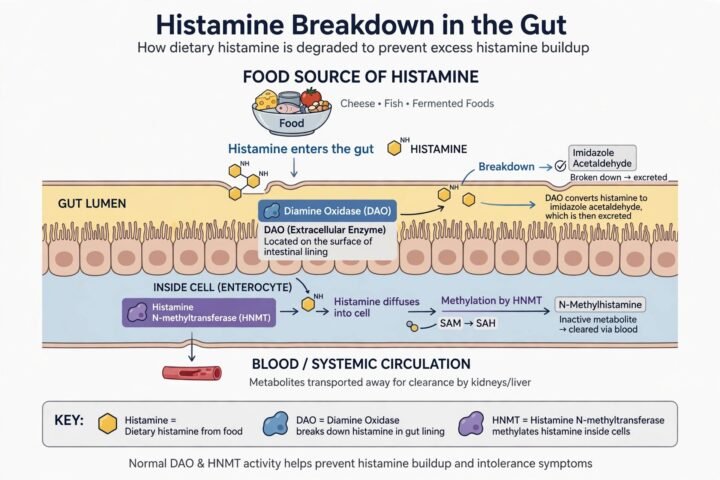
How dietary histamine is normally broken down in the gut: DAO works on histamine in the intestinal lining, while HNMT handles histamine inside cells. The histamine intolerance theory is that this breakdown falls behind intake.
That theory is plausible, but plausible is not the same as proven. Cleveland Clinic describes histamine intolerance as a proposed condition and notes that it has not been scientifically validated that reduced DAO causes it. Histamine intolerance is also not a food allergy: it does not involve the immune system in the way an allergy does, which is why it is sometimes called a pseudoallergy. It is also different from histamine poisoning, a well-documented food-poisoning pattern that affects several people who ate the same high-histamine fish dish.
What are the symptoms of histamine intolerance?
The symptoms attributed to histamine intolerance are wide-ranging, which is part of the diagnostic problem. Reviews list bloating — reported as the most frequent gut symptom — along with post-meal fullness, diarrhoea, abdominal pain, and constipation. Beyond the gut, reported symptoms include flushing, itching, hives, headache, dizziness, a runny or congested nose, sneezing, and a racing heart. Symptoms are usually described as appearing within a few hours of eating.
Notice what that list does not do: it does not point to one condition. Almost every symptom on it is common and has many other causes, from irritable bowel syndrome and reflux to allergy, migraine, and anxiety. A 2021 review in Nutrients stresses that the problem with diagnosing histamine intolerance is precisely the inconstancy and variety of the symptoms — the same person may react differently to a similar meal on a different day. A symptom list alone, however closely it seems to match, cannot confirm histamine intolerance.
Is there a test for histamine intolerance?
No — not a validated one. The 2025 dietary-management review states plainly that, despite the many commercial tests on offer, a clinically available, validated biomarker for histamine sensitivity has not yet been developed. Diagnosis, where it is attempted, rests on clinical assessment: a detailed history, ruling out other conditions, and observing the response to a low-histamine diet followed by reintroduction.
59 people, about 85% ruled out — In a 2023 placebo-controlled histamine challenge study, suspicion of histamine intolerance was disproved in most of the 59 people referred because they believed histamine in food was causing their symptoms, and many participants reacted to the placebo. Blinded testing, not symptom-matching, is what separated the two.
The test sold most often is a blood DAO test. The reasoning sounds logical — if low DAO is the problem, measure DAO — but blood DAO activity varies within the same person, results overlap heavily between people with and without symptoms, and reviews conclude its validity for diagnosis is limited. Skin-prick approaches do not measure how the intestine handles histamine from food, stool histamine is unreliable because gut bacteria themselves secrete histamine, and genetic panels for the AOC1 gene, which encodes DAO, show a predisposition at most — not a diagnosis. Paying for any of these may give you a number; it does not give you an answer.
| Test or approach | What it measures | Can it diagnose histamine intolerance? |
|---|---|---|
| Blood (serum) DAO activity | DAO enzyme activity in a blood sample | No — varies within a person and overlaps between groups; no validated threshold |
| AOC1 genetic panel | Gene variants linked to lower DAO activity | No — predisposition at most, not a diagnosis |
| Stool or urine histamine | Histamine or its breakdown products | No — influenced by diet and gut bacteria; not validated |
| Structured diet trial with reintroduction | Whether symptoms reproducibly follow histamine-rich foods | The approach reviews support — clinical assessment, not a lab test |
What else could explain these symptoms?
Because the symptoms are non-specific, a proper workup looks for better-established explanations first. The differential diagnosis in the reviews includes food allergy, irritable bowel syndrome and other gut–brain interaction disorders, inflammatory bowel disease, coeliac disease, lactose intolerance and fructose malabsorption, reflux, chronic urticaria, allergic and non-allergic rhinitis, asthma, migraine, and mast cell conditions. Cleveland Clinic makes the same point from the clinic side: other conditions often cause symptoms that look like a histamine reaction, so a provider may suggest allergy or gut testing and a food diary before settling on any label.
This step matters for a practical reason. If the real cause is coeliac disease, an allergy, or a treatable gut condition, months spent on an ever-tightening low-histamine diet delay the treatment that would actually help — and unnecessary restriction carries its own nutritional risks, a theme this site returns to when checking claims about whether sugar causes inflammation and other single-cause diet stories.

Fermented and aged foods are the ones most often flagged in low-histamine lists — but food lists differ widely between sources, which is one reason unsupervised restriction can spiral.
Does a low-histamine diet help?
Dietary management is considered the cornerstone approach in the reviews — with an important qualification. The evidence base is small and the diets studied are inconsistent: different studies exclude different foods, and there is disagreement about the histamine content of specific foods and about whether some foods truly release histamine at all. A systematic review of food-chemical elimination diets found the strongest support for a low-histamine diet was for symptoms in chronic urticaria, a specific skin condition — not proof that it resolves the broad, mixed symptom picture usually attributed to histamine intolerance.
What the reviews do support is the structure, not a permanent list: a short restriction phase, then deliberate reintroduction, food by food, to find an individual’s actual tolerance. The 2021 Nutrients review calls a low-histamine diet the gold-standard therapeutic approach and treats a good response to it as supporting evidence — while stressing that diagnosis requires systematically excluding similar disorders first. In other words, the diet is a test you run carefully for a few weeks, not an identity you adopt for life. If a balanced pattern is the goal once testing is done, our guides to how much protein you actually need and how much fibre you need are more useful foundations than any elimination list.
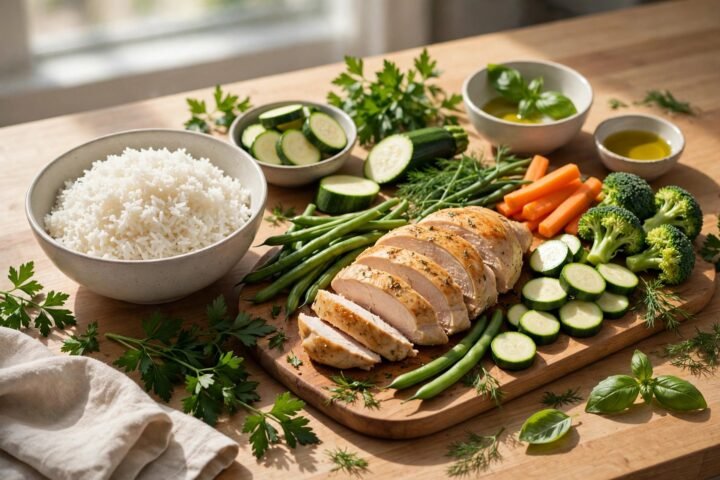
A short trial phase usually centres on freshly cooked, simple meals — fresh meat or fish cooked and eaten promptly, rice, and fresh vegetables — rather than aged, fermented, or leftover foods.
Do DAO supplements work for histamine intolerance?
DAO supplements — usually enzyme extract, most often from pig kidney, taken before meals — are proposed to help break down histamine in the gut. The 2025 review notes that efficacy has been shown in some intervention studies, but also that key questions remain unanswered, including how the enzyme’s origin and cofactors affect activity and how products compare. The 2021 review is similarly cautious, describing DAO supplementation as something that may be considered as a subsidiary treatment alongside dietary measures in people with intestinal DAO deficiency — not as a stand-alone fix.
So the fair summary is: limited, mixed, low-certainty evidence, and no basis for presenting DAO supplements as proven. The same caution applies to the wider supplement shelf marketed at this audience; our evidence checks on fish oil versus eating fish show how often supplement claims run ahead of the trial data. If you try a DAO supplement, that is a personal experiment to discuss with your clinician — especially if you take medicines that can affect DAO or have a pork allergy, since most products are porcine-derived — not a diagnosis or a treatment plan.
How do you try a low-histamine diet safely?
If, after other causes have been considered, you and your clinician decide a trial makes sense, reviews and clinic guidance converge on the same shape. Keep a dated food and symptom diary first, noting medicines, stress, menstrual cycle, and activity as well as meals, because all of these can colour symptoms. Then follow a short, defined restriction phase — commonly described as about two weeks — eating freshly prepared foods and pausing the highest-histamine categories such as aged cheeses, cured and fermented foods, fermented drinks including alcohol, and leftovers kept for days, since histamine rises as food ages.
Then reintroduce foods one at a time and record what actually happens. Reintroduction is the step most internet lists skip, and it is the step that turns restriction into information. If symptoms do not reproducibly follow a food, that food goes back in. A dietitian can help keep the trial nutritionally complete — adequate anti-inflammatory eating principles and enough protein and fibre matter more long-term than a perfect avoidance list. Stop and reassess if the diet is becoming a source of anxiety or if you are losing weight unintentionally.
When should you see a doctor about histamine intolerance?
See a clinician promptly — rather than starting a diet — if you have swelling of the lips, tongue, or throat, difficulty breathing, fainting, or a widespread rash with feeling unwell, as those can signal allergy or anaphylaxis, not intolerance. Book an appointment if symptoms are persistent, are worsening, involve blood in the stool, unintentional weight loss, vomiting, or disturbed sleep, or if you are cutting out more and more foods without getting clearer answers. An allergist or gastroenterologist can work through the differential diagnosis — allergy, coeliac disease, inflammatory or functional gut conditions, and mast cell disorders — that a food diary alone cannot separate.
Frequently asked questions
Is histamine intolerance real?
Histamine intolerance is a proposed condition: the idea that reduced DAO activity lets histamine from food build up and cause symptoms. Cleveland Clinic notes the American Academy of Allergy and Immunology does not currently recognise it as a condition, a 2023 blinded challenge study ruled it out in most people who suspected it, and experts disagree about the mechanism. The symptoms people experience are real; whether dietary histamine is the cause is unproven in most cases.
What foods are highest in histamine?
Foods most often listed as high in histamine are aged, fermented, cured, or long-stored foods: aged cheeses, cured meats, sauerkraut and other fermented vegetables, fermented soy products, wine and beer, and fish that was not kept properly cold. Lists differ considerably between sources, and histamine content varies with storage and freshness, so no single food list is authoritative — another reason trials should be short and structured.
Can a blood test check my DAO level and diagnose histamine intolerance?
A blood test can measure DAO activity, but it cannot diagnose histamine intolerance. Reviews state there is no validated biomarker for the condition: blood DAO varies within the same person, overlaps between people with and without symptoms, and has no agreed diagnostic threshold. Diagnosis, where attempted, is clinical — history, exclusion of other conditions, and a structured diet trial with reintroduction.
How long should a low-histamine diet trial last?
Reviews describe a short restriction phase — commonly around two weeks, with some guidance describing 10 to 14 days — followed by gradual, one-at-a-time reintroduction over the following weeks. It is meant to be a time-limited test, ideally supervised by a clinician or dietitian, not a permanent diet. If there is no clear, reproducible pattern by the end of reintroduction, the diet has given its answer and should not simply keep tightening.
Conclusion
Histamine intolerance names a real frustration — symptoms after meals that no one has explained — but the label itself remains unproven. There is no validated test, blood DAO cannot confirm or exclude it, blinded challenge ruled it out in most suspected cases in the best-known study, and the low-histamine diet lists circulating online disagree with each other. What the evidence does support is methodical: rule out allergy, coeliac disease, and gut conditions first; keep a proper food and symptom diary; and, if a trial still makes sense, run it short, structured, and with reintroduction, ideally with professional support.
Be sceptical of anyone selling certainty here — a definitive test, a supplement presented as proven, or a permanent list of forbidden foods. Discuss persistent symptoms with your clinician or dentist, who can direct the workup that a diet trial cannot replace.
Sources
- Cleveland Clinic — Histamine Intolerance: Causes, Symptoms & Treatment (proposed condition, not recognised by the American Academy of Allergy and Immunology; other conditions often explain the symptoms; food diary and specialist referral).
- Hrubisko M et al. — Histamine Intolerance — The More We Know the Less We Know. A Review, Nutrients 2021 (symptom heterogeneity, differential diagnosis, low-histamine diet as the therapeutic gold standard, DAO supplementation as subsidiary only).
- Jackson K et al. — Evidence for Dietary Management of Histamine Intolerance, International Journal of Molecular Sciences 2025 (no validated biomarker; diagnosis by clinical assessment and diet response; DAO, AOC1 variants, and limits of serum DAO, skin-prick, and stool testing).
- Bent RK et al. — Placebo-Controlled Histamine Challenge Disproves Suspicion of Histamine Intolerance, Journal of Allergy and Clinical Immunology: In Practice 2023 (59 referred patients; suspicion disproved in most under blinded challenge).
Medical disclaimer: This article is educational information only and is not medical advice. It does not diagnose histamine intolerance or any other condition, and it does not recommend a diet, test, or supplement for any individual. If you have persistent or severe symptoms, discuss them with your clinician or dentist.





0 Comments