
Educational information · Not medical advice
In brief
Napping and dementia explained: what the 10-year study found, why frequent naps likely signal early brain changes, and when to talk to a doctor about it.
In this article
- What did the new napping and dementia study actually find?
- Does napping cause dementia?
- What does the earlier napping and dementia research show?
- Which napping patterns should you pay attention to?
- Should you stop napping?
- When should new daytime sleepiness prompt a doctor visit?
- Frequently asked questions
- Conclusion
- Sources
Key Takeaways
- In a 10-year study of 995 older adults, people who napped most days or every day developed dementia at a 48% higher rate than people who rarely or never napped.
- That link between napping and dementia is observational. It does not show that naps cause dementia, and the researchers say frequent napping may be a marker of early brain changes rather than a cause of them.
- Unintentional napping — falling asleep without meaning to — was also linked to higher risk, at 39% above non-nappers.
- Experts do not advise simply stopping naps. What is worth noticing is a change: needing to nap much more often, or dozing off unintentionally, especially alongside memory or thinking changes.
If you nap most afternoons, a headline linking napping and dementia can sound alarming — as if the nap itself were damaging your brain. The research behind those headlines says something narrower and, in a way, more useful. This article explains what the newest napping and dementia study found, what it cannot prove, how it fits with earlier work, and which changes in daytime sleep are actually worth bringing up with a clinician.
The short version: frequent, unintentional daytime sleep in older adults travels with a higher rate of later dementia. The most likely reading, on the researchers’ own account, is that a growing need to nap can be an early warning sign of changes already under way in the brain — not evidence that a planned afternoon rest causes dementia.
What did the new napping and dementia study actually find?
The study at the center of the current napping and dementia discussion was published online on October 5, 2026, in The Journals of Gerontology: Medical Sciences. Led by researchers at the Johns Hopkins Bloomberg School of Public Health, it followed 995 U.S. Medicare beneficiaries aged 65 and older who were free of dementia at the start of the study in 2013, using data from the National Health and Aging Trends Study (NHATS), a nationally representative survey of older adults. Participants were tracked for up to 10 years.
48% higher — the rate of developing dementia among participants who napped frequently (most days or every day) compared with those who rarely or never napped, after accounting for demographics, health conditions, and nighttime sleep characteristics including sleep duration, daytime sleepiness, and a measure of obstructive sleep apnea risk (Jiang et al., 2026).
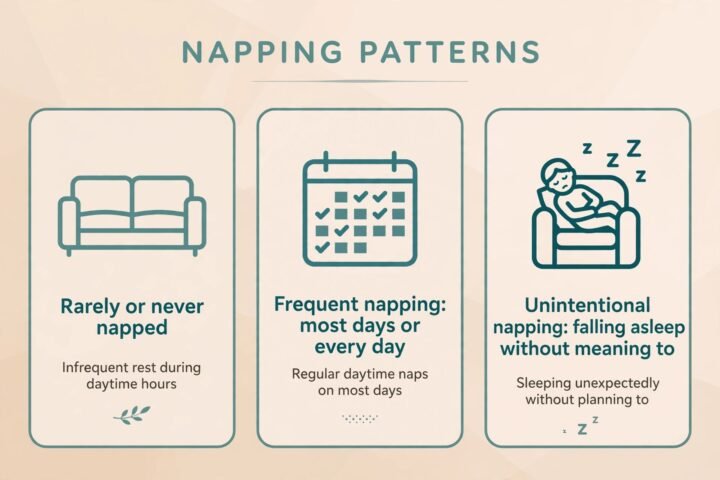
Three patterns stood out:
- Frequent napping: napping most days or every day was associated with a 48% higher rate of developing dementia than rarely or never napping.
- Unintentional napping: falling asleep without meaning to, rather than planning a nap, was associated with a 39% higher rate.
- Short naps: napping for 30 minutes or less was associated with a 40% higher rate — an association that held up after accounting for a range of potential confounders, while the association for naps longer than 30 minutes weakened once nighttime sleep factors were considered.
That last finding surprises many readers, because short naps are usually the ones recommended for alertness. It is one reason the authors treat napping patterns as a signal to understand, not a simple dose of something harmful: if brief naps themselves were the problem, the pattern would be expected to look different. The team also ran a check aimed at timing. When they excluded dementia cases diagnosed within the first five years of follow-up, the associations for frequent and unintentional napping remained similar — which supports the idea that napping patterns may meaningfully precede a dementia diagnosis by years, rather than simply reflecting a diagnosis already made.
Does napping cause dementia?
On current evidence, that claim is not supported — and the napping and dementia researchers themselves say so plainly. The Johns Hopkins team cautions that the findings are observational and cannot establish that napping causes dementia. Senior author Adam Spira puts the alternative directly: more frequent napping could be a marker of changes in the brain, rather than a cause of brain changes that lead to dementia.
There is a plausible mechanism for that direction. Brain regions that help regulate wakefulness can degenerate early in the course of dementia. As those wake-promoting systems weaken, a person may doze more during the day — so increased napping would be an early effect of the disease process, not its trigger. The relationship may also run both ways at once: napping is a potential risk factor for dementia at the same time as early brain changes lead to more frequent napping, as the researchers describe it.
The study also has limits that matter before anyone changes their habits over it. Napping was self-reported, which can be subject to recall bias — people are imperfect historians of their own dozing. Dementia status was determined using a validated algorithmic classification rather than a clinical diagnosis. And past research on napping and cognitive decline has yielded mixed results, with some studies finding no association or even potential benefits from short naps; differences in study design, including self-report versus wearable measurement, and cultural attitudes toward napping may help explain the inconsistency. The authors say longer-term studies combining detailed, objective measures of both daytime and nighttime sleep are needed.
| Pattern | What it meant in the study | Association with developing dementia |
|---|---|---|
| Frequent napping | Napping most days or every day | 48% higher rate vs rarely/never napping |
| Unintentional napping | Falling asleep without meaning to | 39% higher rate vs non-nappers |
| Short naps | Napping for 30 minutes or less | 40% higher rate vs non-nappers |
| Rarely / never napping | Little or no daytime napping | Reference group |
Read the table the way the authors ask you to: these are associations in one observational cohort, adjusted for many but never all possible confounders. They identify a group worth closer attention; they do not assign cause to any individual napper.
What does the earlier napping and dementia research show?
The NHATS findings do not stand alone, and the earlier work points in the same “warning sign” direction. In a study led by researchers at UC San Francisco and Harvard Medical School, published in 2022 in Alzheimer’s & Dementia, 1,401 older adults in the Rush Memory and Aging Project (average age 81) wore a watch-like device for up to 14 days a year, for up to 14 years. Prolonged inactivity between 9 a.m. and 7 p.m. was counted as a nap — an objective measure, unlike self-report.
Participants who napped more than an hour a day had a 40% higher risk of developing Alzheimer’s disease than those who napped less than an hour a day, and those who napped at least once a day had a 40% higher risk than those who napped less often. Crucially, that association remained after adjusting for nighttime sleep quantity and quality, suggesting daytime napping itself carries signal independent of a bad night.
The change-over-time data may be the most telling part. Among participants who did not develop cognitive impairment, daily daytime napping increased by an average of 11 minutes per year. That rate of increase doubled, to 24 minutes per year, after a diagnosis of mild cognitive impairment, and nearly tripled, to 68 minutes per year, after a diagnosis of Alzheimer’s disease. In other words, napping did not sit still as a fixed habit that preceded disease — it accelerated as cognition declined. The authors describe a bidirectional, “vicious cycle” relationship, and point to other work suggesting Alzheimer’s-related changes may damage the wake-promoting neurons that keep people alert during the day. Two different designs — self-report in NHATS, actigraphy in Rush — converging on “more and more unintentional daytime sleep goes with dementia” is stronger than either study alone, while still falling short of proving causation.
Which napping patterns should you pay attention to?
Pulling the napping and dementia evidence together, the pattern worth noticing is change, not the existence of a nap:
- Frequency climbing: drifting from an occasional rest to napping most days or every day, without a clear reason such as illness or a run of short nights.
- Losing intention: falling asleep without meaning to — in a chair, mid-conversation, or during activities you used to stay awake for.
- Needing more despite sleeping at night: daytime sleepiness that persists even when nighttime sleep duration looks adequate, which is why both studies adjusted for nighttime sleep and still found the association.
- Company it keeps: new daytime sleep alongside memory, attention, or judgment changes is a different picture from sleepiness alone.
Daytime sleepiness also has many more ordinary causes that a clinician will want to rule out first — poor nighttime sleep, obstructive sleep apnea, medicines, mood, and other health conditions among them. If broken nights are part of your picture, our explainers on why you wake up at 3 AM and sleep hygiene habits that actually help cover the nighttime side, and what CBT-I is explains the first-line insomnia therapy. A napping change is a prompt to look for a cause, not a diagnosis by itself.

Should you stop napping?
No study cited here supports that advice, and the Johns Hopkins authors do not give it. Their lead author suggests instead that monitoring napping behaviors could serve as an early and accessible marker to help identify older adults at higher risk for dementia and guide targeted prevention efforts. A marker is something to observe and report — like a change in appetite or walking speed — not something to suppress and forget.
For an occasional, planned nap, the general guidance is unchanged. Brief naps can increase alertness: the CDC’s NIOSH training module notes that a brief nap of under 20 minutes can increase alertness for a couple of hours with less grogginess, and that waking from light sleep — around 20 minutes, before deeper sleep — tends to mean less sleep inertia than waking after about an hour in deep sleep. Our own guide to how long a nap should be walks through nap length by goal, coffee naps, and when naps backfire on nighttime sleep. Keep a planned nap short, early in the afternoon, and intentional — and treat a growing inability to stay awake, rather than a chosen rest, as the thing to discuss.
When should new daytime sleepiness prompt a doctor visit?
Talk to your health care provider if daytime sleep is new, increasing, or unintentional — and sooner if it arrives with cognitive changes. The CDC notes that dementia is not a normal part of aging, and lists signs that may point to dementia, including getting lost in a familiar neighborhood, forgetting the name of a close family member or friend, forgetting old memories, and not being able to complete common tasks on your own. Problems with memory, attention, communication, reasoning and judgment, and visual processing can all be part of the picture.
The CDC’s advice is direct: see your health care provider if you notice any of these signs, because the sooner the cause is identified, the sooner you and your provider can work out a diagnosis and next steps — and some causes of memory and sleep problems are treatable conditions other than dementia. Bring specifics: when the napping changed, how often you doze unintentionally, how you are sleeping at night, and any medicines you take. That timeline is exactly the information the napping and dementia research suggests is worth tracking.
Frequently asked questions
Does napping cause dementia?
No evidence cited here shows that. The napping and dementia studies are observational: they show frequent and unintentional napping traveling with higher dementia rates, but they cannot establish cause and effect. The Johns Hopkins senior author says frequent napping may be a marker of brain changes rather than a cause of them, and early dementia can damage the brain systems that keep people awake.
How much napping was linked to dementia in the new study?
In Jiang et al. (2026), napping most days or every day was associated with a 48% higher rate of developing dementia over up to 10 years, compared with rarely or never napping, among 995 adults aged 65 and older. Unintentional napping was associated with a 39% higher rate, and naps of 30 minutes or less with a 40% higher rate.
Should older adults stop napping to prevent dementia?
That is not what the researchers advise, and no trial shows that stopping naps prevents dementia. A planned, brief nap is a normal part of many older adults’ routines. What the evidence supports is noticing change — needing to nap far more often, or falling asleep unintentionally — and raising that change with a clinician, especially alongside memory or thinking changes.
What else can cause new daytime sleepiness in older adults?
Many things besides early dementia: poor or fragmented nighttime sleep, obstructive sleep apnea, medication effects, mood disorders, and other medical conditions. That is why new daytime sleepiness deserves an evaluation rather than an assumption. A clinician can review nighttime sleep, medicines, and health conditions, and check cognition if the overall picture — including any CDC-listed dementia signs — warrants it.
Conclusion
The honest answer to the headline question is: probably a warning sign, not a cause. Across a 10-year national study and an earlier 14-year actigraphy study, older adults who napped frequently, for longer, or without intending to developed dementia at higher rates — and in the actigraphy study, napping accelerated sharply as cognition declined. That pattern fits a brain losing its wake-promoting machinery early in disease far better than it fits naps damaging a healthy brain.
So do not fear a planned afternoon rest, and do not try to prevent dementia by forcing yourself to stay awake. Do notice change. If you or someone close to you is dozing off unintentionally, needing naps most days where that is new, or sleeping in the day despite sleeping at night — particularly with any memory or thinking changes — bring that timeline to a clinician. In the napping and dementia story, the change is the signal.
Sources
- Jiang K, et al. Napping Characteristics and Incident Dementia: Results From the National Health and Aging Trends Study. The Journals of Gerontology: Medical Sciences 2026 (published online October 5, 2026). Summary and author quotes: Johns Hopkins Bloomberg School of Public Health, October 13, 2026. Johns Hopkins summary
- Li P, et al. Daytime napping and Alzheimer’s dementia study, Rush Memory and Aging Project. Alzheimer’s & Dementia 2022. Summary: UC San Francisco. UCSF summary and Harvard Gazette summary
- Centers for Disease Control and Prevention. Signs and Symptoms of Dementia (reviewed August 14, 2024). CDC dementia signs
- Centers for Disease Control and Prevention, NIOSH. Work Hour Training, Module 7: Napping, Nap Duration. CDC NIOSH nap duration module
Medical disclaimer: This article is educational information only and is not medical advice. It does not diagnose or treat any condition. If you notice new or increasing daytime sleepiness or changes in memory or thinking, discuss them with your own clinician, who knows your history and other medicines.





0 Comments