Educational information · Not medical advice
In brief
Sleep hygiene explained clearly: which habits actually help you sleep, why tips alone don't treat insomnia, and when CBT-I is the next step to ask about.
In this article
- What is sleep hygiene, exactly?
- Which sleep hygiene habits have the most support?
- What about caffeine, alcohol, and late meals?
- How should your bedroom and wind-down look?
- Why is sleep hygiene alone not a treatment for insomnia?
- How do you put sleep hygiene into a simple 7-day plan?
- When should you get help instead of another tip list?
- Frequently asked questions
- Conclusion
- Sources
Key Takeaways
- Sleep hygiene is the set of daily habits and bedroom conditions that support sleep: a regular schedule, morning light, a cool dark quiet room, and a wind-down routine.
- The habits with the clearest support are the boring ones — same wake time every day, caffeine and alcohol kept away from bedtime, devices off at least 30 minutes before bed (CDC).
- Sleep hygiene alone is not a treatment for chronic insomnia. The American Academy of Sleep Medicine (AASM) suggests clinicians not use sleep hygiene as a single-component therapy for chronic insomnia disorder; CBT-I is the strong-recommendation first-line treatment.
- Use sleep hygiene as the foundation, not the finish line: if sleep is still broken 3 or more nights a week for 3 months or more, ask about CBT-I by name.
Sleep hygiene is the advice almost everyone with poor sleep hears first — and it is genuinely useful, up to a point. Sleep hygiene means the daily habits and bedroom conditions that make good sleep more likely: when you get up, when you have caffeine, how dark and cool your room is, and how you spend the last hour of the day.
This article separates the sleep hygiene habits that public-health guidance actually supports from the limits of tip lists. The honest summary is this: sleep hygiene helps many people sleep a little better, and it is sensible support for any sleep plan — but guidelines are plain that sleep hygiene alone does not treat chronic insomnia. Knowing which side of that line you are on saves months of frustration.
What is sleep hygiene, exactly?
The Centers for Disease Control and Prevention (CDC) describes better sleep habits as a practical list: going to bed and getting up at the same time every day, keeping the bedroom quiet, relaxing, and at a cool temperature, turning off electronic devices at least 30 minutes before bedtime, avoiding large meals and alcohol before bedtime, avoiding caffeine in the afternoon or evening, and exercising regularly. That list is the core of what clinicians mean by sleep hygiene.
Notice what sleep hygiene is not. It is not a therapy programme, it has no sessions, and it does not retrain the learned association between bed and wakefulness that keeps chronic insomnia going. It is closer to dental hygiene than to dental treatment: daily habits that prevent problems and support health, but not a fix once a disorder is established. That distinction — support versus treatment — runs through everything below, and it is why our explainer on what CBT-I is and how it works treats hygiene as one supporting piece inside a larger package.
Which sleep hygiene habits have the most support?
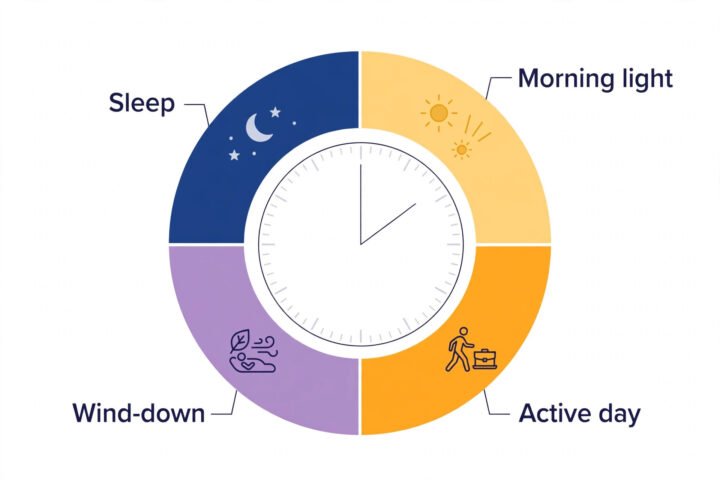
A regular schedule, anchored on wake time. The CDC puts consistency first: go to bed and get up at the same time every day. A fixed wake time is the anchor most people can actually hold, including after a poor night, because it sets the body clock for the following evening. Our guide to morning light and your body clock explains why light soon after that fixed wake time is the strongest daily reset signal.
Daylight and daytime activity. Regular exercise is on the CDC list, and a peer-reviewed review of sleep hygiene in the general population (Irish and colleagues, Sleep Medicine Reviews, 2015) found that regular exercise produced modest improvements in sleep, while noting that the evidence did not support the common claim that late-night exercise always disrupts sleep. The practical reading: move during the day, and if evening exercise leaves you wired, move it earlier — do not drop it.
Short, early naps — or none. If night sleep is fragile, long or late naps discharge the sleep pressure you need at bedtime. If you nap, keep it short and early in the afternoon; our article on how long a nap should be covers the timing trade-offs in detail.
At least 30 minutes
The CDC advises turning off electronic devices at least 30 minutes before bedtime — one of the few sleep hygiene habits with a specific number attached. Pair it with a fixed wake time and you have the two highest-yield changes on the list.
What about caffeine, alcohol, and late meals?
Caffeine: earlier than you think. The CDC advises avoiding caffeine in the afternoon or evening. The Irish 2015 review found caffeine close to bedtime disrupts sleep with a dose-response relationship — more caffeine, more disruption — and that tolerance to its sleep effects can develop within days, which is why a daily afternoon coffee can quietly become part of the problem. A practical sleep hygiene rule is a personal cut-off in the early afternoon, earlier if you are sensitive.
Alcohol: a sedative that fragments sleep. The same review found acute alcohol before bed shortens the time to fall asleep but increases arousal in the second half of the night, in a dose-dependent way. That pattern — fall asleep fast, wake at 3 AM — is familiar to many readers; our article on waking up at 3 AM every night covers the alcohol rebound in depth. The CDC includes avoiding alcohol before bedtime in its habit list.
Meals: light and earlier. The CDC advises avoiding large meals before bedtime. A heavy, late meal can add reflux and discomfort to the list of things that surface you in lighter late-night sleep. A small snack if you are hungry is a different matter from a full meal an hour before bed.
How should your bedroom and wind-down look?
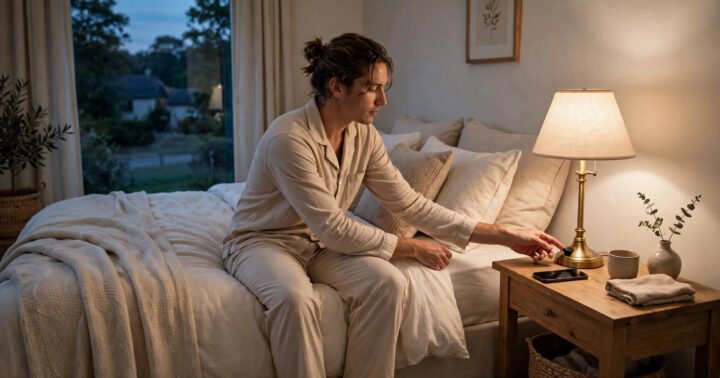
The CDC’s bedroom advice is short: quiet, relaxing, and at a cool temperature, with electronic devices turned off at least 30 minutes before bedtime. Dark matters too — evening light tells the body clock the day is still going. You do not need to buy anything to act on this: curtains that actually close, a cooler room, and chargers that live outside the bedroom cover most of it.

The wind-down is the bridge between a busy evening and that room. Spend the last part of the evening on calm, repetitive activities — reading, a shower, preparing for tomorrow — at roughly the same time each night, so the routine itself becomes a cue for sleepiness. This is also where sleep hygiene shades into stimulus control, a CBT-I component: go to bed when sleepy, and if you are awake and frustrated for roughly 20 minutes, get up to a dim, quiet place and return when drowsy, rather than training yourself to lie awake.
Sleep hygiene habits compared
| Habit | What guidance says | Practical step |
|---|---|---|
| Regular schedule | Same bed and wake time every day (CDC) | Fix the wake time first; keep weekends close |
| Screens and light | Devices off at least 30 minutes before bed (CDC) | Charge the phone outside the bedroom |
| Caffeine | Avoid in the afternoon or evening (CDC); dose-response disruption (Irish 2015) | Set an early-afternoon cut-off |
| Alcohol | Avoid before bedtime (CDC); fragments second-half sleep (Irish 2015) | Test 2–3 weeks with no evening alcohol |
| Bedroom | Quiet, relaxing, cool (CDC) | Dark curtains, cooler temperature, no work in bed |
| Exercise | Exercise regularly (CDC); modest sleep gains (Irish 2015) | Move daily; shift late sessions earlier if wired |
Why is sleep hygiene alone not a treatment for insomnia?
Because the guideline evidence says so, plainly. In its 2021 clinical practice guideline on behavioural and psychological treatments for chronic insomnia disorder in adults, the American Academy of Sleep Medicine gave multicomponent cognitive behavioural therapy for insomnia (CBT-I) its single strong recommendation — the grade clinicians should follow under most circumstances. In the same guideline, the AASM suggests that clinicians not use sleep hygiene as a single-component therapy for chronic insomnia disorder in adults (a conditional recommendation).
The AASM’s reasoning, in its guideline announcement, is that although sleep hygiene practices are often suggested and well understood by patients, sleep hygiene recommendations do not constitute an effective stand-alone therapy. That is not a dismissal of the habits — CBT-I programmes include sensible sleep habits as support — it is a warning against offering a tip list as the whole answer to someone with a chronic disorder. If you have followed every list faithfully for months and still sleep badly, the evidence-based conclusion is not that you failed the list; it is that the list was never the treatment.
How do you put sleep hygiene into a simple 7-day plan?
Change one or two things at a time, in this order. Days 1–2: fix your wake time and get outdoor light soon after waking. Days 3–4: set your caffeine cut-off and keep alcohol away from the evening. Days 5–6: set up the bedroom — cool, dark, quiet — and move device charging out of it. Day 7: add the wind-down: devices off at least 30 minutes before bed, same calm routine each night. Keep a brief sleep diary as you go — bedtime, wake time, caffeine, alcohol, and how the night felt — because patterns are easier to see on paper than at 3 AM, and that diary is exactly what a clinician will ask for if you need the next step.
When should you get help instead of another tip list?
Book an appointment if poor sleep happens 3 or more nights a week, has lasted 3 months or more, or is affecting your days — the chronic-insomnia pattern described in sleep-medicine guidance — and ask specifically about CBT-I. Do not wait for the three-month mark if broken sleep is impairing work, mood, or safety, including drowsy driving.
Get assessed promptly, rather than optimising habits, if you have loud snoring with witnessed pauses in breathing, waking gasping or choking, or severe daytime sleepiness. That cluster points to sleep apnea, which needs a sleep study; no hygiene routine fixes a collapsing airway. Also raise persistent insomnia with your clinician if it arrives with low mood, anxiety, pain, reflux, or a recent medicine change, so those drivers are treated in parallel.
Frequently asked questions
Does sleep hygiene actually work?
Sleep hygiene helps many people sleep somewhat better, and its habits — regular schedule, no late caffeine or alcohol, a cool dark room, devices off before bed — are recommended by the CDC for better sleep. What it does not do, on its own, is treat chronic insomnia disorder: the AASM suggests against using sleep hygiene as a single-component therapy for chronic insomnia, where CBT-I is first-line.
What is the most important sleep hygiene habit?
Guidance consistently puts the regular schedule first: going to bed and getting up at the same time every day, per the CDC. In practice, fixing the wake time is the most holdable version of that habit, because it anchors the body clock, morning light, and the following night’s sleepiness. Caffeine and alcohol timing are the next highest-yield changes for most people.
How long does sleep hygiene take to work?
Expect gradual change over one to two weeks of consistent habits, not a single transformed night. The schedule and light habits work through the body clock, which shifts in days rather than hours. If two to three consistent weeks of good sleep hygiene leave sleep still broken most nights, treat that as useful information: it is time to ask about CBT-I rather than adding more tips.
Is sleep hygiene the same as CBT-I?
No. Sleep hygiene is a list of habits; CBT-I is a structured, multi-component therapy — sleep diary, stimulus control, sleep scheduling, cognitive work, and relaxation — delivered over several sessions. The AASM gives multicomponent CBT-I a strong recommendation for chronic insomnia and suggests against sleep hygiene alone as a single-component treatment. Hygiene habits support CBT-I; they do not replace it.
Conclusion
Sleep hygiene is worth doing: a fixed wake time, morning light, caffeine and alcohol kept away from bedtime, a cool dark quiet bedroom, and devices off at least 30 minutes before bed are low-cost habits with real guidance behind them. Done consistently for a couple of weeks, they give many people noticeably better sleep.
Just keep the limit in view. Sleep hygiene is the foundation, not the treatment, for chronic insomnia — the AASM is explicit on that point, and CBT-I is the first-line therapy to ask for by name when tips are not enough. And if snoring, gasping, or heavy daytime sleepiness are part of your picture, get sleep apnea assessed directly.
Medical disclaimer: This article is educational information only and is not medical advice. It does not diagnose or prescribe. Discuss your symptoms, treatment options, and risks with your doctor or sleep clinician.
Sources
- Centers for Disease Control and Prevention (CDC): About Sleep — better sleep habits: same bed/wake time daily, quiet relaxing cool bedroom, devices off at least 30 minutes before bed, avoid large meals, alcohol and afternoon/evening caffeine, exercise regularly.
- Edinger JD, et al. Behavioral and psychological treatments for chronic insomnia disorder in adults: an American Academy of Sleep Medicine clinical practice guideline. Journal of Clinical Sleep Medicine, 2021 — strong recommendation for multicomponent CBT-I; conditional recommendation against sleep hygiene as a single-component therapy for chronic insomnia. Summary at PMC7853203 and AASM.
- Irish LA, et al. The role of sleep hygiene in promoting public health: a review of empirical evidence. Sleep Medicine Reviews, 2015 — caffeine dose-response disruption, alcohol fragmenting second-half sleep, and modest sleep gains from regular exercise. Summary table at PMC4400203.





0 Comments