Educational information · Not medical advice
In brief
How long to wear a night guard for TMJ? See the TMJ splint timeline: when it should start helping, what soreness is normal, and when to call your dentist.
In this article
- What is a TMJ splint, and how is it meant to help?
- How long should you wear a TMJ splint each day?
- How long until a TMJ splint works?
- Is pain normal when you start wearing a splint?
- What does the evidence say about splint therapy?
- How can you give your splint the best chance of helping?
- When should you stop and call your dentist?
- Frequently asked questions
- Conclusion
- Sources
Key Takeaways
- Most TMJ splints are worn at night only, for as long as you sleep. How long to wear a night guard for TMJ during the day depends on your prescriber’s plan — some people are asked to add daytime hours at first, then taper.
- Judge a splint over weeks, not days. In the 2024 Cochrane review, trial outcomes were measured between 4.4 weeks and 4 months, and the evidence for pain relief was rated very low certainty.
- Mild awareness, extra saliva, and brief morning stiffness can be part of settling in. New or worsening pain is not: the National Institute of Dental and Craniofacial Research (NIDCR) advises stopping an appliance that causes pain and consulting your dentist or doctor.
- A splint is removable and reversible. It should never be designed to permanently change your bite, and it needs follow-up adjustment — the fitting visit is the start of treatment, not the end.
You have just been handed a clear piece of hard acrylic and a short instruction: wear it at night. Then the questions start. How long to wear a night guard for TMJ each day? How many weeks until it helps? And if your jaw aches on the third morning, is that normal adjustment — or a sign something is wrong?
This article answers those timing and troubleshooting questions directly: the usual wearing schedule for TMJ splint therapy, a realistic timeline for judging whether it is working, which early sensations are common, and which ones mean stop and call your dentist. It also gives the honest evidence picture, because a splint’s benefits are real for some people but less certain than most fitting-day conversations suggest.
What is a TMJ splint, and how is it meant to help?
A TMJ splint is a custom-made oral appliance — usually hard acrylic — that fits over the upper or lower teeth. TMJ is the temporomandibular joint, the hinge in front of each ear, and TMD (temporomandibular disorder) is the umbrella term for problems with that joint and the chewing muscles. The NIDCR counts more than 30 conditions under that name, which is one reason no single appliance suits everyone.
The most common design is the stabilization splint: a flat, smooth surface that lets the opposing teeth meet evenly, all at once, instead of landing on the high spots and slopes of natural teeth. The idea is to give the jaw a stable platform, spread clenching forces across the arch, protect the teeth from grinding wear, and let overworked chewing muscles settle. Our comparison of a TMJ splint vs. a night guard explains how the same piece of plastic can be prescribed mainly as treatment, mainly as tooth protection, or as both.
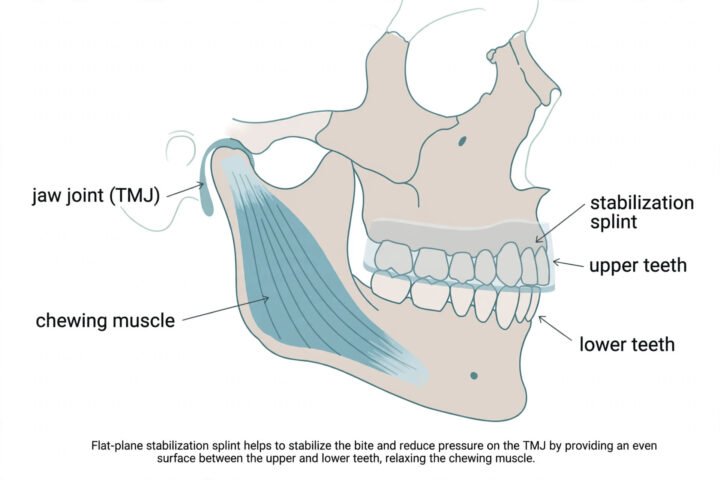
Two features define a well-made splint. First, it is reversible: when you take it out, your bite is unchanged. The NIDCR specifically cautions against treatments that permanently change the bite, and a splint should never be designed to do that. Second, it is adjustable. The dentist refines the bite contacts at the fitting appointment and again at follow-ups, because as your muscles relax, the way your jaw closes can shift slightly — and the splint has to keep up.
How long should you wear a TMJ splint each day?
For most people, the answer to how long to wear a night guard for TMJ is simple: all night, every night, for as long as you sleep. Night is when sleep bruxism — clenching and grinding you cannot consciously control — does most of its damage, so night-only wear is the standard prescription for a stabilization splint.
Some prescribers add daytime hours, especially early on. A typical pattern is nighttime wear plus a few daytime hours during the first weeks while symptoms settle, then a taper back to nights only as pain eases. Others prescribe night wear alone from the start. There is no single schedule proven best for everyone, which is why your own dentist’s plan — and the review appointments that go with it — matters more than any generic timetable. If you were not told a schedule, ask. “Wear it at night” leaves real questions unanswered: every night or only during flares? What about naps? Should you wear it while working at a desk, when many people clench without noticing?
A few practical rules apply whatever your schedule. Wear the splint for the hours prescribed, not more: more hours is not automatically better, and round-the-clock wear of an appliance that has not been reviewed raises the risk of bite changes. Take it out to eat, unless your dentist has specifically designed a plan that says otherwise. And bring it to every follow-up, even if it feels fine — the wear marks on the acrylic tell your dentist where and how hard you clench, which is diagnostic information, not just wear and tear. If your main problem is tooth wear rather than joint or muscle pain, our guide to the best night guard for jaw clenching covers materials and fit in more depth.
How long until a TMJ splint works?
Expect to judge a splint over weeks. The trials behind splint therapy did not measure results after a few nights: in the 2024 Cochrane review of occlusal interventions for TMD, the key outcomes were measured between 4.4 weeks and 4 months. A 2017 meta-analysis of stabilization splints likewise separated short-term results — where it found a benefit for pain — from long-term follow-up, where the difference between splints and other treatments faded.
In practical terms, the first one to two weeks are mostly adaptation: getting used to the bulk, the extra saliva, and a new nighttime routine. If a splint is going to help your pain, the change people usually report first is quieter mornings — less jaw stiffness and soreness on waking — before daytime symptoms shift. By a follow-up at roughly a month, you and your dentist should be able to say whether the trend is positive, flat, or worse, and adjust the splint, the schedule, or the plan accordingly.
What a splint will not do is work on a deadline it cannot meet. It does not stop the clenching itself — your muscles may still clench against it while it protects your teeth — and it does not correct the drivers behind the clenching, such as stress, poor sleep, or daytime habits. If nothing has changed after several weeks of faithful wear and at least one adjustment visit, that is useful information, not a personal failure: it means the diagnosis or the treatment mix needs another look.
Is pain normal when you start wearing a splint?
Some early sensations are common and usually settle within the first week or so: awareness of the appliance, a feeling of bulk, extra saliva (many new wearers notice drooling at first, because the mouth treats the splint as something to flush out), and brief stiffness when you take it out in the morning that eases as you start moving your jaw.
Pain is different. The NIDCR’s guardrail is plain: if an appliance causes pain, stop using it and consult your dentist or doctor. New tooth pain, pain that is worse than the pain you started with, jaw pain that lingers well after the splint comes out, or a bite that starts to feel “off” — teeth meeting differently than they used to — are not things to push through. They usually mean the fit or the bite contacts need adjustment, and occasionally that a splint is the wrong tool for your particular TMD. An adjustment visit is a normal part of splint therapy, not an admission that something went wrong; what matters is that you report the symptom instead of quietly abandoning the splint in a drawer, or quietly enduring it.
What does the evidence say about splint therapy?
Honestly stated: modest and unsettled. The 2024 Cochrane review included 57 studies with 2,846 participants, most of them testing full hard stabilization splints. It judged only one study to be at low risk of bias and rated the certainty of the evidence as very low for every comparison. A hard stabilization splint may reduce muscle pain when chewing compared with no treatment, but the reviewers concluded the evidence is insufficient to reach firm conclusions about effectiveness.
The 2017 meta-analysis in PLOS ONE, covering 33 randomized trials, found a short-term benefit: stabilization splints improved pain reduction (odds ratio 2.08) and pain intensity compared with control treatments, with the clearest effects in muscle-origin TMD. In long-term follow-up, however, outcomes equalized with other treatments, and the quality of evidence for the main outcomes was low.
That pattern — possible short-term help, uncertain long-term advantage — is why guidelines frame splints as one reversible part of conservative care, alongside education, jaw rest during flares, heat or cold, gentle exercise, and habit change, rather than as a stand-alone cure. It is also why, when pain is chronic, other approaches may rank ahead of a splint: our comparison of physical therapy vs. splint vs. Botox for TMJ walks through how those options stack up in the trial evidence.
How can you give your splint the best chance of helping?
Most splint problems are schedule, fit, or follow-through problems. This summary pulls the article’s main points together:
| Question | Usual answer | Watch out for |
|---|---|---|
| How many hours a day? | All night, every night; some prescribers add daytime hours early on, then taper | Wearing it far beyond the prescribed hours without review |
| How long until it helps? | Judge over weeks; trials measured outcomes at 4.4 weeks to 4 months | Expecting a verdict after two or three nights |
| Is early soreness normal? | Mild awareness, extra saliva, and brief morning stiffness can settle in the first week or so | New or worsening pain — stop and call your dentist (NIDCR) |
| How long does therapy last? | Reviewed at follow-ups and adjusted; many plans reassess after the first months | Wearing the same unreviewed splint for years |
| Can it change my bite? | A reviewed full-coverage splint is designed not to; it is reversible by design | A bite that feels different after removal — report it promptly |
Beyond the table: keep the splint clean (rinse it, brush it gently, let it dry in its vented case), keep it away from heat that can warp acrylic, and store it where a pet cannot reach it. Track your mornings for the first month — a simple note of jaw stiffness or headache on waking gives your follow-up visit real data instead of a vague impression. And keep doing the unglamorous parts of conservative care: softer foods during a flare, no gum chewing, and attention to daytime clenching, because the splint only covers the hours it is in your mouth.
When should you stop and call your dentist?
Stop wearing the splint and call promptly if you notice any of the following: pain that is new, or clearly worse than before the splint; a single tooth that hurts or feels high when you close; a bite that feels different and stays different after the splint comes out; a jaw that locks open or closed, or opening that becomes limited; a cracked, broken, or suddenly loose splint; or sores on your gums or cheeks that do not settle within a few days. Each of these has a mechanical fix or a diagnostic implication your dentist needs to see in person.
Seek care urgently for jaw symptoms with a different character — a jaw that will not close after yawning, facial swelling, fever, or pain after a blow to the face — because those point away from routine splint adjustment and toward problems that need same-day assessment.
Frequently asked questions
How long do you wear a TMJ splint each day?
Most people wear a TMJ splint all night, every night, for as long as they sleep — that is the standard schedule for TMJ splint therapy, because clenching and grinding do most damage during sleep. Some dentists add a few daytime hours for the first weeks and then taper to nights only. Follow the schedule you were prescribed, and ask if you were never given one.
Why does my night guard make me drool?
Extra saliva is a common early reaction: your mouth initially treats the splint as a foreign object — or food — and produces more saliva to flush it out. For most wearers this settles over the first week or two of nightly use as the mouth adapts. Drooling that persists, or that comes with soreness or a poor fit, is worth mentioning at your follow-up so the fit can be checked.
Can a TMJ splint be permanent?
No — a splint is a removable, reversible appliance, and that is a deliberate safety feature. The NIDCR cautions against treatments designed to permanently change your bite, and a “permanent splint” that is bonded in place or worn indefinitely without review works against that principle. If a plan involves permanently altering your teeth or bite, ask what evidence supports it and consider a second opinion before agreeing.
How much does a TMJ splint cost?
Costs vary widely by region, by whether the appliance is custom-made in a lab or fitted from a simpler design, and by what your insurance covers, so any single figure would mislead. What you can do is ask for the full picture before treatment: the appliance fee, whether fitting and adjustment visits are included, and what a replacement would cost. Those follow-up visits are part of the therapy, not an optional extra.
Conclusion
The short answer to how long to wear a night guard for TMJ is: all night, every night, on the schedule your prescriber set — with daytime hours only if they are part of your plan. Give it weeks, not nights, before judging it: the trials behind splint therapy measured outcomes from about a month to four months, and they found possible short-term pain relief with very low certainty overall. Treat mild early awareness and extra saliva as settling-in, but treat pain as information: the NIDCR’s rule — stop an appliance that causes pain and get it checked — protects both your teeth and your bite.
A splint works best as a reviewed, adjustable part of conservative care, not as a device you wear unexamined for years. Wear it as prescribed, bring it to every follow-up, report changes early, and let the evidence trend — quieter mornings, less pain, better function — decide whether it stays in your plan.
Medical disclaimer: This article is for educational purposes only and is not medical or dental advice. It is general information, not a diagnosis or a recommendation for any individual. Discuss jaw pain, clenching, tooth wear, or bite changes with your own dentist or clinician, and stop using any appliance that causes pain until it has been checked.
Sources
- National Institute of Dental and Craniofacial Research (NIDCR) — Temporomandibular Disorders (TMD): conservative care first; an appliance should not permanently change the bite, and should be stopped if it causes pain — nidcr.nih.gov/health-info/tmj
- Singh BP et al. — Occlusal interventions for managing temporomandibular disorders, Cochrane Database of Systematic Reviews, 2024 (57 studies, 2,846 participants; very low certainty for all comparisons; outcomes measured between 4.4 weeks and 4 months) — cochrane.org
- Kuzmanovic Pficer J et al. — Occlusal stabilization splint for patients with temporomandibular disorders: meta-analysis of short and long term effects, PLOS ONE, 2017 (33 randomized trials; short-term pain benefit, long-term outcomes equalized, low quality of evidence) — pmc.ncbi.nlm.nih.gov/articles/PMC5293221




0 Comments