
Educational information · Not medical advice
In brief
Botox for TMJ how many units, what it costs per session in 2026, and will insurance pay? Units, price math, duration, and questions to ask your clinician.
In this article
- Botox for TMJ: how many units do people usually need?
- What does Botox for TMJ cost per session?
- How long does TMJ Botox last, and what is the yearly cost?
- Will insurance pay for Botox for TMJ?
- What affects the price you are quoted?
- What are the risks and limits to weigh against the cost?
- Frequently asked questions
- Conclusion
- Sources
Key Takeaways
- When people ask about botox for tmj how many units they will need, the honest range from studies and clinics is wide: trials used 10 to 75 units per muscle, and many clinics start around 20 to 30 units per masseter.
- Price follows units. U.S. clinics commonly quote roughly $400 to $1,200 per session for masseter treatment, with higher totals when the temporalis is also treated.
- Effects typically fade after 3 to 6 months, so the real question is the yearly cost of repeat sessions, not one session alone.
- Botox is not FDA-approved for temporomandibular disorders (TMD) or bruxism, so most insurance plans do not pay. Coverage, when it happens, is usually through a medical plan with prior authorization — get it in writing first.
If you are pricing this treatment, you are really asking three linked questions: for botox for tmj how many units will you need, what will those units cost per session, and will insurance pay any of it? This article answers all three with the ranges studies and U.S. clinics actually report, and it is frank about the limits: there is no approved dosing table, prices vary widely, and coverage is the exception, not the rule.
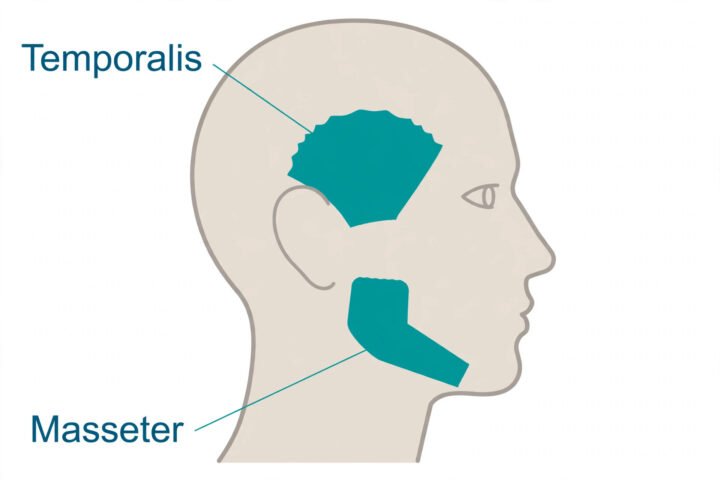
First, the names. Botox is a brand name for onabotulinumtoxinA, a botulinum toxin type A product. TMJ is the temporomandibular joint in front of each ear; TMD means temporomandibular disorder, the group of conditions affecting the jaw joint and the muscles that move it. Injected into the masseter — the large chewing muscle at the angle of the jaw — and sometimes the temporalis at the temple, the toxin temporarily weakens those muscles. For the evidence behind that idea, and who it may or may not suit, see our earlier guide to Botox for TMJ and what the evidence actually says.
Botox for TMJ: how many units do people usually need?
There is no FDA-approved dose for this use, so there is no official answer to the botox for tmj how many units question. What exists is a range from research and from clinical practice, and the two overlap but do not match exactly.
In research, a 2024 systematic review in the Balkan Journal of Dental Medicine looked at 47 clinical studies from 2000 to 2024 of botulinum toxin for TMD, myofascial pain, and bruxism. Injections mostly targeted the masseter and temporalis muscles, at doses ranging from 10 to 75 international units (IU) per muscle. Individual randomized trials of sleep bruxism have used protocols such as 10, 25, or 30 units in each masseter. A separate systematic review and meta-analysis of randomized trials for muscular TMD reported that a higher bilateral dose, 60 to 100 units in total, was associated with greater pain reduction at six months — but that is a finding about groups in trials, not a prescription for any one person.
In clinics, many providers describe a common starting point of around 20 to 30 units of onabotulinumtoxinA per masseter for an average adult, with higher doses for larger, stronger muscles and heavy clenchers, and lower, more conservative doses at a first visit. Treating the temporalis as well adds more units. Two cautions matter here. First, units are not interchangeable between products: a dose quoted for Botox does not translate directly to Dysport (abobotulinumtoxinA) or Xeomin (incobotulinumtoxinA). Second, more units is not automatically better — dose should follow muscle size, symptoms, and a clinician’s examination, not a menu.
10 to 75 units per muscle — the dose range used across 47 clinical studies reviewed in 2024. That spread is exactly why a quote without an examination, and without naming the muscles to be treated, tells you very little.
What does Botox for TMJ cost per session?
Most U.S. providers price by the unit, so the session price is unit price multiplied by total units, sometimes plus a consultation or injection fee. Published U.S. clinic pricing reviewed for this article commonly puts Botox at about $10 to $15 per unit in many markets, with wider ranges in premium urban clinics, and puts a typical masseter session at roughly $400 to $1,200. Some clinics quote a broader $300 to $1,500 range when the temporalis is included or doses are high.
| Plan | Typical total units | Illustrative cost at $10–$15/unit |
|---|---|---|
| Conservative first visit, masseters only | 30–40 units | $300–$600 |
| Standard masseter treatment | 40–60 units | $400–$900 |
| Strong clenching, larger masseters | 60–100 units | $600–$1,500 |
| Masseters plus temporalis | Add roughly 20–50 units | Add roughly $200–$750 |
Read that table as arithmetic, not as a quote. Your price depends on the product used, the muscles treated, your city, and who injects — an oral surgeon, a dentist, a dermatologist, or a med spa may all price differently. Always ask for the total in writing: how many units, in which muscles, at what per-unit price, and whether follow-up or touch-up visits cost extra. If a quote for botox for tmj how many units are included is vague, that is a reason to pause, not to book.
How long does TMJ Botox last, and what is the yearly cost?
Reviews comparing botulinum toxin with splint therapy for bruxism describe onset in 1 to 2 weeks, peak effect after 4 to 6 weeks, and benefit decreasing after 3 to 6 months. Clinics generally give the same 3-to-6-month window. That temporary effect is the central cost fact: a $700 session repeated three times a year is a $2,100-a-year commitment, for as long as you keep repeating it.
Compare that with one-time or longer-lived options before you decide. A custom splint has an up-front cost but is not re-bought every few months, and physical therapy is a course of visits rather than an indefinite subscription. Our comparison of physical therapy vs splint vs Botox for TMJ lays out how the evidence and the effort differ, and our guide to a TMJ splint vs a night guard explains what a guard does and does not do. For some people, medicines are part of the discussion instead — see muscle relaxers for TMJ, compared.

Will insurance pay for Botox for TMJ?
Usually, no — and you should budget on that assumption. Botox for TMJ is off-label: the FDA has not approved it for TMD or bruxism. The U.S. National Institute of Dental and Craniofacial Research (NIDCR) notes that researchers do not have conclusive evidence that botulinum toxin type A injections into the chewing muscles help with TMDs, which is one reason many insurers classify the treatment as experimental or elective for this use.
Coverage, when it happens, almost always runs through a medical plan, not a dental plan, and usually requires prior authorization before treatment. Insurer policies that do consider it typically demand documentation: a clear diagnosis of muscle-related pain or painful bruxism, and records showing that conservative care — for example a night guard and medication — was tried and did not help enough. Approval is the insurer’s decision, it is plan-specific, and being treated first and filing later is a common reason for denial. If cost depends on coverage, get the authorization in writing before the appointment, and ask which diagnosis and procedure codes the clinic will submit.
One separate case is worth naming: Botox does have an FDA-approved protocol for chronic migraine. If you have chronic migraine as well as jaw pain, that is a different treatment, with different dosing and different coverage rules, prescribed for the migraine — not a back door to coverage for jaw injections. Discuss it with your clinician on its own merits.
What affects the price you are quoted?
Five things drive most of the variation. First, total units, which follow muscle size and whether the temporalis is treated. Second, the product: different botulinum toxin products are dosed in different, non-interchangeable units and priced differently, so compare total treatment prices, not unit prices alone. Third, geography: per-unit prices are higher in premium urban markets than in smaller ones. Fourth, the provider’s training and setting. Fifth, what is bundled: some quotes include consultation and review visits, others add them.
A practical way to compare two quotes is to ask each clinic the same four questions: How many units, in which muscles? Which product? What is the all-in total today? And what will the likely repeat cost be in four to six months? Those answers make the botox for tmj how many units and how much discussion concrete, and they expose a low headline price that quietly assumes very few units.
What are the risks and limits to weigh against the cost?
Paying more does not remove the limits of the treatment itself. The evidence is mixed: the 2024 review of 47 studies reported pain relief in many included studies, while a 2024 pooled analysis of placebo-controlled trials found no significant advantage over placebo and called for higher-quality trials. NIDCR’s position remains that benefit is not conclusively shown. Botox also does nothing for problems inside the joint itself, such as a displaced disc or arthritis — it acts on muscle only.
Reported adverse effects in studies were generally mild and temporary, including transient muscle weakness or atrophy that resolved within months, and possible chewing weakness or smile asymmetry in clinical practice. The FDA prescribing information carries a boxed warning that botulinum toxin effects can spread beyond the injection site, in rare cases causing serious swallowing or breathing problems hours to weeks after injection. It is also generally avoided in pregnancy and breastfeeding and in certain neuromuscular conditions. A clinician should go through these points, and the alternatives, before you pay for a first session.
Frequently asked questions
For Botox for TMJ, how many units do most people get?
There is no approved dose. Trials used 10 to 75 units per muscle, and many clinics start around 20 to 30 units per masseter, so 40 to 60 units in total for both sides is a common starting range. Larger muscles, strong clenching, or adding the temporalis raises the total. Your dose should be set after an examination, not from a price list.
How much does Botox for TMJ cost in 2026?
Published U.S. clinic pricing commonly puts a masseter session at roughly $400 to $1,200, priced at about $10 to $15 per unit in many markets. Conservative first treatments can cost less, and large doses or temporalis treatment can push the total toward $1,500. Because effects last 3 to 6 months, multiply the session price by two to four for a realistic yearly figure.
Does insurance cover Botox for TMJ?
Most plans do not, because the use is off-label and the evidence is not conclusive. When coverage does occur, it is usually through a medical plan, with prior authorization, a documented muscle-related diagnosis, and records that a guard and medication were tried first. Dental plans rarely cover the injections. Get any approval in writing before treatment rather than filing afterwards and hoping.
Is a cheaper per-unit price a better deal?
Not necessarily. A low per-unit price with a high unit count can cost more than a higher per-unit price with a conservative dose, and different botulinum toxin products use non-interchangeable units, so per-unit prices are not directly comparable across products. Compare the all-in total for a named product, named muscles, and a stated unit count — and ask what the repeat session will cost.
Conclusion
So, for botox for tmj how many units and how much money are we really talking about? For most adults who proceed, think in terms of roughly 40 to 60 units in the masseters as a common starting range, roughly $400 to $1,200 per session at typical U.S. prices, repeated every 3 to 6 months, and usually paid out of pocket. Those are ranges to plan with, not promises: your muscles, your city, and your clinician’s judgment set the real numbers.
If the yearly cost gives you pause, that pause is useful. Conservative care — a well-made guard, physical therapy, habit changes, and time — remains the recommended starting point, and Botox, if it is used at all, is best framed as an add-on for selected muscle-driven cases after those steps. Bring written quotes, the unit counts behind them, and your insurance answer in writing to that conversation, and decide with full numbers in front of you.
Medical disclaimer: This article is educational information only and is not medical advice. It does not diagnose or prescribe. Discuss your symptoms, treatment options, risks, and costs with your dentist, doctor, or orofacial pain specialist.
Sources
- Botulinum toxin A as a treatment for temporomandibular disorders: a systematic review (47 clinical studies, 2000–2024), Balkan Journal of Dental Medicine, 2024 — ouci.dntb.gov.ua
- National Institute of Dental and Craniofacial Research (NIDCR): Summary of Treatment for Temporomandibular Disorders — botulinum toxin injections not listed because evidence is not conclusive — nidcr.nih.gov
- Effect of botulinum toxin type A on muscular temporomandibular disorder: a systematic review and meta-analysis of randomized controlled trials, Journal of Oral Rehabilitation, 2023 — bilateral 60–100 units associated with greater pain reduction at 6 months.
- U.S. clinic pricing pages reviewed 2026-11-17 for per-unit and per-session ranges (clinic guides in New Jersey, Florida, California, and national cost guides): typical $10–$15 per unit in many markets; masseter sessions commonly $400–$1,200.





0 Comments