
Educational information · Not medical advice
In brief
Morning sunlight circadian rhythm reset: how much light you need, outdoors vs a light box, a 5-day shift plan, and the evening rules that protect it daily.
In this article
- Why does morning light set your body clock?
- How much morning light do you actually need?
- Is outdoor light or a light box better?
- How do you shift a late schedule earlier in 5 days?
- What should your evenings look like while you reset?
- What mistakes undo morning light?
- When should you get help for a broken sleep schedule?
- Frequently asked questions
- Conclusion
- Sources
Key Takeaways
- Light is the strongest signal that resets your sleep-wake cycle, according to the NHLBI — and morning light moves the clock earlier, while evening light moves it later.
- The morning sunlight circadian rhythm effect depends on timing first: get bright light soon after you wake, at the same time every day.
- In one trial, a single 30-minute morning bright-light exposure produced about 75% of the phase advance of a 2-hour pattern — in a protocol that combined the light with afternoon melatonin and a gradually advancing sleep schedule.
- Shift gradually: move wake time, light, and bedtime earlier in small steps over several days instead of forcing a two-hour jump in one night.
- Protect the shift at night: dim lights and screens in the evening, because artificial light can lower melatonin and make it harder to fall asleep.
If your sleep schedule has drifted late — falling asleep at 1 or 2 AM, struggling to wake, feeling alert at exactly the wrong hour — the problem is often timing, not effort. The morning sunlight circadian rhythm connection explains why: light reaching your eyes in the morning is the main signal that tells your body clock what time it is, and a clock that never gets a clear morning signal tends to drift later each day.
This article explains how morning sunlight circadian rhythm resetting works, how much light you need, whether outdoor light or a light box is the better tool, and a 5-day plan for shifting a late schedule earlier. If your problem is waking in the night rather than falling asleep late, our guide to why you wake up at 3 AM covers that pattern, and our explainer on what CBT-I is covers the first-line therapy for chronic insomnia.
Why does morning light set your body clock?
Your body runs on a circadian rhythm — a roughly 24-hour cycle that times sleep, alertness, hormone release, and body temperature. That cycle does not keep perfect time on its own, so it needs a daily reset signal. The National Heart, Lung, and Blood Institute (NHLBI, part of the NIH) puts it plainly: light is the strongest signal in the environment to help reset your sleep-wake cycle.
Timing decides the direction of the reset. Light in the morning pulls the clock earlier, so sleepiness arrives earlier that night and waking gets easier. Light late in the day pushes the clock later. The NHLBI describes the same rule for light therapy: to move sleep and wake times earlier, use bright light when you wake up in the morning — a method used for delayed sleep-wake phase disorder — and to move them later, use light late in the afternoon or early in the evening.
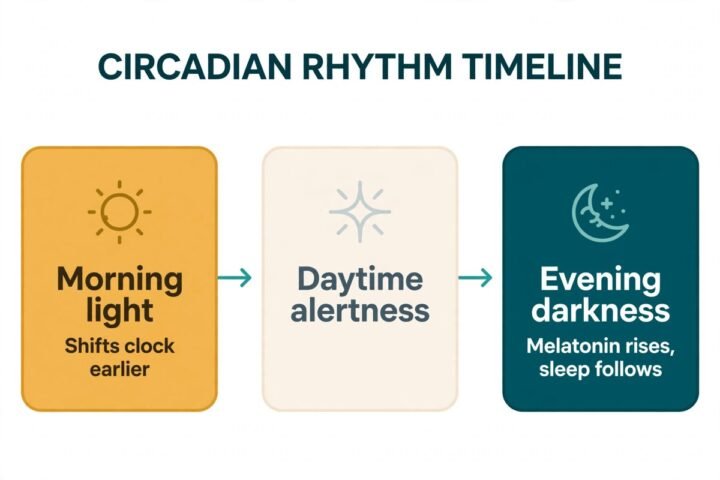
Melatonin is the other half of the signal. Your brain releases melatonin in response to darkness, and evening levels help set up sleep. The NHLBI notes that artificial light at night can lower melatonin levels, making it harder to fall asleep. That is why a morning sunlight circadian rhythm routine is really a pair of habits: bright light early, and dimmer light late. One without the other is half a signal. Our article on melatonin for sleep explains how that timing signal works in more detail.
How much morning light do you actually need?
Less than many people fear — if the timing is right. In a study by Crowley and Eastman published in Sleep Medicine in 2015, 50 adults advanced their sleep schedule by 1 hour a day for 3 days while using morning bright light from a light box at about 5,000 lux. A single 30-minute exposure each morning produced a phase advance of 1.8 hours — about 75% of the 2.4-hour advance from a 2-hour intermittent pattern, and as much as a 1-hour pattern spread over more than 3 hours.
One detail matters before you copy the dose: every participant in that trial also took 0.5 mg of melatonin in the afternoon — 5 hours before their baseline bedtime on the first treatment day, and an hour earlier on each day after. The authors' own conclusion is that a 30-minute morning bright-light exposure with afternoon melatonin is an efficient way to advance circadian rhythms. So the 1.8-hour shift belongs to the combination — light, timed melatonin, and the advancing schedule together — not to light alone, and a light-only routine should be expected to move more slowly.
About 30 minutes
In Crowley and Eastman (2015), one 30-minute morning bright-light exposure at about 5,000 lux, combined with afternoon melatonin and a gradually advancing sleep schedule, shifted the body clock 1.8 hours earlier over 3 days — 75% of the shift from a 2-hour light pattern in the same combined protocol.
Outdoor daylight is a powerful version of the same signal: even on an overcast day it reaches 5,000–20,000 lux, and the practical light-therapy guide cited in the Sources below notes that 30 or more minutes outdoors in the right window is often as effective as a light box. That is why a walk outside soon after waking is the simplest version of this routine. The practical rules that matter most are consistency and timing: get the light soon after you wake, at roughly the same time every day, including weekends. A huge dose at noon does less for a late schedule than a modest dose at wake time, because noon light lands in the middle of the clock's day, where it shifts timing very little. That timing rule is the core of the morning sunlight circadian rhythm effect: the same light helps or does nothing depending on when it arrives.
Is outdoor light or a light box better?
For most people, outdoor light is the first choice: it is free, it is bright, and pairing it with a short walk adds daytime physical activity, which the NHLBI also recommends — during the day, not close to bedtime. A light box becomes useful when your wake time comes before sunrise, in dark winter months, or when weather or work keeps you indoors. The NHLBI describes light therapy as planned time each day sitting in front of a light box that produces bright light similar to sunlight, with light visors and light glasses as alternatives.
| Option | How it works | Best for | Watch out for |
|---|---|---|---|
| Outdoor morning light | Daylight soon after waking; 5,000–20,000 lux even on an overcast day, per the light-therapy guide cited below | Most people resetting a late schedule | Easy to skip on dark or rainy mornings |
| Light box | Scheduled daily session in front of a bright lamp, similar to sunlight | Waking before sunrise, winter, indoor work | Side effects can include eye strain, headache, agitation, and nausea; ask a doctor first with an eye condition or light-sensitive medicines |
| Ordinary indoor light | Room lighting at home or work, typically only 100–500 lux | Support on days you cannot get outside | Orders of magnitude dimmer than daylight; too dim to reliably shift a late clock on its own |
Whichever source you use, do not stare directly at a light box, and treat dose claims on packaging with care: what matters is the brightness reaching your eyes at the distance you actually sit. If you use a light box and notice eye strain, headache, or agitation, that is a reason to stop and discuss it with a clinician, not to push through — those are the side effects the NHLBI lists for light therapy.
How do you shift a late schedule earlier in 5 days?
The trial evidence points to gradual steps, not a single heroic night. In Crowley and Eastman's study, sleep and wake times advanced by 1 hour a day for 3 days alongside morning light and afternoon melatonin — a supervised, combined protocol. The plan below adapts the light-and-schedule parts for home use, with smaller steps; without the melatonin component, expect it to work more slowly than the trial, and discuss adding timed melatonin with a clinician rather than improvising it. Here is a 5-day version built on the same principles:
- Day 1 — anchor the wake time. Pick a wake time 30 minutes earlier than your current one and get bright light within the first part of the morning, outdoors if you can. Keep that wake time fixed from now on, even after a rough night.
- Day 2 — add the evening half. Keep the morning light, and dim household lights and screens in the last part of the evening. The NHLBI suggests dim lighting for a period before bed can help reduce circadian symptoms.
- Day 3 — move bedtime to match. Go to bed 30 minutes earlier, but only when sleepy. Lying awake in bed trains frustration, not sleep; our guide to how long a nap should be covers the related daytime rule — keep naps short and early while you reset.
- Day 4 — repeat the step. Move wake time, morning light, and bedtime another 30 minutes earlier, if the first step has started to hold and you are falling asleep at the new bedtime.
- Day 5 — hold and consolidate. Stop advancing for a few days. Keep the fixed wake time, the morning light, and the dim evening exactly the same, including on days off, while the new schedule settles.
Two supports make the plan work better. Keep a regular meal schedule — the NHLBI recommends it as part of resetting a sleep-wake cycle — and limit caffeine, alcohol, and nicotine close to bedtime, which can fragment the sleep you are trying to move. If you clench your jaw at night, a shifting schedule can temporarily worsen morning jaw soreness; our article on why you clench your jaw at night covers that overlap.
What should your evenings look like while you reset?
Evenings are where most resets quietly fail. You can do everything right at 7 AM and undo it at 10 PM with bright overhead lights and a bright screen, because evening light tells the clock the day is still going and can lower melatonin. The NHLBI's advice is practical: get less artificial light at night from TVs and electronic devices, use light-blocking glasses, screen filters, or apps to dim devices if that helps, and keep lighting dim for a period before bed.

A workable evening looks boring on purpose: overhead lights off or dimmed an hour or two before bed, a lamp instead, screens dimmed, and a regular bedtime routine in a cool, quiet room. The NHLBI recommends a relaxing bedtime routine and regular sleep and waking times to help you fall asleep faster and stay asleep longer. Think of the evening as protecting the morning's work — the morning sunlight circadian rhythm signal sets the clock, and the dim evening stops anything from setting it back.
What mistakes undo morning light?
Chasing light at the wrong time. A bright session at midday or in the evening does not advance a late clock the way morning light does, and evening light actively delays it. When in doubt, anchor light to your wake time, not to the clock on the wall.
Sleeping in on weekends. Two late mornings can hand back most of a week's progress, because the clock follows the latest strong signal. Keep wake time steady while you reset; you can relax it slightly once the new schedule is stable.
Jumping too far, too fast. Forcing a two-hour-earlier bedtime when you are not sleepy usually means two hours of lying awake, which teaches your brain that bed means wakefulness. Small steps that hold beat big steps that collapse.
Treating light as the whole treatment. Morning light resets timing; it does not treat sleep apnea, chronic insomnia, pain, or the caffeine and alcohol habits that fragment sleep. If those are present, light alone will disappoint — which is information, not failure.
When should you get help for a broken sleep schedule?
Book an appointment if a late or broken schedule persists despite two to three consistent weeks of morning light and dim evenings, or if it is affecting work, mood, or safety — including drowsy driving. A clinician can check for delayed sleep-wake phase disorder and for conditions that mimic a timing problem.
Get assessed promptly if you have loud snoring with witnessed pauses in breathing, waking gasping or choking, or severe daytime sleepiness. That cluster points to sleep apnea, which needs a sleep study rather than a light routine. Also ask a doctor before using a light box if you have an eye condition or take medicines that make you sensitive to light — the NHLBI flags both — and mention any history of bipolar disorder, since bright light can trigger hypomania or mania in susceptible people and should be used only under psychiatric supervision in that situation. A sleep diary for a week or two, noting wake time, light, bedtime, caffeine, and alcohol, makes that appointment far more productive.
Frequently asked questions
How long does it take morning light to reset your body clock?
Expect gradual change over days, not one night. In the Crowley and Eastman trial, three days of morning bright light with afternoon melatonin and a schedule advancing one hour a day shifted the clock up to about two hours earlier. At home, smaller light-and-schedule steps are more sustainable: many people notice earlier sleepiness within the first week if wake time, morning light, and dim evenings stay consistent.
Can morning sunlight replace a light box?
Often, yes. Even on an overcast day, outdoor daylight reaches about 5,000–20,000 lux, and a practical light-therapy guide notes that 30 or more minutes outdoors in the right window is often as effective as a light box. A box earns its place when you wake before sunrise, in dark winter months, or when you cannot get outside in the morning. What matters most is brightness reaching your eyes soon after waking, from either source.
What if I wake up before sunrise?
Use indoor light strategically: turn on bright household lights when you wake, consider a light box, and then get outdoor light once the sun is up. Do not wait in dim light until sunrise, because that delays your morning signal by hours. Keep the same wake time daily, and ask a clinician before light-box use if you have an eye condition or take light-sensitive medicines.
Does morning light help if you wake at 3 AM?
It can help stabilise the overall rhythm, but waking at 3 AM is usually a sleep-maintenance problem rather than a late-clock problem, with causes such as alcohol, caffeine, stress, pain, or sleep apnea. Morning light is a reasonable support, not the main fix. If the pattern happens at least three nights a week for three months, ask about CBT-I, the first-line insomnia treatment.
Conclusion
A broken sleep schedule is usually a clock that has lost its daily reset signal. Restoring the morning sunlight circadian rhythm routine — bright light soon after a fixed wake time, a gradual shift in small steps, and a dim, screen-light evening — gives the clock the two clearest signals it uses: light early, darkness late.
Give the plan consistent weeks, not perfect days, and judge it by whether sleepiness is arriving earlier and mornings are getting easier. If it is not working, or if snoring, gasping, or heavy daytime sleepiness are part of your picture, get assessed — a timing routine cannot treat sleep apnea or chronic insomnia on its own, and both have effective treatments once they are named.
Medical disclaimer: This article is educational information only and is not medical advice. It does not diagnose or prescribe. Discuss your symptoms, treatment options, and risks with your doctor or sleep clinician.
Sources
- National Heart, Lung, and Blood Institute (NHLBI), NIH. Circadian Rhythm Disorders — Treatment — light is the strongest signal to reset the sleep-wake cycle; morning light-box use to move sleep earlier (delayed sleep-wake phase disorder); evening light to move it later; artificial light at night can lower melatonin; dim lighting before bed; light-therapy side effects (agitation, eye strain, headaches, migraines, nausea) and the eye-condition / light-sensitive-medicine caution; regular meal schedule, daytime activity, and limiting caffeine, alcohol, and nicotine near bedtime.
- Crowley SJ, Eastman CI. Phase advancing human circadian rhythms with morning bright light, afternoon melatonin, and gradually shifted sleep: can we reduce morning bright light duration? Sleep Medicine, 2015 (PMC4344919) — 50 adults; sleep advanced 1 hour/day for 3 days; every participant also took 0.5 mg melatonin in the afternoon (5 hours before baseline bedtime on day 1, an hour earlier each day); a single 30-minute morning exposure at about 5,000 lux, with that melatonin and schedule, produced a 1.8-hour phase advance, about 75% of the 2.4-hour advance from the 2-hour pattern.
- Better Sleep Project. Light Therapy for Circadian Rhythm Disorders: A Practical Guide — outdoor daylight is 5,000–20,000 lux even on an overcast day; ordinary indoor lighting is typically 100–500 lux; midday is a phase-shifting dead zone; the standard light-box session is 30 minutes at 10,000 lux; bright light can trigger hypomania or mania in bipolar disorder and should be used only under psychiatric supervision in that situation.
- National Heart, Lung, and Blood Institute (NHLBI), NIH. Insomnia — Diagnosis — insomnia may be diagnosed at difficulty falling or staying asleep at least 3 nights a week, and is chronic at 3 or more nights a week for 3 months or longer; keep a sleep diary for 1 to 2 weeks before seeing a doctor; clinicians ask about loud snoring and waking gasping, and a sleep study looks for sleep apnea and circadian rhythm disorders.
- Qaseem A, et al. Management of Chronic Insomnia Disorder in Adults: A Clinical Practice Guideline From the American College of Physicians. Annals of Internal Medicine, 2016 — CBT-I recommended as the initial treatment for all adults with chronic insomnia (as reviewed in full in our CBT-I explainer, linked above).





0 Comments