Educational information · Not medical advice
In brief
Best pillow for tmj side sleeper setup: fill the shoulder gap, keep your head level, and compare back, side and stomach positions for morning jaw pain.
In this article
- Why does your sleeping position matter for TMJ?
- What is the best sleeping position for TMJ?
- How should side sleepers set up their pillow?
- How should back sleepers set up their pillow?
- Why is stomach sleeping the hardest on your jaw?
- What should you look for in a pillow for TMJ?
- When is morning jaw pain not just your pillow?
- Frequently asked questions
- Conclusion
- Sources
Key Takeaways
- There is little direct research on sleeping positions for TMJ, so treat position as a low-risk comfort test, not a proven treatment.
- Back sleeping keeps pressure off both jaw joints. Side sleeping can work if the pillow fills the shoulder gap and keeps your head level.
- The best pillow for tmj side sleeper use is not the softest or the most expensive — it is the one that keeps your nose in line with your breastbone and your jaw off the pillow edge.
- Stomach sleeping turns your head to one side for hours and presses one jaw joint into the mattress, so it is the position most worth changing.
- Back sleeping is not right for everyone: if you snore heavily or have sleep apnea, discuss position with a clinician before forcing it.
If you wake with a sore jaw on one side, a dull temple headache, or teeth that feel tired, your pillow may be part of the story. The best pillow for tmj side sleeper setups — and the best position overall — is the one that keeps your head, neck, and jaw in a neutral line for hours, without pressing one joint into the bed. This article compares back, side, and stomach sleeping honestly, explains how to set up each one, and flags the cases where morning pain needs more than a new pillow.
First, a limit worth stating plainly. There is little research that directly tests sleeping positions for temporomandibular disorders (TMD). What clinicians rely on is mechanics, comfort, and broader self-care guidance. Mayo Clinic lists changing posture and sleep position among the first self-care steps for jaw pain, alongside eating softer foods, avoiding large jaw movements, and relaxation to reduce clenching. That makes position worth testing — it does not make any position a cure.
Why does your sleeping position matter for TMJ?
TMJ is the joint in front of each ear that connects your lower jaw to your skull. TMD covers problems with that joint, the chewing muscles, and nearby tissues. During the day you can notice clenching and correct it. During sleep you cannot. If your face is pressed into a pillow, your head is turned, or your neck is bent for six to eight hours, one side of the jaw can take sustained pressure while the muscles on the other side stay stretched.
Position also interacts with clenching and grinding, called bruxism. In a small polysomnography study of people with sleep bruxism, 74% of rhythmic jaw-muscle activity events were scored in the supine (back) position, compared with 23% in the side position, even though sleeping time did not differ much between the two positions. A 2024 study of 100 adults with obstructive sleep apnea likewise found rhythmic masticatory muscle activity was significantly higher in the supine position than in non-supine positions, and was associated with sleep arousals in both. The lesson is not that back sleeping causes grinding. It is that position, arousals, and jaw activity are linked in ways that differ from person to person — which is why a one-week test of a new setup, judged by your own mornings, beats any universal rule.
Our guide to why you clench your jaw at night covers the stress, medicine, and sleep-apnea drivers behind that overnight activity in detail.
What is the best sleeping position for TMJ?
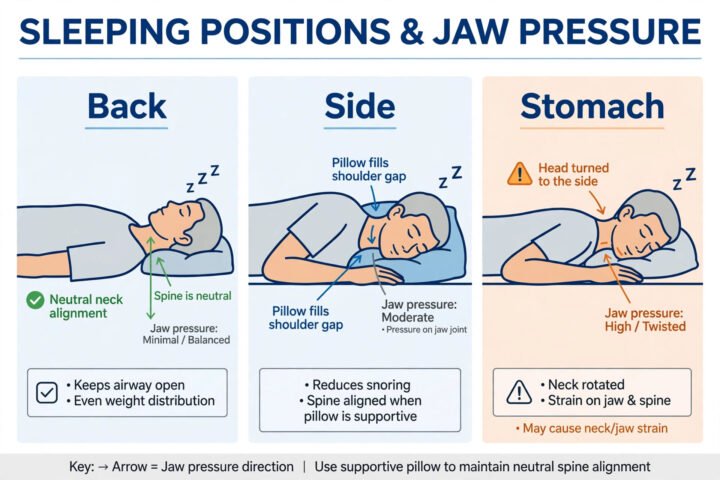
For most people with jaw pain, back sleeping is the easiest position to recommend first, because no pillow presses on either jaw joint and the head can stay centred. Side sleeping is a close second and is the position most adults actually keep, provided the pillow setup is right. Stomach sleeping is last, for mechanical reasons explained below.
About 3 in 4
In the classic sleep-laboratory study of sleep bruxism patients, about 3 in 4 jaw-muscle activity events (74%) occurred while sleeping on the back — a reminder that the position with the least pillow pressure can still be the position where clenching shows up most.
Back, side, and stomach sleeping compared for TMJ
| Position | Pressure on the jaw | Pillow goal | Main caution |
|---|---|---|---|
| Back | Lowest — no pillow against either joint | Low, supportive pillow under the neck curve | May worsen snoring or sleep apnea in some people |
| Side | Moderate — one joint faces the pillow | Firmer, higher pillow that fills the shoulder gap | Too flat or too high bends the neck sideways |
| Stomach | Highest — head turned, jaw pressed into the bed | Very flat pillow only as a harm-reduction step | Sustained neck rotation and one-sided jaw load |
That ranking is about pressure, not about clenching, and the two do not always move together — as the supine bruxism findings above show. Use the table as a starting point, then let a week of mornings judge it.
How should side sleepers set up their pillow?
Side sleeping is where pillow choice matters most, which is why searches for the best pillow for tmj side sleeper setups are really searches for the right height. Your head sits further from the mattress on your side than on your back, because your shoulder is in the way. The pillow has to fill that shoulder-to-head gap exactly. Too flat, and your head drops, bending your neck down and compressing the lower jaw joint. Too high, and your neck bends up, stretching the muscles on the lower side.
Use this setup:
- Check the line. Lying on your side, your nose should point in line with the centre of your chest, not angled down toward the mattress or up toward the ceiling.
- Keep the jaw free. Position the pillow under your head and neck, with your jaw and cheek at or just beyond the pillow edge where possible, rather than buried in the middle of it.
- Do not sleep on your hand. A hand or arm under the cheek or jaw pushes the jaw sideways for hours. Healthwise care instructions for TMD specifically list not sleeping on your stomach, and clinical self-care advice consistently warns against resting the jaw on a hand.
- Hug a second pillow. A body pillow or a pillow in front of your chest stops the top shoulder rolling forward and dragging your chin down.
- Test the other side. If you always wake sore on the side you sleep on, try favouring the opposite side for a week before concluding the joint itself is the problem. Our earlier guide to the best sleeping position for TMJ ear pain makes the same point for ear symptoms.
So what is the best pillow for tmj side sleeper use in practice? A medium-firm to firm pillow, high enough to fill your specific shoulder gap, that holds its shape through the night instead of collapsing flat by 3 AM. Contour pillows with a raised edge can help some side sleepers keep that line, but no specific design has good trial evidence behind it for TMD — fit to your body is the test, not the label on the box.
How should back sleepers set up their pillow?
Back sleeping removes pillow pressure from the jaw, but a bad pillow can still spoil it. A pillow that is too high pushes your chin toward your chest and holds the jaw and neck muscles in flexion all night. One that is too flat lets your head fall back and your jaw drop open, which can leave the mouth dry and the jaw muscles working to close it.

Aim for a lower, supportive pillow that fills the curve of your neck while your forehead and chin stay roughly level. A small rolled towel inside the pillowcase, under the neck curve, is a cheap way to test contour support before buying anything. A thin pillow under your knees can make staying on your back more comfortable by easing lower-back tension.
Two cautions belong here. First, staying on your back is hard for natural side and stomach sleepers; pillows placed on either side can act as soft boundaries, but expect an adjustment period of a week or two. Second, back sleeping can worsen snoring and obstructive sleep apnea, because gravity lets the tongue and soft palate fall back. If you snore loudly, have witnessed pauses in breathing, or wake unrefreshed with heavy daytime sleepiness, do not force back sleeping as a jaw fix — get the breathing pattern assessed. Our overview of oral appliance therapy for sleep apnea explains how jaw position and the airway interact, and a guard is not an apnea device. If a dentist has recommended a night guard, our comparison of the best night guard for jaw clenching and TMJ explains how it fits alongside position changes.
Why is stomach sleeping the hardest on your jaw?
Stomach sleeping requires your head to turn almost fully to one side so you can breathe. That holds your neck in rotation and presses one side of your face and jaw into the mattress for hours at a time. It is the only common position that combines rotation, direct jaw pressure, and asymmetry all night, every night. Healthwise TMD care instructions put it plainly in their list of things to avoid: do not sleep on your stomach.
If you are a committed stomach sleeper, change gradually rather than demanding a perfect switch on night one. Start the night on your side with a body pillow in front of you, which makes rolling fully onto your stomach harder. If you do end up on your stomach, use the flattest pillow you can tolerate, or none, to reduce the neck angle. Judge the experiment over one to two weeks of mornings, not one night — position habits change slowly, and a single bad night proves nothing.
What should you look for in a pillow for TMJ?
Shop by fit and position, not by TMJ branding. No pillow has been shown in good trials to treat TMD, and a pillow marketed for TMJ is not automatically the best pillow for tmj side sleeper or back-sleeper use. Work through these checks instead:
- Height (loft) matched to position. Higher and firmer for side sleeping, lower for back sleeping. Adjustable-fill pillows are useful because you can tune the height instead of guessing once.
- Shape retention. A pillow that starts at the right height and collapses by morning fails the only test that matters. Memory foam and latex tend to hold shape; soft down tends not to.
- Neck support, not just head cushioning. The pillow should support the neck curve so the head does not roll or tilt.
- A return window. Because fit is individual, buy where you can return or exchange after a week of real sleep if your mornings do not improve.
- No bite-changing claims. A pillow is a comfort aid. Be wary of any sleep product — pillow, guard, or device — that promises to permanently realign your bite or jaw. The National Institute of Dental and Craniofacial Research cautions against appliances designed to permanently change the bite.
Before spending at all, run the free version of the test: fold or roll a towel to adjust the height of the pillow you already own, for three or four nights in each position you use. If a height change alone eases your mornings, you have learned what to buy. If nothing changes, the problem is probably not the pillow, and the money is better saved for a dental examination.
When is morning jaw pain not just your pillow?
Position changes are self-care, and self-care has limits. Book a dental appointment if morning jaw pain keeps returning despite a week or two of position changes, if your jaw clicks painfully, locks open or closed, or will not open fully, or if you notice tooth wear, chips, or new sensitivity. Mayo Clinic notes that a dentist can recommend a specially designed mouth guard, called an occlusal splint, when the wear pattern on your teeth suggests you grind at night — and that assessment comes before appliance shopping, not after.
Get prompt medical care for a jaw that is locked and cannot be gently freed, facial swelling or fever, pain after an injury, new numbness or weakness, or loud snoring with witnessed breathing pauses and severe daytime sleepiness. Those patterns are not pillow problems.
Frequently asked questions
What is the best sleeping position for TMJ?
Back sleeping is usually the best starting position because no pillow presses on either jaw joint and your head can stay centred with a low, supportive pillow. Side sleeping is a reasonable second choice with the right pillow height. There is little direct research, so choose the position that reliably gives you the easiest mornings over a week or two.
What is the best pillow for a TMJ side sleeper?
The best pillow for tmj side sleeper use is a medium-firm to firm pillow high enough to fill the gap between your shoulder and your head, keeping your nose in line with your breastbone. It should hold its shape all night and let your jaw sit at the pillow edge rather than pressed into it. No specific brand or contour design has strong trial evidence for TMD.
Can sleeping on my side cause TMJ?
Side sleeping does not cause TMD by itself, but it can load one jaw joint more than the other for hours, especially if your pillow is too flat or too high, or you sleep with a hand under your jaw. If pain is consistently worse on the side you sleep on, test the opposite side and a corrected pillow height before assuming the joint is damaged.
Should I force myself to sleep on my back if I have sleep apnea?
No. Back sleeping can worsen snoring and obstructive sleep apnea because the tongue and soft tissues fall backward. Studies also show jaw-muscle activity during sleep is higher in the supine position in people with sleep apnea. If you have loud snoring, witnessed breathing pauses, or heavy daytime sleepiness, discuss sleep position with your doctor or sleep clinician rather than forcing back sleeping for your jaw.
Conclusion
The best sleeping position and pillow for TMJ is a testable setup, not a product. Back sleeping with a low, supportive pillow removes jaw pressure entirely for people who can tolerate it and who do not have a breathing reason to avoid it. Side sleeping — the position most adults keep — works when the pillow fills the shoulder gap, keeps the head level, and leaves the jaw free. Stomach sleeping is the one position worth actively leaving behind.
Give any new setup a week or two, judge it by your mornings, and keep the result in proportion: position is one low-risk part of TMD self-care, alongside softer foods during flares, avoiding gum and large jaw movements, and relaxation for clenching. If morning pain persists, locks, or comes with tooth damage or breathing symptoms, a dentist — not a better pillow — is the next step.
Medical disclaimer: This article is educational information only and is not medical advice. It does not diagnose or prescribe. Discuss your symptoms, treatment options, and risks with your dentist, doctor, or sleep clinician.
Sources
- Mayo Clinic: Self-care offers hope for jaw pain — first self-care steps include eating softer foods, avoiding large jaw movements, and changing posture and sleep position — mayoclinic.org
- Healthwise: Temporomandibular Disorder — Care Instructions — home care including heat or ice, relaxed jaw position, and not sleeping on your stomach — healthwise.net
- Miyawaki S, et al. Association between sleep bruxism, swallowing-related laryngeal movement, and sleep positions. Sleep, 2003 — 74% of rhythmic masticatory muscle activity events in sleep bruxism patients occurred in the supine position — pubmed.ncbi.nlm.nih.gov
- The effect of sleep position on sleep bruxism in adults with obstructive sleep apnea. Journal of Oral Rehabilitation, 2024 — rhythmic masticatory muscle activity significantly higher supine than non-supine in 100 adults with OSA, associated with arousals — pubmed.ncbi.nlm.nih.gov




0 Comments