
Educational information · Not medical advice
In brief
TMJ after wisdom teeth removal stiffness is usually normal for 7–10 days. Learn the timeline, dry socket signs, and when to call your surgeon promptly.
In this article
- Is jaw stiffness normal after wisdom teeth removal?
- How long does tmj after wisdom teeth removal stiffness usually last?
- Why does the jaw get stiff and sore after the surgery?
- How can I tell normal stiffness from something wrong?
- What helps a stiff jaw loosen up safely?
- Can wisdom teeth removal lead to a lasting TMJ problem?
- When should I call my dentist or oral surgeon?
- Frequently asked questions
- Conclusion
- Sources
Key Takeaways
- A stiff, sore jaw is a common part of tmj after wisdom teeth removal recovery: NHS guidance says it should wear off within 7 to 10 days, and pain and swelling can last up to 2 weeks.
- The direction matters more than any single day: stiffness that is slowly easing is typical healing, while pain or swelling that gets worse after the first few days is not.
- Worsening pain a few days after surgery, especially with a bad taste or an empty-looking socket, can be dry socket and needs your dentist, not more waiting.
- Gentle movement, soft food, and following your surgeon’s aftercare usually help more than forcing the jaw open or resting it completely for weeks.
- If opening is still clearly limited after 2 weeks, or new clicking, locking, or jaw pain develops, ask for a TMJ assessment rather than assuming it will settle on its own.
If you are searching for tmj after wisdom teeth removal because your jaw feels stiff, tight, or hard to open since surgery, you are describing one of the most common recovery complaints there is. The jaw joint (the temporomandibular joint, or TMJ) and the chewing muscles sit very close to where lower wisdom teeth are removed, so some temporary jaw trouble after the procedure is expected.
This article separates the normal version of that stiffness — the kind that peaks early and fades — from the patterns that mean something else is going on, such as dry socket, infection, or a jaw problem that needs its own assessment. It also gives a realistic timeline, because “how long is this supposed to last?” is usually the real question.
Is jaw stiffness normal after wisdom teeth removal?
Yes, in most cases. The NHS guide to wisdom tooth removal lists a stiff, sore jaw among the expected effects for up to 2 weeks after surgery, alongside pain, swelling, bruising on the cheek, and chewing and swallowing feeling uncomfortable. That stiffness even has a clinical name, trismus, when mouth opening is noticeably limited.
Think of the early stiffness as part of healing rather than damage. The tissues around a lower wisdom tooth have been stretched, pressed, and operated on, and the nearby chewing muscles respond by tightening protectively. As the swelling settles, that guarding usually settles with it. A jaw that feels tight on day 2 or 3, when swelling is often at its worst, is following the usual script.
What makes tmj after wisdom teeth removal symptoms worth watching is not their presence but their trajectory. Normal stiffness improves a little most days. Stiffness that plateaus for a week, or that starts improving and then sharply worsens, deserves a phone call. The sections below give you the timeline and the warning patterns to compare against.
7 to 10 days — the time NHS guidance gives for a stiff, sore jaw to wear off after wisdom tooth removal, within a wider recovery of up to 2 weeks.
How long does tmj after wisdom teeth removal stiffness usually last?
For most people, jaw stiffness follows the swelling curve. The NHS says pain and swelling usually start to improve after 1 or 2 days, are worse in the first few days, and that a stiff, sore jaw should wear off within 7 to 10 days, even though some effects can linger for up to 2 weeks. Difficult or impacted removals tend to sit at the longer end of that range.
A practical way to read your own recovery looks like this:
| Period | What is typical for the jaw | What would be unusual |
|---|---|---|
| Days 1–3 | Stiffness and swelling build; opening may feel quite limited; chewing is uncomfortable | Bleeding that will not stop, or swelling that makes swallowing or breathing difficult |
| Days 4–7 | Stiffness slowly eases; opening improves a little each day; soft food is still easiest | Pain that is clearly worse than day 1, a bad taste, fever, or feeling unwell |
| Days 7–10 | Jaw soreness wears off for most people, per NHS guidance | No improvement in opening at all over the whole week |
| Up to 2 weeks | Mild lingering soreness or bruising can remain while the gum heals | Stiffness still clearly limiting eating, or new clicking, locking, or one-sided jaw pain |
If your experience roughly matches the middle column, time is usually the main treatment. If it matches the right-hand column at any point, skip ahead to the “when to call” section — those patterns are checked in person, not waited out. Readers whose jaw trouble followed a filling, crown, or cleaning rather than surgery may find our guide to jaw pain after dental work closer to their situation.
Why does the jaw get stiff and sore after the surgery?
Several ordinary mechanisms stack up. First, the mouth is held open, sometimes with support, while the surgeon works at the very back of the jaw — close to the joint and to the masseter and pterygoid chewing muscles. Second, removing a lower, impacted wisdom tooth involves tissue and sometimes bone around that corner of the jaw, and the resulting inflammation does not respect neat boundaries: swelling in the socket area makes the whole jaw feel tight. Third, the chewing muscles guard the area, tightening to limit movement while it heals.
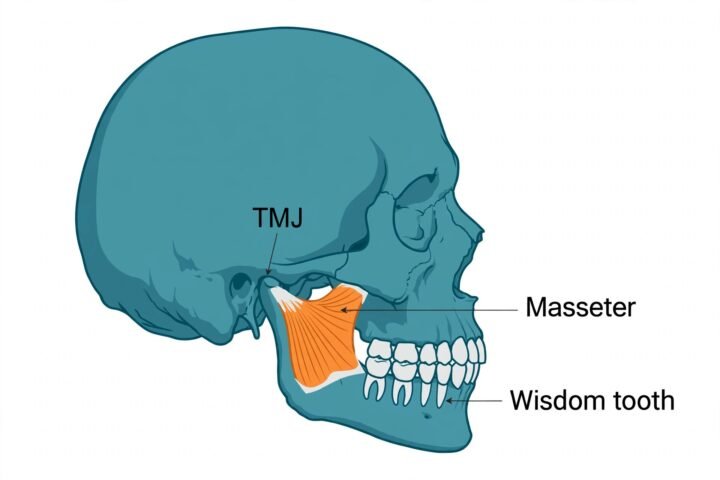
Schematic diagram: the TMJ sits just in front of the ear, the masseter muscle powers chewing, and the lower wisdom tooth sits at the back of the same jaw — which is why surgery there can make the whole jaw feel stiff.
That anatomy also explains why tmj after wisdom teeth removal pain is often felt in surprising places. Discomfort near the ear, temple, or along the jawline can come from the joint and muscles rather than the socket itself. Ear-area pain alone does not prove an ear problem or a joint injury, but pain that radiates and intensifies a few days after surgery is one of the dry socket patterns described next, so the timing matters.
How can I tell normal stiffness from something wrong?
The single most useful test is direction. Normal healing, even when it is slow, moves in one direction: each day is the same or a little better. The NHS advises urgent dental advice if pain and swelling are severe or getting worse and painkillers are not helping, if there is pain with a bad taste in the mouth, if you have a high temperature or feel unwell, or if bleeding does not stop.
One complication deserves its own paragraph. Dry socket (alveolar osteitis) happens when the blood clot in the socket fails to form, dislodges, or dissolves before the gum heals. Mayo Clinic describes it as the most common complication after tooth extractions such as wisdom teeth, with pain usually beginning 1 to 3 days after removal; NHS Inform puts the window at 3 to 5 days. Clues include severe or worsening pain, an empty-looking socket, pain spreading to the ear, eye, temple, or neck on the same side, and a bad taste or smell. Over-the-counter medicine alone usually is not enough for dry socket — your dentist can flush the socket and place a medicated dressing.
Infection is the other pattern to respect: swelling that keeps increasing after the first few days, fever, pus or a foul taste, or feeling generally unwell. And numbness or tingling in the tongue, lower lip, or chin that does not improve should be reported, since the NHS lists nerve effects among the possible complications of wisdom tooth removal. None of these can be sorted out from a description alone; they need the surgeon who can look in the socket.
What helps a stiff jaw loosen up safely?
Start with your surgeon’s own aftercare instructions, which override any general guide. Within that, the NHS self-care advice after wisdom tooth removal includes taking paracetamol or ibuprofen as directed for pain, eating soft or liquid food until chewing is comfortable, and gently pressing a cold cloth to the face early on to reduce swelling.

Soft foods such as soup, yogurt, mashed potato, and smoothies (drunk from a glass, not a straw, while your surgeon advises against straws) let a stiff jaw rest while you keep eating.
Beyond that, gentle movement usually beats total rest once the first days have passed. Opening and closing slowly, within comfort, several times a day helps the muscles let go of their guarding; forcing the jaw wide, testing it with tough food, or doing aggressive stretches can flare the area instead. Think of it like the early phase of a TMJ flare-up: calm the irritation first, then restore movement gradually. Warmth on the cheek is soothing for many people after the initial swelling phase, but follow your surgeon’s timing on heat versus cold rather than improvising.
Protect the socket while you do all this. The clot in the socket is the foundation healing builds on, which is why aftercare sheets typically warn against vigorous rinsing, spitting, smoking, and straws early on. If clenching at night is adding to your jaw ache during recovery, our guide to why you clench your jaw at night covers the longer-term picture once you have healed.
Can wisdom teeth removal lead to a lasting TMJ problem?
Sometimes jaw symptoms outlast the socket, and the research here is genuinely mixed, so it should be presented honestly. A systematic review of third molar extraction as a risk factor for temporomandibular disorders (TMD) included seven non-randomized studies: six reported higher levels of TMD after wisdom tooth removal, with odds ratios around 1.81 to 2.15, while one found no significant association. The review rated confidence in those estimates as low to moderate, with risk of bias a particular concern, and called for randomized trials with standardized diagnosis.
In plain terms: most post-surgery jaw stiffness is temporary muscle and joint irritation that resolves as healing completes, a smaller number of people notice jaw pain, clicking, or limited opening that persists, and the evidence does not let anyone promise which group a given person will be in. Pre-existing jaw problems matter too — someone who already had clicking or jaw pain before surgery is more likely to notice it afterward.
If, after the socket has healed, you are left with ongoing jaw pain, new clicking with pain, episodes of the jaw catching or locking, or opening that stays limited, that is no longer “recovery” and deserves a TMJ assessment in its own right. Gentle, guided exercises are often part of that care; our overview of TMJ exercises for jaw clicking is a reasonable starting read, and our article on whether wisdom teeth can cause migraines covers the headache side of the same anatomy.
When should I call my dentist or oral surgeon?
Call promptly — the same day where possible — if you have bleeding that does not stop, pain and swelling that are severe or getting worse despite painkillers, pain together with a bad taste, a high temperature or feeling unwell, an empty-looking socket with escalating pain, swelling that interferes with swallowing, or numbness that is not improving. Difficulty breathing or swallowing is an emergency, not a wait-until-morning symptom.
Call routinely, rather than urgently, if your jaw opening has not improved at all after the first week, if stiffness is still clearly present at 2 weeks, or if new jaw clicking, locking, or one-sided pain appears as the socket heals. Those visits are how a lingering tmj after wisdom teeth removal problem gets caught while it is still a muscle-and-joint irritation rather than a settled habit of guarding and clenching.
Frequently asked questions
How long does jaw stiffness last after wisdom teeth removal?
For most people, a stiff, sore jaw wears off within 7 to 10 days, according to NHS guidance, although pain, swelling, and bruising can last up to 2 weeks. Impacted or difficult removals often take the longer end of that range. Stiffness that has not improved at all after a week, or is still clearly limiting you at 2 weeks, should be checked by your dentist or surgeon.
Can wisdom teeth removal cause TMJ problems?
It can be followed by jaw joint and muscle symptoms, and a systematic review found most included studies reported more temporomandibular disorder signs after third molar removal, though the evidence was low to moderate certainty and one study found no association. Most post-surgery stiffness is temporary. Jaw pain, clicking, or locking that persists after the socket heals deserves its own TMJ assessment.
Why can I not open my mouth fully after wisdom teeth removal?
Limited opening, called trismus, usually comes from swelling and protective tightening of the chewing muscles near the surgical site, combined with soreness in the jaw joint after being held open during surgery. It typically peaks in the first few days and eases as swelling falls. Opening that worsens after initially improving, or comes with fever or a bad taste, needs a dental check.
What does dry socket feel like compared with normal jaw stiffness?
Normal stiffness and soreness ease a little each day and respond to the pain relief your dentist recommended. Dry socket pain usually starts or sharply worsens 1 to 5 days after removal, can feel severe, may spread to the ear, eye, temple, or neck, and often comes with a bad taste or smell and an empty-looking socket. It needs treatment from your dentist, typically flushing and a medicated dressing.
Conclusion
tmj after wisdom teeth removal stiffness is, for most people, a normal and temporary part of healing: the joint and chewing muscles sit right next to the surgical site, they react to swelling and guarding, and NHS guidance expects the stiffness to wear off within 7 to 10 days, inside a recovery of up to 2 weeks. The pattern to trust is steady, day-by-day improvement.
What should change your plan is a change in direction — worsening pain or swelling, a bad taste or fever, an empty socket with escalating pain, bleeding that will not stop, or stiffness that simply does not move. Those are reasons to call your dentist or oral surgeon promptly, and jaw symptoms that remain after the socket has healed deserve a TMJ assessment rather than indefinite waiting. When in doubt, ask the team who did the surgery; they would rather check a healing socket than treat a late complication.
Sources
- NHS — Wisdom tooth removal (recovery, stiff sore jaw within 7 to 10 days, effects up to 2 weeks, urgent advice criteria). nhs.uk
- NHS Inform — Wisdom tooth removal (swelling and discomfort up to 2 weeks, dry socket at 3 to 5 days, nerve effects). nhsinform.scot
- Mayo Clinic — Dry socket: symptoms and causes (most common complication after extraction, pain beginning 1 to 3 days after removal, radiating pain, bad taste). Mayo Clinic health information
- Is the extraction of third molars a risk factor for the temporomandibular disorders? A systematic review (seven non-randomized studies, six reporting higher TMD levels, low-to-moderate certainty). springermedicine.com
This article is educational information only and is not medical or dental advice. It does not replace the aftercare instructions or assessment of your own dentist or oral surgeon. If you have severe, worsening, or worrying symptoms after surgery, contact them promptly.




0 Comments