Educational information · Not medical advice
In brief
Jaw clicking on one side without pain is usually a harmless disc click. Learn what causes it, when it can lock, and which signs need prompt dental care.
Jaw Clicking or Popping Without Pain: Should You Worry? (Disc Displacement Explained)
In this article
- Is jaw clicking on one side without pain normal?
- What causes the click? Disc displacement with reduction, explained
- Why does it happen on one side only?
- Will a painless click get worse or lock?
- When should you see a dentist about a clicking jaw?
- What helps a clicking jaw — and what to avoid
- Frequently asked questions
- Conclusion
- Sources
Key Takeaways
- Jaw clicking on one side without pain is common, is considered normal by the National Institute of Dental and Craniofacial Research (NIDCR), and does not require treatment on its own.
- The usual cause is disc displacement with reduction: a small cushion of cartilage inside the jaw joint sits forward when your mouth is closed and snaps back into place as you open.
- A systematic review of 167 papers found this is mostly a stable, pain-free, lifelong condition — only a small minority lose the click and develop a locked jaw.
- Get checked promptly if clicking becomes painful, your jaw locks or will not open fully, or the way your teeth fit together changes.
- Do not chase a cure for a painless click. Experts recommend conservative care and avoiding treatments that permanently change your bite, teeth, or jaw joint.
It usually starts quietly. You yawn, take a bite, or open wide for the dentist, and one side of your jaw makes a clear click or pop. It does not hurt. Nothing feels stuck. So is jaw clicking on one side without pain a warning sign, or just noise? The short answer, backed by the U.S. National Institute of Dental and Craniofacial Research (NIDCR), is reassuring: clicking or popping sounds in the jaw joints, without pain, are common, are considered normal, and do not require treatment. This article explains what makes the sound, why it often affects only one side, the small set of changes that do deserve a prompt appointment, and why doing nothing — apart from a few gentle habits — is often the right plan.
Temporomandibular disorders (TMDs) are a group of more than 30 conditions affecting the jaw joint and its muscles, according to NIDCR. TMD affects about 5% of U.S. adults and is about twice as common in women as in men. A painless sound on its own is not the same thing as a disorder that needs treatment.
Is jaw clicking on one side without pain normal?
Yes, in most cases. NIDCR states the point twice in its TMD guidance: sounds without pain in the jaw joints are normal, happen frequently, and do not need treatment. That is a strong, clear position from the federal institute that studies these conditions, and it applies directly to jaw clicking on one side without pain.
Context helps. Reviews of imaging and clinical studies report that a displaced jaw-joint disc — the most common source of a click — is found in roughly 18% to 35% of the general population, most of whom have no pain at all. In other words, the anatomy behind a click is common; symptoms are not automatic. Many jaw joint and muscle problems are also temporary and do not get worse, NIDCR notes, which is why simple measures, or simply monitoring, are usually enough.
There is also no single standard test that diagnoses a TMD, and a click alone does not prove a diagnosis. Under the DC/TMD criteria (Schiffman et al., 2014), the examination for disc displacement with reduction has high specificity (0.92) but low sensitivity (0.34) — a useful screening clue, not a verdict.

What causes the click? Disc displacement with reduction, explained
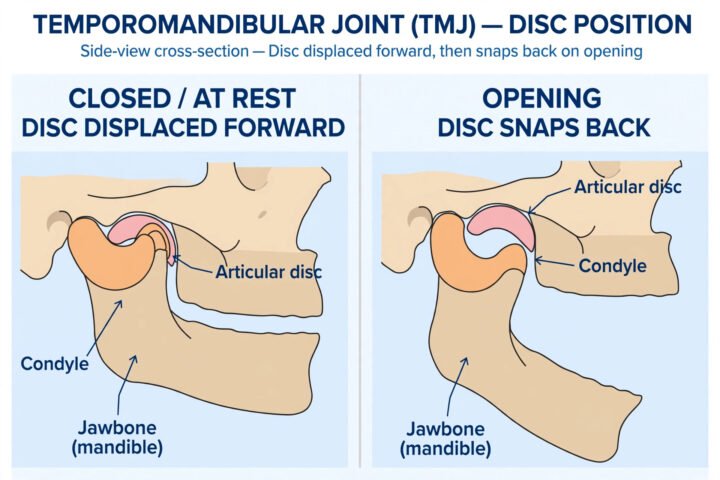
Inside each temporomandibular joint (TMJ) sits a small, oval cushion of cartilage called the articular disc. It sits between the rounded end of the jawbone — the condyle — and the socket in the skull, and it is meant to glide with the condyle as you open and close.
In disc displacement with reduction, the disc sits forward of the condyle while your mouth is closed. As you open, the condyle moves forward and slips back underneath the disc — the disc is “recaptured,” or reduces. That sudden movement onto the condyle is what you hear and feel as a click or pop. As you close, the disc can slip forward again, sometimes with a softer second click. A click on both opening and closing is called a reciprocal click, and it is the classic pattern described in reviews of internal derangements of the TMJ, such as Young (2015) in the Journal of Indian Prosthodontic Society.
Because the disc does get back into place during opening, your range of motion is not limited in this condition. You can open fully; the joint is simply noisy while it works. Young makes the same reassurance explicit: disc displacements often involve neither pain nor dysfunction and therefore do not require treatment, and for people with nonpainful joint noises, explanation and monitoring are appropriate.
Why does it happen on one side only?
Each side of your jaw has its own joint and its own disc, and the two sides do not have to behave the same way. A disc can sit slightly forward on the left while the right disc tracks normally, which is why jaw clicking on one side without pain is such a common search — and such a common finding. One-sided clicking does not, by itself, suggest something more sinister than the two-sided kind.
Why a disc shifts is often unclear. NIDCR notes that joint injury can lead to some TMDs, but in most cases the exact cause is not clear — and research does not support the belief that a bad bite or orthodontic treatment, such as braces, causes TMDs. A click that started after braces is not, on its own, evidence of damage or a reason to undo dental work.
By the numbers
Disc displacement is reported in about 18% to 35% of the general population (Naeije et al., 2013), while TMD overall affects about 5% of U.S. adults (NIDCR). A displaced, clicking disc is far more common than a painful jaw disorder.
Will a painless click get worse or lock?
For most people, no. A systematic review by Naeije and colleagues (Journal of Oral Rehabilitation, 2013), covering 167 papers, concluded that a disc displacement with reduction is mostly a stable, pain-free and lifelong condition of the joint — in the authors’ memorable phrase, for most patients it is just a pain-free, lifelong “noisy annoyance.”
In only a small minority of patients does the disc lose its capacity to slip back on opening. That change — disc displacement without reduction — is the condition behind a “closed lock”: the disc stays forward, acts like a doorstop, and limits how wide you can open. The DC/TMD defines limited opening as less than 40 mm between the upper and lower front teeth on assisted opening. Even then, the outlook is usually good: the same review notes that the signs and symptoms of a closed lock tend to reduce and in many cases resolve within months, and reviews of internal derangements report that non-reducing discs usually return to a satisfactory range of motion over time.
One pattern sits in between: disc displacement with reduction, with intermittent locking — the jaw clicks as usual, but occasionally catches or briefly will not open fully. Mention that change at a dental visit. If a lock becomes persistent, our guide to a jaw locked closed or open explains what to do right away.
When should you see a dentist about a clicking jaw?
A painless click alone can simply be monitored. Book a prompt appointment if the picture changes in any of these ways, drawn from the symptom lists published by NIDCR and the NHS:
- Pain arrives — pain in the chewing muscles or jaw joint is the most common TMD symptom, and painful clicking, popping, or grating is on NIDCR’s list of signs that may signal a TMD.
- Your jaw locks, catches and stays stuck, or will not open fully. The NHS advises an urgent appointment if you have difficulty opening your mouth fully, your jaw is locking, or you are unable to eat or drink.
- Jaw stiffness or limited movement that was not there before.
- Your bite changes — a change in the way the upper and lower teeth fit together.
- Pain spreads to the face or neck, or you develop ringing in the ears, hearing changes, or dizziness alongside jaw symptoms.
- The click follows an injury — a blow to the head or face is a recognised cause of TMD in NHS guidance, and a new joint sound after trauma deserves an examination.
At that visit, expect questions and a hands-on examination of the joint and muscles rather than automatic imaging or a splint prescription. If jaw pain does flare, our 48-hour TMJ flare-up plan covers the first steps — soft diet, heat or ice, and sensible medication use — while you wait to be seen.
What helps a clicking jaw — and what to avoid
If jaw clicking on one side without pain is your only symptom, the evidence-based “treatment” is mostly reassurance plus habits that avoid overloading the joint. NIDCR and the NHS suggest, for jaw symptoms generally: eat soft foods during sore periods, apply heat or cold, gently stretch and strengthen the jaw muscles with exercises, and reduce habits such as jaw clenching, gum chewing, and nail biting. The NHS adds a practical one for clickers: do not yawn too wide — support your chin with your hand when a big yawn builds.
Gentle, structured exercises are the active option with the best fit for a noisy but painless joint. Our printable TMJ exercise routine and our guide to the best TMJ exercises for jaw clicking walk through controlled opening and resistance exercises step by step. Keep movements pain-free; exercises are for mobility and muscle control, not for forcing a click away.
What to avoid matters too. Do not repeatedly click your jaw on purpose to “test” it — overloading the joint can turn a quiet joint sore. And follow NIDCR’s conservative-first principle: avoid treatments that permanently change the jaw joints, teeth, or bite, or involve surgery, for a symptom guidelines say needs no treatment. If someone proposes rebuilding your bite or operating to silence a painless click, get a second opinion — ideally from an orofacial pain specialist — first.
Frequently asked questions
Can a clicking jaw go away on its own?
It can. Many jaw joint problems are temporary and do not get worse, and signs and symptoms go away without treatment for many people, according to NIDCR. Clicks also often simply persist harmlessly for years — a stable, pain-free disc displacement with reduction is described in the research literature as a lifelong but benign condition. Either outcome — fading away or staying as background noise — is normal when there is no pain and movement is full.
Should I get a night guard for a clicking jaw?
Not for the click alone. A guard protects teeth from grinding and can help muscle pain in some people, but it is not a treatment that puts a displaced disc back, and NIDCR says painless joint sounds do not require treatment. If you also grind your teeth at night, wake with sore muscles, or are wearing your teeth down, that is a separate conversation worth having with your dentist — the guard would be for the grinding, not the sound.
Does jaw clicking mean I will get arthritis in the joint?
A click by itself does not mean that. The best natural-course evidence — a systematic review of 167 papers — describes disc displacement with reduction as mostly stable and pain-free, progressing to a non-reducing disc in only a small minority, and rarely with a painful locked jaw even then. Degenerative joint changes are a separate TMD category with their own signs, typically pain and grating rather than a clean click. New pain or a grating, sandpapery sound is a reason to be examined.
Why does my jaw pop when I yawn?
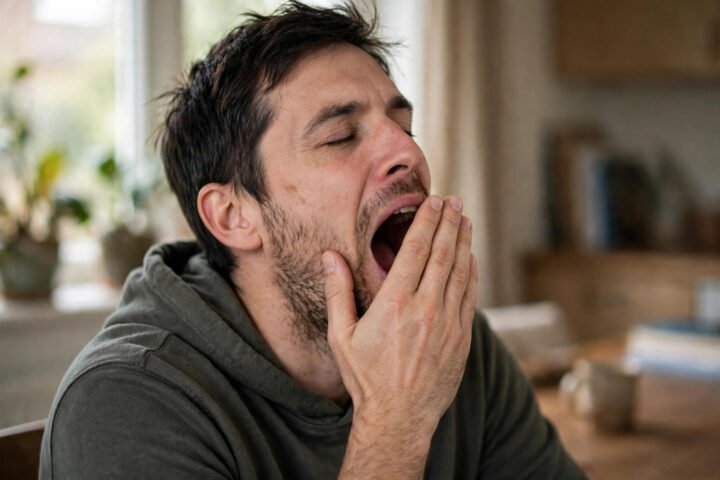
Yawning opens the jaw wider than almost anything else you do, and wide opening is exactly when a forward-sitting disc gets recaptured by the condyle — the movement that makes the click. It is the same mechanism as clicking when you open to eat, just at a wider range. The NHS advises not yawning too wide if you have jaw symptoms; cupping a hand under your chin to limit the last part of a yawn is a simple, effective habit.
Conclusion
Jaw clicking on one side without pain feels like it should mean something is wearing out. The evidence says otherwise: it is usually a disc that sits slightly forward and snaps back as you open — common, considered normal by NIDCR, and, in the research on its natural course, mostly stable for life. You do not need to fix a sound. You need to notice change: pain, locking, limited opening, or a bite that suddenly fits differently. Those are the signs that turn a noisy annoyance into something a dentist or orofacial pain specialist should examine.
Until then, keep the joint’s workload light, skip the gum-chewing marathons, support big yawns, and be sceptical of anyone offering irreversible treatment for a painless click. If you are unsure whether your symptoms still count as “just a click,” a routine dental examination is a reasonable, low-pressure next step.
Medical disclaimer: This article is educational information only and is not medical or dental advice. It does not diagnose any condition. If you have jaw pain, locking, limited opening, or a change in your bite, consult a dentist, doctor, or orofacial pain specialist for an in-person evaluation.
Sources
- National Institute of Dental and Craniofacial Research (NIDCR), NIH — TMD (Temporomandibular Disorders): prevalence, painless clicking considered normal and not requiring treatment, conservative-first guidance, symptom list.
- Young A. Internal derangements of the temporomandibular joint: a review of the anatomy, diagnosis, and management. Journal of Indian Prosthodontic Society, 2015 — PMC4762294: disc displacement with and without reduction, reciprocal click, limited opening under 40 mm, prognosis.
- Schiffman E, et al. Diagnostic Criteria for Temporomandibular Disorders (DC/TMD) for Clinical and Research Applications. Journal of Oral & Facial Pain and Headache, 2014;28(1):6–27 — PubMed 24482784: diagnostic validity, including sensitivity 0.34 / specificity 0.92 for disc displacement with reduction.
- Naeije M, et al. Disc displacement within the human temporomandibular joint: a systematic review of a “noisy annoyance.” Journal of Oral Rehabilitation, 2013;40(2):139–158 — PubMed 23199296: 18–35% prevalence, stable pain-free natural course, small-minority progression.
- NHS — Temporomandibular disorder (TMD): self-care, avoiding wide yawning, and urgent-advice criteria.




0 Comments