
Educational information · Not medical advice
In brief
This tmj exercises pdf routine gives you 6 gentle printable exercises with pictures, step-by-step instructions, and safety tips for daily jaw relief at home.
Printable TMJ Exercises (With Pictures): A 6-Exercise Daily Routine
In this article
Key Takeaways
- This tmj exercises pdf routine is a printable page: print this page or use your browser to save as PDF, then work through 6 gentle exercises in order.
- Do 6 repetitions of each exercise, in several short sessions a day. Gentle is the rule — never force through sharp pain.
- The evidence is promising but small and low quality overall, so treat exercises as conservative self-care, not a guaranteed fix.
- Stop and get checked promptly if your jaw locks, swells, or pain keeps worsening.
If your jaw aches by the end of the day, clicks when you chew, or feels stiff when you wake up, a short daily exercise routine is one of the simplest conservative steps you can try at home. This tmj exercises pdf routine brings six commonly used jaw exercises together on one printable page, with pictures, step-by-step instructions, and clear repetition counts, so you do not have to piece them together from separate videos.
Temporomandibular disorders (TMD) affect about 5% of adults in the United States and are about twice as common in women, according to the National Institute of Dental and Craniofacial Research (NIDCR), which stresses conservative, reversible care first. Exercises fit that approach: they cost nothing and need no equipment. If a flare is already under way, pair this routine with the steps in our guide to a TMJ flare-up and its 48-hour plan rather than pushing through a painful day.
Can TMJ exercises actually help your jaw?
Jaw exercises aim at three things: relaxing braced muscles, improving how smoothly and how far the jaw opens, and retraining coordination. The rest position alone can help, because many people hold their teeth together for hours without noticing, adding constant low-level load.
Exercises are not right for every jaw problem and are not a substitute for an examination. A clicking jaw without pain is common and, as NIDCR notes, usually needs no treatment. Pain, limited opening, or a jaw that catches or locks deserves assessment first. Our comparison of physical therapy versus splint versus Botox for TMJ explains where guided therapy sits alongside other options.
How do you use this printable routine safely?
Treat this tmj exercises pdf page as your daily sheet. Print this page, or save as PDF from your browser, and keep it where you will see it. Work through the exercises in order. Most people do best with several short sessions a day rather than one long session that fatigues sore muscles.
The dose is modest: 6 repetitions of each exercise, moving slowly, with rest between repetitions. Sit upright, shoulders down, head level. Move only into mild stretch or effort. Sharp or escalating pain is a stop signal. If an exercise repeatedly provokes pain, skip it and mention it at your next dental or medical visit.
Daytime habits matter too. If you catch yourself clenching at work, our habit-reversal plan for how to stop clenching your jaw during the day pairs well with exercise 1. A warm compress for a few minutes beforehand can also help stiff muscles relax, though it is optional.
What are the 6 exercises in this daily routine?
Here is the full tmj exercises pdf routine in order. Read each safety note before your first session, and use the picture sheet below as a visual reminder.
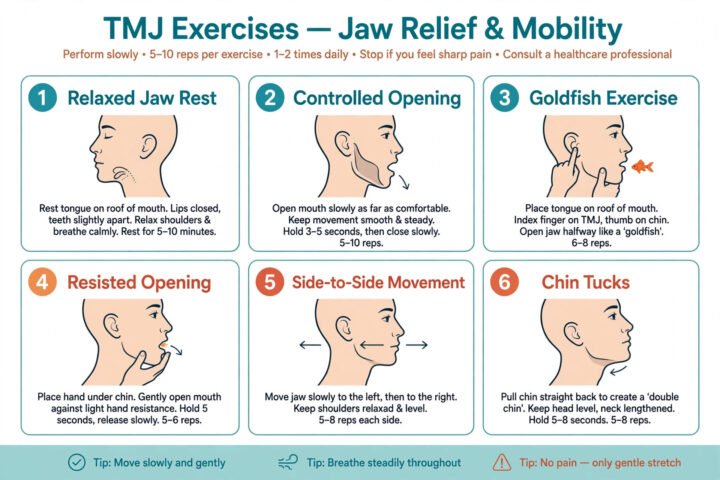
1. Relaxed jaw rest position
Sit comfortably and let your shoulders drop. Place the front of your tongue lightly on the roof of your mouth, just behind your upper front teeth. Let your lips come together while your teeth stay slightly apart, and breathe slowly through your nose. Hold this relaxed position for 30 to 60 seconds, then release. Repeat 6 times. Safety note: there should be no effort or pain here at all — this is a rest position, not a stretch, and you can return to it throughout the day whenever you notice tension.
2. Controlled opening with tongue on palate
Keep your tongue pressed gently on the roof of your mouth. Slowly open your mouth only as far as your tongue stays comfortably on the palate — for many people that is a small opening at first. Close slowly. Repeat 6 times, keeping the movement smooth and straight rather than letting the jaw swing to one side. Safety note: stop before any sharp pain or hard block. The tongue acts as a natural limiter, so do not force past the point where it would have to let go.
3. Goldfish exercise (partial opening)
Place one index finger on the jaw joint, just in front of your ear, and the thumb or a finger of your other hand on the front of your chin. Open your mouth about halfway, feeling the joint move under your finger, then close slowly. Repeat 6 times. Safety note: use only a partial opening, not your widest opening, and keep the pressure of your fingers light — they are there to give feedback, not to push or pull the jaw.
4. Resisted opening
Place your thumb under your chin. Try to open your mouth slowly while your thumb provides gentle resistance, so the jaw muscles work without the mouth opening very far. Hold the gentle effort for about 5 seconds, then relax completely. Repeat 6 times. Safety note: the resistance should be mild — roughly a quarter of your maximum effort. If this provokes joint pain rather than mild muscle effort, skip this exercise and stick with the unresisted movements.
5. Side-to-side jaw movement
Start from the rest position, teeth slightly apart. Move your jaw slowly to the right as far as is comfortable, hold for 2 to 3 seconds, return to the centre, then move slowly to the left and hold again. That is one cycle; repeat 6 times. Safety note: keep the movement small and controlled, and do not click or pop the jaw deliberately. If one direction is clearly more limited or painful, do not force it to match the other side.
6. Chin tucks
Sit or stand tall, looking straight ahead. Draw your head straight back, as if making a gentle double chin, keeping your eyes level rather than tipping your chin down. Hold for 5 seconds, feeling a mild stretch at the back of the neck, then release. Repeat 6 times. Safety note: the movement is small and horizontal, not a nod. Stop if it causes dizziness, arm pain, or numbness, and mention those symptoms to a clinician.

What does the evidence say about TMJ exercises?
It is important to be plain about this: the evidence for jaw exercises is low and based on small studies. A 2023 systematic review by Shimada and colleagues, published in Frontiers in Oral Health, found only 5 randomised controlled trials with 145 participants in total that tested jaw exercises for painful temporomandibular disorders. Coordination exercise showed a significant effect on pain and on mobility, but the studies were too few and too varied for the reviewers to combine them in a meta-analysis.
Evidence at a glance: only 5 RCTs and 145 participants in Shimada et al. 2023, and 48 studies pooled in Armijo-Olivo et al. 2016 — with overall evidence rated low.
An earlier review by Armijo-Olivo and colleagues in Physical Therapy in 2016 pooled 48 studies of manual therapy and therapeutic exercise. Overall evidence was rated low, and manual therapy plus exercise looked most promising — suggesting exercises may work best as part of guided care, not as a stand-alone cure. Read the Shimada 2023 systematic review in full and the NIDCR overview of temporomandibular disorders for the underlying detail.
That honest picture is exactly why this tmj exercises pdf routine is framed as gentle self-care. If several weeks of consistent, pain-free practice bring no change — or things get worse — that is useful information to take to a dentist, doctor, or physical therapist, not a reason to exercise harder.
When should you stop and get help instead?
Stop any exercise that causes sharp pain, and do not restart it until you understand why it hurt. Seek prompt care from a dentist or doctor if your jaw locks and will not open or close — our emergency guide explains what to do when your jaw is locked closed or open — or if you notice swelling, a recent injury or trauma to the jaw, fever, numbness in the face, a bite that suddenly feels different, or pain that steadily worsens despite rest and gentle care.
Also get checked if you cannot open wide enough to eat comfortably, if pain spreads, or if headaches are new or unusually severe. These signs can point to infection, joint damage, or conditions outside the jaw, and none should be managed with exercises alone.
Frequently asked questions
How often should I do these TMJ exercises?
Start with the full routine two or three times a day, doing 6 repetitions of each exercise, and add the relaxed rest position whenever you notice tension during the day. Several short, gentle sessions usually suit sore jaw muscles better than one long session. Consistency over two to three weeks matters more than intensity on any single day.
Can I save this routine as a PDF?
Yes. This page is designed as the tmj exercises pdf itself: use your browser print option and choose save as PDF, or print this page on paper and keep it by your desk or mirror. Saving it that way keeps the pictures, step order, repetition counts, and safety notes together on one sheet for daily use.
Should TMJ exercises hurt?
No. You may feel a mild stretch, gentle muscle effort, or awareness in muscles that are not used to moving this way, and that should settle within minutes. Sharp, stabbing, or escalating pain is a stop signal. Reduce the range, slow down, or skip that exercise entirely, and get assessed if the same movement keeps provoking pain.
How long before exercises help my jaw pain?
There is no guaranteed timeline, and the research base is small, so be wary of anyone promising fast results. Many clinicians suggest judging a gentle routine after two to three weeks of consistent practice. If pain, stiffness, or limited opening are unchanged or worse by then, book an assessment rather than adding more repetitions or force.
Conclusion
A short, gentle routine you actually repeat is worth more than an ambitious programme you abandon. Keep this tmj exercises pdf sheet visible, do 6 repetitions of each exercise in several short sessions a day, return to the rest position whenever you catch yourself clenching, and let pain — not willpower — set the limit for every movement.
Exercises sit inside a bigger picture of conservative care: soft foods during flares, warmth, and professional assessment when symptoms persist or red flags appear.
Sources
- National Institute of Dental and Craniofacial Research (NIDCR). Temporomandibular Disorders (TMD). nidcr.nih.gov/health-info/tmd
- Shimada A, et al. Effectiveness of exercise therapy for temporomandibular disorders: a systematic review. Frontiers in Oral Health, 2023. PMC10382173
- Armijo-Olivo S, et al. Effectiveness of manual therapy and therapeutic exercise for temporomandibular disorders: systematic review and meta-analysis. Physical Therapy, 2016;96:9-25.
Disclaimer: This article is educational information only and is not medical advice. It does not diagnose or treat any condition. Talk with your dentist, doctor, or physical therapist about your own symptoms, especially if pain persists, worsens, or your jaw locks.





0 Comments