
Educational information · Not medical advice
In brief
How long should a nap be? Trials say 10-20 minutes for alertness, about 90 minutes for a full cycle - plus coffee naps, timing, and when naps backfire.
In this article
Key Takeaways
- For most adults, how long should a nap be? About 10 to 20 minutes of sleep — long enough to refresh alertness, short enough to wake before deep sleep.
- The grogginess after a longer nap is sleep inertia: it happens when you wake from slow-wave sleep, and it can take 15 to 30 minutes or more to clear.
- The other length that can work is about 90 minutes — roughly one full sleep cycle — but it costs more of your day and is easier to get wrong.
- A coffee nap — caffeine right before a 15- to 20-minute nap — beat caffeine alone and a nap alone in small driving and laboratory studies.
- Nap early in the afternoon, not after about 3 p.m. Needing long naps every day is a signal to look at night sleep, not a reason to nap longer.
How long should a nap be? It is the question everyone asks after the wrong nap — the 45-minute one that left you heavier than before, or the two-hour one that stole your evening sleep. The research answer is surprisingly specific: for a quick refresh, aim for about 10 to 20 minutes of actual sleep. That is long enough to gain alertness and short enough to wake while you are still in light sleep.
This article explains how long should a nap be for different goals, why the middle lengths — roughly 30 to 60 minutes — are usually the worst choice, how a coffee nap works, and when daytime sleepiness is a sign of something else. If your nights are the problem, our guides to why you wake up at 3 AM and melatonin for sleep cover two common patterns.
How long should a nap be for most adults?
For most healthy adults who want alertness without grogginess, how long should a nap be is best answered with a range, not a single number: about 10 to 20 minutes of sleep. Mayo Clinic advises keeping naps short — a 20- to 30-minute nap is ideal in its guidance, and the longer you nap, the more likely you are to feel groggy afterward. The National Heart, Lung, and Blood Institute (NHLBI, part of the NIH) gives a similar practical limit: limit naps, take them earlier in the afternoon, and keep adult naps to no more than about 20 minutes if you have trouble sleeping at night.
The clearest head-to-head test came from Brooks and Lack, published in the journal Sleep in 2006. Twenty-four healthy young adults had their night sleep restricted to about five hours, then took afternoon naps of exactly 5, 10, 20, or 30 minutes of actual sleep, or no nap. The 10-minute nap improved alertness, fatigue, vigour, and cognitive performance immediately, with some gains still measurable more than two hours later. The 20-minute nap helped too, but its benefits did not appear until about 35 minutes after waking. The 30-minute nap began with a period of impaired alertness — sleep inertia — before its benefits arrived.
10 minutes
In Brooks and Lack (2006), the 10-minute nap was the length the authors called overall the most effective after a short night — benefits were immediate, while the 20-minute nap took about 35 minutes to pay off and the 30-minute nap started with grogginess.
One practical detail matters: those minutes are minutes of sleep, not minutes on the pillow. If you usually take 10 minutes to fall asleep, a 20-minute sleep goal means setting an alarm for about 30 minutes from lying down. Counting pillow time instead of sleep time is the most common reason a planned power nap turns into a deep-sleep wake-up.
Why does the 20-minute rule work?
Sleep is not one uniform state. In the first minutes you drift through light sleep (stages N1 and N2). As a nap continues, you are increasingly likely to enter slow-wave sleep (stage N3) — deep sleep. Waking from light sleep is usually easy. Waking from slow-wave sleep produces sleep inertia: the heavy, disoriented grogginess that can follow a longer nap.
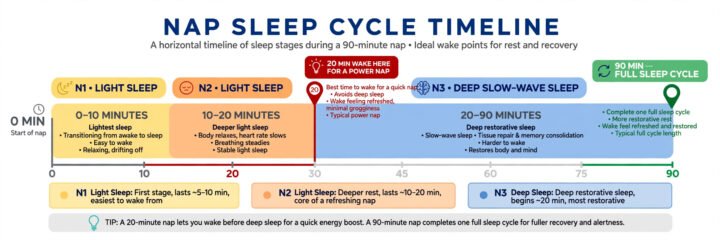
Tassi and Muzet, reviewing sleep inertia in Sleep Medicine Reviews in 2000, described it as a measurable drop in alertness and performance after waking, worst after waking from slow-wave sleep, that can take 15 to 30 minutes to fully clear — and sometimes longer after deep sleep or severe sleep loss. That is why the 20-minute rule is arithmetic, not folklore: end the nap before deep sleep is likely, and you collect the alertness gain without paying the inertia cost.
The rule is a guardrail, not a gate. How fast you reach slow-wave sleep varies with how sleep-deprived you are, the time of day, and you personally. After a very short night you may reach deep sleep faster, which is why some people feel groggy even after 25 minutes. If that happens to you, shorten the nap rather than lengthening it.
What about a 90-minute nap?
A nap of about 90 minutes is the other length sleep guidance often mentions, because roughly 90 minutes is a typical full sleep cycle: light sleep, deep sleep, and back toward lighter sleep and dreaming. NIOSH training material summarised in nap guidance puts it this way — waking at about 20 minutes, before deeper sleep, or at about 90 minutes, near the end of a cycle, may leave less grogginess than waking in the middle.
A 90-minute nap can suit a specific job: catching up after a genuinely short night when you have the time, and when you can still protect the coming night. It is not the better everyday default. It costs far more time, its timing is easier to miss — wake at 60 minutes instead and you are in the worst zone — and a long daytime sleep can reduce the sleep pressure you need to fall asleep at night. The comparison below summarises the trade-offs.
| Length (sleep) | What you wake from | Best for | Main cost |
|---|---|---|---|
| 10–20 minutes | Light sleep (N1–N2) | A quick alertness lift in the afternoon | Benefits fade within a few hours; does not repay a sleep debt |
| 30–60 minutes | Often slow-wave sleep | Rarely the best choice | Sleep inertia — grogginess that can outlast the benefit |
| About 90 minutes | End of a full cycle, lighter sleep | Catch-up after a short night, when time allows | Time cost; can reduce night-time sleep pressure |
| Over 90 minutes, daily | Varies | A warning sign, not a strategy | May signal poor night sleep or a sleep disorder; linked in observational studies to worse health |
That last row deserves care. In a dose-response meta-analysis of prospective cohorts, Yamada and colleagues (Sleep, 2015) found habitual naps of 60 minutes or more were associated with higher rates of cardiovascular disease and all-cause mortality than not napping, while naps under 60 minutes showed no such association. Association is not proof that long naps cause illness — people who are already unwell nap longer — but it is another reason to treat a daily need for long naps as information about your nights and your health, not as a habit to optimise.
Does a coffee nap actually work?
A coffee nap means drinking coffee quickly, then napping immediately for about 15 to 20 minutes, so you wake just as the caffeine begins to take effect. In small controlled studies, the combination performed better than either part alone.
At Loughborough University, Reyner and Horne (1997) gave sleepy drivers caffeine, a short nap, both, or placebo before a driving simulator session; caffeine plus a short nap suppressed sleepiness and reduced driving incidents more than caffeine alone. Hayashi and colleagues (2003) compared a 20-minute nap with caffeine beforehand against a nap alone, bright light, and face washing, and found the caffeine-nap combination most effective for sleepiness and performance over the following hour.
Keep the caveats with the trick. These were small, short-term studies, often in young adults. A coffee nap can service acute sleepiness; it does not cancel a sleep debt, and caffeine taken too late in the day can damage the night you are trying to protect — caffeine's effects can last for hours, which is why the same guidance that permits a coffee nap also says to avoid caffeine in the afternoon and evening if night sleep is fragile. For most people, a coffee nap is an occasional tool for a hard afternoon, not a daily system.
When is the best time of day to nap?
Early afternoon is the window most guidance converges on. Alertness naturally dips after lunch, and Mayo Clinic advises taking naps in the early afternoon and avoiding naps after 3 p.m., because later naps make it harder to sleep soundly at night. NHLBI guidance points the same way: if you have trouble falling asleep at night, limit naps or take them earlier in the afternoon.
Think of it as protecting two things at once. A nap early enough borrows a little sleep pressure and repays it before bedtime. A nap at 5 or 6 p.m. borrows the pressure you needed at 11 p.m. If evenings are when you crash on the sofa, a planned short early-afternoon nap is often a better answer than the unplanned evening doze — and if you snore heavily or have diagnosed sleep apnea, ask your clinician whether you should use your treatment during naps too, and read our guide to oral appliances and sleep apnea for how jaw position affects breathing at night.
When do naps backfire?
Naps backfire in predictable ways. They are too long, so you wake in sleep inertia. They are too late, so night sleep suffers. Or they become the treatment for a problem they cannot treat. Mayo Clinic notes that if you experience insomnia or poor sleep quality at night, napping may worsen those problems, and that short naps are the safer choice in that situation. For chronic insomnia, the first-line treatment in guidelines is cognitive behavioural therapy for insomnia — see our explainer on what CBT-I is — not longer daytime sleep.
There are also patterns that should prompt a conversation with a clinician rather than a better alarm setting: needing naps every day just to get through, falling asleep unintentionally, loud snoring with witnessed pauses, or daytime sleepiness that persists despite adequate time in bed. Those can point to sleep apnea, another sleep disorder, a medical condition, or a medication effect. People who clench or grind in their sleep often wake unrefreshed as well — our article on why you clench your jaw at night covers that pattern and its links to stress, medicines, and apnea.
How do you take a nap that helps, step by step?
First, choose the goal before you lie down: a 10- to 20-minute alertness nap on a normal day, or an approximately 90-minute catch-up nap after a short night when you have protected time. Avoid the 30- to 60-minute middle by default. Second, set the alarm for sleep time plus your usual time to fall asleep — for most people, about 25 to 30 minutes total for a power nap. Third, nap early in the afternoon, in a quiet, dark, comfortable place, and put screens away; Mayo Clinic's advice to create a restful environment applies to naps as much as to nights.
Fourth, give yourself a buffer after waking. Even a well-timed nap can leave a few minutes of reduced alertness, and after any nap you should not drive or do a safety-critical task until you feel fully awake. Bright light, movement, and washing your face are reasonable ways people help that transition, though the evidence for each add-on is thinner than the evidence for nap length itself. Finally, judge the experiment by your night: if a nap pattern leaves you unable to fall asleep at your usual time, shorten it, move it earlier, or drop it — the nap works for the night, not against it.
Frequently asked questions
How long should a nap be to not feel groggy?
About 10 to 20 minutes of sleep for most people. Grogginess — sleep inertia — mainly comes from waking out of deep slow-wave sleep, which becomes more likely as a nap passes roughly half an hour. If you still wake groggy at 20 minutes, try 10 minutes, and remember to count sleep time, not time lying down.
Is a 2-hour nap bad for you?
A single 2-hour nap after a very short night is mainly costly in time and in night-time sleep pressure. The concern is the habit: observational research links habitual naps of 60 minutes or more with worse cardiovascular and mortality outcomes, though that likely partly reflects underlying illness. Needing long naps daily is a reason to review your night sleep with a clinician.
What is a coffee nap, and how long should it be?
A coffee nap is coffee drunk immediately before a short nap, so caffeine begins working as you wake. Studies used about 15 to 20 minutes of napping after caffeine, and the combination beat caffeine alone and a nap alone on sleepiness and performance in small trials. Keep it early in the day so the caffeine does not harm your night.
Should I nap if I have insomnia?
Usually, be cautious. Mayo Clinic notes napping may worsen insomnia or poor night-time sleep quality, and guideline first-line treatment for chronic insomnia is CBT-I, which often restricts daytime sleep while sleep is retrained. If you do nap, keep it short and early, and discuss a persistent pattern with your clinician rather than extending naps.
Conclusion
So, how long should a nap be? For the everyday afternoon lift, 10 to 20 minutes of sleep, taken early in the afternoon, with an alarm set for sleep time plus falling-asleep time. For genuine catch-up, about 90 minutes can complete a cycle — but the 30- to 60-minute middle is where grogginess lives, and a daily need for long naps is a signal about your nights, not a strategy.
Used that way, a nap is a precise tool: small, timed, and in service of the night that follows. If daytime sleepiness persists despite enough time in bed, or naps stop working, discuss it with your clinician or dentist — especially if snoring, witnessed pauses, or morning jaw pain are part of the picture.
Medical disclaimer: This article is educational information only and is not medical advice. It does not diagnose or treat any condition. Talk with your clinician or dentist about persistent daytime sleepiness, insomnia, snoring, or jaw pain.
Sources
- Brooks A, Lack L. A brief afternoon nap following nocturnal sleep restriction: which nap duration is most recuperative? Sleep, 2006 — 10-minute nap most effective overall; 20-minute benefits delayed about 35 minutes; 30-minute nap began with sleep inertia.
- Tassi P, Muzet A. Sleep inertia. Sleep Medicine Reviews, 2000 — review of sleep inertia, worst after waking from slow-wave sleep.
- Rosekind MR et al. Crew factors in flight operations IX: effects of planned cockpit rest. NASA Ames Research Center, 1994 — planned cockpit nap averaging about 26 minutes improved alertness and performance in long-haul crews.
- Reyner LA, Horne JA. Suppression of sleepiness in drivers: combination of caffeine with a short nap. Psychophysiology, 1997; and Hayashi M et al. The alerting effects of caffeine, bright light and face washing after a short daytime nap. Clinical Neurophysiology, 2003 — coffee-nap studies.
- Yamada T et al. Daytime napping and the risk of cardiovascular disease and all-cause mortality: a prospective study and dose-response meta-analysis. Sleep, 2015 — habitual naps of 60 minutes or more associated with higher cardiovascular disease and mortality; under 60 minutes, no such association.
- Mayo Clinic. Napping: Do's and don'ts for healthy adults — keep naps short (20–30 minutes ideal), nap in the early afternoon, avoid napping after 3 p.m., create a restful environment.
- National Heart, Lung, and Blood Institute (NIH). Healthy Sleep Habits — limit naps or take them earlier in the afternoon; adults should nap for no more than about 20 minutes if they have trouble sleeping at night (as summarised in guidance reviewed this run).
- NIOSH / CDC nap guidance, as summarised in nap-planning guidance reviewed this run — waking at about 20 minutes, before deeper sleep, or at about 90 minutes, near the end of a sleep cycle, may leave less grogginess.





0 Comments