
Educational information · Not medical advice
In brief
TMJ during menopause: why jaw pain can start or worsen in perimenopause, what the studies actually found, whether HRT helps, red flags, and what helps.
In this article
- Can TMJ start or worsen in perimenopause and menopause?
- What did the menopause studies actually find?
- Why would changing hormones affect your jaw?
- Why does jaw pain flare around a period in perimenopause?
- Is it TMJ, or something else that needs faster care?
- Does hormone therapy help TMJ, or make it worse?
- What helps jaw pain in menopause, starting with the basics?
- Frequently asked questions
- Conclusion
- Sources
Key Takeaways
- Yes — jaw pain can start or worsen around menopause. In one study of women aged 45 to 55, signs of a temporomandibular disorder were found in about two in three menopausal women, compared with about one in three women who had not reached menopause.
- The evidence is mixed, not settled: hormone levels were not measured in that comparison, other studies disagree, and researchers cannot yet say that falling estrogen causes TMJ problems.
- Hormone therapy is not a TMJ treatment. A systematic review found no significant link between estrogen replacement and whether a woman had a temporomandibular disorder.
- New jaw pain after 50 with a new headache, a tender scalp, or any vision change needs same-day care — it can signal giant cell arteritis, not a jaw-joint problem.
- Start with the conservative basics: soft foods for a while, heat or cold, less clenching, and a proper jaw examination.
Your jaw never troubled you in your thirties. Now, in your late forties, you wake with an aching jaw, your chewing muscles feel tired by dinner, and the joint in front of your ear clicks where it never did. If you have been searching for information about tmj during menopause, you are asking a reasonable question: can the menopause transition really do this to a jaw?
The studies lean toward a real association — but the honest answer is more careful than most pages on tmj during menopause. This article covers what researchers actually found, why the evidence points in two directions at once, the one look-alike condition in this age group that is an emergency, and what helps.
Can TMJ start or worsen in perimenopause and menopause?
Yes, it can. Temporomandibular disorders (TMDs) — the group of more than 30 conditions that cause pain and dysfunction in the jaw joint and the muscles that control jaw movement, in the words of the National Institute of Dental and Craniofacial Research (NIDCR) — are at least twice as common in women as in men, and NIDCR notes they are especially common in women between 35 and 44 years old. That is exactly the window in which perimenopause, the transition years before periods stop, usually begins.
Some women notice brand-new symptoms: morning jaw stiffness, aching in front of the ear, clicking that has started to hurt, chewing muscles that fatigue quickly. Others had mild, occasional jaw pain for years and find it becomes more frequent in the transition. Sleep often worsens in the same years, and poor sleep and nighttime clenching feed each other — if you wake with a sore jaw, our guide to why you clench your jaw at night covers that loop. Do not assume every new symptom is hormonal, though: teeth, sinuses, ears, and — rarely but importantly — blood vessels can all cause pain in the same area.
What did the menopause studies actually find?
The most direct comparison is a 2018 study at Shiraz Dental School in Iran, published in the Journal of the Korean Association of Oral and Maxillofacial Surgeons. Researchers examined 140 women aged 45 to 55 — 69 who had not reached menopause and 71 who had — using the Helkimo clinical dysfunction index, a standardised examination of jaw movement, joint function, and muscle and joint tenderness.
About 2 in 3 vs about 1 in 3
In the Shiraz study, 67.6% of menopausal women (48 of 71) had some degree of TMD on examination, compared with 33.3% of non-menopausal women (23 of 69). Impaired jaw-joint function was about four times as likely in the menopausal group (odds ratio 4.17, P<0.001).
Almost every part of the examination was more often abnormal after menopause: impaired joint function (67.6% vs 33.3%), pain in the chewing muscles (36.6% vs 18.8%), pain in the joint itself (25.4% vs 8.7%), and pain during jaw movements (26.8% vs 8.7%). The one measure that did not differ significantly was range of jaw movement (P=0.178) — menopausal jaws were not measurably stiffer in how far they opened.
Two cautions belong with those numbers. This was one small, single-centre study of women attending a dental school, not a random sample — clinic rates run higher than in the general population, where NIDCR puts TMD at about 5% of U.S. adults. And the researchers did not measure hormone levels, a limitation they state themselves: the study shows an association between menopause status and jaw findings about tmj during menopause; it cannot show falling estrogen caused them.
A larger Brazilian study adds a second piece. Lora and colleagues evaluated 284 postmenopausal women using the Research Diagnostic Criteria for TMD and found 129 (about 45%) had a temporomandibular disorder — but whether a woman used hormone replacement therapy made no difference to whether she had TMD or how much pain she reported.
Why would changing hormones affect your jaw?
There are plausible mechanisms, and researchers call them plausible rather than proven. Estrogen and progesterone receptors have been detected in the human TMJ disc — the small cushion between the jaw bone and the skull — suggesting the joint's tissues can respond to reproductive hormones. In animal work cited by the Shiraz researchers, estrogen appears necessary for normal collagen and protein development in the joint, and estrogen deficiency in rats produced destructive joint changes that estradiol replacement could prevent. Estrogen also seems to influence pain: studies cited in the same paper found jaw pain behaviour in animals was higher when estradiol was low, and estradiol showed anti-inflammatory effects in the joint.
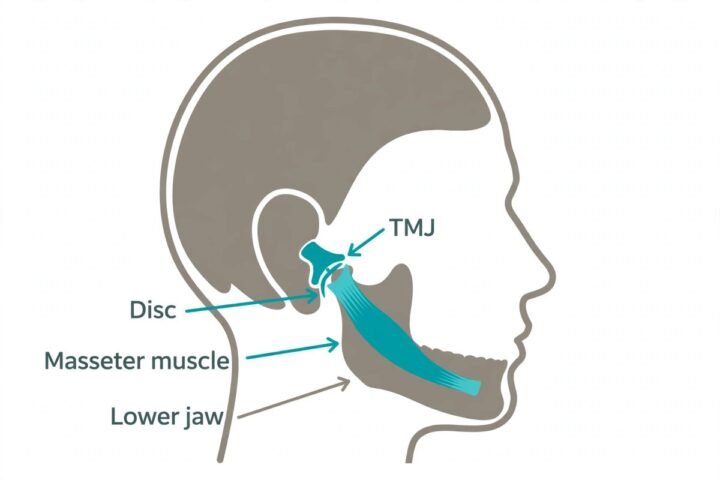
But the same literature contains the opposite signal. Other studies found higher TMD rates when estrogen was higher, and a large older case-control study by LeResche and colleagues (Pain, 1997) found postmenopausal women receiving estrogen had about 30% higher odds of being referred for TMD treatment, with a dose-response pattern. The Shiraz authors float a possible reconciliation — a physiological estrogen level may be needed for a healthy joint, while higher levels could promote inflammation — as a hypothesis, not a conclusion. The fair summary of tmj during menopause research: hormones probably play some role, the direction is not simple, and nobody can yet tell an individual woman that her estrogen level explains her jaw.
Why does jaw pain flare around a period in perimenopause?
If your cycles are still happening but irregular, your jaw may be worse in the days just before a period. That pattern has a research foothold: work cited in the menopause literature found TMD pain at its highest when estrogen was at its lowest point in the menstrual cycle, the late premenstrual phase. Perimenopause exaggerates those swings before periods stop, so a jaw that flared premenstrually in your thirties can flare harder and less predictably in your forties.
Tracking helps. Note jaw pain alongside cycle, sleep, and stress for two or three months; a clear pattern is useful to bring to an appointment. If flares are short and settle on their own, our 48-hour plan for a TMJ flare-up covers the self-care that helps most. The same transition affects other joints too — see our article on perimenopause shoulder pain.
Is it TMJ, or something else that needs faster care?
Most new jaw pain in midlife is muscular or joint-related and settles with conservative care. But this age group has one look-alike that changes the urgency completely, plus the usual dental mimics. Use this comparison to judge how fast to seek care, not as a diagnosis.
| Pattern | More typical of | How fast to act |
|---|---|---|
| Aching in front of the ear or in the chewing muscles, worse with chewing, yawning, or on waking; clicking that hurts | A temporomandibular disorder (muscle or joint) | Book a dental or medical appointment; start conservative self-care meanwhile |
| Over 50: a new headache, scalp tenderness, jaw pain or tiredness when chewing that eases when you stop, or any vision change | Giant cell arteritis (inflamed arteries) — not a jaw-joint problem | Same-day urgent care — untreated, it can cause permanent vision loss |
| Pain centred on one tooth, worse with biting or hot/cold, swelling, or a bad taste | A tooth or gum problem | Prompt dental appointment; urgently if there is swelling or fever |
| Locked jaw, jaw that will not close, or pain after an injury | Joint displacement or injury | Same-day assessment |
The giant cell arteritis row deserves emphasis because its jaw symptom — pain when chewing — is easily mistaken for a jaw-joint problem. NHS-adapted guidance is blunt: it needs urgent medical attention, and without prompt steroid treatment it can lead to permanent visual impairment. If you are over 50 and the pattern fits, do not wait to see whether jaw exercises help. Our side-by-side symptom checker for TMJ, tooth, sinus, and ear pain can help sort the more everyday alternatives.
Does hormone therapy help TMJ, or make it worse?
On current evidence: neither, in any way you could count on. A 2023 systematic review in BMC Oral Health, conducted following PRISMA and Cochrane principles, searched seven databases for studies of estrogen replacement therapy and TMD. Only three studies met its criteria. It concluded there is no conclusive evidence that estrogen replacement increases TMD risk, that estrogen therapy is unlikely to have a noticeable impact on TMD either way — and that with so few studies, more research is needed.
That sits alongside the older LeResche finding of roughly 30% higher odds of TMD referral among estrogen users, and Lora's 284-woman study finding no association at all. Three designs, three answers — which is why hormone therapy should be decided on its own established grounds (hot flushes, bone health, your personal risk profile) with your clinician, not started or stopped in the hope of fixing a jaw. If your pain clearly changed after a hormone change, report that timing to both prescriber and dentist; individual patterns matter even when group studies disagree. Hormones interact with jaw symptoms at other life stages too — see TMJ during pregnancy for the higher-hormone end of the story.
What helps jaw pain in menopause, starting with the basics?
The menopause context changes the questions you ask, not the first-line treatment. NIDCR's position is that because evidence for many TMD treatments is limited, experts recommend starting with conservative, reversible care and avoiding treatments that permanently change the jaw joints, teeth, or bite, or involve surgery. Many cases improve on their own; early treatment's job is to calm the joint and muscles while that happens.

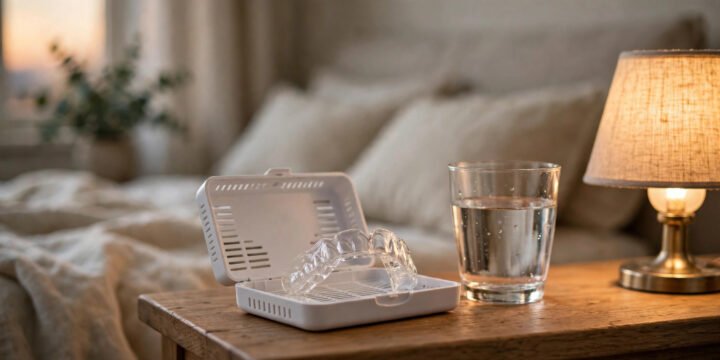
The self-care NIDCR lists for new jaw discomfort is deliberately simple: eat soft foods for a while; apply heat or cold to the face, with gentle exercises to stretch and strengthen the jaw muscles; use over-the-counter pain relief such as an NSAID like ibuprofen as directed; and reduce habits that load the jaw — clenching, gum chewing, nail biting. If that is not enough, a clinician may add physical therapy (NIDCR notes manual therapy can improve function and relieve pain), behavioural approaches such as cognitive behavioural therapy or biofeedback for clenching, or an intraoral appliance — a night guard or splint. On appliances, NIDCR is candid: there is not a lot of evidence they improve TMD pain, one should never be designed to permanently change your bite, and you should stop and call your dentist if it causes pain.
Two menopause-specific additions are worth raising at your appointment. First, sleep: if broken sleep is driving nighttime clenching, treating the sleep problem is jaw treatment too, so describe your sleep honestly, not just your jaw. Second, stress and anxiety commonly rise in the transition and drive daytime clenching — our explainer on anxiety, jaw clenching, and the stress–pain loop covers that mechanism and the breaks that interrupt it.
Frequently asked questions
Can menopause cause TMJ?
Menopause does not cause every case, but jaw problems are more common around it. In the Shiraz study of women aged 45 to 55, about two in three menopausal women had TMD signs on examination versus about one in three premenopausal women. Researchers suspect hormones play a role in tmj during menopause — estrogen receptors exist in the jaw joint's disc — but no study has proven falling estrogen directly causes TMJ disorders.
Why is my jaw pain worse before my period in perimenopause?
Probably the same low-estrogen window that existed in your thirties, amplified. Research cited in the menopause literature found TMD pain highest when estrogen was at its lowest, just before a period. Perimenopause makes cycles irregular and hormonal swings larger, so premenstrual jaw flares can become stronger and less predictable before periods stop.
Will HRT fix my jaw pain?
Do not count on it. A 2023 systematic review found no significant association between estrogen replacement and having a temporomandibular disorder, and the 284-woman Lora study found HRT users and non-users had similar rates of TMD and similar pain. Hormone therapy has established uses, but treating jaw pain is not one of them; decide it with your clinician on its own merits.
When is jaw pain in menopause an emergency?
If you are over 50 and jaw pain comes with a new headache, a tender scalp, jaw pain or tiredness when chewing that eases at rest, or any vision change, seek same-day urgent care — that pattern can be giant cell arteritis, which can cause permanent vision loss without prompt treatment. A locked jaw, facial swelling, or pain after an injury also needs same-day assessment.
Conclusion
If your jaw started aching as your cycles changed, you are not imagining the timing. The best direct study found temporomandibular problems about twice as often in menopausal women as in same-age women who had not reached menopause, and the biology — hormone receptors in the joint, estrogen's effects on pain and inflammation — makes the link plausible. But research on tmj during menopause also contains contradictory results, especially on hormone therapy, and supports neither blaming estrogen outright nor expecting hormones to fix the problem.
The practical path is unglamorous and works for most people: rule out the urgent look-alike if your pattern fits it, get a proper jaw examination, and work through the conservative measures — soft diet for a while, heat or cold, less clenching, attention to sleep — before considering anything irreversible. Bring notes on cycles, sleep, and flares; where the group evidence is this mixed, your own pattern is genuinely useful evidence.
Sources
- National Institute of Dental and Craniofacial Research (NIDCR). Temporomandibular Disorders (TMD) — overview, symptoms, and conservative-first treatment guidance; and TMD and Jaw Pain data (TMD affects about 5% of U.S. adults; at least twice as common in women).
- Farzin M, Taghva M, Babooie M. Comparison of temporomandibular disorders between menopausal and non-menopausal women. Journal of the Korean Association of Oral and Maxillofacial Surgeons, 2018 — 140 women aged 45–55; TMD in 67.6% of menopausal vs 33.3% of non-menopausal women; hormone levels not measured.
- Lora VRMM et al. Prevalence of temporomandibular disorders in postmenopausal women and relationship with pain and HRT. Brazilian Oral Research, 2016 — 284 postmenopausal women; 129 had TMD; HRT use was not associated with TMD or pain.
- Correlating estrogen replacement therapy and temporomandibular disorders: a systematic review following PRISMA principles and the Cochrane Handbook. BMC Oral Health, 2023 — three eligible studies; no significant association between estrogen replacement and TMD occurrence; more research needed.
- LeResche L et al. Use of exogenous hormones and risk of temporomandibular disorder pain. Pain, 1997 — case-control studies finding about 30% higher odds of TMD referral with postmenopausal estrogen use; an older result later reviews have not confirmed conclusively.
- NHS-adapted guidance via nidirect. Giant cell arteritis (temporal arteritis) — jaw pain when chewing, new headache, scalp tenderness, and vision problems need urgent attention to protect sight.
Medical disclaimer: This article is educational information only and is not medical advice. It does not diagnose any condition or recommend a specific treatment for you. Jaw, face, or head pain — especially new pain after 50 with headache, scalp tenderness, or vision changes — should be assessed promptly by a dentist or doctor.


0 Comments