Educational information · Not medical advice
In brief
Cold plunge evidence checked: what ice baths do for recovery and soreness, the muscle-growth trade-off, fat-burn claims, risks, and who should skip them.
In this article
- What happens to your body in a cold plunge?
- Does a cold plunge help muscle recovery?
- Can a cold plunge blunt muscle growth?
- Does a cold plunge burn fat or improve mood?
- How long should you stay in a cold plunge, and how cold should it be?
- Who should skip cold plunges?
- Frequently asked questions
- Conclusion
- Sources
Key Takeaways
- A cold plunge reliably reduces muscle soreness after hard exercise for up to about four days, according to pooled reviews of the trial evidence — that is its best-supported benefit.
- Used right after strength training, regular cold water immersion may blunt gains in muscle size and strength. Timing matters: save the plunge for rest days or after endurance sessions if building muscle is the goal.
- The fat-burn claim is not supported by the health-outcomes review evidence: in an 11-trial meta-analysis, inflammation markers rose, not fell, right after immersion, and no meaningful fat-loss effect was shown.
- The first minute is the risky part. Cold shock — an involuntary gasp, rapid breathing, and a spike in heart rate and blood pressure — is why people with heart conditions, uncontrolled blood pressure, or who are pregnant should get medical clearance first or skip it.
A cold plunge looks simple: a tub, cold water, a few uncomfortable minutes. The claims around it are not simple at all. Depending on who is selling what, a cold plunge is said to speed recovery, burn fat, fix inflammation, sharpen mood, and extend life. This article checks those claims against what systematic reviews and trials actually found, explains the one real trade-off most guides bury, and covers the safety response — cold shock — that decides who should not get in at all.
The short version: a cold plunge is a reasonable tool for one job, easing soreness after hard exercise. For most of the other popular claims, the evidence is small, mixed, or points the other way. And it is a genuine physiological stress, not a spa treatment, so the safety section matters as much as the benefits.
What happens to your body in a cold plunge?
The moment skin meets cold water, cold receptors fire and trigger the cold shock response. University of Portsmouth physiologist Mike Tipton and colleagues, who have studied cold water immersion (CWI) for decades, describe it as an involuntary gasp followed by uncontrollable rapid breathing, a release of stress hormones, a rise in blood pressure, and a faster heart rate. The response is strongest in water between about 10°C and 15°C (50–59°F), peaks in roughly the first 30 seconds, and then fades over the first few minutes as the skin’s cold receptors adapt.
That response explains both the appeal and the danger. The stress-hormone surge is why people climb out feeling wired and alert. The same surge is why the first minute carries the risk: if the gasp happens with your face in or near the water, you can inhale water, and the sudden load on the heart and circulation can provoke rhythm problems in susceptible people. Tipton’s group also describes “autonomic conflict,” where cold shock (which speeds the heart) and the diving response triggered by face immersion and breath-holding (which slows it) fire at the same time — a combination linked to arrhythmias.
Stay in longer and a second phase begins: the muscles and nerves near the skin cool, movements get clumsier, and grip and coordination fade. That is cooling of the tissues, not yet true hypothermia, which takes longer. It is also why how you feel is a poor guide to how long you have been in — a point the Portsmouth guidance makes explicitly for people who plunge often and have blunted their response through repetition.
Does a cold plunge help muscle recovery?
This is the claim with real evidence behind it. A 2026 umbrella review in Sports Medicine – Open pulled together 15 systematic reviews with meta-analyses, covering 161 unique studies of post-exercise cold water immersion. Its clearest findings were about soreness and readiness: immersion reduced muscle soreness for up to 96 hours after exercise and lowered creatine kinase, a marker of muscle damage, between 24 and 72 hours. Muscular power recovered better at 24 hours after hard or eccentric exercise, and jump performance improved at 24 to 48 hours, even though it was worse in the first hours right after getting out.
The same review is honest about the limits. The overall quality of the underlying reviews was rated low to critically low, and the certainty of evidence low to very low. Immersion did not improve maximal strength recovery at any point up to a week. Endurance performance improved only in the first hour or so after immersion, with no later benefit. In other words, a cold plunge helps you feel recovered and restores some explosive power by the next day — useful if you compete again tomorrow — but it is not a general performance enhancer.
The protocols that worked in those reviews were fairly consistent: about 10 to 15 minutes at roughly 10–15°C, or a shorter stint in colder water. That is a research protocol, not a recommendation to start there — the safety section below explains why beginners start much shorter.
Can a cold plunge blunt muscle growth?
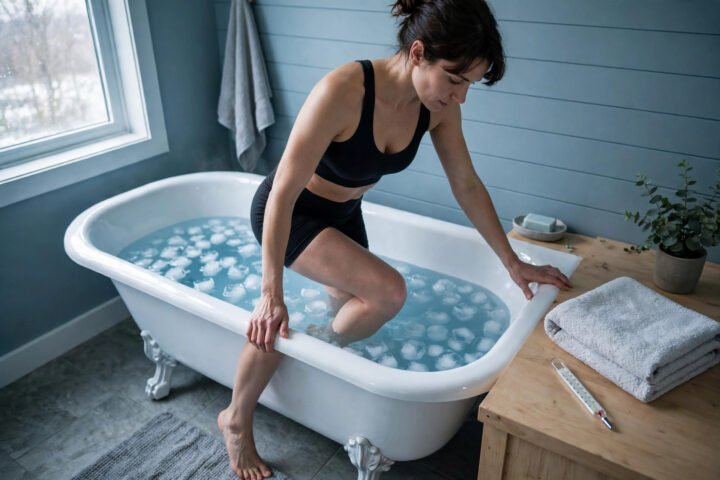
Yes — this is the trade-off the umbrella review and a dedicated meta-analysis both flag. The 2026 umbrella review concluded that cold water immersion impaired strength and hypertrophy (muscle-growth) gains when used repeatedly after resistance training, while endurance adaptations appeared unaffected. A 2024 systematic review and meta-analysis in the European Journal of Sport Science, pooling eight studies of cold water immersion combined with resistance training, reached the same conclusion: applying CWI immediately after lifting sessions may attenuate gains in muscle size, in both trained and untrained people, though the authors note the study quality was fair to poor and the finding should be read with some caution.
The practical reading is about timing, not prohibition. If your main goal is building muscle and strength, do not make an ice bath the automatic end of every lifting session. Keep plunges for rest days, after endurance or competition days when next-day soreness is the problem, or separated from lifting by many hours. If your main goal is getting through a tournament weekend or a heavy endurance block, the soreness benefit may be worth more than the small adaptation cost.
Does a cold plunge burn fat or improve mood?
Here the marketing runs well ahead of the data. The most relevant evidence is a 2025 systematic review and meta-analysis in PLOS ONE that pooled 11 randomized trials of cold water immersion in 3,177 healthy adults, using showers, ice baths, or plunges at 15°C or colder, and looked at the health and wellbeing outcomes people actually plunge for: stress, sleep, immunity, inflammation, mood, and quality of life.
11 trials, 3,177 participants — the entire randomized evidence base the 2025 PLOS ONE review could pool for cold water immersion and health outcomes. In that pool, inflammation markers rose immediately after immersion rather than falling, and the review’s authors describe the evidence base as constrained by few trials and small samples (Cain et al., 2025).
What that review found, claim by claim:
- Inflammation: markers went up, significantly, immediately after immersion and again at one hour — an acute stress response, the opposite of the popular “plunging lowers inflammation” claim, at least on this timescale.
- Stress: lower at 12 hours after immersion, but not immediately, and not at 1, 24, or 48 hours — a single favourable time point out of five measured.
- Immunity: no significant effect on immune markers in the first hour. In the review’s narrative summary, one large cold-shower trial reported 29% less sickness absence — but that is one trial, of showers, measuring days off work rather than infections prevented.
- Sleep and quality of life: improvements were reported, while mood itself showed no clear effect in the pooled analysis.
- Fat burn: cold exposure does make the body produce heat, and laboratory cold studies are a real research area — but no trial in this health-outcomes evidence base showed meaningful fat loss from plunging, and no longevity outcome has been tested in a randomized trial at all. Treat “burns fat” and “extends life” as unproven.
None of this means the alert, clear-headed feeling after a plunge is imaginary — the stress-hormone surge is real, and many people value exactly that. It means the feeling is not evidence of fat melting, inflammation resolving, or years being added. If you enjoy it and it is safe for you, that is a legitimate reason. It just is not the reason the ads give.
How long should you stay in a cold plunge, and how cold should it be?
The research protocols cluster around 10–15°C (50–59°F). The recovery reviews found 10 to 15 minutes at that range most effective for next-day recovery, and the health-outcomes trials used anything from 30 seconds to much longer. There is no tested “optimal” dose for general wellbeing, because the trials are few and inconsistent — anyone quoting you a precise prescription for mood or metabolism is going beyond the evidence.
If you decide to try it, the safety guidance from the Portsmouth researchers is the sensible frame: get a medical check first if you have any health condition; enter gradually and never jump or dive in; keep your face out of the water until the cold shock response has settled; keep immersions in colder water under 10 minutes; do not plunge alone, especially when new to it; and do not judge your time by how cold you feel. Shorter and warmer is the rational starting point — the stress response you are training yourself to tolerate is the same one that makes the first minute hazardous. People exploring cold as a calming technique sometimes start with the gentler end of this spectrum; our guide to vagus nerve exercises for stress covers where cold water fits among those claims, and our sleep hygiene evidence check covers the related claim that evening routines fix sleep.
Who should skip cold plunges?
Cold water immersion is one of the larger acute stresses you can put on the heart and circulation, so some people should not do it without medical clearance — and some should not do it at all:
- Heart and circulation conditions: coronary artery disease, a history of heart attack or stroke, heart rhythm problems, or heart failure. The cold shock spike in heart rate and blood pressure, plus the risk of arrhythmia from autonomic conflict, is aimed directly at this system.
- Uncontrolled high blood pressure: immersion raises blood pressure sharply within seconds.
- Pregnancy: there is no human research establishing a safe temperature or duration for cold immersion in pregnancy, and the cardiovascular system is already working harder. The search question “can you cold plunge while pregnant” has a straightforward answer on current evidence: do not start, and if you plunged regularly before pregnancy, discuss it with your obstetric clinician before continuing.
- Raynaud’s phenomenon and cold sensitivity conditions, and anyone prone to fainting: a loss of consciousness in water is dangerous in itself.
- Children and anyone who cannot exit the water quickly and unaided.
Get out immediately for chest pain, an irregular or racing heartbeat that does not settle, confusion, uncontrollable shivering, or numbness that spreads or does not recover. And the standing rule from every safety source: never plunge alone as a beginner, and never plunge in open water without experienced company. The same caution-first logic applies to other trending recovery tools — see our evidence check on weighted vests for walking for a parallel example of benefits being smaller and risks more specific than the marketing suggests, and our guide to how much water you should drink for another everyday claim that shrinks under scrutiny.
Frequently asked questions
Does a cold plunge burn fat?
Not in any way the trial evidence can currently show. Cold exposure makes your body generate heat, which uses energy, but the 2025 PLOS ONE review of 11 randomized trials and 3,177 adults found no meaningful fat-loss outcome from cold water immersion, and no longevity outcome has been tested in a randomized trial. Treat fat-burn claims as unproven marketing, not a reason to plunge.
How long should you stay in a cold plunge?
Research recovery protocols typically used about 10 to 15 minutes at 10–15°C, but those were supervised studies in healthy, often athletic participants. Safety guidance advises keeping colder-water immersions under 10 minutes, entering gradually, and starting much shorter if you are new. There is no evidence-based optimal dose for general wellbeing, and longer is not better.
Can you cold plunge while pregnant?
Current evidence does not establish any safe temperature or duration for cold immersion during pregnancy, and the cold shock response sharply raises heart rate and blood pressure at a time when the cardiovascular system is already under extra load. The prudent answer is to skip it during pregnancy, or to continue only with explicit clearance from your obstetric clinician if you were a regular before conceiving.
Is a cold plunge bad for muscle growth?
It can be, depending on timing. A 2024 meta-analysis of eight studies and a 2026 umbrella review both found that using cold water immersion immediately and repeatedly after resistance training may blunt gains in muscle size and strength, while endurance adaptations appear unaffected. If building muscle is your priority, keep plunges away from lifting sessions — rest days or endurance days instead.
Conclusion
A cold plunge is neither a miracle nor a menace; it is a strong, brief stress with one well-supported use. The evidence says it eases muscle soreness and restores some next-day power after hard exercise. It also says regular post-lifting plunges can cost you some of the muscle you are training for, that inflammation rises rather than falls in the hour after immersion, and that fat-burn and longevity claims have no randomized-trial support. Enjoy the alertness if you like it — just file it under “feels good, evidence thin,” not under medicine.
And respect the first minute. Cold shock is a documented, potentially dangerous response, strongest in exactly the 10–15°C water most people plunge in. Enter slowly, never alone, keep it short, and if you have a heart condition, uncontrolled blood pressure, Raynaud’s, or you are pregnant, talk to your clinician first — or skip it entirely. The tub will still be there when the evidence, and your clearance, are clearer.
Medical disclaimer: This article is educational information only and is not medical advice. It does not diagnose or treat any condition. Cold water immersion carries real cardiovascular risks for some people; discuss whether it is appropriate for you with your own clinician, who knows your history and medicines.
Sources
- Cain T, et al. Effects of cold-water immersion on health and wellbeing: A systematic review and meta-analysis. PLOS ONE, 2025. journals.plos.org
- Berjisian E, et al. Strategic application of post-exercise cold-water immersion to enhance performance recovery and adaptation: An umbrella review of 15 published systematic reviews with meta-analysis. Sports Medicine – Open, 2026. pmc.ncbi.nlm.nih.gov
- Piñero A, et al. Throwing cold water on muscle growth: A systematic review with meta-analysis of the effects of postexercise cold water immersion on resistance training-induced hypertrophy. European Journal of Sport Science, 2024. pmc.ncbi.nlm.nih.gov
- Tipton M, Massey H, Mayhew A, Morgan P. Cold water therapies: minimising risks. University of Portsmouth / Surf Life Saving GB guidance paper. pure.port.ac.uk (PDF)





0 Comments