
Educational information · Not medical advice
In brief
Glycine for sleep explained: 3 small trials, one 3-gram dose, no independent replication. What the evidence supports, what it doesn't, and who should skip it.
In this article
- What is glycine, and why would it affect sleep?
- What did the human trials of glycine for sleep actually find?
- How strong is that evidence, really?
- What dose was tested — and what was never tested?
- Who should be careful with glycine, or skip it?
- What has stronger evidence for ongoing poor sleep?
- Frequently asked questions
- Conclusion
- Sources
Key Takeaways
- The entire human evidence for glycine for sleep rests on three small, short trials — roughly 40 people in total — run largely by researchers at Ajinomoto, a company that manufactures glycine. No independent group has replicated them.
- Every trial used the same dose: 3 grams of glycine before bed. Participants reported better sleep quality and less next-day fatigue, and one sleep-lab study found people fell asleep and reached deep sleep sooner.
- Glycine was never tested in people diagnosed with clinical insomnia, and no trial lasted more than a few nights. “Promising” is the honest label — not “proven.”
- For chronic insomnia, cognitive behavioral therapy for insomnia (CBT-I) remains the first-line treatment in clinical guidelines, with a far larger evidence base than any supplement.
Glycine for sleep has become one of the most repeated supplement tips online: stir a few grams of a sweet-tasting powder into a drink before bed, fall asleep faster, wake up clearer. The claim is not invented from nothing — there are real human trials behind it. But those trials are far smaller, shorter, and less independent than the confident social-media version suggests. This article walks through exactly what was tested, what the results actually showed, and where the evidence stops.
The short answer: glycine for sleep is a plausible, early-stage finding, not an established treatment. Three small trials found modest benefits at a 3-gram bedtime dose. That is genuinely more evidence than most sleep supplements have — and it is still not much. If your sleep problem is persistent, the better-supported options in the last section deserve your attention first.
What is glycine, and why would it affect sleep?
Glycine is a non-essential amino acid — “non-essential” means your body makes it on its own, so you do not have to get it from food or supplements. According to the research group behind the sleep trials, the body synthesizes roughly 45 grams of glycine a day, and a typical diet adds about 3 to 5 grams more. Glycine is also a building block of collagen and plays roles throughout the body.
In the nervous system, glycine does two opposite-sounding jobs. It acts as an inhibitory neurotransmitter through glycine receptors, and as an excitatory co-agonist at NMDA receptors (N-methyl-D-aspartate receptors, a type of glutamate receptor involved in brain signaling). The sleep hypothesis comes from the second of those roles, and from body temperature.
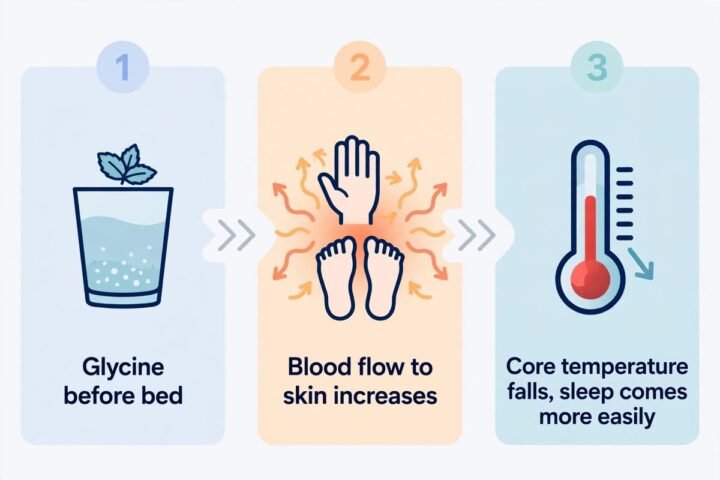
Falling asleep normally goes along with a drop in core body temperature, as blood flow to the skin increases and heat leaves the body. In rat studies by the same research group, oral glycine increased skin blood flow, lowered core body temperature, and shortened the time to fall asleep — effects that depended on NMDA receptors in the suprachiasmatic nucleus, the brain’s master circadian clock. That mechanism is coherent and testable. It is also, so far, demonstrated mainly in animals, at doses far higher per kilogram than the human trials used. A plausible mechanism is a reason to run human trials; it is not itself proof that a supplement works in people.
What did the human trials of glycine for sleep actually find?
Three human trials make up the evidence base. All three used 3 grams of glycine taken before bed, all three were crossover studies (each participant tried both glycine and a placebo in different periods), and all three came from the same Japanese research group.
The first, by Inagawa and colleagues in 2006, enrolled people who reported unsatisfactory sleep. Participants took 3 grams of glycine or a flavor-matched placebo about an hour before bed for several nights. On glycine, they rated their sleep quality better and reported less fatigue, and better liveliness and clear-headedness, the next morning. The outcomes were questionnaires — how people felt — not sleep-lab measurements.
The second, by Yamadera and colleagues in 2007, is the most cited. Eleven volunteers who were dissatisfied with their sleep took 3 grams of glycine or placebo before bed and were monitored with polysomnography — the overnight sleep-lab recording of brain waves, breathing, and heart rate. Participants again rated their sleep better on glycine. The recordings showed shorter time to fall asleep and shorter time to reach slow-wave (deep) sleep, with no change in overall sleep architecture — the proportions of the night spent in each sleep stage stayed the same. That is a real, objectively measured finding. It is also a finding from 11 people, over a very short period.
The third, by Bannai and colleagues in 2012, asked a different question: does glycine help the next day after too little sleep? Ten healthy male volunteers — all employees of Ajinomoto, the amino-acid manufacturer where the researchers worked — had their time in bed cut by 25 percent (to about 5.5 hours) for three consecutive nights, taking 3 grams of glycine or placebo 30 minutes before bed. Seven participants were included in the final analysis. On glycine, fatigue ratings fell significantly, sleepiness showed a tendency to decrease (it did not reach statistical significance), and performance on a psychomotor vigilance test — a reaction-time measure of alertness — improved significantly.
3 trials, about 40 people, 3 grams — every human result behind the glycine-for-sleep claim comes from three small crossover trials totaling roughly 40 participants, each using the same 3-gram bedtime dose, and none lasting more than a few nights.
How strong is that evidence, really?
Read plainly, the trials point the same direction: people felt they slept better, felt less tired the next day, and in the one sleep-lab study, fell asleep and reached deep sleep sooner. Consistent results across three studies count for something. So do the limits, and they are substantial.
Size. Roughly 40 people across all three trials is a very small evidence base. Small studies produce unstable estimates — effects often shrink when larger trials are run. Duration. The trials lasted a few nights each. They say nothing about whether benefits persist over weeks or months, which is the timescale that matters for a nightly supplement. Independence. The trials were conducted by researchers at Ajinomoto, a major glycine manufacturer; the 2012 trial’s participants were Ajinomoto employees, and its protocol was approved by Ajinomoto’s own review board. A manufacturer link does not make results false — but independent replication by an unaffiliated group is the standard check, and for glycine and sleep it has not happened. Population. Participants had sleep complaints or were healthy volunteers with experimentally shortened sleep. None of the trials enrolled people diagnosed with chronic insomnia disorder, so the results cannot be assumed to apply to clinical insomnia.
It also matters what the trials did not show. No trial demonstrated that glycine treats a sleep disorder, extends total sleep time in people sleeping normally, or keeps working long-term. If you have already read our evidence check on melatonin for sleep and its dose and timing limits, the pattern will feel familiar: a real signal, in small studies, that marketing inflates into a certainty.
| Study | Who took part | Dose and timing | What improved |
|---|---|---|---|
| Inagawa et al., 2006 | Adults with unsatisfactory sleep (small crossover sample) | 3 g, about 1 hour before bed, several nights | Self-rated sleep quality; less next-day fatigue |
| Yamadera et al., 2007 | 11 adults dissatisfied with their sleep | 3 g before bed, sleep-lab nights | Self-rated sleep quality; faster sleep onset and faster entry to slow-wave sleep on polysomnography; sleep architecture unchanged |
| Bannai et al., 2012 | 10 healthy male volunteers (7 analyzed), sleep cut by 25% for 3 nights | 3 g, 30 minutes before bed | Less fatigue (significant); tendency to less sleepiness; better psychomotor vigilance performance |
All three trials were conducted by the same research group, with manufacturer involvement. No independent replication has been published.
What dose was tested — and what was never tested?
There is exactly one studied dose for glycine for sleep: 3 grams, taken 30 to 60 minutes before bed. Every other number circulating online — 1 gram, 2 grams, 5 grams, glycine stacked with other supplements — is untested for sleep. More is not known to be better, and no trial has compared doses against each other, so there is no evidence that a larger scoop produces a larger effect.
Two related claims also outrun the data. First, collagen: collagen protein is rich in glycine, so collagen powders are sometimes marketed as an indirect sleep aid. The glycine trials used pure glycine powder, not collagen, and their results do not automatically transfer. Second, food: glycine occurs naturally in protein foods, but ordinary servings provide far less than the 3-gram trial dose, and no study has tested whether glycine-rich foods before bed change sleep.

Who should be careful with glycine, or skip it?
At the 3-gram dose, the sleep trials reported no notable side effects, and glycine is a normal dietary amino acid rather than an exotic compound. That is reassuring as far as it goes — a few dozen people studied for a few nights cannot rule out uncommon or long-term effects, and supplement products are not held to the same pre-market testing standard as medicines.
Standard medical references advise extra caution for several groups. Women who are pregnant or breastfeeding should not take glycine supplements. High doses of a single amino acid taken for long periods are not advised without medical supervision, because single-amino-acid supplements can burden the kidneys and unbalance normal protein metabolism — a particular concern for anyone with kidney disease and for children. If you take prescription medicines, have a kidney or liver condition, or are considering glycine for a child, discuss it with your clinician first. And if poor sleep comes with loud snoring, witnessed pauses in breathing, or severe daytime sleepiness, that pattern needs a sleep evaluation — possible sleep apnea — rather than a supplement trial. Our guide to waking up at 3 AM and sleep maintenance insomnia covers the common causes worth ruling out.
What has stronger evidence for ongoing poor sleep?
If sleep has been poor at least three nights a week for three months or more, that pattern meets the usual definition of chronic insomnia disorder — and it has a first-line treatment with a much deeper evidence base than any supplement. The American College of Physicians recommends cognitive behavioral therapy for insomnia (CBT-I) as the initial treatment for all adults with chronic insomnia, a strong recommendation based on moderate-quality evidence. CBT-I combines sleep restriction, stimulus control, and cognitive techniques, and its benefits tend to persist after treatment ends. Our step-by-step explainer on what CBT-I is and how it works walks through each component and how to access it, including digital programs.
Foundations matter alongside any therapy: a consistent wake time, morning daylight (see our guide to morning light and resetting your body clock), and limiting caffeine and alcohol late in the day. None of this makes glycine forbidden — it puts it in proportion. It is not a substitute for diagnosing why you are sleeping badly.
Frequently asked questions
Does glycine for sleep actually work?
In three small trials totaling roughly 40 people, 3 grams of glycine before bed improved self-rated sleep quality and reduced next-day fatigue, and one sleep-lab study found faster sleep onset and faster entry to deep sleep. All three trials came from one manufacturer-linked research group and lasted only a few nights, so the honest verdict is promising but unproven — larger, independent trials are still needed.
How much glycine should you take for sleep?
The only dose tested for sleep is 3 grams, taken 30 to 60 minutes before bed. No trial has tested lower or higher doses, compared doses, or combined glycine with other sleep supplements, so any other amount is a guess rather than an evidence-based recommendation. This article describes what the trials used; it is not a personal prescription — discuss supplements with your clinician.
Is glycine safe to take every night?
Long-term nightly safety has not been established, because the sleep trials lasted only a few nights each. Glycine is a normal dietary amino acid and the trials reported no notable side effects at 3 grams, but medical references advise against high doses of single amino acids for long periods without supervision, and women who are pregnant or breastfeeding should not take glycine supplements.
Is glycine better than melatonin for sleep?
No study has compared them directly, and they are aimed at different problems. Melatonin’s strongest evidence is for body-clock issues such as jet lag, while glycine’s small trials measured sleep quality and next-day fatigue. Neither has strong evidence as a treatment for chronic insomnia, for which guidelines recommend CBT-I first. Choosing between two weakly supported options matters less than identifying why your sleep is poor.
Conclusion
Glycine for sleep is one of the more interesting supplement claims because something real sits underneath it: a defined mechanism in animal research, and three small human trials whose results point the same way. It is also a case study in how thin evidence gets thick marketing. About 40 participants, a few nights per trial, one manufacturer-linked research group, no testing in clinical insomnia, and no long-term data — that is the whole foundation.
If you are curious about glycine, hold it to that standard: a 3-gram dose is the only one studied, benefits so far are modest and short-term, and persistent poor sleep deserves the better-supported path first — an evaluation for causes such as sleep apnea, and CBT-I for chronic insomnia. Talk with your clinician or dentist about what fits your situation, especially if you are pregnant, have kidney disease, or take prescription medicines.
Sources
- Bannai M, Kawai N, Ono K, Nakahara K, Murakami N. The effects of glycine on subjective daytime performance in partially sleep-restricted healthy volunteers. Frontiers in Neurology, 2012. Full text: PMC3328957 — includes the 3 g dose, 30-minutes-before-bed timing, 25% sleep restriction protocol, participant numbers, and the summary of the earlier Inagawa (2006) and Yamadera (2007) trials.
- Kawai N, et al. The sleep-promoting and hypothermic effects of glycine are mediated by NMDA receptors in the suprachiasmatic nucleus. Neuropsychopharmacology, 2015: PubMed 25533534 — the animal mechanism study (skin blood flow, core temperature, SCN receptors).
- Qaseem A, et al. Management of chronic insomnia disorder in adults: a clinical practice guideline from the American College of Physicians. Annals of Internal Medicine, 2016. Summary: American College of Physicians — CBT-I as the strong, first-line recommendation for chronic insomnia.
- Glycine — side effects, toxicity, and interactions. UW Medicine Health Library (reviewed September 1, 2025): UW Medicine Health Library — pregnancy/breastfeeding caution and high-dose single-amino-acid warnings.
Medical disclaimer: This article is educational information only and is not medical advice. It does not diagnose or treat any condition. Talk with your clinician, dentist, or sleep specialist about your own sleep and before starting any supplement.




0 Comments